RankRizz

Thermodynamics — JEE Main Previous Year Questions

Every Thermodynamics question JEE Main has set from 2004–2026, grouped by the idea it tests rather than the order of the syllabus. 190 questions across 6 distinct ideas. Free to read, answer key on every one.

DATA UPDATED

Questions

190

Distinct ideas

6

Share of marks

3%

Difficulty

MEDIUM

The ideas inside Thermodynamics

A chapter is not one subject — it is a handful of procedures the examiner reuses. These are the ones Thermodynamics questions actually test.

Every Thermodynamics question

61–80 OF 190 · NEWEST FIRST

JEE MAIN 2023 · 01 FEB S2Carnot engine and Carnot cycle

A Carnot engine operating between two reservoirs has efficiency 13\frac{1}{3}. When the temperature of cold reservoir raised by xx, its efficiency decreases to 16\frac{1}{6}. The value of xx, if the temperature of hot reservoir is 99°99° C, will be

  1. A

    16.516.5 K

  2. B

    3333 K

  3. C

    6666 K

  4. D

    6262 K

JEE MAIN 2023 · 31 JAN S1Zeroth and first law of thermodynamics

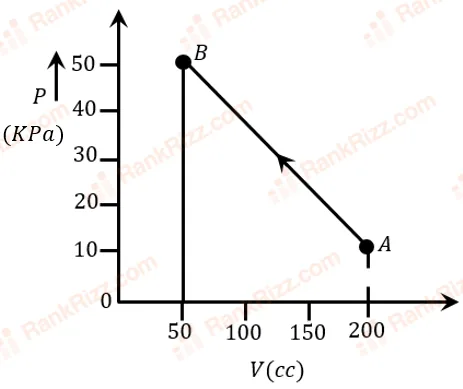
The pressure of a gas changes linearly with volume from AA to BB as shown in figure. If no heat is supplied to or extracted from the gas then change in the internal energy of the gas will be

Figure for JEE Main 2023 Physics question on Zeroth and first law of thermodynamics
  1. A

    6 J

  2. B

    Zero

  3. C

    -4.5 J

  4. D

    4.5 J

JEE MAIN 2023 · 31 JAN S2Isothermal and adiabatic processes

A hypothetical gas expands adiabatically such that its volume changes from 08 litres to 27 litres. If the ratio of final pressure of the gas to initial pressure of the gas is 1681\dfrac{16}{81}. Then the ratio of CpCv\dfrac{C_p}{C_v} will be.

  1. A

    43\dfrac{4}{3}

  2. B

    31\dfrac{3}{1}

  3. C

    12\dfrac{1}{2}

  4. D

    32\dfrac{3}{2}

JEE MAIN 2023 · 30 JAN S1Isothermal and adiabatic processes

Heat is given to an ideal gas in an isothermal process.
A. Internal energy of the gas will decrease.
B. Internal energy of the gas will increase.
C. Internal energy of the gas will not change.
D. The gas will do positive work.
E. The gas will do negative work.
Choose the correct answer from the options given below:

  1. A

    A and E only

  2. B

    B and D only

  3. C

    C and E only

  4. D

    C and D only

JEE MAIN 2023 · 30 JAN S2Carnot engine and Carnot cycle

Given below are two statements: one is labelled as Assertion A and the other is labelled as Reason R.
Assertion A: Efficiency of a reversible heat engine will be highest at −273°-273°C temperature of cold reservoir.
Reason R: The efficiency of Carnot's engine depends not only on temperature of cold reservoir but it depends on the temperature of hot reservoir too and is given as η=(1−T2T1)\eta = \left(1 - \frac{T_2}{T_1}\right)
In the light of the above statements, choose the correct answer from the options given below:

  1. A

    A is true but R is false

  2. B

    Both A and R are true but R is NOT the correct explanation of A

  3. C

    A is false but R is true

  4. D

    Both A and R are true and R is the correct explanation of A

JEE MAIN 2023 · 29 JAN S1Zeroth and first law of thermodynamics

Given below are two statements. One is labelled as Assertion A and the other is labelled as Reason R.
Assertion A: If dQdQ and dWdW represent the heat supplied to the system and the work done on the system respectively. Then according to the first law of thermodynamics dQ=dU−dWdQ = dU - dW.
Reason R: First law of thermodynamics is based on law of conservation of energy.
In the light of the above statements, choose the correct answer from the option given below:

  1. A

    A is correct but R is not correct

  2. B

    A is not correct but R is correct

  3. C

    Both A and R are correct and R is the correct explanation of A

  4. D

    Both A and R are correct but R is not the correct explanation of A

JEE MAIN 2023 · 25 JAN S1Carnot engine and Carnot cycle

A Carnot engine with efficiency 50% takes heat from a source at 600 K. In order to increase the efficiency to 70%, keeping the temperature of sink same, the new temperature of the source will be:

  1. A

    360 K

  2. B

    1000 K

  3. C

    900 K

  4. D

    300 K

JEE MAIN 2023 · 25 JAN S2Isobaric, isochoric and polytropic processes

Match List I with List II:
A. Isothermal Process   I. Work done by the gas decreases internal energy
B. Adiabatic Process   II. No change in internal energy
C. Isochoric Process   III. The heat absorbed goes partly to increase internal energy and partly to do work
D. Isobaric Process   IV. No work is done on or by the gas
Choose the correct answer from the options below:

  1. A

    A-II, B-I, C-III, D-IV

  2. B

    A-II, B-I, C-IV, D-III

  3. C

    A-I, B-II, C-IV, D-III

  4. D

    A-I, B-II, C-III, D-IV

JEE MAIN 2023 · 24 JAN S1Zeroth and first law of thermodynamics

1 g of a liquid is converted to vapour at 3×1053 \times 10^5 Pa pressure. If 10% of the heat supplied is used for increasing the volume by 1600 cm3\text{cm}^3 during this phase change, then the increase in internal energy in the process will be :

  1. A

    4320 J

  2. B

    432000 J

  3. C

    4800 J

  4. D

    4.32×1084.32 \times 10^8 J

JEE MAIN 2023 · 24 JAN S1Zeroth and first law of thermodynamics

1 g of a liquid is converted to vapour at 3×1053 \times 10^5 Pa pressure. If 10% of the heat supplied is used for increasing the volume by 1600 cm3^3 during this phase change, then the increase in internal energy in the process will be:

  1. A

    4320 J

  2. B

    432000 J

  3. C

    4800 J

  4. D

    4.32×1084.32 \times 10^8 J

JEE MAIN 2023 · 24 JAN S2Isothermal and adiabatic processes

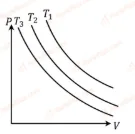
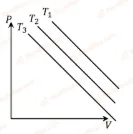
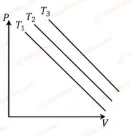
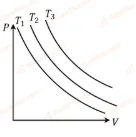
In an Isothermal change, the change in pressure and volume of a gas can be represented for three different temperature; T3>T2>T1T_3 > T_2 > T_1 as:

  1. A
    Figure for JEE Main 2023 Physics question on Isothermal and adiabatic processes
  2. B
    Figure for JEE Main 2023 Physics question on Isothermal and adiabatic processes
  3. C
    Figure for JEE Main 2023 Physics question on Isothermal and adiabatic processes
  4. D
    Figure for JEE Main 2023 Physics question on Isothermal and adiabatic processes
JEE MAIN 2022 · 29 JUL S1Isothermal and adiabatic processes

The pressure P1P_1 and density d1d_1 of diatomic gas (γ=75)(\gamma = \frac{7}{5}) changes suddenly to P2(>P1)P_2(> P_1) and d2d_2 respectively during an adiabatic process. The temperature of the gas increases and becomes _____ times of its initial temperature. (Given d2d1=32\frac{d_2}{d_1} = 32)

JEE MAIN 2022 · 29 JUL S2Work done in thermodynamic processes and P-V diagrams

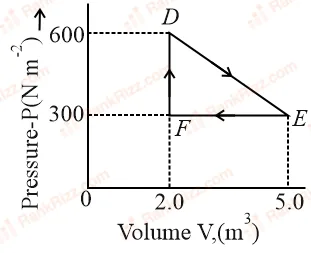
A thermodynamic system is taken from an original state D to an intermediate state E by the linear process shown in the figure. Its volume is then reduced to the original volume from E to F by an isobaric process. The total work done by the gas from D to E to F will be

Figure for JEE Main 2022 Physics question on Work done in thermodynamic processes and P-V diagrams
  1. A

    -450 J

  2. B

    450 J

  3. C

    900 J

  4. D

    1350 J

JEE MAIN 2022 · 28 JUL S1Carnot engine and Carnot cycle

A Carnot engine has efficiency of 50%. If the temperature of sink is reduced by 40°C, its efficiency increases by 30%. The temperature of the source will be:

  1. A

    166.7 K

  2. B

    255.1 K

  3. C

    266.7 K

  4. D

    367.7 K

JEE MAIN 2022 · 27 JUL S2Carnot engine and Carnot cycle

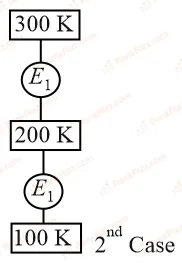
In 1st case, Carnot engine operates between temperatures 300 K and 100 K. In 2nd case, as shown in the figure, a combination of two engines is used. The efficiency of this combination (in 2nd case) will be :

Figure for JEE Main 2022 Physics question on Carnot engine and Carnot cycle
  1. A

    same as the 1st case

  2. B

    always greater than the 1st case

  3. C

    always less than the 1st case

  4. D

    may increase or decrease with respect to the 1st case

JEE MAIN 2022 · 26 JUL S1Isobaric, isochoric and polytropic processes

77 mole of certain monoatomic ideal gas undergoes a temperature increase of 40 K40 \text{ K} at constant pressure. The increase in the internal energy of the gas in this process is (Given R=8.3 J K−1 mol−1R = 8.3 \text{ J K}^{-1} \text{ mol}^{-1})

  1. A

    5810 J5810 \text{ J}

  2. B

    3486 J3486 \text{ J}

  3. C

    11620 J11620 \text{ J}

  4. D

    6972 J6972 \text{ J}

JEE MAIN 2022 · 26 JUL S1Isothermal and adiabatic processes

A monoatomic gas at pressure PP and volume VV is suddenly compressed to one eighth of its original volume. The final pressure at constant entropy will be

  1. A

    PP

  2. B

    8P8P

  3. C

    32P32P

  4. D

    64P64P

JEE MAIN 2022 · 25 JUL S1Isothermal and adiabatic processes

A certain amount of gas of volume VV at 27°C27°C temperature and pressure 2×10⁷ N m−22 \times 10^7 \text{ N m}^{-2} expands isothermally until its volume gets doubled. Later it expands adiabatically until its volume gets redoubled. The final pressure of the gas will be (Use γ=1.5\gamma = 1.5)

  1. A

    3.536×10⁵ Pa3.536 \times 10^5 \text{ Pa}

  2. B

    3.536×10⁶ Pa3.536 \times 10^6 \text{ Pa}

  3. C

    1.25×10⁶ Pa1.25 \times 10^6 \text{ Pa}

  4. D

    1.25×10⁵ Pa1.25 \times 10^5 \text{ Pa}

JEE MAIN 2022 · 25 JUL S2Carnot engine and Carnot cycle

Let η1\eta_1 is the efficiency of an engine at T1=447°CT_1 = 447°C and T2=147°CT_2 = 147°C while η2\eta_2 is the efficiency at T1=947°CT_1 = 947°C and T2=47°CT_2 = 47°C. The ratio η1η2\dfrac{\eta_1}{\eta_2} will be

  1. A

    0.410.41

  2. B

    0.560.56

  3. C

    0.730.73

  4. D

    0.700.70

JEE MAIN 2022 · 29 JUN S1Carnot engine and Carnot cycle

300 calories of heat is given to a heat engine, and it rejects 225 calories of heat. If source temperature is 227°C, then the temperature of sink will be ______ °C.