Thermodynamics JEE Main PYQs with answer key
PHYSICS · 190 PAST QUESTIONS · 6 TOPICS · 2004–2026
HOW TO USE THIS SHEET
Every JEE Main Thermodynamics question we hold, grouped by topic, most-asked topic first and newest first inside each. The answer key is at the end (187 of 190 questions have a checked key); the worked solution is on each question’s page, printed beside it.
Isothermal and adiabatic processes 54
Initial pressure and volume of a monoatomic ideal gas are and . The change in internal energy of this gas in adiabatic expansion to volume is __________ J.
- (A)
- (B)
- (C)
- (D)
rr2.rankrizz.com/jee-main/physics/thermodynamics/q/8-apr-2026-s2-q36
- (A)
A cylinder with adiabatic walls is closed at both ends and is divided into two compartments by a frictionless adiabatic piston. Ideal gas is filled in both (left and right) the compartments at same P, V, T. Heating is started from left side until pressure changes to . If initial volume of each compartment was 9 litres then the final volume in right-hand side compartment is __________ litres. (for this ideal gas )
- (A)
3
- (B)
4
- (C)
14
- (D)
9
rr2.rankrizz.com/jee-main/physics/thermodynamics/q/6-apr-2026-s2-q30
- (A)
A vessel contains 0.15 m of a gas at pressure 8 bar and temperature 140 °C with and . It is expanded adiabatically till pressure falls to 1 bar. The work done during this process is __________ kJ. (R is gas constant)
Answer: ____________
rr2.rankrizz.com/jee-main/physics/thermodynamics/q/2-apr-2026-s1-q47
One mole of an ideal diatomic gas expands from volume to isothermally at a temperature and does W joule of work. lf the gas undergoes same magnitude of expansion adiabatically from doing the same amount of work , then its final temperature will be (close to) ____
- (A)
-189
- (B)
-117
- (C)
-30
- (D)
-56
rr2.rankrizz.com/jee-main/physics/thermodynamics/q/23-jan-2026-s2-q26
- (A)
The volume of an ideal gas increases 8 times and temperature becomes of initial temperature during a reversible change. If there is no exchange of heat in this process then identify the gas from the following options (Assuming the gases given in the options are ideal gases):
- (A)
- (B)
$$He
- (C)
- (D)
rr2.rankrizz.com/jee-main/physics/thermodynamics/q/22-jan-2026-s1-q28
- (A)
A monoatomic gas having is stored in a thermally insulated container and the gas is suddenly compressed to of its initial volume. The ratio of final pressure and initial pressure is :
( is the ratio of specific heats of the gas at constant pressure and at constant volume)- (A)
16
- (B)
40
- (C)
32
- (D)
28
rr2.rankrizz.com/jee-main/physics/thermodynamics/q/2025-apr-8-s2-q36
- (A)
A gas is kept in a container having walls which are thermally non-conducting. Initially the gas has a volume of 800 cm and temperature 27°C. The change in temperature when the gas is adiabatically compressed to 200 cm is :
(Take : is the ratio of specific heats at constant pressure and at constant volume)- (A)
K
- (B)
K
- (C)
K
- (D)
K
rr2.rankrizz.com/jee-main/physics/thermodynamics/q/2025-apr-03-s1-q37
- (A)
In an adiabatic process, which of the following statements is true?
- (A)
The molar heat capacity is infinite
- (B)
Work done by the gas equals the increase in internal energy
- (C)
The molar heat capacity is zero
- (D)
The internal energy of the gas decreases as the temperature increases
rr2.rankrizz.com/jee-main/physics/thermodynamics/q/2025-apr-02-s1-q37
- (A)
Identify the characteristics of an adiabatic process in a monoatomic gas.
(A) Internal energy is constant.
(B) Work done in the process is equal to the change in internal energy.
(C) The product of temperature and volume is a constant.
(D) The product of pressure and volume is a constant.
(E) The work done to change the temperature from to is proportional to
Choose the correct answer from the options given below :- (A)
(A), (C), (D) only
- (B)
(A), (C), (E) only
- (C)
(B), (E) only
- (D)
(B), (D) only
rr2.rankrizz.com/jee-main/physics/thermodynamics/q/2025-apr-02-s2-q35
- (A)
The workdone in an adiabatic change in an ideal gas depends upon only :
- (A)
change in its temperature
- (B)
change in its volume
- (C)
change in its pressure
- (D)
change in its specific heat
rr2.rankrizz.com/jee-main/physics/thermodynamics/q/29-jan-2025-s1-q40
- (A)
Given below are two statements. One is labelled as Assertion (A) and the other is labelled as Reason (R).
Assertion (A) : With the increase in the pressure of an ideal gas, the volume falls off more rapidly in an isothermal process in comparison to the adiabatic process.
Reason (R) : In isothermal process, PV = constant, while in adiabatic process = constant. Here is the ratio of specific heats, P is the pressure and V is the volume of the ideal gas. In the light of the above statements, choose the correct answer from the options given below :- (A)
Both (A) and (R) are true and (R) is the correct explanation of (A)
- (B)
Both (A) and (R) are true but (R) is NOT the correct explanation of (A)
- (C)
(A) is true but (R) is false
- (D)
(A) is false but (R) is true
rr2.rankrizz.com/jee-main/physics/thermodynamics/q/29-jan-2025-s2-q29
- (A)
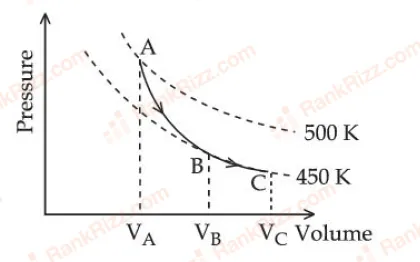
A poly-atomic molecule (, where R is gas constant) goes from phase space point to point to point A to B is an adiabatic path B and C to is an isothermal path. The net heat absorbed per unit mole by the system is :- (A)
500R(ln 3 + ln 4)
- (B)
450R(ln 4 − ln 3)
- (C)
500R ln 2
- (D)
400R ln 4
rr2.rankrizz.com/jee-main/physics/thermodynamics/q/29-jan-2025-s2-q42
- (A)
Given below are two statements. One is labelled as Assertion (A) and the other is labelled as Reason (R). Assertion (A) : In an insulated container, a gas is adiabatically shrunk to half of its initial volume. The temperature of the gas decreases. Reason (R): Free expansion of an ideal gas is an irreversible and an adiabatic process. In the light of the above statements, choose the correct answer from the options given below :
- (A)
Both (A) and (R) are true but (R) is NOT the correct explanation of (A)
- (B)
(A) is false but (R) is true
- (C)
(A) is true but (R) is false
- (D)
Both (A) and (R) are true and (R) is the correct explanation of (A)
rr2.rankrizz.com/jee-main/physics/thermodynamics/q/24-jan-2025-s2-q44
- (A)
An ideal gas initially at C temperature, is compressed suddenly to one fourth of its volume. If the ratio of specific heat at constant pressure to that at constant volume is 3/2, the change in temperature due to the thermodynamic process is _____ K.
Answer: ____________
rr2.rankrizz.com/jee-main/physics/thermodynamics/q/23-jan-2025-s1-q49
A sample of 1 mole gas at temperature T is adiabatically expanded to double its volume. If adiabatic constant for the gas is , then the work done by the gas in the process is:
- (A)
- (B)
- (C)
- (D)
rr2.rankrizz.com/jee-main/physics/thermodynamics/q/9-apr-2024-s1-q8
- (A)
The volume of an ideal gas is changed adiabatically from 5 litres to 4 litres. The ratio of initial pressure to final pressure is:
- (A)
- (B)
- (C)
- (D)
rr2.rankrizz.com/jee-main/physics/thermodynamics/q/9-apr-2024-s1-q9
- (A)
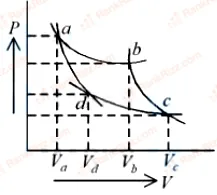
Two different adiabatic paths for the same gas intersect two isothermal curves as shown in P-V diagram. The relation between the ratio and the ratio is:
- (A)
- (B)
- (C)
- (D)
rr2.rankrizz.com/jee-main/physics/thermodynamics/q/8-apr-2024-s1-q9
- (A)
During an adiabatic process, if the pressure of a gas is found to be proportional to the cube of its absolute temperature, then the ratio of for the gas is :
- (A)
- (B)
- (C)
- (D)
rr2.rankrizz.com/jee-main/physics/thermodynamics/q/05-apr-2024-s2-q8
- (A)
A sample of gas at temperature is adiabatically expanded to double its volume. Adiabatic constant for the gas is . The work done by the gas in the process is: ( mole)
- (A)
- (B)
- (C)
- (D)
rr2.rankrizz.com/jee-main/physics/thermodynamics/q/04-apr-2024-s2-q8
- (A)
Choose the correct statement for processes & shown in figure.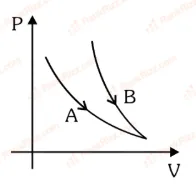
- (A)
for process and for process
- (B)
for process and
- (C)
for process and for process
- (D)
for process and for process
rr2.rankrizz.com/jee-main/physics/thermodynamics/q/30-jan-2024-s2-q8
- (A)
During an adiabatic process, the pressure of a gas is found to be proportional to the cube of its absolute temperature. The ratio of for the gas is :
- (A)
- (B)
- (C)
- (D)
rr2.rankrizz.com/jee-main/physics/thermodynamics/q/27-jan-2024-s2-q8
- (A)
The initial pressure and volume of an ideal gas are and . The final pressure of the gas when the gas is suddenly compressed to volume will be:
(Given = ratio of specific heats at constant pressure and at constant volume.)- (A)
- (B)
- (C)
- (D)
rr2.rankrizz.com/jee-main/physics/thermodynamics/q/13-apr-2023-s2-q8
- (A)
Consider two containers A and B containing monoatomic gases at the same Pressure , Volume and Temperature . The gas in A is compressed isothermally to of its original volume while the gas in B is compressed adiabatically to of its original volume. The ratio of final pressure of gas in B to that of gas in A is
- (A)
8
- (B)
4
- (C)
- (D)
rr2.rankrizz.com/jee-main/physics/thermodynamics/q/10-apr-2023-s1-q8
- (A)
A gas is compressed adiabatically, which one of the following statement is NOT true?
- (A)
There is no heat supplied to the system
- (B)
There is no change in the internal energy
- (C)
The temperature of the gas increases
- (D)
The change in the internal energy is equal to the work done on the gas
rr2.rankrizz.com/jee-main/physics/thermodynamics/q/10-apr-2023-s2-q7
- (A)
A sample of gas at temperature is adiabatically expanded to double its volume. The work done by the gas in the process is, (given ):
- (A)
- (B)
- (C)
- (D)
rr2.rankrizz.com/jee-main/physics/thermodynamics/q/01-feb-2023-s1-q8
- (A)
A hypothetical gas expands adiabatically such that its volume changes from 08 litres to 27 litres. If the ratio of final pressure of the gas to initial pressure of the gas is . Then the ratio of will be.
- (A)
- (B)
- (C)
- (D)
rr2.rankrizz.com/jee-main/physics/thermodynamics/q/31-jan-2023-s2-q8
- (A)
Heat is given to an ideal gas in an isothermal process.
A. Internal energy of the gas will decrease.
B. Internal energy of the gas will increase.
C. Internal energy of the gas will not change.
D. The gas will do positive work.
E. The gas will do negative work.
Choose the correct answer from the options given below:- (A)
A and E only
- (B)
B and D only
- (C)
C and E only
- (D)
C and D only
rr2.rankrizz.com/jee-main/physics/thermodynamics/q/30-jan-2023-s1-q9
- (A)
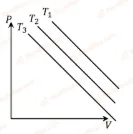
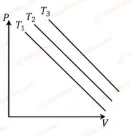
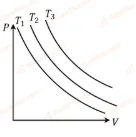
In an Isothermal change, the change in pressure and volume of a gas can be represented for three different temperature; as:
- (A)
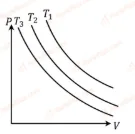
- (B)
- (C)
- (D)
rr2.rankrizz.com/jee-main/physics/thermodynamics/q/24-jan-2023-s2-q9
- (A)
The pressure and density of diatomic gas changes suddenly to and respectively during an adiabatic process. The temperature of the gas increases and becomes _____ times of its initial temperature. (Given )
Answer: ____________
rr2.rankrizz.com/jee-main/physics/thermodynamics/q/29-jul-2022-s1-q23
A monoatomic gas at pressure and volume is suddenly compressed to one eighth of its original volume. The final pressure at constant entropy will be
- (A)
- (B)
- (C)
- (D)
rr2.rankrizz.com/jee-main/physics/thermodynamics/q/26-jul-2022-s1-q8
- (A)
A certain amount of gas of volume at temperature and pressure expands isothermally until its volume gets doubled. Later it expands adiabatically until its volume gets redoubled. The final pressure of the gas will be (Use )
- (A)
- (B)
- (C)
- (D)
rr2.rankrizz.com/jee-main/physics/thermodynamics/q/25-jul-2022-s1-q7
- (A)
Starting with the same initial conditions, an ideal gas expands from volume to in three different ways. The work done by the gas is if the process is purely isothermal, , if the process is purely adiabatic and if the process is purely isobaric. Then, choose the correct option
- (A)
- (B)
- (C)
- (D)
rr2.rankrizz.com/jee-main/physics/thermodynamics/q/29-jun-2022-s2-q8
- (A)
Statement - I : When amount of an ideal gas undergoes adiabatic change from state to state , then work done is , where and = universal gas constant.
Statement - II : In the above case, when work is done on the gas, the temperature of the gas would rise.- (A)
Both statement-I and statement-II are true.
- (B)
Both statement-I and statement-II are false.
- (C)
Statement-I is true but statement-II is false.
- (D)
Statement-I is false but statement-II is true.
rr2.rankrizz.com/jee-main/physics/thermodynamics/q/28-jun-2022-s1-q7
- (A)
A sample of gas with is taken through an adiabatic process in which the volume is compressed from 1200 cm to 300 cm. If the initial pressure is 200 kPa. The absolute value of the workdone by the gas in the process = _________ J.
Answer: ____________
rr2.rankrizz.com/jee-main/physics/thermodynamics/q/31-aug-2021-s2-q22
One mole of an ideal gas is taken through an adiabatic process where the temperature rises from 27°C to 37°C. If the ideal gas is composed of polyatomic molecule that has 4 vibrational modes, which of the following is true? [R = 8.314 J mol K]
- (A)
work done by the gas is close to 332 J
- (B)
work done on the gas is close to 582 J
- (C)
work done by the gas is close to 582 J
- (D)
work done on the gas is close to 332 J
rr2.rankrizz.com/jee-main/physics/thermodynamics/q/27-jul-2021-s2-q9
- (A)
A monoatomic ideal gas, initially at temperature is enclosed in a cylinder fitted with a frictionless piston. The gas is allowed to expand adiabatically to a temperature by releasing the piston suddenly. If and are the lengths of the gas column, before and after the expansion respectively, then the value of will be:
- (A)
- (B)
- (C)
- (D)
rr2.rankrizz.com/jee-main/physics/thermodynamics/q/25-jul-2021-s1-q8
- (A)
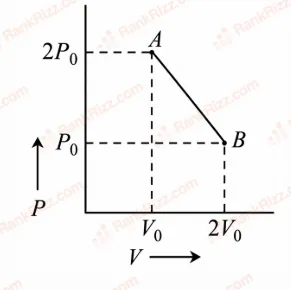
One mole of an ideal gas at 27 C is taken from A to B as shown in the given PV indicator diagram. The work done by the system will be ___ J. [Given, J mole K, ln 2 = 0.6931] (Round off to the nearest integer)
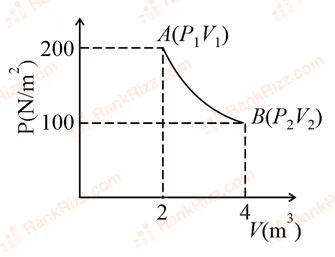
Answer: ____________
rr2.rankrizz.com/jee-main/physics/thermodynamics/q/20-jul-2021-s2-q24
For an adiabatic expansion of an ideal gas, the fractional change in its pressure is equal to (where is the ratio of specific heats):
- (A)
- (B)
- (C)
- (D)
rr2.rankrizz.com/jee-main/physics/thermodynamics/q/18-mar-2021-s2-q8
- (A)
Which one is the correct option for the two different thermodynamic processes?

- (A)
(c) and (a)
- (B)
(c) and (d)
- (C)
(a) only
- (D)
(b) and (c)
rr2.rankrizz.com/jee-main/physics/thermodynamics/q/17-mar-2021-s2-q7
- (A)
In an adiabatic process, the density of a diatomic gas becomes times its initial value. The final pressure of the gas is found to be times the initial pressure. The value of is:
- (A)
32
- (B)
326
- (C)
128
- (D)
rr2.rankrizz.com/jee-main/physics/thermodynamics/q/5-sep-2020-s2-q7
- (A)
A balloon filled with helium (32°C and 1.7 atm) bursts. Immediately afterwards the expansion of helium can be considered as:
- (A)
irreversible isothermal
- (B)
irreversible adiabatic
- (C)
reversible adiabatic
- (D)
reversible isothermal
rr2.rankrizz.com/jee-main/physics/thermodynamics/q/3-sep-2020-s1-q5
- (A)
An engine takes in 5 moles of air at 20 C and 1 atm, and compresses it adiabatically to of the original volume. Assuming air to be a diatomic ideal gas made up of rigid molecules, the change in its internal energy during this process comes out to be X kJ. The value of X to the nearest integer is:
Answer: ____________
rr2.rankrizz.com/jee-main/physics/thermodynamics/q/2-sep-2020-s1-q22
Starting at temperature , one mole of an ideal diatomic gas is first compressed adiabatically from volume to . It is then allowed to expand isobarically to volume . If all the processes are the quasi-static then the final temperature of the gas (in ) is (to the nearest integer) ___________.
Answer: ____________
rr2.rankrizz.com/jee-main/physics/thermodynamics/q/9-jan-2020-s2-q21
A litre of dry air at STP expands adiabatically to a volume of 3 litres. If , the work done by air is: () [Take air to be an ideal gas]
- (A)
60.7 J
- (B)
90.5 J
- (C)
100.8 J
- (D)
48 J
rr2.rankrizz.com/jee-main/physics/thermodynamics/q/7-jan-2020-s1-q7
- (A)
The given diagram shows four processes i.e., isochoric, isobaric, isothermal and adiabatic. The correct assignment of the processes, in the same order is given by:
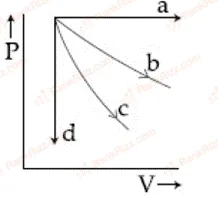
- (A)
a d b c
- (B)
d a b c
- (C)
a d c b
- (D)
d a c b
rr2.rankrizz.com/jee-main/physics/thermodynamics/q/8-apr-2019-s2-q11
- (A)
A rigid diatomic ideal gas undergoes an adiabatic process at room temperature. The relation between temperature and volume for this process is = constant, then x is:
- (A)
- (B)
- (C)
- (D)
rr2.rankrizz.com/jee-main/physics/thermodynamics/q/11-jan-2019-s1-q10
- (A)
One mole of an ideal monoatomic gas is compressed isothermally in a rigid vessel to double its pressure at room temperature, 27C. The work done on the gas will be:
- (A)
300R ln 6
- (B)
300R
- (C)
300R ln 7
- (D)
300R ln 2
rr2.rankrizz.com/jee-main/physics/thermodynamics/q/15-apr-2018-s1-q11
- (A)
Consider a spherical shell of radius R at temperature T. The black body radiation inside it can be considered as an ideal gas of photons with internal energy per unit volume and pressure . If the shell now undergoes an adiabatic expansion the relation between T and R is:
- (A)
- (B)
- (C)
- (D)
rr2.rankrizz.com/jee-main/physics/thermodynamics/q/4-apr-2015-offline-q10
- (A)
During an adiabatic compression, 830 J of work is done on 2 moles of a diatomic ideal gas to reduce its volume by 50%. The change in its temperature is nearly: (R = 8.3 JK mol)
- (A)
40 K
- (B)
33 K
- (C)
20 K
- (D)
14 K
rr2.rankrizz.com/jee-main/physics/thermodynamics/q/11-apr-2014-online-q12
- (A)
An ideal gas at atmospheric pressure is adiabatically compressed so that its density becomes 32 times of its initial value. If the final pressure of gas is 128 atmospheres, the value of '' of the gas is :
- (A)
1.5
- (B)
1.4
- (C)
1.3
- (D)
1.6
rr2.rankrizz.com/jee-main/physics/thermodynamics/q/22-apr-2013-online-q10
- (A)
This question has Statement 1 and Statement 2. Of the four choices given after the Statements, choose the one that best describes the two Statements. Statement 1: In an adiabatic process, change in internal energy of a gas is equal to work done on/by the gas in the process. Statement 2: The temperature of a gas remains constant in an adiabatic process.
- (A)
Statement 1 is true, Statement 2 is true, Statement 2 is a correct explanation of Statement 1.
- (B)
Statement 1 is true, Statement 2 is false.
- (C)
Statement 1 is false, Statement 2 is true.
- (D)
Statement 1 is false, Statement 2 is true, Statement 2 is not a correct explanation of Statement 1.
rr2.rankrizz.com/jee-main/physics/thermodynamics/q/2012-physics-499122
- (A)
An ideal monatomic gas with pressure , volume and temperature is expanded isothermally to a volume and a final pressure . If the same gas is expanded adiabatically to a volume , the final pressure is . The ratio is
- (A)
- (B)
- (C)
- (D)
rr2.rankrizz.com/jee-main/physics/thermodynamics/q/2012-physics-499174
- (A)
A given ideal gas with at a temperature . If the gas is compressed adiabatically to one-fourth of its initial volume, the final temperature will be
- (A)
- (B)
- (C)
- (D)
rr2.rankrizz.com/jee-main/physics/thermodynamics/q/2012-physics-499389
- (A)
The work of is performed in order to compress one kilo mole of gas adiabatically and in this process the temperature of the gas increases by . The gas is
- (A)
monoatomic
- (B)
diatomic
- (C)
triatomic
- (D)
a mixture of monoatomic and diatomic
rr2.rankrizz.com/jee-main/physics/thermodynamics/q/2006-physics-499984
- (A)
Carnot engine and Carnot cycle 37
A Carnot engine (E) is working between two temperatures 473 K and 273 K . In a new system two engines - engine works between 473 K to 373 K and engine works between 373 K to 273 K . If and are the efficiencies of the engines and , respectively, then
- (A)
- (B)
- (C)
- (D)
rr2.rankrizz.com/jee-main/physics/thermodynamics/q/28-jan-2025-s1-q34
- (A)
An engine operating between the boiling and freezing points of water will have
A. Efficiency more than 27%.
B. Efficiency less than the efficiency of a Carnot engine operating between the same two temperatures.
C. Efficiency equal to 27%.
D. Efficiency less than 27%.
Choose the correct answer from the options given below- (A)
B, C and D only
- (B)
A and B only
- (C)
B and D only
- (D)
B and C only
rr2.rankrizz.com/jee-main/physics/thermodynamics/q/12-apr-2023-s1-q8
- (A)
Work done by a Carnot engine operating between temperatures 127C and 27C is 2 kJ. The amount of heat transferred to the engine by the reservoir is:
- (A)
8 kJ
- (B)
2.67 kJ
- (C)
2 kJ
- (D)
4 kJ
rr2.rankrizz.com/jee-main/physics/thermodynamics/q/08-apr-2023-s2-q8
- (A)
A Carnot engine operating between two reservoirs has efficiency . When the temperature of cold reservoir raised by , its efficiency decreases to . The value of , if the temperature of hot reservoir is C, will be
- (A)
K
- (B)
K
- (C)
K
- (D)
K
rr2.rankrizz.com/jee-main/physics/thermodynamics/q/01-feb-2023-s2-q8
- (A)
Given below are two statements: one is labelled as Assertion A and the other is labelled as Reason R.
Assertion A: Efficiency of a reversible heat engine will be highest at C temperature of cold reservoir.
Reason R: The efficiency of Carnot's engine depends not only on temperature of cold reservoir but it depends on the temperature of hot reservoir too and is given as
In the light of the above statements, choose the correct answer from the options given below:- (A)
A is true but R is false
- (B)
Both A and R are true but R is NOT the correct explanation of A
- (C)
A is false but R is true
- (D)
Both A and R are true and R is the correct explanation of A
rr2.rankrizz.com/jee-main/physics/thermodynamics/q/30-jan-2023-s2-q7
- (A)
A Carnot engine with efficiency 50% takes heat from a source at 600 K. In order to increase the efficiency to 70%, keeping the temperature of sink same, the new temperature of the source will be:
- (A)
360 K
- (B)
1000 K
- (C)
900 K
- (D)
300 K
rr2.rankrizz.com/jee-main/physics/thermodynamics/q/25-jan-2023-s1-q8
- (A)
A Carnot engine has efficiency of 50%. If the temperature of sink is reduced by 40°C, its efficiency increases by 30%. The temperature of the source will be:
- (A)
166.7 K
- (B)
255.1 K
- (C)
266.7 K
- (D)
367.7 K
rr2.rankrizz.com/jee-main/physics/thermodynamics/q/28-jul-2022-s1-q7
- (A)
In 1st case, Carnot engine operates between temperatures 300 K and 100 K. In 2nd case, as shown in the figure, a combination of two engines is used. The efficiency of this combination (in 2nd case) will be :
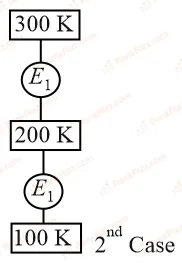
- (A)
same as the 1st case
- (B)
always greater than the 1st case
- (C)
always less than the 1st case
- (D)
may increase or decrease with respect to the 1st case
rr2.rankrizz.com/jee-main/physics/thermodynamics/q/27-jul-2022-s2-q8
- (A)
Let is the efficiency of an engine at and while is the efficiency at and . The ratio will be
- (A)
- (B)
- (C)
- (D)
rr2.rankrizz.com/jee-main/physics/thermodynamics/q/25-jul-2022-s2-q9
- (A)
300 calories of heat is given to a heat engine, and it rejects 225 calories of heat. If source temperature is 227°C, then the temperature of sink will be ______ °C.
Answer: ____________
rr2.rankrizz.com/jee-main/physics/thermodynamics/q/29-jun-2022-s1-q22
In a carnot engine, the temperature of reservoir is C and that of sink is K. If the work done by the engine when it transfers heat from reservoir to sink is kJ, the quantity of heat absorbed by the engine from reservoir is ______ J.
Answer: ____________
rr2.rankrizz.com/jee-main/physics/thermodynamics/q/27-jun-2022-s1-q23
The efficiency of a Carnot's engine, working between steam point and ice point, will be
- (A)
- (B)
- (C)
- (D)
rr2.rankrizz.com/jee-main/physics/thermodynamics/q/26-jun-2022-s1-q7
- (A)
A heat engine operates with the cold reservoir at temperature K. The minimum temperature of the hot reservoir, if the heat engine takes J heat from the hot reservoir and delivers J heat to the cold reservoir per cycle, is ______ K.
Answer: ____________
rr2.rankrizz.com/jee-main/physics/thermodynamics/q/26-jun-2022-s2-q25
A Carnot engine whose heat sinks at C, has an efficiency of . By how many degrees should the temperature of the source be changed to increase the efficiency by of the original efficiency?
- (A)
Increases by C
- (B)
Increases by C
- (C)
Increases by C
- (D)
Increases by C
rr2.rankrizz.com/jee-main/physics/thermodynamics/q/24-jun-2022-s1-q9
- (A)
A Carnot engine takes kcal of heat from a reservoir at C and gives heat to a sink at C. The work done by the engine is
- (A)
J
- (B)
Zero
- (C)
J
- (D)
J
rr2.rankrizz.com/jee-main/physics/thermodynamics/q/24-jun-2022-s2-q8
- (A)
A reversible engine has an efficiency of . If the temperature of the sink is reduced by 58°C, its efficiency becomes double. Calculate the temperature of the sink:
- (A)
180.4°C
- (B)
382°C
- (C)
174 K
- (D)
280°C
rr2.rankrizz.com/jee-main/physics/thermodynamics/q/31-aug-2021-s1-q8
- (A)
A heat engine operates between a cold reservoir at temperature K and a hot reservoir at temperature . It takes 300 J of heat from the hot reservoir and delivers 240 J of heat to the cold reservoir in a cycle. The minimum temperature of the hot reservoir has to be _________.
Answer: ____________
rr2.rankrizz.com/jee-main/physics/thermodynamics/q/27-aug-2021-s2-q23
A refrigerator consumes an average 35 W power to operate between temperature -10°C to 25°C. If there is no loss of energy then how much average heat per second does it transfer?
- (A)
350 J s
- (B)
298 J s
- (C)
263 J s
- (D)
35 J s
rr2.rankrizz.com/jee-main/physics/thermodynamics/q/26-aug-2021-s2-q9
- (A)
Two Carnot engines and operate in series such that engine A absorbs heat at and rejects heat to a sink at temperature T. Engine B absorbs half of the heat rejected by Engine and rejects heat to the sink at . When workdone in both the cases is equal, to value of T is:
- (A)
- (B)
- (C)
- (D)
rr2.rankrizz.com/jee-main/physics/thermodynamics/q/27-jul-2021-s2-q10
- (A)
A heat engine has an efficiency of . When the temperature of sink is reduced by 62°C, its efficiency gets doubled. The temperature of the source is:
- (A)
124°C
- (B)
37°C
- (C)
62°C
- (D)
99°C
rr2.rankrizz.com/jee-main/physics/thermodynamics/q/25-jul-2021-s2-q8
- (A)
A Carnot's engine working between 400 K and 800 K has a work output of 1200 J per cycle. The amount of heat energy supplied to the engine from the source in each cycle is:
- (A)
3200 J
- (B)
1800 J
- (C)
1600 J
- (D)
2400 J
rr2.rankrizz.com/jee-main/physics/thermodynamics/q/17-mar-2021-s1-q8
- (A)
For an ideal heat engine, the temperature of the source is 127°C. In order to have 60% efficiency the temperature of the sink should be ________°C. (Round off to the nearest integer)
Answer: ____________
rr2.rankrizz.com/jee-main/physics/thermodynamics/q/16-mar-2021-s2-q26
A reversible heat engine converts one-fourth of the heat input into work. When the temperature of the sink is reduced by 52 K, its efficiency is doubled. The temperature in Kelvin of the source will be ______.
Answer: ____________
rr2.rankrizz.com/jee-main/physics/thermodynamics/q/25-feb-2021-s2-q24
If minimum possible work is done by a refrigerator in converting 100 grams of water at 0°C to ice, how much heat (in calories) is released to the surroundings at temperature 27°C (Latent heat of ice = 80 Cal/gram) to the nearest integer?
Answer: ____________
rr2.rankrizz.com/jee-main/physics/thermodynamics/q/3-sep-2020-s2-q23
A Carnot engine having an efficiency of is being used as a refrigerator. If the work done on the refrigerator is 10 J, the amount of heat absorbed from the reservoir at a lower temperature is
- (A)
99 J
- (B)
100 J
- (C)
1 J
- (D)
90 J
rr2.rankrizz.com/jee-main/physics/thermodynamics/q/8-jan-2020-s2-q8
- (A)
A Carnot engine operates between two reservoirs of temperatures 900K and 300K. The engine performs 1200J of work per cycle. The heat energy (in J) delivered by the engine to the low temperature reservoir, in a cycle, is
Answer: ____________
rr2.rankrizz.com/jee-main/physics/thermodynamics/q/7-jan-2020-s1-q23
Two ideal Carnot engines operate in cascade (all heat given up by one engine is used by the other engine to produce work) between temperatures, T and T. The temperature of the hot reservoir of the first engine is T and the temperature of the cold reservoir of the second engine is T. T is temperature of the sink of first engine which is also the source for the second engine. How is T related to T and T, if both the engines perform equal amount of work?
- (A)
- (B)
- (C)
- (D)
rr2.rankrizz.com/jee-main/physics/thermodynamics/q/7-jan-2020-s2-q8
- (A)
A Carnot engine has an efficiency of . When the temperature of the sink is reduced by 62°C, its efficiency is doubled. The temperatures of the source and the sink are, respectively,
- (A)
124 °C, 62 °C
- (B)
37 °C, 99 °C
- (C)
99 °C, 37 °C
- (D)
62 °C, 124 °C
rr2.rankrizz.com/jee-main/physics/thermodynamics/q/12-apr-2019-s2-q11
- (A)
Three Carnot engines operate in series between a heat source at a temperature and a heat sink at temperature (see figure). There are two other reservoirs at temperature and , as shown, with . The three engines are equally efficient if:
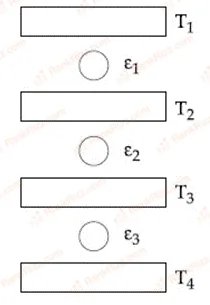
- (A)
- (B)
- (C)
- (D)
rr2.rankrizz.com/jee-main/physics/thermodynamics/q/10-jan-2019-s1-q11
- (A)
Two carnot engines and are operated in series. The first one, , receives heat at and rejects to a reservoir at temperature . The second engine receives heat rejected by the first engine and, in turn, rejects to a heat reservoir at . Calculate the temperature if the work outputs of the two engines are equal:
- (A)
500 K
- (B)
400 K
- (C)
300 K
- (D)
600 K
rr2.rankrizz.com/jee-main/physics/thermodynamics/q/9-jan-2019-s2-q9
- (A)
A Carnot's engine works as a refrigerator between 250 K and 300 K. It receives 500 cal heat from the reservoir at the lower temperature. The amount of work done in each cycle to operate the refrigerator is:
- (A)
420 J
- (B)
2100 J
- (C)
772 J
- (D)
2520 J
rr2.rankrizz.com/jee-main/physics/thermodynamics/q/15-apr-2018-s1-q10
- (A)
Two Carnot engines A and B are operated in series. Engine A receives heat from a reservoir at 600 K and rejects heat to a reservoir at temperature T. Engine B receives heat rejected by engine A and in turn rejects it to a reservoir at 100 K. If the efficiencies of the two engines A and B are represented by and respectively, then what is the value of ?
- (A)
- (B)
- (C)
- (D)
rr2.rankrizz.com/jee-main/physics/thermodynamics/q/15-apr-2018-s2-q11
- (A)
A Carnot freezer takes heat from water at inside it and rejects it to the room at a temperature of . The latent heat of ice is J kg. If 5 kg of water at is converted into ice at by the freezer, then the energy consumed by the freezer is close to:
- (A)
J
- (B)
J
- (C)
J
- (D)
J
rr2.rankrizz.com/jee-main/physics/thermodynamics/q/10-apr-2016-online-q10
- (A)
A Carnot engine absorbs 1000 J of heat energy from a reservoir at 127°C and rejects 600 J of heat energy during each cycle. The efficiency of engine and temperature of sink will be:
- (A)
20% and °C
- (B)
40% and °C
- (C)
50% and °C
- (D)
70% and °C
rr2.rankrizz.com/jee-main/physics/thermodynamics/q/12-apr-2014-online-q12
- (A)
A Carnot engine, whose efficiency is , takes in heat from a source maintained at a temperature of . It is desired to have an engine of efficiency . Then, the intake temperature for the same exhaust (sink) temperature must be
- (A)
efficiency of Carnot engine cannot be made larger than
- (B)
- (C)
- (D)
rr2.rankrizz.com/jee-main/physics/thermodynamics/q/2012-physics-499029
- (A)
This question has Statement 1 and Statement 2. Of the four choices given after the Statements, choose the one that best describes the two Statements. Statement 1: An inventor claims to have constructed an engine that has an efficiency of when operated between the boiling and freezing points of water. This is not possible. Statement 2: The efficiency of a real engine is always less than the efficiency of a Carnot engine operating between the same two temperatures.
- (A)
Statement 1 is true, Statement 2 is true, Statement 2 is not the correct explanation of Statement 1.
- (B)
Statement 1 is true, Statement 2 is false.
- (C)
Statement 1 is false, Statement 2 is true.
- (D)
Statement 1 is true, Statement 2 is true, Statement 2 is the correct explanation of Statement 1.
rr2.rankrizz.com/jee-main/physics/thermodynamics/q/2012-physics-499272
- (A)
A Carnot engine operating between temperatures and has efficiency . When is lowered by , its efficiency increases to . Then and are, respectively:
- (A)
and
- (B)
and
- (C)
and
- (D)
and
rr2.rankrizz.com/jee-main/physics/thermodynamics/q/2011-physics-499479
- (A)
Zeroth and first law of thermodynamics 34
One mole of diatomic gas having rotational modes only is kept in a cylinder with a piston system. The cross-section area of the cylinder is 4 cm. The gas is heated slowly to raise the temperature by 1.2 C during which the piston moves by 25 mm. The amount of heat supplied to the gas is __________ J. (Atmospheric pressure = 100 kPa, J/mol. K) (Neglect mass of the piston)
- (A)
24.8
- (B)
25.9
- (C)
15.04
- (D)
29.98
rr2.rankrizz.com/jee-main/physics/thermodynamics/q/8-apr-2026-s2-q35
- (A)
Consider the following statements:
A. Zeroth law of thermodynamics gives concept of temperature
B. First law of thermodynamics gives concept of internal energy
C. In isothermal expansion of ideal gas,
D. Product of intensive and extensive variables is extensive
E. The ratio of any extensive variable to mass will be an extensive variable
Choose the correct combination of statements from the options given below:- (A)
C, D and E Only
- (B)
A, B and C Only
- (C)
A, B and D Only
- (D)
B, C and D Only
rr2.rankrizz.com/jee-main/physics/thermodynamics/q/5-apr-2026-s1-q33
- (A)
Density of water at 4 °C and 20 °C are respectively. The increase in internal energy of 4 kg of water when it is heated from 4 °C to 20 °C is_____ J.
(specific heat capacity of water = J / kg K. and 1 atmospheric pressure )- (A)
234699.2
- (B)
258700.8
- (C)
268799.2
- (D)
315826.2
rr2.rankrizz.com/jee-main/physics/thermodynamics/q/24-jan-2026-s1-q32
- (A)
The internal energy of a monoatomic gas is 3nRT. One mole of helium is kept in a cylinder having internal cross section area of 17 and fitted with a light movable frictionless piston. The gas is heated slowly by suppling 126 J heat. If the temperature rises by , then the piston will move ____ cm.
(atmospheric pressure= Pa)- (A)
14.5
- (B)
1.45
- (C)
1.55
- (D)
15.5
rr2.rankrizz.com/jee-main/physics/thermodynamics/q/23-jan-2026-s2-q33
- (A)
During the melting of a slab of ice at 273 K at atmospheric pressure :
- (A)
Internal energy of ice-water system remains unchanged.
- (B)
Positive work is done by the ice-water system on the atmosphere.
- (C)
Internal energy of the ice-water system decreases.
- (D)
Positive work is done on the ice-water system by the atmosphere.
rr2.rankrizz.com/jee-main/physics/thermodynamics/q/2025-apr-03-s1-q26
- (A)
A piston of mass M is hung from a massless spring whose restoring force law goes as , where k is the spring constant of appropriate dimension. The piston separates the vertical chamber into two parts, where the bottom part is filled with 'n' moles of an ideal gas. An external work is done on the gas isothermally (at a constant temperature T) with the help of a heating filament (with negligible volume) mounted in lower part of the chamber, so that the piston goes up from a height to , the total energy delivered by the filament is (Assume spring to be in its natural length before heating)
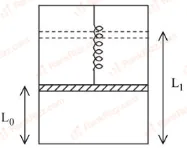
- (A)
- (B)
- (C)
- (D)
rr2.rankrizz.com/jee-main/physics/thermodynamics/q/2025-apr-03-s1-q36
- (A)
Given are statements for certain thermodynamic variables, (A) Internal energy, volume (V) and mass (M) are extensive variables. (B) Pressure (P), temperature (T) and density are intensive variables. (C) Volume (V), temperature (T) and density are intensive variables. (D) Mass (M), temperature (T) and internal energy are extensive variables. Choose the correct answer from the options given below :
- (A)
(B) and (C) Only
- (B)
(C) and (D) Only
- (C)
(D) and (A) Only
- (D)
(A) and (B) Only
rr2.rankrizz.com/jee-main/physics/thermodynamics/q/22-jan-2025-s2-q32
- (A)
A total of heat is given to one mole of helium kept in a cylinder. The temperature of helium increases by . The work done by the gas is: Given, .
- (A)
- (B)
- (C)
- (D)
rr2.rankrizz.com/jee-main/physics/thermodynamics/q/6-apr-2024-s2-q8
- (A)
1 kg of water at 100C is converted into steam at 100C by boiling at atmospheric pressure. The volume of water changes from m as a liquid to 1.671 m as steam. The change in internal energy of the system during the process will be (Given latent heat of vaporisation = 2257 kJ/kg, Atmospheric pressure Pa)
- (A)
kJ
- (B)
kJ
- (C)
kJ
- (D)
kJ
rr2.rankrizz.com/jee-main/physics/thermodynamics/q/11-apr-2023-s1-q6
- (A)
The thermodynamic process, in which internal energy of the system remains constant is
- (A)
Isochoric
- (B)
Adiabatic
- (C)
Isothermal
- (D)
Isobaric
rr2.rankrizz.com/jee-main/physics/thermodynamics/q/11-apr-2023-s2-q7
- (A)
Given below are two statements:
Statement I: If heat is added to a system, its temperature must increase.
Statement II: If positive work is done by a system in a thermodynamic process, its volume must increase.
In the light of the above statements, choose the correct answer from the options given below- (A)
Statement I is true but Statement II is false
- (B)
Both Statement I and Statement II are false
- (C)
Both Statement I and Statement II are true
- (D)
Statement I is false but Statement II is true
rr2.rankrizz.com/jee-main/physics/thermodynamics/q/8-apr-2023-s1-q10
- (A)
A source supplies heat to a system at the rate of 1000 W. If the system performs work at a rate of 200 W. The rate at which internal energy of the system increases is
- (A)
600 W
- (B)
800 W
- (C)
500 W
- (D)
1200 W
rr2.rankrizz.com/jee-main/physics/thermodynamics/q/6-apr-2023-s1-q9
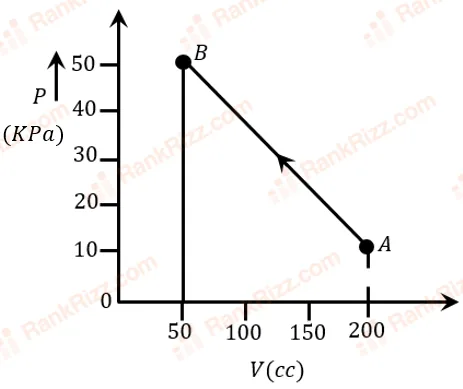
- (A)
The pressure of a gas changes linearly with volume from to as shown in figure. If no heat is supplied to or extracted from the gas then change in the internal energy of the gas will be
- (A)
6 J
- (B)
Zero
- (C)
-4.5 J
- (D)
4.5 J
rr2.rankrizz.com/jee-main/physics/thermodynamics/q/31-jan-2023-s1-q8
- (A)
Given below are two statements. One is labelled as Assertion A and the other is labelled as Reason R.
Assertion A: If and represent the heat supplied to the system and the work done on the system respectively. Then according to the first law of thermodynamics .
Reason R: First law of thermodynamics is based on law of conservation of energy.
In the light of the above statements, choose the correct answer from the option given below:- (A)
A is correct but R is not correct
- (B)
A is not correct but R is correct
- (C)
Both A and R are correct and R is the correct explanation of A
- (D)
Both A and R are correct but R is not the correct explanation of A
rr2.rankrizz.com/jee-main/physics/thermodynamics/q/29-jan-2023-s1-q7
- (A)
1 g of a liquid is converted to vapour at Pa pressure. If 10% of the heat supplied is used for increasing the volume by 1600 during this phase change, then the increase in internal energy in the process will be :
- (A)
4320 J
- (B)
432000 J
- (C)
4800 J
- (D)
J
rr2.rankrizz.com/jee-main/physics/thermodynamics/q/24-jan-2023-s1-q7
- (A)
1 g of a liquid is converted to vapour at Pa pressure. If 10% of the heat supplied is used for increasing the volume by 1600 cm during this phase change, then the increase in internal energy in the process will be:
- (A)
4320 J
- (B)
432000 J
- (C)
4800 J
- (D)
J
rr2.rankrizz.com/jee-main/physics/thermodynamics/q/24-jan-2023-s1-q7-494022
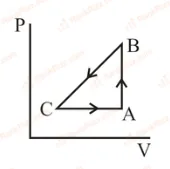
- (A)
A sample of an ideal gas is taken through the cyclic process as shown in figure. It absorbs, 40 J of heat during the part , no heat during and rejects 60 J of heat during . A work of 50 J is done on the gas during the part . The internal energy of the gas at is 1560 J. The work done by the gas during the part is
- (A)
20 J
- (B)
30 J
- (C)
J
- (D)
J
rr2.rankrizz.com/jee-main/physics/thermodynamics/q/28-jun-2022-s2-q9
- (A)
An electric appliance supplies 6000 J min, heat to the system. If the system delivers a power of 90 W. How long it would take to increase the internal energy by J?
- (A)
s
- (B)
s
- (C)
s
- (D)
s
rr2.rankrizz.com/jee-main/physics/thermodynamics/q/26-aug-2021-s1-q6
- (A)
In thermodynamics, heat and work are:
- (A)
Path functions
- (B)
Intensive thermodynamic state variables
- (C)
Extensive thermodynamic state variables
- (D)
Point functions
rr2.rankrizz.com/jee-main/physics/thermodynamics/q/16-mar-2021-s1-q7
- (A)
1 mole of rigid diatomic gas performs a work of when heat is supplied to it. The molar heat capacity of the gas during this transformation is . The value of is
[ universal gas constant]Answer: ____________
rr2.rankrizz.com/jee-main/physics/thermodynamics/q/26-feb-2021-s2-q22
A monoatomic gas of mass 4.0 u is kept in an insulated container. The container is moving with velocity 30 m s. If the container is suddenly stopped then a change in temperature of the gas ( = gas constant) is . Value of is,
Answer: ____________
rr2.rankrizz.com/jee-main/physics/thermodynamics/q/25-feb-2021-s1-q24
Match the thermodynamics processes taking place in a system with the correct conditions. In the table: is the heat supplied, is the work done and is change in internal energy of the system.
Process Condition
(I) Adiabatic (A)
(II) Isothermal (B)
(III) Isochoric (C)
(IV) Isobaric (D)- (A)
(I)-(A), (II)-(B), (III)-(D), (IV)-(D)
- (B)
(I)-(B), (II)-(A), (III)-(D), (IV)-(C)
- (C)
(I)-(A), (II)-(A), (III)-(B), (IV)-(C)
- (D)
(I)-(B), (II)-(D), (III)-(A), (IV)-(C)
rr2.rankrizz.com/jee-main/physics/thermodynamics/q/4-sep-2020-s2-q10
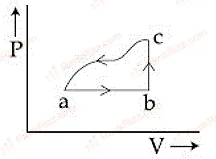
- (A)
A sample of an ideal gas is taken through the cyclic process abca as shown in the figure. The change in the internal energy of the gas along the path ca is -180 J. The gas absorbs 250 J of heat along the path ab and 60 J along the path bc. The work done by the gas along the path abc is:
- (A)
130 J
- (B)
100 J
- (C)
120 J
- (D)
140 J
rr2.rankrizz.com/jee-main/physics/thermodynamics/q/12-apr-2019-s1-q10
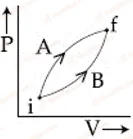
- (A)
Following figure shows two processes A and B for a gas. If and are the amount of heat absorbed by the system in two cases, and and are changes in internal energies, respectively, then:
- (A)
- (B)
- (C)
- (D)
rr2.rankrizz.com/jee-main/physics/thermodynamics/q/9-apr-2019-s1-q10
- (A)
A gas can be taken from A to B via two different processes ACB and ADB.
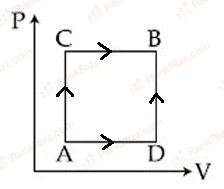
When path ACB is used 60 J of heat flows into the system and 30 J of work is done by the system. If the path ADB is used then work done by the system is 10 J, the heat flows into the system in the path ADB is:- (A)
100 J
- (B)
20 J
- (C)
40 J
- (D)
80 J
rr2.rankrizz.com/jee-main/physics/thermodynamics/q/9-jan-2019-s1-q12
- (A)
A monoatomic gas is compressed from a volume of 2 m to a volume of 1 m at a constant pressure of 100 N m. Then it is heated at constant volume by supplying 150 J of energy. As a result, the internal energy of the gas:
- (A)
Decreases by 50 J
- (B)
Increases by 250 J
- (C)
Decreases by 250 J
- (D)
0 J
rr2.rankrizz.com/jee-main/physics/thermodynamics/q/19-apr-2014-online-q12
- (A)
One mole of diatomic ideal gas undergoes a cyclic process ABC as shown in figure. The process BC is adiabatic. The temperatures at A, B and C are 400 K, 800 K and 600 K respectively. Choose the correct statement:
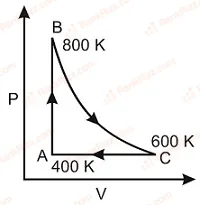
- (A)
The change in internal energy in whole cyclic process is 250 R
- (B)
The change in internal energy in the process CA is 700 R
- (C)
The change in internal energy in the process AB is -350 R
- (D)
The change in internal energy in the process BC is -500 R
rr2.rankrizz.com/jee-main/physics/thermodynamics/q/6-apr-2014-offline-q13
- (A)
Given that 1 g of water in liquid phase has volume 1 cm and in vapour phase 1671 cm at atmospheric pressure and the latent heat of vaporization of water is 2256 J/g; the change in the internal energy in joules for 1 g of water at 373 K when it changes from liquid phase to vapour phase at the same temperature is :
- (A)
2256
- (B)
167
- (C)
2089
- (D)
1
rr2.rankrizz.com/jee-main/physics/thermodynamics/q/22-apr-2013-online-q9
- (A)
There are two identical chambers, completely thermally insulated from surroundings. Both chambers have a partition wall dividing the chambers in two compartments. Compartment 1 is filled with an ideal gas and Compartment 3 is filled with a real gas. Compartments 2 and 4 are vacuum. A small hole (orifice) is made in the partition walls and the gases are allowed to expand in vacuum.
Statement - 1 : No change in the temperature of the gas takes place when ideal gas expands in vacuum. However, the temperature of real gas goes down (cooling) when it expands in vacuum.
Statement - 2 : The internal energy of an ideal gas is only kinetic. The internal energy of a real gas is kinetic as well as potential.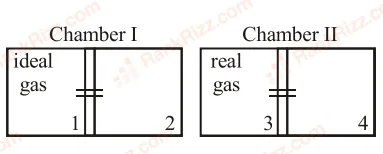
- (A)
Statement-1 is false and Statement-2 is true.
- (B)
Statement-1 and Statement-2 both are true. Statement-2 is the correct explanation of Statement-1.
- (C)
Statement-1 is true and Statement-2 is false.
- (D)
Statement-1 and Statement-2 both are true. Statement-2 is not correct explanation of Statement-1.
rr2.rankrizz.com/jee-main/physics/thermodynamics/q/9-apr-2013-online-q10
- (A)
A thermally insulated vessel contains an ideal gas of molecular mass and ratio of specific heats . It is moving with speed and is suddenly brought to rest. Assuming no heat is lost to the surroundings, its temperature increases by:
- (A)
- (B)
- (C)
- (D)
rr2.rankrizz.com/jee-main/physics/thermodynamics/q/2011-physics-499480
- (A)
When a system is taken from state to state along the path iaf, it is found that cal and cal.
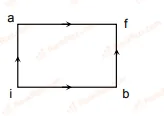
Along the path 'ibf' cal. W along the path ibf is- (A)
6 cal
- (B)
16 cal.
- (C)
66 cal.
- (D)
14 cal.
rr2.rankrizz.com/jee-main/physics/thermodynamics/q/2007-physics-499752
- (A)
Which of the following is incorrect regarding the first law of thermodynamics?
- (A)
It is applicable to any cyclic process
- (B)
It is a restatement of the principle of conservation of energy
- (C)
It introduces the concept of the internal energy
- (D)
It introduces the concept of the entropy
rr2.rankrizz.com/jee-main/physics/thermodynamics/q/2005-physics-500156
- (A)
A system goes from to via two processes I and II as shown in the figure. If and are the changes in internal energies in the processes I and II respectively, the
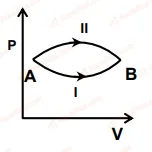
- (A)
- (B)
relation between and can not be determined
- (C)
- (D)
rr2.rankrizz.com/jee-main/physics/thermodynamics/q/2005-physics-500160
- (A)
Which of the following statements is correct for any thermodynamic system?
- (A)
The internal energy changes in all processes.
- (B)
Internal energy and entropy are state functions.
- (C)
The change in entropy can never be zero.
- (D)
The work done in an adiabatic process is always zero.
rr2.rankrizz.com/jee-main/physics/thermodynamics/q/2004-physics-500199
- (A)
Work done in thermodynamic processes and P-V diagrams 30
In the following p- V diagram the equation of state along the curved path is given by where a is a constant. The total work done in the closed path is
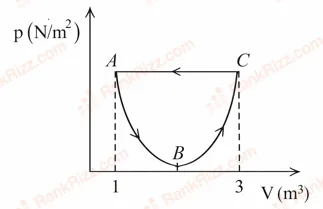
- (A)
- (B)
- (C)
- (D)
rr2.rankrizz.com/jee-main/physics/thermodynamics/q/28-jan-2026-s1-q36
- (A)
A thermodynamic system is taken through the cyclic process as shown in the figure. The total work done by the system during the cycle is ______ J.
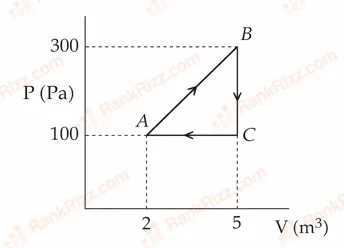
Answer: ____________
rr2.rankrizz.com/jee-main/physics/thermodynamics/q/28-jan-2026-s2-q47
An ideal gas has undergone through the cyclic process as shown in the figure. Work done by the gas in the entire cycle is ______ J. (Take )
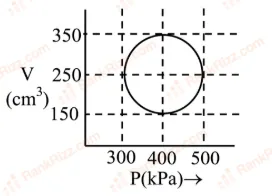
Answer: ____________
rr2.rankrizz.com/jee-main/physics/thermodynamics/q/2025-apr-7-s1-q50
An ideal gas exists in a state with pressure , volume . It is isothermally expanded to 4 times of its initial volume , then isobarically compressed to its original volume. Finally the system is heated isochorically to bring it to its initial state. The amount of heat exchanged in this process is:
- (A)
- (B)
- (C)
- (D)
rr2.rankrizz.com/jee-main/physics/thermodynamics/q/2025-apr-3-s2-q30
- (A)
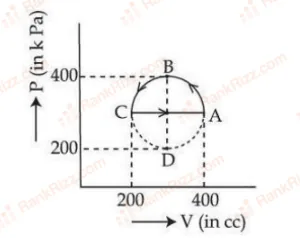
The magnitude of heat exchanged by a system for the given cyclic process ABCA (as shown in figure) is (in SI unit) :
- (A)
- (B)
- (C)
- (D)
zero
rr2.rankrizz.com/jee-main/physics/thermodynamics/q/24-jan-2025-s2-q30
- (A)
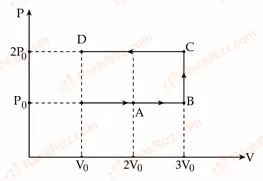
Using the given P - V diagram, the work done by an ideal gas along the path ABCD is :- (A)
- (B)
- (C)
- (D)
rr2.rankrizz.com/jee-main/physics/thermodynamics/q/23-jan-2025-s2-q37
- (A)
A real gas within a closed chamber at undergoes the cyclic process as shown in figure. The gas obeys equation for the path to . The net work done in the complete cycle is (assuming ):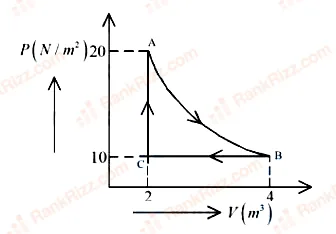
- (A)
- (B)
- (C)
- (D)
rr2.rankrizz.com/jee-main/physics/thermodynamics/q/9-apr-2024-s2-q7
- (A)
The heat absorbed by a system in going through the given cyclic process is :
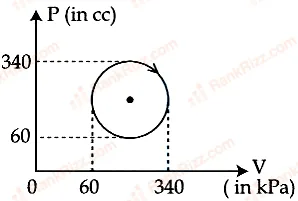
- (A)
- (B)
- (C)
- (D)
rr2.rankrizz.com/jee-main/physics/thermodynamics/q/5-apr-2024-s1-q11
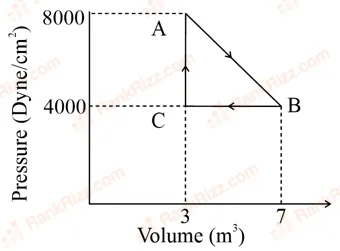
- (A)
A thermodynamic system is taken from an original state to an intermediate state by a linear process as shown in the figure. Its volume is then reduced to the original value from to by an isobaric process. The total work done by the gas from to and to would be :
- (A)
J
- (B)
J
- (C)
J
- (D)
J
rr2.rankrizz.com/jee-main/physics/thermodynamics/q/29-jan-2024-s1-q8
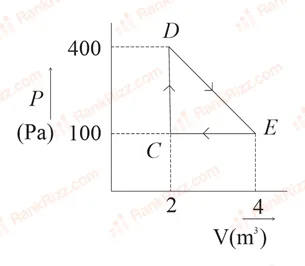
- (A)
A thermodynamic system is taken through cyclic process. The total work done in the process is :
- (A)
J
- (B)
J
- (C)
J
- (D)
Zero
rr2.rankrizz.com/jee-main/physics/thermodynamics/q/15-apr-2023-s1-q8
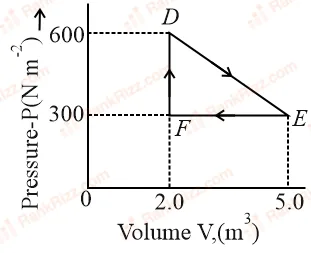
- (A)
A thermodynamic system is taken from an original state D to an intermediate state E by the linear process shown in the figure. Its volume is then reduced to the original volume from E to F by an isobaric process. The total work done by the gas from D to E to F will be
- (A)
-450 J
- (B)
450 J
- (C)
900 J
- (D)
1350 J
rr2.rankrizz.com/jee-main/physics/thermodynamics/q/29-jul-2022-s2-q8
- (A)
In the reported figure, there is a cyclic process on a sample of 1 mol of a diatomic gas. The temperature of the gas during the process and are and () respectively.
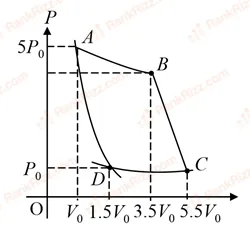
Choose the correct option out of the following for work done if processes and are adiabatic.- (A)
- (B)
- (C)
- (D)
rr2.rankrizz.com/jee-main/physics/thermodynamics/q/27-jul-2021-s1-q8
- (A)
In the reported figure, heat energy absorbed by a system in going through a cyclic process is ___ J.
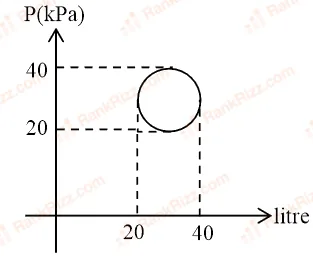
Answer: ____________
rr2.rankrizz.com/jee-main/physics/thermodynamics/q/20-jul-2021-s1-q25
mole of a perfect gas undergoes a cyclic process ABCA (see figure) consisting of the following processes.
: Isothermal expansion at temperature so that the volume is doubled from to and pressure changes from to
: Isobaric compression at pressure to initial volume .
: Isochoric change leading to change of pressure from to
Total work done in the complete cycle ABCA is: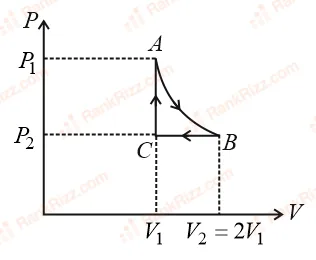
- (A)
- (B)
- (C)
- (D)
0
rr2.rankrizz.com/jee-main/physics/thermodynamics/q/24-feb-2021-s1-q10
- (A)
If one mole of an ideal gas at is allowed to expand reversibly and isothermally (A to B) its pressure is reduced to one-half of the original pressure (see figure). This is followed by a constant volume cooling till its pressure is reduced to one-fourth of the initial value . Then it is restored to its initial state by a reversible adiabatic compression (C to A). The net work done by the gas is equal to:
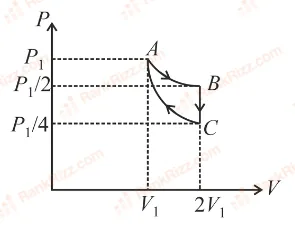
- (A)
0
- (B)
- (C)
- (D)
rr2.rankrizz.com/jee-main/physics/thermodynamics/q/24-feb-2021-s2-q5
- (A)
Three different processes that can occur in an ideal monoatomic gas are shown in the vs diagram. The paths are labelled as , and . The change in internal energies during these processes are taken as , and and the work done as , and . The correct relation between these parameters are:
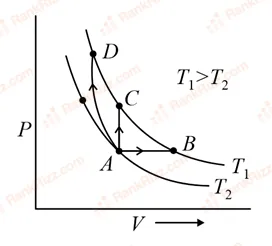
- (A)
, , ,
- (B)
, , ,
- (C)
, ,
- (D)
,
rr2.rankrizz.com/jee-main/physics/thermodynamics/q/5-sep-2020-s1-q7
- (A)
Which of the following is an equivalent cyclic process corresponding to the thermodynamic cyclic given in the figure? Where, is adiabatic. (Graphs are schematic and are not to scale)
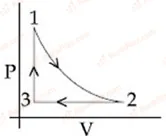
- (A)
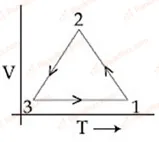
- (B)
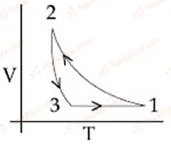
- (C)
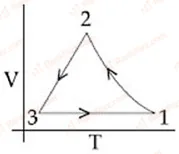
- (D)
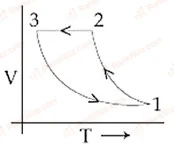
rr2.rankrizz.com/jee-main/physics/thermodynamics/q/9-jan-2020-s1-q7
- (A)
A thermodynamic cycle xyzx is shown on a V-T diagram.
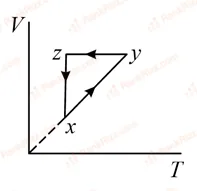
The P-V diagram that best describes this cycle is: (Diagrams are schematic and not to scale)- (A)
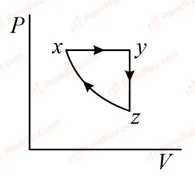
- (B)
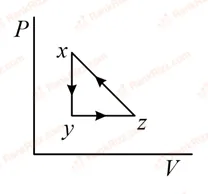
- (C)
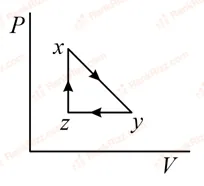
- (D)
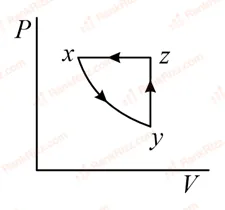
rr2.rankrizz.com/jee-main/physics/thermodynamics/q/8-jan-2020-s1-q8
- (A)
For the given cyclic process CAB as shown for a gas, the work done is:
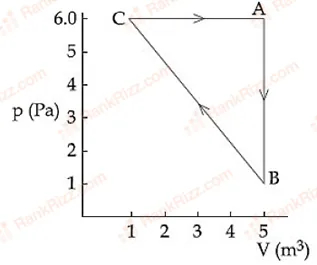
- (A)
10 J
- (B)
5 J
- (C)
1 J
- (D)
30 J
rr2.rankrizz.com/jee-main/physics/thermodynamics/q/12-jan-2019-s1-q9
- (A)
One mole of an ideal monatomic gas is taken along the path ABCA as shown in the PV diagram. The maximum temperature attained by the gas along the path BC is given by:
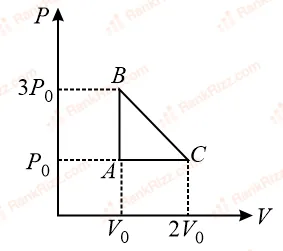
- (A)
- (B)
- (C)
- (D)
rr2.rankrizz.com/jee-main/physics/thermodynamics/q/16-apr-2018-online-q9
- (A)
For the diagram given for an ideal gas
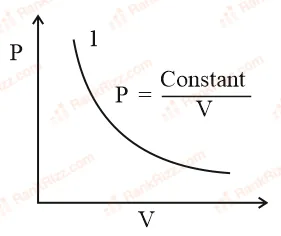
Out of the following which one correctly represents the diagram?
- (A)
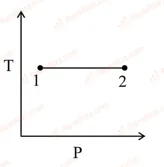
- (B)
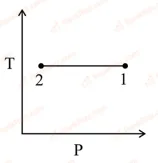
- (C)
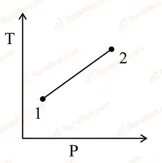
- (D)
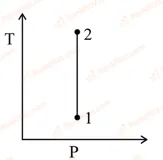
rr2.rankrizz.com/jee-main/physics/thermodynamics/q/9-apr-2017-online-q10
- (A)
moles of an ideal gas undergoes a process as shown in the figure. The maximum temperature of the gas during the process will be:
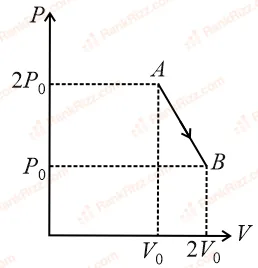
- (A)
- (B)
- (C)
- (D)
rr2.rankrizz.com/jee-main/physics/thermodynamics/q/3-apr-2016-offline-q8
- (A)
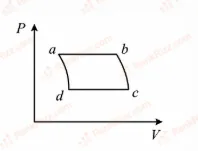
An ideal gas goes through a reversible cycle has the V - T diagram shown below. Process and are adiabatic.
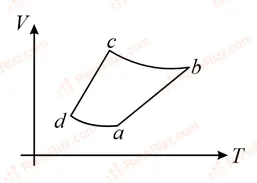
The corresponding P - V diagram for the process is (all figures are schematic and not drawn to scale):
- (A)
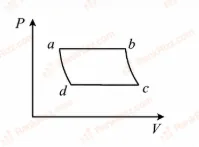
- (B)
- (C)
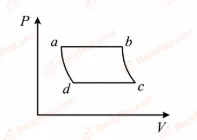
- (D)
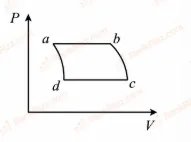
rr2.rankrizz.com/jee-main/physics/thermodynamics/q/10-apr-2015-online-q10
- (A)
A sample of gas expands from to . In which of the following, the work done will be greatest?
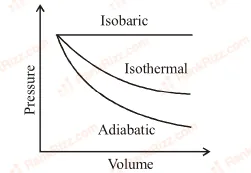
- (A)
Same in all processes
- (B)
Isobaric process
- (C)
Isothermal process
- (D)
Adiabatic process
rr2.rankrizz.com/jee-main/physics/thermodynamics/q/25-apr-2013-online-q8
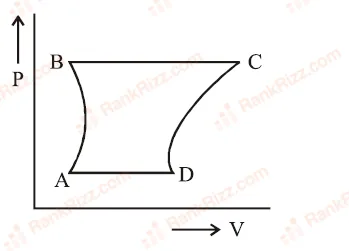
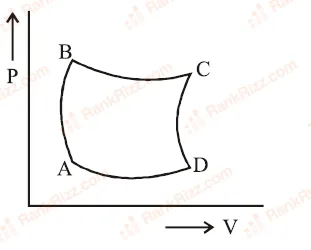
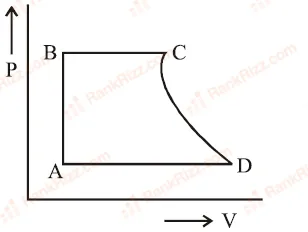
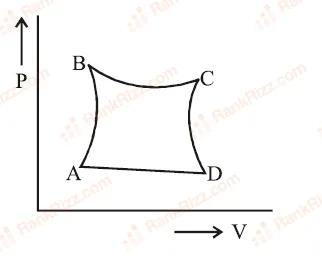
- (A)
A certain amount of gas is taken through a cyclic process (A B C D A) that has two isobars, one isochore and one isothermal. The cycle can be represented on a P - V indicator diagram as :
- (A)
- (B)
- (C)
- (D)
rr2.rankrizz.com/jee-main/physics/thermodynamics/q/22-apr-2013-online-q11
- (A)
The pressure of an ideal gas varies with volume as , where is a constant. One mole of the gas is allowed to undergo expansion such that its volume becomes times its initial volume. The work done by the gas in the process is
- (A)
- (B)
- (C)
- (D)
rr2.rankrizz.com/jee-main/physics/thermodynamics/q/2012-physics-499274
- (A)
moles of an ideal gas undergo a process as shown in the figure. Maximum temperature of the gas during the process is
- (A)
- (B)
- (C)
- (D)
rr2.rankrizz.com/jee-main/physics/thermodynamics/q/2012-physics-499390
- (A)
Directions: Questions 7 to 9 are based on the following figure showing a thermodynamic cycle ABCDA on a P-V diagram. (Figure not available; the cycle ABCDA involves gas state changes with given pressure-volume values from the original paper.) Assuming the gas to be ideal the work done on the gas in taking it from to is
- (A)
- (B)
- (C)
- (D)
rr2.rankrizz.com/jee-main/physics/thermodynamics/q/2009-physics-499565
- (A)
The work done on the gas in taking it from to is
- (A)
- (B)
- (C)
- (D)
rr2.rankrizz.com/jee-main/physics/thermodynamics/q/2009-physics-499566
- (A)
The net work done on the gas in the cycle ABCDA is
- (A)
Zero
- (B)
- (C)
- (D)
rr2.rankrizz.com/jee-main/physics/thermodynamics/q/2009-physics-499567
- (A)
Isobaric, isochoric and polytropic processes 23
An ideal gas at pressure and temperature is expanding such that . The coefficient of volume expansion of the gas is :
- (A)
- (B)
- (C)
- (D)
rr2.rankrizz.com/jee-main/physics/thermodynamics/q/5-apr-2026-s2-q34
- (A)
An ideal gas undergoes a process maintaining relation between pressure and volume as , where and are constants. If two samples A and B (two moles each) with initial volumes and respectively undergo above mentioned process and attain same pressure, then the difference of the temperatures of these samples, is :
(R = gas constant)
- (A)
- (B)
- (C)
- (D)
rr2.rankrizz.com/jee-main/physics/thermodynamics/q/4-apr-2026-s1-q36
- (A)
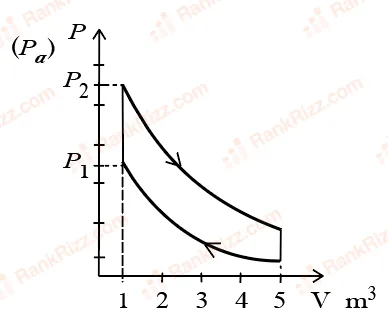
10 mole of an ideal gas is undergoing the process showu in the figure. The heat involved in the process from to is Joule(P_{1}= 21.7Pa and Pa, ) The value of is _________.
- (A)
28
- (B)
15
- (C)
24
- (D)
21
rr2.rankrizz.com/jee-main/physics/thermodynamics/q/24-jan-2026-s2-q33
- (A)
Match List-I with List-II.
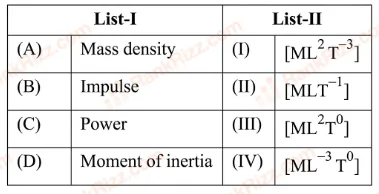
Choose the correct answer from the options given below :
- (A)
(A)-(IV), (B)-(II), (C)-(III), (D)-(I)
- (B)
(A)-(I), (B)-(III), (C)-(IV), (D)-(II)
- (C)
(A)-(IV), (B)-(II), (C)-(I), (D)-(III)
- (D)
(A)-(II), (B)-(III), (C)-(IV), (D)-(I)
rr2.rankrizz.com/jee-main/physics/thermodynamics/q/2025-apr-7-s2-q36
- (A)
Match List-I with List-II.
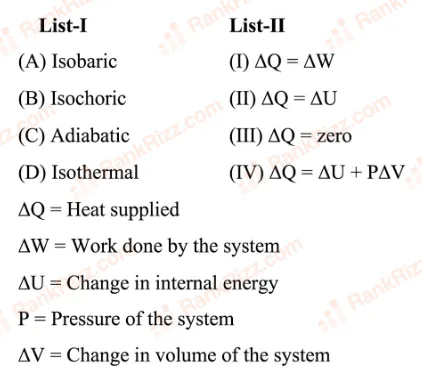
Choose the correct answer from the options given below :
- (A)
(A)-(IV), (B)-(III), (C)-(II), (D)-(I)
- (B)
(A)-(IV), (B)-(I), (C)-(III), (D)-(II)
- (C)
(A)-(IV), (B)-(II), (C)-(III), (D)-(I)
- (D)
(A)-(II), (B)-(IV), (C)-(III), (D)-(I)
rr2.rankrizz.com/jee-main/physics/thermodynamics/q/2025-apr-4-s2-q42
- (A)
An ideal gas goes from an initial state to final state. During the process, the pressure of gas increases linearly with temperature.
A. The work done by gas during the process is zero.
B. The heat added to gas is different from change in its internal energy.
C. The volume of the gas is increased.
D. The internal energy of the gas is increased.
E. The process is isochoric (constant volume process) Choose the correct answer from the options given below:
- (A)
E Only
- (B)
A, B, C, D Only
- (C)
A, D, E Only
- (D)
A, C Only
rr2.rankrizz.com/jee-main/physics/thermodynamics/q/24-jan-2025-s1-q31
- (A)
The pressure and volume of an ideal gas are related as (Constant). The work done when the gas is taken from state to state is :
- (A)
- (B)
- (C)
- (D)
rr2.rankrizz.com/jee-main/physics/thermodynamics/q/01-feb-2024-s1-q9
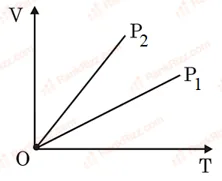
- (A)
The given figure represents two isobaric processes for the same mass of an ideal gas, then
- (A)
- (B)
- (C)
- (D)
rr2.rankrizz.com/jee-main/physics/thermodynamics/q/31-jan-2024-s1-q10
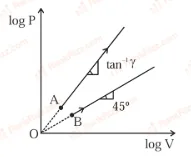
- (A)
Two thermodynamical processes are shown in the figure. The molar heat capacity for process and are and . The molar heat capacity at constant pressure and constant volume are represented by and , respectively. Choose the correct statement.
- (A)
- (B)
and
- (C)
- (D)
rr2.rankrizz.com/jee-main/physics/thermodynamics/q/30-jan-2024-s1-q9
- (A)
Match List I with List II:
A. Isothermal Process I. Work done by the gas decreases internal energy
B. Adiabatic Process II. No change in internal energy
C. Isochoric Process III. The heat absorbed goes partly to increase internal energy and partly to do work
D. Isobaric Process IV. No work is done on or by the gas
Choose the correct answer from the options below:- (A)
A-II, B-I, C-III, D-IV
- (B)
A-II, B-I, C-IV, D-III
- (C)
A-I, B-II, C-IV, D-III
- (D)
A-I, B-II, C-III, D-IV
rr2.rankrizz.com/jee-main/physics/thermodynamics/q/25-jan-2023-s2-q9
- (A)
mole of certain monoatomic ideal gas undergoes a temperature increase of at constant pressure. The increase in the internal energy of the gas in this process is (Given )
- (A)
- (B)
- (C)
- (D)
rr2.rankrizz.com/jee-main/physics/thermodynamics/q/26-jul-2022-s1-q7
- (A)
A monoatomic gas performs a work of where is the heat supplied to it. The molar heat capacity of the gas will be ______ .
Where is the gas constant.Answer: ____________
rr2.rankrizz.com/jee-main/physics/thermodynamics/q/24-jun-2022-s2-q23
The temperature of 3.00 mol of an ideal diatomic gas is increased by 40.0°C without changing the pressure of the gas. The molecules in the gas rotate but do not oscillate. If the ratio of change in internal energy of the gas to the amount of workdone by the gas is . Then the value of (round off to the nearest integer) is _________.
(Given R = 8.31 J )Answer: ____________
rr2.rankrizz.com/jee-main/physics/thermodynamics/q/1-sep-2021-s2-q28
For an ideal gas the instantaneous change in pressure with volume is given by the equation . If at is the given boundary condition, then the maximum temperature one mole of gas can attain is: (Here is the gas constant)
- (A)
- (B)
infinity
- (C)
0°C
- (D)
rr2.rankrizz.com/jee-main/physics/thermodynamics/q/31-aug-2021-s1-q9
- (A)
The volume of a given mass of monoatomic gas changes with temperature according to the relation . The workdone when temperature changes by 90 K will be . The value of is [R universal gas constant]
Answer: ____________
rr2.rankrizz.com/jee-main/physics/thermodynamics/q/26-feb-2021-s2-q23
In a certain thermodynamical process, the pressure of a gas depends on its volume as . The work done when the temperature changes from 100°C to 300°C will be where denotes number of moles of a gas, find .
Answer: ____________
rr2.rankrizz.com/jee-main/physics/thermodynamics/q/25-feb-2021-s1-q23
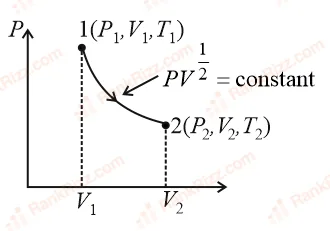
Thermodynamic process is shown below on a diagram for one mole of an ideal gas. If , then the ratio of temperature is:
- (A)
- (B)
- (C)
- (D)
2
rr2.rankrizz.com/jee-main/physics/thermodynamics/q/25-feb-2021-s2-q4
- (A)
Match List I with List II.
List I List II (a) Isothermal (i) Pressure constant (b) Isochoric (ii) Temperature constant (c) Adiabatic (iii) Volume constant (d) Isobaric (iv) Heat content is constant
Choose the correct answer from the options given below:- (A)
(a)(ii), (b)(iii), (c)(iv), (d)(i)
- (B)
(a)(iii), (b)(ii), (c)(i), (d)(iv)
- (C)
(a)(i), (b)(iii), (c)(ii), (d)(iv)
- (D)
(a)(ii), (b)(iv), (c)(iii), (d)(i)
rr2.rankrizz.com/jee-main/physics/thermodynamics/q/24-feb-2021-s1-q9
- (A)
One mole of an ideal gas passes through a process where pressure and volume obey the relation P = P[1 - ]. Here P and V are constants. Calculate the change in the temperature of the gas if its volume changes from V to 2V.
- (A)
- (B)
- (C)
- (D)
rr2.rankrizz.com/jee-main/physics/thermodynamics/q/10-apr-2019-s2-q14
- (A)
In a process, temperature and volume of one mole of an ideal monoatomic gas are varied according to the relation VT = K, where K is a constant. In this process the temperature of the gas is increased by . The amount of heat absorbed by gas is (R is gas constant):
- (A)
- (B)
- (C)
- (D)
rr2.rankrizz.com/jee-main/physics/thermodynamics/q/11-jan-2019-s2-q10
- (A)
Half mole of an ideal monoatomic gas is heated at a constant pressure of 1 atm from 20C to 90C. Work done by the gas is
- (A)
73 J
- (B)
581 J
- (C)
291 J
- (D)
146 J
rr2.rankrizz.com/jee-main/physics/thermodynamics/q/10-jan-2019-s2-q9
- (A)
An ideal gas undergoes a quasi-static, reversible process in which its molar heat capacity C remains constant. If during this process the relation of pressure P and volume V is given by = constant, then n is given by (Here and are molar specific heat at constant pressure and constant volume, respectively):
- (A)
- (B)
- (C)
- (D)
rr2.rankrizz.com/jee-main/physics/thermodynamics/q/3-apr-2016-offline-q9
- (A)
The equation of state for a gas is given by , where n is the number of moles and is a positive constant. The initial temperature and pressure of one mole of the gas contained in a cylinder are T and P respectively. The work done by the gas when its temperature doubles isobarically will be:
- (A)
- (B)
- (C)
- (D)
rr2.rankrizz.com/jee-main/physics/thermodynamics/q/9-apr-2014-online-q10
- (A)
Second law, heat engines, refrigerators and reversibility 12
Water of mass m gram is slowly heated to increase the temperature from to The change in entropy of the water, given specific heat of water is , is :
- (A)
- (B)
zero
- (C)
- (D)
rr2.rankrizz.com/jee-main/physics/thermodynamics/q/23-jan-2025-s2-q31
- (A)
An ideal gas in a cylinder is separated by a piston in such a way that the entropy of one part is and that of the other part is . Given that . If the piston is removed then the total entropy of the system will be:
- (A)
- (B)
- (C)
- (D)
rr2.rankrizz.com/jee-main/physics/thermodynamics/q/18-mar-2021-s2-q9
- (A)
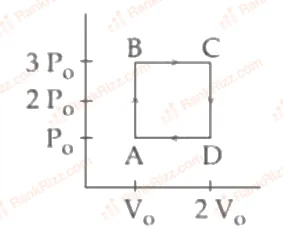
An engine operates by taking a monatomic ideal gas through the cycle shown in the figure. The percentage efficiency of the engine is close to___
Answer: ____________
rr2.rankrizz.com/jee-main/physics/thermodynamics/q/6-sep-2020-s2-q22
A heat engine is involved with exchange of heat of 1915 J, J, J and J, during one cycle achieving and efficiency of 50.0%. The value of Q is:
- (A)
640 J
- (B)
40 J
- (C)
980 J
- (D)
400 J
rr2.rankrizz.com/jee-main/physics/thermodynamics/q/2-sep-2020-s2-q6
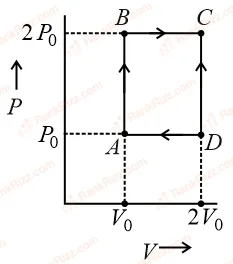
- (A)
An engine operates by taking moles of an ideal gas through the cycle shown in figure. The thermal efficiency of the engine is: (Take , where is gas constant)
- (A)
0.24
- (B)
0.15
- (C)
0.32
- (D)
0.08
rr2.rankrizz.com/jee-main/physics/thermodynamics/q/8-apr-2017-online-q10
- (A)
A solid body of constant heat capacity 1 J (C) is being heated by keeping it in contact with reservoirs in two ways: (i) Sequentially keeping in contact with 2 reservoirs such that each reservoir supplies the same amount of heat. (ii) Sequentially keeping in contact with 8 reservoirs such that each reservoir supplies the same amount of heat. In both cases the body is brought from initial temperature 100 K to final temperature 200 K. Entropy change of the body in the two cases respectively is: Note: This question was awarded as a bonus since temperatures were given in centigrade instead of in Kelvin. Proper corrections are made in the question to avoid it.
- (A)
- (B)
- (C)
- (D)
rr2.rankrizz.com/jee-main/physics/thermodynamics/q/4-apr-2015-offline-q11
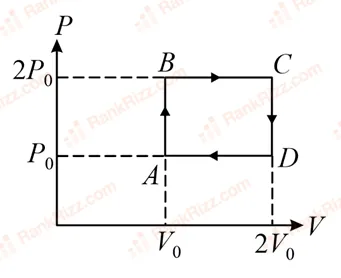
- (A)
The below P-V diagram represents the thermodynamic cycle of an engine, operating with an ideal mono-atomic gas. The amount of heat, extracted from the source in a single cycle, is:
- (A)
- (B)
- (C)
- (D)
rr2.rankrizz.com/jee-main/physics/thermodynamics/q/7-apr-2013-offline-q9
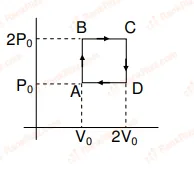
- (A)
Helium gas goes through a cycle (consisting of two isochoric and two isobaric lines) as shown in figure. Efficiency of this cycle is nearly: (Assume the gas to be close to ideal gas)
- (A)
- (B)
- (C)
- (D)
rr2.rankrizz.com/jee-main/physics/thermodynamics/q/2012-physics-499028
- (A)
The door of a working refrigerator is left open in a well insulated room. The temperature of air in the room will
- (A)
decrease
- (B)
increase in winters and decrease in summers
- (C)
remain the same
- (D)
increase
rr2.rankrizz.com/jee-main/physics/thermodynamics/q/2012-physics-499171
- (A)
A diatomic ideal gas is used in a Car engine as the working substance. If during the adiabatic expansion part of the cycle, volume of the gas increases from to the efficiency of the engine is
- (A)
0.5
- (B)
0.75
- (C)
0.99
- (D)
0.25
rr2.rankrizz.com/jee-main/physics/thermodynamics/q/2010-physics-499629
- (A)
A Carnot engine, having an efficiency of as heat engine, is used as a refrigerator. If the work done on the system is 10 J, the amount of energy absorbed from the reservoir at lower temperature is
- (A)
99 J
- (B)
90 J
- (C)
1 J
- (D)
100 J
rr2.rankrizz.com/jee-main/physics/thermodynamics/q/2007-physics-499751
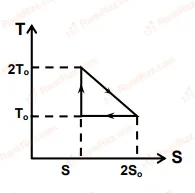
- (A)
The temperature-entropy diagram of a reversible engine cycle is given in the figure. Its efficiency is
- (A)
- (B)
- (C)
- (D)
rr2.rankrizz.com/jee-main/physics/thermodynamics/q/2005-physics-500158
- (A)
Answer key
- 01 C
- 02 B
- 03 120
- 04 D
- 05 B
- 06 C
- 07 D
- 08 C
- 09 C
- 10 A
- 11 A
- 12 B
- 13 B
- 14 273
- 15 C
- 16 C
- 17 B
- 18 C
- 19 C
- 20 A
- 21 B
- 22 A
- 23 B
- 24 B
- 25 D
- 26 A
- 27 D
- 28 A
- 29 4
- 30 C
- 31 B
- 32 A
- 33 A
- 34 480
- 35 B
- 36 B
- 37 17258
- 38 A
- 39 B
- 40 C
- 41 B
- 42 46
- 43 —
- 44 B
- 45 B
- 46 B
- 47 D
- 48 D
- 49 C
- 50 B
- 51 B
- 52 D
- 53 C
- 54 B
- 55 D
- 56 C
- 57 A
- 58 D
- 59 D
- 60 B
- 61 C
- 62 A
- 63 B
- 64 102
- 65 16
- 66 A
- 67 540
- 68 B
- 69 D
- 70 C
- 71 500
- 72 C
- 73 D
- 74 D
- 75 D
- 76 -113
- 77 208
- 78 8791
- 79 D
- 80 600
- 81 B
- 82 C
- 83 C
- 84 A
- 85 A
- 86 D
- 87 D
- 88 B
- 89 C
- 90 D
- 91 D
- 92 B
- 93 C
- 94 C
- 95 D
- 96 D
- 97 C
- 98 D
- 99 D
- 100 B
- 101 C
- 102 —
- 103 B
- 104 D
- 105 C
- 106 A
- 107 A
- 108 B
- 109 B
- 110 A
- 111 25
- 112 3600
- 113 D
- 114 A
- 115 C
- 116 C
- 117 B
- 118 D
- 119 C
- 120 —
- 121 C
- 122 A
- 123 D
- 124 A
- 125 B
- 126 B
- 127 300
- 128 314
- 129 A
- 130 A
- 131 C
- 132 B
- 133 B
- 134 D
- 135 B
- 136 B
- 137 B
- 138 100
- 139 A
- 140 D
- 141 B
- 142 C
- 143 A
- 144 A
- 145 C
- 146 B
- 147 C
- 148 A
- 149 B
- 150 C
- 151 D
- 152 D
- 153 C
- 154 A
- 155 B
- 156 C
- 157 B
- 158 D
- 159 C
- 160 C
- 161 C
- 162 A
- 163 D
- 164 A
- 165 B
- 166 B
- 167 2
- 168 25
- 169 D
- 170 60
- 171 50
- 172 A
- 173 A
- 174 B
- 175 A
- 176 C
- 177 D
- 178 C
- 179 A
- 180 D
- 181 19
- 182 C
- 183 B
- 184 C
- 185 D
- 186 A
- 187 D
- 188 B
- 189 B
- 190 C
“—” marks a question whose key we have not checked yet; its page shows the latest on it.
Past questions are reproduced with their sitting. Not affiliated with NTA or the IITs. Every question, online and free: rr2.rankrizz.com/jee-main/physics/thermodynamics