JEE Main 2016 Physics question — Work done in thermodynamic processes and P-V diagrams
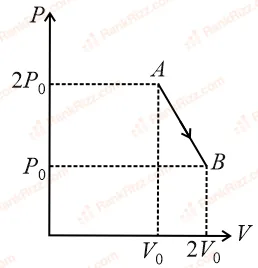
moles of an ideal gas undergoes a process as shown in the figure. The maximum temperature of the gas during the process will be:
SOLUTION
The coordinates of the two marked points on the diagram can be read directly from the figure.
At point , the pressure is twice the reference value while the volume equals the reference value, so
At point , the pressure is the reference value while the volume is twice the reference value, so
During the process the line joining the two points is a straight line on the plane. Hence the relation between pressure and volume is linear and can be written in the form where is the slope and is the intercept.
We first evaluate the slope. Using the two end-points,
Next we find the intercept by substituting the co-ordinates of point :
So the complete equation of the path is
For an ideal gas, the temperature at any stage is given by the ideal-gas law
Substituting the expression for obtained above, the temperature as a function of volume becomes
To locate the maximum temperature, we differentiate this expression with respect to volume and set the derivative to zero:
At the extremum, so
This intermediate volume is indeed between and confirming that we have an internal maximum.
We now calculate the corresponding pressure. Substituting into the line equation,
Finally, substituting these and values back into the ideal-gas relation gives the maximum temperature:
Hence, the correct answer is Option C.
Topic: Work done in thermodynamic processes and P-V diagrams