JEE MAIN 2026 · 08 APR S2Isothermal and adiabatic processes
Initial pressure and volume of a monoatomic ideal gas are and . The change in internal energy of this gas in adiabatic expansion to volume is __________ J.
- A
- B
- C
- D
Isothermal and adiabatic processes has been asked 54 times in JEE Main, in 14 different years between 2006 and 2026, and in all of the last five exam years (2022–2026), 33 questions in all. That is 28% of Thermodynamics, its most-asked topic. Last asked in JEE Main 08 Apr 2026, Shift 2. 47 are multiple choice and 7 numerical-value; 16 easy and 34 medium by our difficulty labels. All of them are below, newest first, free to read.
Questions
54
Years asked
14
Since
2006
Of the chapter
28%
Questions on Isothermal and adiabatic processes in every year it was asked, newest first.
| Year | Relative frequency | Questions |
|---|---|---|
| 2026 | 5 | |
| 2025 | 9 | |
| 2024 | 7 | |
| 2023 | 7 | |
| 2022 | 5 | |
| 2021 | 6 | |
| 2020 | 5 | |
| 2019 | 2 | |
| 2018 | 1 | |
| 2015 | 1 | |
| 2014 | 1 | |
| 2013 | 1 | |
| 2012 | 3 | |
| 2006 | 1 | |
| Total | 54 |
1–20 OF 54 · NEWEST FIRST
Initial pressure and volume of a monoatomic ideal gas are and . The change in internal energy of this gas in adiabatic expansion to volume is __________ J.
A cylinder with adiabatic walls is closed at both ends and is divided into two compartments by a frictionless adiabatic piston. Ideal gas is filled in both (left and right) the compartments at same P, V, T. Heating is started from left side until pressure changes to . If initial volume of each compartment was 9 litres then the final volume in right-hand side compartment is __________ litres. (for this ideal gas )
3
4
14
9
A vessel contains 0.15 m of a gas at pressure 8 bar and temperature 140 °C with and . It is expanded adiabatically till pressure falls to 1 bar. The work done during this process is __________ kJ. (R is gas constant)
One mole of an ideal diatomic gas expands from volume to isothermally at a temperature and does W joule of work. lf the gas undergoes same magnitude of expansion adiabatically from doing the same amount of work , then its final temperature will be (close to) ____
-189
-117
-30
-56
The volume of an ideal gas increases 8 times and temperature becomes of initial temperature during a reversible change. If there is no exchange of heat in this process then identify the gas from the following options (Assuming the gases given in the options are ideal gases):
$$He
A monoatomic gas having is stored in a thermally insulated container and the gas is suddenly compressed to of its initial volume. The ratio of final pressure and initial pressure is :
( is the ratio of specific heats of the gas at constant pressure and at constant volume)
16
40
32
28
A gas is kept in a container having walls which are thermally non-conducting. Initially the gas has a volume of 800 cm and temperature 27°C. The change in temperature when the gas is adiabatically compressed to 200 cm is :
(Take : is the ratio of specific heats at constant pressure and at constant volume)
K
K
K
K
In an adiabatic process, which of the following statements is true?
The molar heat capacity is infinite
Work done by the gas equals the increase in internal energy
The molar heat capacity is zero
The internal energy of the gas decreases as the temperature increases
Identify the characteristics of an adiabatic process in a monoatomic gas.
(A) Internal energy is constant.
(B) Work done in the process is equal to the change in internal energy.
(C) The product of temperature and volume is a constant.
(D) The product of pressure and volume is a constant.
(E) The work done to change the temperature from to is proportional to
Choose the correct answer from the options given below :
(A), (C), (D) only
(A), (C), (E) only
(B), (E) only
(B), (D) only
The workdone in an adiabatic change in an ideal gas depends upon only :
change in its temperature
change in its volume
change in its pressure
change in its specific heat
Given below are two statements. One is labelled as Assertion (A) and the other is labelled as Reason (R).
Assertion (A) : With the increase in the pressure of an ideal gas, the volume falls off more rapidly in an isothermal process in comparison to the adiabatic process.
Reason (R) : In isothermal process, PV = constant, while in adiabatic process = constant. Here is the ratio of specific heats, P is the pressure and V is the volume of the ideal gas. In the light of the above statements, choose the correct answer from the options given below :
Both (A) and (R) are true and (R) is the correct explanation of (A)
Both (A) and (R) are true but (R) is NOT the correct explanation of (A)
(A) is true but (R) is false
(A) is false but (R) is true
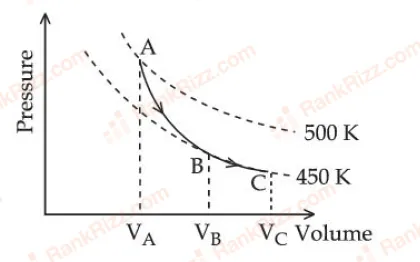
A poly-atomic molecule (, where R is gas constant) goes from phase space point to point to point A to B is an adiabatic path B and C to is an isothermal path. The net heat absorbed per unit mole by the system is :
500R(ln 3 + ln 4)
450R(ln 4 − ln 3)
500R ln 2
400R ln 4
Given below are two statements. One is labelled as Assertion (A) and the other is labelled as Reason (R). Assertion (A) : In an insulated container, a gas is adiabatically shrunk to half of its initial volume. The temperature of the gas decreases. Reason (R): Free expansion of an ideal gas is an irreversible and an adiabatic process. In the light of the above statements, choose the correct answer from the options given below :
Both (A) and (R) are true but (R) is NOT the correct explanation of (A)
(A) is false but (R) is true
(A) is true but (R) is false
Both (A) and (R) are true and (R) is the correct explanation of (A)
An ideal gas initially at C temperature, is compressed suddenly to one fourth of its volume. If the ratio of specific heat at constant pressure to that at constant volume is 3/2, the change in temperature due to the thermodynamic process is _____ K.
A sample of 1 mole gas at temperature T is adiabatically expanded to double its volume. If adiabatic constant for the gas is , then the work done by the gas in the process is:
The volume of an ideal gas is changed adiabatically from 5 litres to 4 litres. The ratio of initial pressure to final pressure is:
Two different adiabatic paths for the same gas intersect two isothermal curves as shown in P-V diagram. The relation between the ratio and the ratio is:
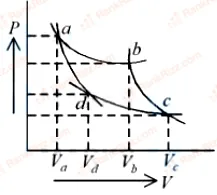
During an adiabatic process, if the pressure of a gas is found to be proportional to the cube of its absolute temperature, then the ratio of for the gas is :
A sample of gas at temperature is adiabatically expanded to double its volume. Adiabatic constant for the gas is . The work done by the gas in the process is: ( mole)
Choose the correct statement for processes & shown in figure.
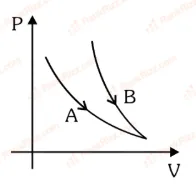
for process and for process
for process and
for process and for process
for process and for process