RankRizz

Thermodynamics — JEE Main Previous Year Questions

Every Thermodynamics question JEE Main has set from 2004–2026, grouped by the idea it tests rather than the order of the syllabus. 190 questions across 6 distinct ideas. Free to read, answer key on every one.

DATA UPDATED

Questions

190

Distinct ideas

6

Share of marks

3%

Difficulty

MEDIUM

The ideas inside Thermodynamics

A chapter is not one subject — it is a handful of procedures the examiner reuses. These are the ones Thermodynamics questions actually test.

Every Thermodynamics question

121–140 OF 190 · NEWEST FIRST

JEE MAIN 2020 · 05 SEP S2Isothermal and adiabatic processes

In an adiabatic process, the density of a diatomic gas becomes 32n32n times its initial value. The final pressure of the gas is found to be nn times the initial pressure. The value of nn is:

  1. A

    32

  2. B

    326

  3. C

    128

  4. D

    132\frac{1}{32}

JEE MAIN 2020 · 04 SEP S2Zeroth and first law of thermodynamics

Match the thermodynamics processes taking place in a system with the correct conditions. In the table: ΔQ\Delta Q is the heat supplied, ΔW\Delta W is the work done and ΔU\Delta U is change in internal energy of the system.
Process    Condition
(I) Adiabatic    (A) ΔW=0\Delta W = 0
(II) Isothermal    (B) ΔQ=0\Delta Q = 0
(III) Isochoric    (C) ΔU≠0,ΔW≠0,ΔQ≠0\Delta U \neq 0, \Delta W \neq 0, \Delta Q \neq 0
(IV) Isobaric    (D) ΔU=0\Delta U = 0

  1. A

    (I)-(A), (II)-(B), (III)-(D), (IV)-(D)

  2. B

    (I)-(B), (II)-(A), (III)-(D), (IV)-(C)

  3. C

    (I)-(A), (II)-(A), (III)-(B), (IV)-(C)

  4. D

    (I)-(B), (II)-(D), (III)-(A), (IV)-(C)

JEE MAIN 2020 · 03 SEP S1Isothermal and adiabatic processes

A balloon filled with helium (32°C and 1.7 atm) bursts. Immediately afterwards the expansion of helium can be considered as:

  1. A

    irreversible isothermal

  2. B

    irreversible adiabatic

  3. C

    reversible adiabatic

  4. D

    reversible isothermal

JEE MAIN 2020 · 03 SEP S2Carnot engine and Carnot cycle

If minimum possible work is done by a refrigerator in converting 100 grams of water at 0°C to ice, how much heat (in calories) is released to the surroundings at temperature 27°C (Latent heat of ice = 80 Cal/gram) to the nearest integer?

JEE MAIN 2020 · 02 SEP S1Isothermal and adiabatic processes

An engine takes in 5 moles of air at 20 °°C and 1 atm, and compresses it adiabatically to 1/10th1/10^{th} of the original volume. Assuming air to be a diatomic ideal gas made up of rigid molecules, the change in its internal energy during this process comes out to be X kJ. The value of X to the nearest integer is:

JEE MAIN 2020 · 02 SEP S2Second law, heat engines, refrigerators and reversibility

A heat engine is involved with exchange of heat of 1915 J, −40-40 J, +125+125 J and −Q-Q J, during one cycle achieving and efficiency of 50.0%. The value of Q is:

  1. A

    640 J

  2. B

    40 J

  3. C

    980 J

  4. D

    400 J

JEE MAIN 2020 · 09 JAN S1Work done in thermodynamic processes and P-V diagrams

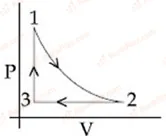
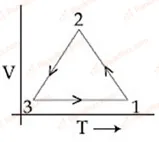
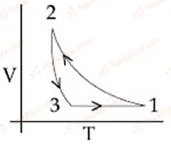
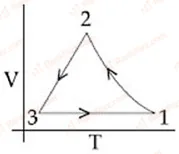
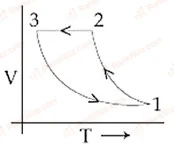
Which of the following is an equivalent cyclic process corresponding to the thermodynamic cyclic given in the figure? Where, 1→21 \to 2 is adiabatic. (Graphs are schematic and are not to scale)

Figure for JEE Main 2020 Physics question on Work done in thermodynamic processes and P-V diagrams
  1. A
    Figure for JEE Main 2020 Physics question on Work done in thermodynamic processes and P-V diagrams
  2. B
    Figure for JEE Main 2020 Physics question on Work done in thermodynamic processes and P-V diagrams
  3. C
    Figure for JEE Main 2020 Physics question on Work done in thermodynamic processes and P-V diagrams
  4. D
    Figure for JEE Main 2020 Physics question on Work done in thermodynamic processes and P-V diagrams
JEE MAIN 2020 · 09 JAN S2Isothermal and adiabatic processes

Starting at temperature 300K300K, one mole of an ideal diatomic gas (γ=1.4)(\gamma = 1.4) is first compressed adiabatically from volume V1V_1 to V2=V116V_2 = \frac{V_1}{16}. It is then allowed to expand isobarically to volume 2V22V_2. If all the processes are the quasi-static then the final temperature of the gas (in °K°K) is (to the nearest integer) ___________.

JEE MAIN 2020 · 08 JAN S1Work done in thermodynamic processes and P-V diagrams

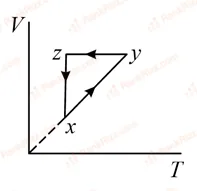
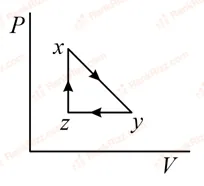
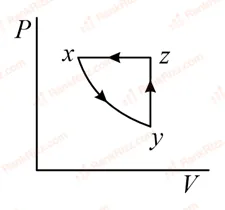
A thermodynamic cycle xyzx is shown on a V-T diagram.

Figure for JEE Main 2020 Physics question on Work done in thermodynamic processes and P-V diagrams


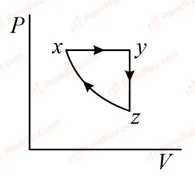
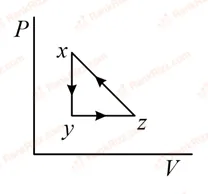
The P-V diagram that best describes this cycle is: (Diagrams are schematic and not to scale)

  1. A
    Figure for JEE Main 2020 Physics question on Work done in thermodynamic processes and P-V diagrams
  2. B
    Figure for JEE Main 2020 Physics question on Work done in thermodynamic processes and P-V diagrams
  3. C
    Figure for JEE Main 2020 Physics question on Work done in thermodynamic processes and P-V diagrams
  4. D
    Figure for JEE Main 2020 Physics question on Work done in thermodynamic processes and P-V diagrams
JEE MAIN 2020 · 08 JAN S2Carnot engine and Carnot cycle

A Carnot engine having an efficiency of 110\frac{1}{10} is being used as a refrigerator. If the work done on the refrigerator is 10 J, the amount of heat absorbed from the reservoir at a lower temperature is

  1. A

    99 J

  2. B

    100 J

  3. C

    1 J

  4. D

    90 J

JEE MAIN 2020 · 07 JAN S1Isothermal and adiabatic processes

A litre of dry air at STP expands adiabatically to a volume of 3 litres. If γ=1.40\gamma = 1.40, the work done by air is: (31.4=4.65553^{1.4} = 4.6555) [Take air to be an ideal gas]

  1. A

    60.7 J

  2. B

    90.5 J

  3. C

    100.8 J

  4. D

    48 J

JEE MAIN 2020 · 07 JAN S1Carnot engine and Carnot cycle

A Carnot engine operates between two reservoirs of temperatures 900K and 300K. The engine performs 1200J of work per cycle. The heat energy (in J) delivered by the engine to the low temperature reservoir, in a cycle, is

JEE MAIN 2020 · 07 JAN S2Carnot engine and Carnot cycle

Two ideal Carnot engines operate in cascade (all heat given up by one engine is used by the other engine to produce work) between temperatures, T1_1 and T2_2. The temperature of the hot reservoir of the first engine is T1_1 and the temperature of the cold reservoir of the second engine is T2_2. T is temperature of the sink of first engine which is also the source for the second engine. How is T related to T1_1 and T2_2, if both the engines perform equal amount of work?

  1. A

    T=2T1T2T1+T2T = \frac{2T_1 T_2}{T_1 + T_2}

  2. B

    T=T1+T22T = \frac{T_1 + T_2}{2}

  3. C

    T=T1T2T = \sqrt{T_1 T_2}

  4. D

    T=0T = 0

JEE MAIN 2019 · 12 APR S1Zeroth and first law of thermodynamics

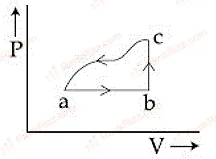
A sample of an ideal gas is taken through the cyclic process abca as shown in the figure. The change in the internal energy of the gas along the path ca is -180 J. The gas absorbs 250 J of heat along the path ab and 60 J along the path bc. The work done by the gas along the path abc is:

Figure for JEE Main 2019 Physics question on Zeroth and first law of thermodynamics
  1. A

    130 J

  2. B

    100 J

  3. C

    120 J

  4. D

    140 J

JEE MAIN 2019 · 12 APR S2Carnot engine and Carnot cycle

A Carnot engine has an efficiency of 16\frac{1}{6}. When the temperature of the sink is reduced by 62°C, its efficiency is doubled. The temperatures of the source and the sink are, respectively,

  1. A

    124 °C, 62 °C

  2. B

    37 °C, 99 °C

  3. C

    99 °C, 37 °C

  4. D

    62 °C, 124 °C

JEE MAIN 2019 · 10 APR S2Isobaric, isochoric and polytropic processes

One mole of an ideal gas passes through a process where pressure and volume obey the relation P = P0_0[1 - 12(V0V)2\frac{1}{2}\left(\frac{V_0}{V}\right)^2]. Here P0_0 and V0_0 are constants. Calculate the change in the temperature of the gas if its volume changes from V0_0 to 2V0_0.

  1. A

    12P0V0R\frac{1}{2}\frac{P_0 V_0}{R}

  2. B

    54P0V0R\frac{5}{4}\frac{P_0 V_0}{R}

  3. C

    14P0V0R\frac{1}{4}\frac{P_0 V_0}{R}

  4. D

    34P0V0R\frac{3}{4}\frac{P_0 V_0}{R}

JEE MAIN 2019 · 09 APR S1Zeroth and first law of thermodynamics

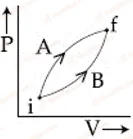
Following figure shows two processes A and B for a gas. If ΔQA\Delta Q_A and ΔQB\Delta Q_B are the amount of heat absorbed by the system in two cases, and ΔUA\Delta U_A and ΔUB\Delta U_B are changes in internal energies, respectively, then:

Figure for JEE Main 2019 Physics question on Zeroth and first law of thermodynamics
  1. A

    ΔQA<ΔQB;  ΔUA<ΔUB\Delta Q_A < \Delta Q_B; \; \Delta U_A < \Delta U_B

  2. B

    ΔQA=ΔQB;  ΔUA=ΔUB\Delta Q_A = \Delta Q_B; \; \Delta U_A = \Delta U_B

  3. C

    ΔQA>ΔQB;  ΔUA=ΔUB\Delta Q_A > \Delta Q_B; \; \Delta U_A = \Delta U_B

  4. D

    ΔQA>ΔQB;  ΔUA>ΔUB\Delta Q_A > \Delta Q_B; \; \Delta U_A > \Delta U_B

JEE MAIN 2019 · 08 APR S2Isothermal and adiabatic processes

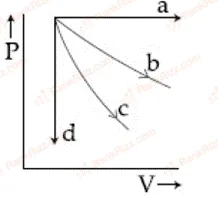
The given diagram shows four processes i.e., isochoric, isobaric, isothermal and adiabatic. The correct assignment of the processes, in the same order is given by:

Figure for JEE Main 2019 Physics question on Isothermal and adiabatic processes
  1. A

    a d b c

  2. B

    d a b c

  3. C

    a d c b

  4. D

    d a c b

JEE MAIN 2019 · 12 JAN S1Work done in thermodynamic processes and P-V diagrams

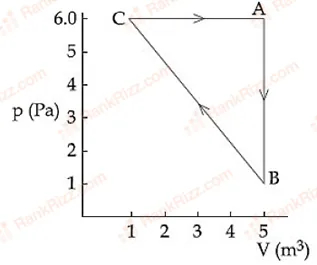
For the given cyclic process CAB as shown for a gas, the work done is:

Figure for JEE Main 2019 Physics question on Work done in thermodynamic processes and P-V diagrams
  1. A

    10 J

  2. B

    5 J

  3. C

    1 J

  4. D

    30 J

JEE MAIN 2019 · 11 JAN S1Isothermal and adiabatic processes

A rigid diatomic ideal gas undergoes an adiabatic process at room temperature. The relation between temperature and volume for this process is TVxTV^x = constant, then x is:

  1. A

    35\frac{3}{5}

  2. B

    25\frac{2}{5}

  3. C

    23\frac{2}{3}

  4. D

    53\frac{5}{3}