RankRizz

Thermodynamics — JEE Main Previous Year Questions

Every Thermodynamics question JEE Main has set from 2004–2026, grouped by the idea it tests rather than the order of the syllabus. 190 questions across 6 distinct ideas. Free to read, answer key on every one.

DATA UPDATED

Questions

190

Distinct ideas

6

Share of marks

3%

Difficulty

MEDIUM

The ideas inside Thermodynamics

A chapter is not one subject — it is a handful of procedures the examiner reuses. These are the ones Thermodynamics questions actually test.

Every Thermodynamics question

21–40 OF 190 · NEWEST FIRST

JEE MAIN 2025 · 03 APR S1Isothermal and adiabatic processes

A gas is kept in a container having walls which are thermally non-conducting. Initially the gas has a volume of 800 cm3^3 and temperature 27°C. The change in temperature when the gas is adiabatically compressed to 200 cm3^3 is :
(Take γ=1.5\gamma = 1.5 : γ\gamma is the ratio of specific heats at constant pressure and at constant volume)

  1. A

    327327 K

  2. B

    600600 K

  3. C

    522522 K

  4. D

    300300 K

JEE MAIN 2025 · 03 APR S2Work done in thermodynamic processes and P-V diagrams

An ideal gas exists in a state with pressure P0P_0, volume V0V_0. It is isothermally expanded to 4 times of its initial volume (V0)(V_0), then isobarically compressed to its original volume. Finally the system is heated isochorically to bring it to its initial state. The amount of heat exchanged in this process is:

  1. A

    P0V0(2ln⁡2−0.75)P_0 V_0 (2\ln 2 - 0.75)

  2. B

    P0V0(ln⁡2−0.75)P_0 V_0 (\ln 2 - 0.75)

  3. C

    P0V0(ln⁡2−0.25)P_0 V_0 (\ln 2 - 0.25)

  4. D

    P0V0(2ln⁡2−0.25)P_0 V_0 (2\ln 2 - 0.25)

JEE MAIN 2025 · 02 APR S1Isothermal and adiabatic processes

In an adiabatic process, which of the following statements is true?

  1. A

    The molar heat capacity is infinite

  2. B

    Work done by the gas equals the increase in internal energy

  3. C

    The molar heat capacity is zero

  4. D

    The internal energy of the gas decreases as the temperature increases

JEE MAIN 2025 · 02 APR S2Isothermal and adiabatic processes

Identify the characteristics of an adiabatic process in a monoatomic gas.
(A) Internal energy is constant.
(B) Work done in the process is equal to the change in internal energy.
(C) The product of temperature and volume is a constant.
(D) The product of pressure and volume is a constant.
(E) The work done to change the temperature from T1T_1 to T2T_2 is proportional to (T2−T1)(T_2 - T_1)

Choose the correct answer from the options given below :

  1. A

    (A), (C), (D) only

  2. B

    (A), (C), (E) only

  3. C

    (B), (E) only

  4. D

    (B), (D) only

JEE MAIN 2025 · 29 JAN S1Isothermal and adiabatic processes

The workdone in an adiabatic change in an ideal gas depends upon only :

  1. A

    change in its temperature

  2. B

    change in its volume

  3. C

    change in its pressure

  4. D

    change in its specific heat

JEE MAIN 2025 · 29 JAN S2Isothermal and adiabatic processes

Given below are two statements. One is labelled as Assertion (A) and the other is labelled as Reason (R).
Assertion (A) : With the increase in the pressure of an ideal gas, the volume falls off more rapidly in an isothermal process in comparison to the adiabatic process.
Reason (R) : In isothermal process, PV = constant, while in adiabatic process PVγPV^{\gamma} = constant. Here γ\gamma is the ratio of specific heats, P is the pressure and V is the volume of the ideal gas. In the light of the above statements, choose the correct answer from the options given below :

  1. A

    Both (A) and (R) are true and (R) is the correct explanation of (A)

  2. B

    Both (A) and (R) are true but (R) is NOT the correct explanation of (A)

  3. C

    (A) is true but (R) is false

  4. D

    (A) is false but (R) is true

JEE MAIN 2025 · 29 JAN S2Isothermal and adiabatic processes
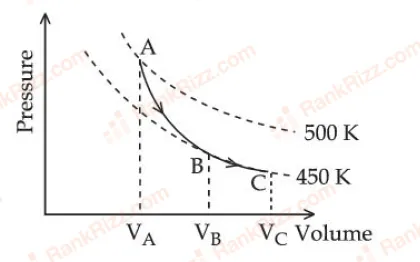
page7_img3


A poly-atomic molecule (CV=3R, CP=4RC_V = 3R,\, C_P = 4R, where R is gas constant) goes from phase space point A (PA=105 Pa, VA=4×10⁻⁶ mA\ (P_A = 10^5\,\text{Pa},\ V_A = 4 \times 10^{-6}\,\text{m} to point B (PB=5×10⁴ Pa, VB=6×10⁻⁶ m3)B\ (P_B = 5 \times 10^4\,\text{Pa},\ V_B = 6 \times 10^{-6}\,\text{m}^3) to point C (PC=104 Pa,  VC=8×10⁻⁶ m3).C\,(P_C = 10^4\,\text{Pa},\; V_C = 8 \times 10^{-6}\,\text{m}^3). A to B is an adiabatic path B and C to is an isothermal path. The net heat absorbed per unit mole by the system is :

  1. A

    500R(ln 3 + ln 4)

  2. B

    450R(ln 4 − ln 3)

  3. C

    500R ln 2

  4. D

    400R ln 4

JEE MAIN 2025 · 28 JAN S1Carnot engine and Carnot cycle

A Carnot engine (E) is working between two temperatures 473 K and 273 K . In a new system two engines - engine E1E_{1} works between 473 K to 373 K and engine E2E_{2} works between 373 K to 273 K . If η12,η1\eta_{12},\eta_{1} and η2\eta_{2} are the efficiencies of the engines E,E1E,E_{1} and E2E_{2}, respectively, then

  1. A

    η12=η1η2\eta_{12}=\eta_{1}\eta_{2}

  2. B

    η12≥η1+η2\eta_{12} \geq \eta_{1}+\eta_{2}

  3. C

    η12=η1+η2\eta_{12}=\eta_{1}+\eta_{2}

  4. D

    η12≤η1+η2\eta_{12} \leq \eta_{1}+\eta_{2}

JEE MAIN 2025 · 24 JAN S1Isobaric, isochoric and polytropic processes

An ideal gas goes from an initial state to final state. During the process, the pressure of gas increases linearly with temperature.

A. The work done by gas during the process is zero. 

B. The heat added to gas is different from change in its internal energy. 

C. The volume of the gas is increased. 

D. The internal energy of the gas is increased. 

E. The process is isochoric (constant volume process) Choose the correct answer from the options given below:

  1. A

    E Only

  2. B

    A, B, C, D Only

  3. C

    A, D, E Only

  4. D

    A, C Only

JEE MAIN 2025 · 24 JAN S2Work done in thermodynamic processes and P-V diagrams

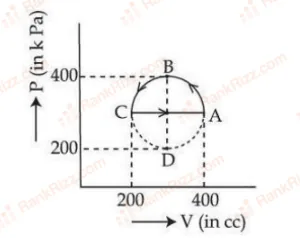
The magnitude of heat exchanged by a system for the given cyclic process ABCA (as shown in figure) is (in SI unit) :

page4_img2
  1. A

    5π5\pi

  2. B

    40π40\pi

  3. C

    10π10\pi

  4. D

    zero

JEE MAIN 2025 · 24 JAN S2Isothermal and adiabatic processes

Given below are two statements. One is labelled as Assertion (A) and the other is labelled as Reason (R). Assertion (A) : In an insulated container, a gas is adiabatically shrunk to half of its initial volume. The temperature of the gas decreases. Reason (R): Free expansion of an ideal gas is an irreversible and an adiabatic process. In the light of the above statements, choose the correct answer from the options given below :

  1. A

    Both (A) and (R) are true but (R) is NOT the correct explanation of (A)

  2. B

    (A) is false but (R) is true

  3. C

    (A) is true but (R) is false

  4. D

    Both (A) and (R) are true and (R) is the correct explanation of (A)

JEE MAIN 2025 · 23 JAN S1Isothermal and adiabatic processes

An ideal gas initially at 0∘0^{\circ}C temperature, is compressed suddenly to one fourth of its volume. If the ratio of specific heat at constant pressure to that at constant volume is 3/2, the change in temperature due to the thermodynamic process is _____ K.

JEE MAIN 2025 · 23 JAN S2Second law, heat engines, refrigerators and reversibility

Water of mass m gram is slowly heated to increase the temperature from T1T_{1} to T2T_{2} The change in entropy of the water, given specific heat of water is 1Jkg−1K−11Jkg^{-1}K^{-1}, is :

  1. A

    mln(T2T1)mln(\frac{T_{2}}{T_{1}})

  2. B

    zero

  3. C

    mln(T1T2)mln(\frac{T_{1}}{T_{2}})

  4. D

    m(T2−T1)m(T_{2}-T_{1})

JEE MAIN 2025 · 23 JAN S2Work done in thermodynamic processes and P-V diagrams
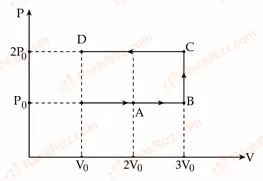
Figure for JEE Main 2025 Physics question on Work done in thermodynamic processes and P-V diagrams


Using the given P - V diagram, the work done by an ideal gas along the path ABCD is :

  1. A

    3P∘V∘3P_{\circ}V_{\circ}

  2. B

    −4P∘V∘-4P_{\circ}V_{\circ}

  3. C

    −3P∘V∘-3P_{\circ}V_{\circ}

  4. D

    4P∘V∘4P_{\circ}V_{\circ}

JEE MAIN 2025 · 22 JAN S2Zeroth and first law of thermodynamics

Given are statements for certain thermodynamic variables, (A) Internal energy, volume (V) and mass (M) are extensive variables. (B) Pressure (P), temperature (T) and density (ρ)(\rho) are intensive variables. (C) Volume (V), temperature (T) and density (ρ)(\rho) are intensive variables. (D) Mass (M), temperature (T) and internal energy are extensive variables. Choose the correct answer from the options given below :

  1. A

    (B) and (C) Only

  2. B

    (C) and (D) Only

  3. C

    (D) and (A) Only

  4. D

    (A) and (B) Only

JEE MAIN 2024 · 09 APR S1Isothermal and adiabatic processes

A sample of 1 mole gas at temperature T is adiabatically expanded to double its volume. If adiabatic constant for the gas is γ=32\gamma = \frac{3}{2}, then the work done by the gas in the process is:

  1. A

    RT[2−2]\frac{R}{T}[2 - \sqrt{2}]

  2. B

    TR[2+2]\frac{T}{R}[2 + \sqrt{2}]

  3. C

    RT[2−2]RT[2 - \sqrt{2}]

  4. D

    RT[2+2]RT[2 + \sqrt{2}]

JEE MAIN 2024 · 09 APR S1Isothermal and adiabatic processes

The volume of an ideal gas (γ=1.5)(\gamma = 1.5) is changed adiabatically from 5 litres to 4 litres. The ratio of initial pressure to final pressure is:

  1. A

    1625\frac{16}{25}

  2. B

    45\frac{4}{5}

  3. C

    855\frac{8}{5\sqrt{5}}

  4. D

    25\frac{2}{\sqrt{5}}

JEE MAIN 2024 · 09 APR S2Work done in thermodynamic processes and P-V diagrams


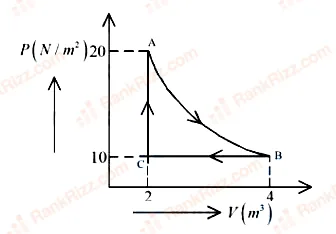
A real gas within a closed chamber at 27°C27°C undergoes the cyclic process as shown in figure. The gas obeys PV3=RTPV^3 = RT equation for the path AA to BB. The net work done in the complete cycle is (assuming R=8 J/molKR = 8 \text{ J/molK}):

page2_img1
  1. A

    20 J20 \text{ J}

  2. B

    205 J205 \text{ J}

  3. C

    −20 J-20 \text{ J}

  4. D

    225 J225 \text{ J}

JEE MAIN 2024 · 08 APR S1Isothermal and adiabatic processes

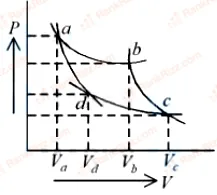
Two different adiabatic paths for the same gas intersect two isothermal curves as shown in P-V diagram. The relation between the ratio VaVd\frac{V_a}{V_d} and the ratio VbVc\frac{V_b}{V_c} is:

Figure for JEE Main 2024 Physics question on Isothermal and adiabatic processes
  1. A

    VaVd≠VbVc\frac{V_a}{V_d} \neq \frac{V_b}{V_c}

  2. B

    VaVd=VbVc\frac{V_a}{V_d} = \frac{V_b}{V_c}

  3. C

    VaVd=(VbVc)−1\frac{V_a}{V_d} = \left(\frac{V_b}{V_c}\right)^{-1}

  4. D

    VaVd=(VbVc)2\frac{V_a}{V_d} = \left(\frac{V_b}{V_c}\right)^2

JEE MAIN 2024 · 06 APR S2Zeroth and first law of thermodynamics

A total of 48 J48 \text{ J} heat is given to one mole of helium kept in a cylinder. The temperature of helium increases by 2°C2°C. The work done by the gas is: Given, R=8.3 J K−1 mol−1R = 8.3 \text{ J K}^{-1} \text{ mol}^{-1}.

  1. A

    24.9 J24.9 \text{ J}

  2. B

    72.9 J72.9 \text{ J}

  3. C

    48 J48 \text{ J}

  4. D

    23.1 J23.1 \text{ J}