JEE MAIN 2021 · 25 JUL S2Carnot engine and Carnot cycle
A heat engine has an efficiency of . When the temperature of sink is reduced by 62°C, its efficiency gets doubled. The temperature of the source is:
- A
124°C
- B
37°C
- C
62°C
- D
99°C
Every Thermodynamics question JEE Main has set from 2004–2026, grouped by the idea it tests rather than the order of the syllabus. 190 questions across 6 distinct ideas. Free to read, answer key on every one.
DATA UPDATED
Questions
190
Distinct ideas
6
Share of marks
3%
Difficulty
MEDIUM
A chapter is not one subject — it is a handful of procedures the examiner reuses. These are the ones Thermodynamics questions actually test.
101–120 OF 190 · NEWEST FIRST
A heat engine has an efficiency of . When the temperature of sink is reduced by 62°C, its efficiency gets doubled. The temperature of the source is:
124°C
37°C
62°C
99°C
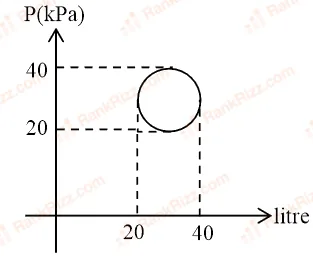
In the reported figure, heat energy absorbed by a system in going through a cyclic process is ___ J.
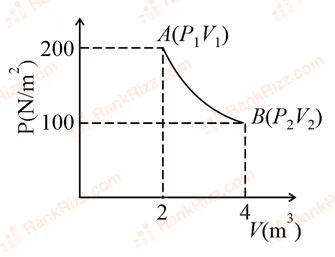
One mole of an ideal gas at 27 C is taken from A to B as shown in the given PV indicator diagram. The work done by the system will be ___ J. [Given, J mole K, ln 2 = 0.6931] (Round off to the nearest integer)
For an adiabatic expansion of an ideal gas, the fractional change in its pressure is equal to (where is the ratio of specific heats):
An ideal gas in a cylinder is separated by a piston in such a way that the entropy of one part is and that of the other part is . Given that . If the piston is removed then the total entropy of the system will be:
A Carnot's engine working between 400 K and 800 K has a work output of 1200 J per cycle. The amount of heat energy supplied to the engine from the source in each cycle is:
3200 J
1800 J
1600 J
2400 J
Which one is the correct option for the two different thermodynamic processes?

(c) and (a)
(c) and (d)
(a) only
(b) and (c)
In thermodynamics, heat and work are:
Path functions
Intensive thermodynamic state variables
Extensive thermodynamic state variables
Point functions
For an ideal heat engine, the temperature of the source is 127°C. In order to have 60% efficiency the temperature of the sink should be ________°C. (Round off to the nearest integer)
1 mole of rigid diatomic gas performs a work of when heat is supplied to it. The molar heat capacity of the gas during this transformation is . The value of is
[ universal gas constant]
The volume of a given mass of monoatomic gas changes with temperature according to the relation . The workdone when temperature changes by 90 K will be . The value of is [R universal gas constant]
In a certain thermodynamical process, the pressure of a gas depends on its volume as . The work done when the temperature changes from 100°C to 300°C will be where denotes number of moles of a gas, find .
A monoatomic gas of mass 4.0 u is kept in an insulated container. The container is moving with velocity 30 m s. If the container is suddenly stopped then a change in temperature of the gas ( = gas constant) is . Value of is,
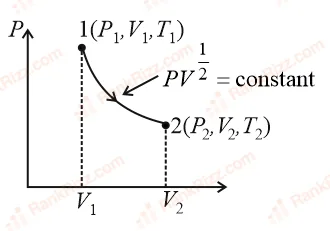
Thermodynamic process is shown below on a diagram for one mole of an ideal gas. If , then the ratio of temperature is:
2
A reversible heat engine converts one-fourth of the heat input into work. When the temperature of the sink is reduced by 52 K, its efficiency is doubled. The temperature in Kelvin of the source will be ______.
Match List I with List II.
| List I | List II |
|---|---|
| (a) Isothermal | (i) Pressure constant |
| (b) Isochoric | (ii) Temperature constant |
| (c) Adiabatic | (iii) Volume constant |
| (d) Isobaric | (iv) Heat content is constant |
Choose the correct answer from the options given below:
(a)(ii), (b)(iii), (c)(iv), (d)(i)
(a)(iii), (b)(ii), (c)(i), (d)(iv)
(a)(i), (b)(iii), (c)(ii), (d)(iv)
(a)(ii), (b)(iv), (c)(iii), (d)(i)
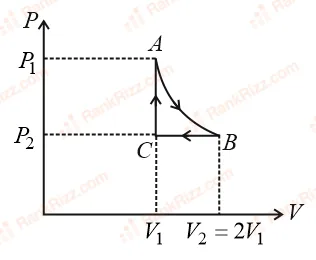
mole of a perfect gas undergoes a cyclic process ABCA (see figure) consisting of the following processes.
: Isothermal expansion at temperature so that the volume is doubled from to and pressure changes from to
: Isobaric compression at pressure to initial volume .
: Isochoric change leading to change of pressure from to
Total work done in the complete cycle ABCA is:
0
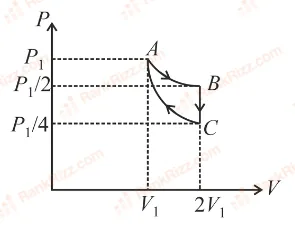
If one mole of an ideal gas at is allowed to expand reversibly and isothermally (A to B) its pressure is reduced to one-half of the original pressure (see figure). This is followed by a constant volume cooling till its pressure is reduced to one-fourth of the initial value . Then it is restored to its initial state by a reversible adiabatic compression (C to A). The net work done by the gas is equal to:
0
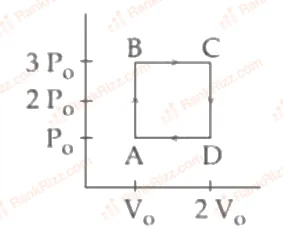
An engine operates by taking a monatomic ideal gas through the cycle shown in the figure. The percentage efficiency of the engine is close to___
Three different processes that can occur in an ideal monoatomic gas are shown in the vs diagram. The paths are labelled as , and . The change in internal energies during these processes are taken as , and and the work done as , and . The correct relation between these parameters are:
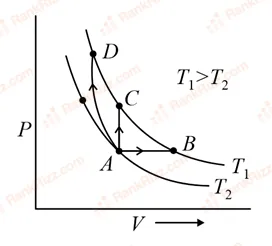
, , ,
, , ,
, ,
,
JEE Advanced has set 42 Thermodynamics questions too. Thermodynamics JEE Advanced PYQs →
OTHER PHYSICS CHAPTERS