RankRizz

Surface Chemistry — JEE Main Previous Year Questions

Every Surface Chemistry question JEE Main has set from 2005–2023, grouped by the idea it tests rather than the order of the syllabus. 123 questions across 4 distinct ideas. Free to read, answer key on every one.

DATA UPDATED

Questions

123

Distinct ideas

4

Share of marks

0%

Difficulty

EASY

The ideas inside Surface Chemistry

A chapter is not one subject — it is a handful of procedures the examiner reuses. These are the ones Surface Chemistry questions actually test.

Every Surface Chemistry question

81–100 OF 123 · NEWEST FIRST

JEE MAIN 2019 · 12 APR S1Properties of colloids and coagulation

Peptization is a:

  1. A

    Process of converting a colloidal solution into precipitate

  2. B

    Process of converting soluble particles to form colloidal solution

  3. C

    Process of bringing colloidal molecule into solution

  4. D

    Process of converting precipitate into colloidal solution
JEE MAIN 2019 · 12 APR S2Properties of colloids and coagulation

Among the following, the incorrect statement about colloids is:

  1. A

    They are larger than small molecules and have high molar mass.

  2. B

    They can scatter light.

  3. C

    The osmotic pressure of a colloidal solution is of higher order than the true solution at the same concentration.

  4. D

    The range of diameters of colloidal particles is between 1 and 1000 nm.

JEE MAIN 2019 · 10 APR S1Adsorption and adsorption isotherms

A gas undergoes physical adsorption on a surface and follows the given Freundlich adsorption isotherm equation
xm=kp0.5\frac{x}{m} = kp^{0.5}
Adsorption of the gas increases with:

  1. A

    Decrease in p and increase in T

  2. B

    Increase in p and decrease in T

  3. C

    Increase in p and increase in T

  4. D

    Decrease in p and decrease in T

JEE MAIN 2019 · 10 APR S2Properties of colloids and coagulation

The correct option among the following is.

  1. A

    Brownian motion in colloidal solution is faster if the viscosity of the solution is very high.

  2. B

    Colloidal particles in lyophobic sols can be precipitated by electrophoresis.

  3. C

    Colloidal medicines are more effective because they have small surface area.

  4. D

    Addition of alum to water makes it unfit for drinking.

JEE MAIN 2019 · 09 APR S1Properties of colloids and coagulation

The aerosol is a kind of colloid in which:

  1. A

    solid is dispersed in gas.

  2. B

    liquid is dispersed in water.

  3. C

    gas is dispersed in solid.

  4. D

    gas is dispersed in liquid.

JEE MAIN 2019 · 09 APR S1Catalysis: homogeneous, heterogeneous and enzyme

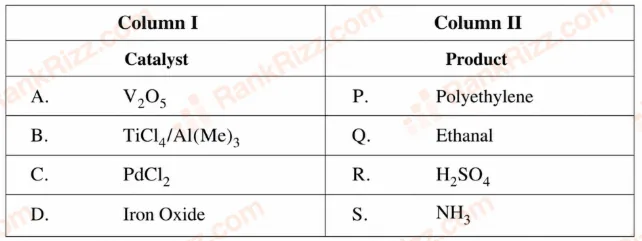
Match the catalysts (Column I) with products (Column II)

Figure for JEE Main 2019 Chemistry question on Catalysis: homogeneous, heterogeneous and enzyme
  1. A

    (A)-(S); (B)-(R); (C)-(Q); (D)-(P)

  2. B

    (A)-(R); (B)-(S); (C)-(P); (D)-(Q)

  3. C

    (A)-(Q); (B)-(R); (C)-(P); (D)-(S)

  4. D

    (A)-(R); (B)-(P); (C)-(Q); (D)-(S)

JEE MAIN 2019 · 08 APR S1Adsorption and adsorption isotherms

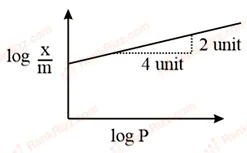
Adsorption of a gas follows Freundlich adsorption isotherm. x is the mass of the gas adsorbed on mass m of the adsorbent. The plot of log⁡xm\log\frac{x}{m} vs log⁡p\log p is shown in the given graph. xm\frac{x}{m} is proportional to:

Figure for JEE Main 2019 Chemistry question on Adsorption and adsorption isotherms
  1. A

    p3p^{3}

  2. B

    p2p^{2}

  3. C

    p2/3p^{2/3}

  4. D

    p3/2p^{3/2}

JEE MAIN 2019 · 12 JAN S1Classification, preparation and types of colloids

Given

Figure for JEE Main 2019 Chemistry question on Classification, preparation and types of colloids

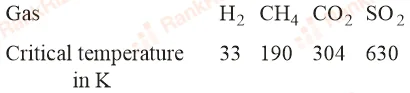
On the basis of data given above, predict which of the following gases shows the least adsorption on a definite amount of charcoal?

  1. A

    CH4_4

  2. B

    CO2_2

  3. C

    SO2_2

  4. D

    H2_2

JEE MAIN 2019 · 12 JAN S2Properties of colloids and coagulation

Among the following, the false statement is:

  1. A

    Latex is a colloidal solution of rubber particles which are positively charged

  2. B

    Tyndall effect can be used to distinguish between a colloidal solution and a true solution.

  3. C

    It is possible to cause artificial rain by throwing electrified sand carrying charge opposite to the one on clouds from an aeroplane.

  4. D

    Lyophilic sols can be coagulated by adding an electrolyte.

JEE MAIN 2019 · 11 JAN S1Properties of colloids and coagulation

An example of solid sol is:

  1. A

    Paint

  2. B

    Gem stones

  3. C

    Butter

  4. D

    Hair cream

JEE MAIN 2019 · 11 JAN S2Properties of colloids and coagulation

Among the colloids cheese (C), milk (M) and smoke (S), the correct combination of the dispersed phase and dispersion medium, respectively is:

  1. A

    C : liquid in solid; M : liquid in solid; S : solid in gas

  2. B

    C : liquid in solid; M : liquid in liquid; S : solid in gas

  3. C

    C : solid in liquid; M : liquid in liquid; S : gas in solid

  4. D

    C : solid in liquid; M : solid in liquid; S : solid in gas

JEE MAIN 2019 · 10 JAN S1Catalysis: homogeneous, heterogeneous and enzyme

Which of the following is not an example of heterogeneous catalysis reaction?

  1. A

    Combustion of Coal

  2. B

    Hydrogenation of Vegetable oils

  3. C

    Ostwald's process

  4. D

    Haber's process

JEE MAIN 2019 · 10 JAN S2Properties of colloids and coagulation

The haemoglobin and the gold sol are examples of:

  1. A

    positively charged sols

  2. B

    negatively and positively charged sols, respectively

  3. C

    negatively charged sols

  4. D

    positively and negatively charged sols, respectively

JEE MAIN 2019 · 09 JAN S1Adsorption and adsorption isotherms

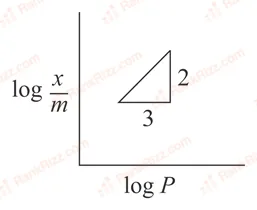
Adsorption of a gas follows Freundlich adsorption isotherm. In the given plot, xx is the mass of the gas adsorbed on mass mm of the adsorbent at pressure P. xm\frac{x}{m} is proportional to:

Figure for JEE Main 2019 Chemistry question on Adsorption and adsorption isotherms
  1. A

    p14p^{\frac{1}{4}}

  2. B

    pp

  3. C

    p2p^2

  4. D

    p12p^{\frac{1}{2}}

JEE MAIN 2019 · 09 JAN S2Properties of colloids and coagulation

For coagulation of arsenious sulphide sol, which of the following salt solutions will be most effective?

  1. A

    Na3PO4Na_3PO_4

  2. B

    NaClNaCl

  3. C

    AlCl3AlCl_3

  4. D

    BaCl2BaCl_2

JEE MAIN 2018 · 16 APR ONLINECatalysis: homogeneous, heterogeneous and enzyme

Which one of the following is not a property of physical adsorption?

  1. A

    Higher the pressure, more the adsorption

  2. B

    Greater the surface area, more the adsorption

  3. C

    Lower the temperature, more the adsorption

  4. D

    Unilayer adsorption occurs

JEE MAIN 2018 · 15 APR S1Properties of colloids and coagulation

Which of the following statements about colloids is false?

  1. A

    When silver nitrate solution is added to potassium iodide solution, a negatively charged colloidal solution is formed

  2. B

    Freezing point of colloidal solution is lower than true solution at same concentration of a solute

  3. C

    Colloidal particles can pass through ordinary filter paper

  4. D

    When excess of electrolyte is added to colloidal solution, colloidal particle will be precipitated

JEE MAIN 2018 · 15 APR S2Catalysis: homogeneous, heterogeneous and enzyme

If x gram of gas is adsorbed by m gram of adsorbent at pressure P the plot of log xm\frac{x}{m} versus log P is linear. The slope of the plot is: (m and k are constants and n > 1)

  1. A

    log k

  2. B

    1n\frac{1}{n}

  3. C

    2k

  4. D

    n

JEE MAIN 2017 · 09 APR ONLINEAdsorption and adsorption isotherms

Adsorption of gas on a surface follows Freundlich adsorption isotherm. The plot of log xm\frac{x}{m} versus log(P) gives a straight line with slope equal to 0.5, then:
(xm\frac{x}{m} is the mass of the gas adsorbed per gram of adsorbent)

  1. A

    adsorption is proportional to the square root of pressure.

  2. B

    adsorption is proportional to the square of pressure.

  3. C

    adsorption is proportional to the pressure.

  4. D

    adsorption is independent of pressure.

JEE MAIN 2017 · 08 APR ONLINEProperties of colloids and coagulation

Among the following, the correct statement is:

  1. A

    sols of metal sulphides are lyophilic.

  2. B

    Brownian movement is more pronounced for smaller particles than for bigger particles.

  3. C

    one would expect charcoal to adsorb chlorine more than hydrogen sulphide.

  4. D

    Hardy Schulze law states that bigger the size of the ions, the greater is its coagulating power.