Four gases, A, B, C and D have critical temperatures 5.3, 33.2, 126.0 and 154.3K respectively. For their adsorption on a fixed amount of charcoal, the correct order is :
- A
C D B A
- B
C B D A
- C
D C B A
- D
D C A B
Adsorption and adsorption isotherms has been asked 34 times in JEE Main, in 11 different years between 2006 and 2023, and in 2 of the last five exam years (2022–2026), 12 questions in all. That is 28% of Surface Chemistry, one of its three most-asked topics. Last asked in JEE Main 12 Apr 2023, Shift 1. 25 are multiple choice and 9 numerical-value; 16 easy and 13 medium by our difficulty labels. All of them are below, newest first, free to read.
Questions
34
Years asked
11
Since
2006
Of the chapter
28%
Questions on Adsorption and adsorption isotherms in every year it was asked, newest first.
| Year | Relative frequency | Questions |
|---|---|---|
| 2023 | 8 | |
| 2022 | 4 | |
| 2021 | 4 | |
| 2020 | 5 | |
| 2019 | 3 | |
| 2017 | 1 | |
| 2016 | 2 | |
| 2015 | 2 | |
| 2012 | 3 | |
| 2009 | 1 | |
| 2006 | 1 | |
| Total | 34 |
1–20 OF 34 · NEWEST FIRST
Four gases, A, B, C and D have critical temperatures 5.3, 33.2, 126.0 and 154.3K respectively. For their adsorption on a fixed amount of charcoal, the correct order is :
C D B A
C B D A
D C B A
D C A B
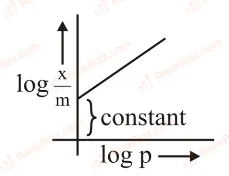
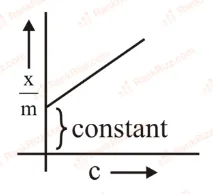
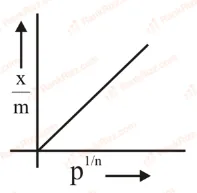
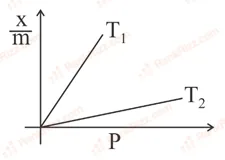
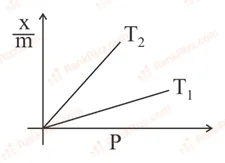
Which of the following represents the Freundlich adsorption isotherms?
(A)

(B)

(C)

(D)

Choose the correct answer from the options given below:
A, C, D only
A, B only
B, C, D only
A, B, D only
Given below are two statements:
Assertion A: Amongst He, Ne, Ar and Kr; 1 g of activated charcoal adsorbs more of Kr.
Reason R: The critical volume V (cm mol) and critical pressure P (atm) is highest for Krypton but the compressibility factor at critical point Z is lowest for Krypton.
A is true but R is false
A is false but R is true
Both A and R are true but R is NOT the correct explanation of A
Both A and R are true and R is the correct explanation A
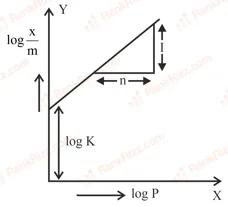
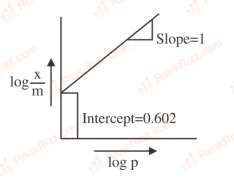
In figure, a straight line is given for Freundrich Adsorption (). The value of and log K are respectively.

and log
and
and
and
Match List I with List II
List I List II
A. Physisorption I. Single Layer Adsorption
B. Chemisorption II. 20-40 kJ mol
C. N(g) + 3H(g) 2NH(g) III. Chromatography
D. Analytical Application or Adsorption IV. Heterogeneous catalysis
Choose the correct answer from the options given below:
A-III, B-IV, C-I, D-II
A-II, B-III, C-I, D-IV
A-II, B-I, C-IV, D-III
A-IV, B-II, C-III, D-I
The graph of vs for an adsorption process is a straight line inclined at an angle of with intercept equal to . The mass of gas adsorbed per unit mass of adsorbent at the pressure of atm is ______ (Nearest integer)
Given:
The number of incorrect statement/s from the following is/are
A. Water vapours are adsorbed by anhydrous calcium chloride.
B. There is a decrease in surface energy during adsorption.
C. As the adsorption proceeds, H becomes more and more negative.
D. Adsorption is accompanied by decrease in entropy of the system.
The number of statement/s which are the characteristics of physisorption is _____.
A. It is highly specific in nature
B. Enthalpy of adsorption is high
C. It decreases with increase in temperature
D. It results into unimolecular layer
E. No activation energy is needed
Given below are the critical temperatures of some of the gases:
| Gas | Critical temperature (K) |
|---|---|
| He | 5.2 |
| 190 | |
| 304.2 | |
| 405.5 |
He
Given below are two statements. One is labelled as Assertion A and the other is labelled as Reason R.
Assertion A: Activated charcoal adsorbs more efficiently than .
Reason R: Gases with lower critical temperatures are readily adsorbed by activated charcoal.
In the light of the above statements, choose the correct answer from the options given below.
Both A and R are correct and R is the correct explanation of A
Both A and R are correct but R is NOT the correct explanation of A
A is correct but R is not correct
A is not correct but R is correct
A Freundlich adsorption isotherm graph is shown.
If the initial pressure of a gas is atm, the mass of the gas adsorbed per gram of the adsorbent is ______ g
When mL of M acetic acid is shaken with g of wood charcoal, the final concentration of acetic acid after adsorption is M. The mass of acetic acid adsorbed per gram of carbon is ______ g.
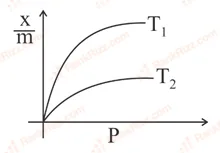
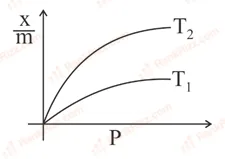
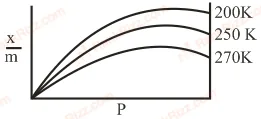
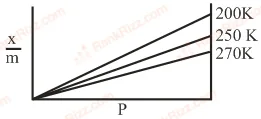
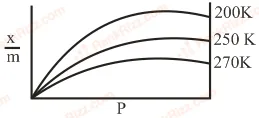
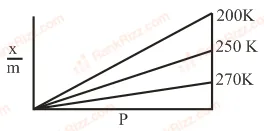
Select the graph that correctly describes the adsorption isotherms at two temperatures and () for a gas:
( - mass of the gas adsorbed, - mass of adsorbent, - pressure)


CH is adsorbed on 1 g charcoal at 0°C following the Freundlich adsorption isotherm. 10.0 mL of CH is adsorbed at 100 mm of Hg, whereas 15.0 mL is adsorbed at 200 mm of Hg. The volume of CH adsorbed at 300 mm of Hg is mL. The value of x is _________ . (Nearest integer)
[Use , ]
CO gas adsorbs on charcoal following Freundlich adsorption isotherm. For a given amount of charcoal, the mass of CO adsorbed becomes 64 times when the pressure of CO is doubled.
The value of n in the Freundlich isotherm equation is _________ . (Round off to the Nearest Integer)
Given below are two statement: one is labelled as Assertion A and the other is labelled as Reason R.
Assertion A : SO(g) is adsorbed to a large extent than H(g) on activated charcoal.
Reason R : SO(g) has a higher critical temperature than H(g)
In the light of the above statements, choose the most appropriate answer from the options given below.
Both A and R are correct but R is not the correct explanation for A
Both A and R are correct and R is the correct explanation of A.
A is not correct but R is correct.
A is correct but R is not correct.
For Freundlich adsorption isotherm, a plot of (y-axis) and (x-axis) gives a straight line, the intercept and slope for the line is 0.4771 and 2, respectively. The mass of gas, adsorbed per gram of adsorbent if the initial pressure is 0.04 atm is ______ .
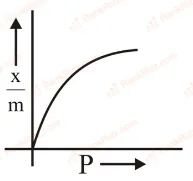
Adsorption of a gas follows Freundlich adsorption isotherm. If is the mass of the gas adsorbed on mass of the adsorbent, the correct plot of versus is:


The mass of gas adsorbed, x, per unit mass of adsorbate, m, was measured at various pressures, p. A graph between and gives a straight line with slope equal to 2 and the intercept equal to 0.4771. The value of at a pressure of 4 atm is:
(Given )
Amongst the following statements regarding adsorption, those that are valid are:
(a) becomes less negative as adsorption proceeds.
(b) On a given adsorbent, ammonia is adsorbed more than nitrogen gas.
(c) On adsorption, the residual force acting along the surface of the adsorbent increases
(d) With increase in temperature, the equilibrium concentration of adsorbate increases.
(d) and (a)
(b) and (c)
(a) and (b)
(c) and (d)
RELATED SURFACE CHEMISTRY TOPICS