RankRizz

Surface Chemistry — JEE Main Previous Year Questions

Every Surface Chemistry question JEE Main has set from 2005–2023, grouped by the idea it tests rather than the order of the syllabus. 123 questions across 4 distinct ideas. Free to read, answer key on every one.

DATA UPDATED

Questions

123

Distinct ideas

4

Share of marks

0%

Difficulty

EASY

The ideas inside Surface Chemistry

A chapter is not one subject — it is a handful of procedures the examiner reuses. These are the ones Surface Chemistry questions actually test.

Every Surface Chemistry question

41–60 OF 123 · NEWEST FIRST

JEE MAIN 2022 · 24 JUN S1Properties of colloids and coagulation

Given below are two statements:
Statement I : Emulsions of oil in water are unstable and sometimes they separate into two layers on standing.
Statement II : For stabilisation of an emulsion, excess of electrolyte is added.
In the light of the above statements, choose the most appropriate answer from the options given below :

  1. A

    Both Statement I and Statement II are correct.

  2. B

    Both Statement I and Statement II are incorrect.

  3. C

    Statement I is correct but Statement II is incorrect.

  4. D

    Statement I is incorrect but Statement II is correct.
JEE MAIN 2022 · 24 JUN S2Adsorption and adsorption isotherms

When 200200 mL of 0.20.2 M acetic acid is shaken with 0.60.6 g of wood charcoal, the final concentration of acetic acid after adsorption is 0.10.1 M. The mass of acetic acid adsorbed per gram of carbon is ______ g.

JEE MAIN 2021 · 01 SEP S2Properties of colloids and coagulation

Match List - I with List - II.
List-I (Colloid Preparation Method)   List-II (Chemical Reaction)
(a) Hydrolysis   (i) 2AuCl3_3 + 3HCHO + 3H2_2O →\rightarrow 2Au(sol) + 3HCOOH + 6HCl
(b) Reduction   (ii) As2_2O3_3 + 3H2_2S →\rightarrow As2_2S3_3(sol) + 3H2_2O
(c) Oxidation   (iii) SO2_2 + 2H2_2S →\rightarrow 3S(sol) + 2H2_2O
(d) Double Decomposition   (iv) FeCl3_3 + 3H2_2O →\rightarrow Fe(OH)3_3(sol) + 3HCl
Choose the most appropriate answer from the options given below:

  1. A

    (a)-(i), (b)-(iii), (c)-(ii), (d)-(iv)

  2. B

    (a)-(iv), (b)-(i), (c)-(iii), (d)-(ii)

  3. C

    (a)-(i), (b)-(ii), (c)-(iv), (d)-(iii)

  4. D

    (a)-(iv), (b)-(ii), (c)-(iii), (d)-(i)

JEE MAIN 2021 · 31 AUG S1Adsorption and adsorption isotherms

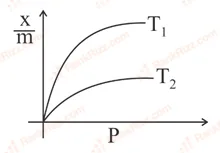
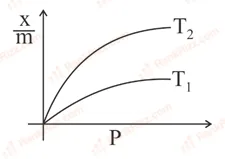
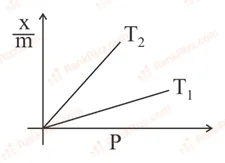
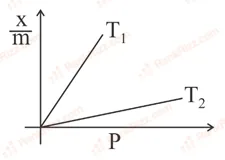
Select the graph that correctly describes the adsorption isotherms at two temperatures T1T_1 and T2T_2 (T1>T2T_1 > T_2) for a gas:
(xx - mass of the gas adsorbed, mm - mass of adsorbent, PP - pressure)

  1. A
    Figure for JEE Main 2021 Chemistry question on Adsorption and adsorption isotherms
  2. B
    Figure for JEE Main 2021 Chemistry question on Adsorption and adsorption isotherms
  3. C
    Figure for JEE Main 2021 Chemistry question on Adsorption and adsorption isotherms
  4. D
    Figure for JEE Main 2021 Chemistry question on Adsorption and adsorption isotherms
JEE MAIN 2021 · 31 AUG S2Adsorption and adsorption isotherms

CH4_4 is adsorbed on 1 g charcoal at 0°C following the Freundlich adsorption isotherm. 10.0 mL of CH4_4 is adsorbed at 100 mm of Hg, whereas 15.0 mL is adsorbed at 200 mm of Hg. The volume of CH4_4 adsorbed at 300 mm of Hg is 10x10^x mL. The value of x is _________ ×10−2\times 10^{-2}. (Nearest integer)
[Use log⁡102=0.3010\log_{10} 2 = 0.3010, log⁡103=0.4771\log_{10} 3 = 0.4771]

JEE MAIN 2021 · 27 AUG S1Properties of colloids and coagulation

Tyndall effect is more effectively shown by:

  1. A

    lyophilic colloid

  2. B

    suspension

  3. C

    lyophobic colloid

  4. D

    true solution

JEE MAIN 2021 · 27 AUG S2Properties of colloids and coagulation

Lyophilic sols are more stable than lyophobic sols because:

  1. A

    the colloidal particles have no charge.

  2. B

    the colloidal particles have positive charge.

  3. C

    the colloidal particles are solvated.

  4. D

    there is a strong electrostatic repulsion between the negatively charged colloidal particles.

JEE MAIN 2021 · 26 AUG S1Classification, preparation and types of colloids

Which one of the following is correct for the adsorption of a gas at a given temperature on a solid surface?

  1. A

    ΔH>0,ΔS>0\Delta H > 0, \Delta S > 0

  2. B

    ΔH<0,ΔS>0\Delta H < 0, \Delta S > 0

  3. C

    ΔH>0,ΔS<0\Delta H > 0, \Delta S < 0

  4. D

    ΔH<0,ΔS<0\Delta H < 0, \Delta S < 0

JEE MAIN 2021 · 26 AUG S2Properties of colloids and coagulation

The sol given below with negatively charged colloidal particles is:

  1. A

    AgNO3_3 added to KI solution

  2. B

    KI added to AgNO3_3 solution

  3. C

    Al2_2O3_3 ⋅\cdot xH2_2O in water

  4. D

    FeCl3_3 added to hot water

JEE MAIN 2021 · 27 JUL S1Adsorption and adsorption isotherms

CO2_2 gas adsorbs on charcoal following Freundlich adsorption isotherm. For a given amount of charcoal, the mass of CO2_2 adsorbed becomes 64 times when the pressure of CO2_2 is doubled.
The value of n in the Freundlich isotherm equation is _________ ×102\times 10^2. (Round off to the Nearest Integer)

JEE MAIN 2021 · 27 JUL S2Adsorption and adsorption isotherms

Given below are two statement: one is labelled as Assertion A and the other is labelled as Reason R.
Assertion A : SO2_2(g) is adsorbed to a large extent than H2_2(g) on activated charcoal.
Reason R : SO2_2(g) has a higher critical temperature than H2_2(g)
In the light of the above statements, choose the most appropriate answer from the options given below.

  1. A

    Both A and R are correct but R is not the correct explanation for A

  2. B

    Both A and R are correct and R is the correct explanation of A.

  3. C

    A is not correct but R is correct.

  4. D

    A is correct but R is not correct.

JEE MAIN 2021 · 25 JUL S1Properties of colloids and coagulation

Sodium stearate CH3_3CH216_{2_{16}}COO−^-Na+^+ is an anionic surfactant which forms micelles in oil. Choose the correct statement for it from the following:

  1. A

    It forms spherical micelles with CH3_3CH216_{2_{16}}- group pointing towards the centre of sphere.

  2. B

    It forms non-spherical micelles with -COO−^- group pointing outwards on the surface.

  3. C

    It forms spherical micelles with CH3_3CH216_{2_{16}}- group pointing outwards on the surface of sphere

  4. D

    It forms non-spherical micelles with CH3_3CH216_{2_{16}}- group pointing towards the centre.

JEE MAIN 2021 · 25 JUL S2Properties of colloids and coagulation

Match List I with List II:
List-I (Example of colloids)          List-II (Classification)
(a) Cheese                                 (i) dispersion of liquid in liquid
(b) Pumice stone                      (ii) dispersion of liquid in gas
(c) Hair cream                           (iii) dispersion of gas in solid
(d) Cloud                                    (iv) dispersion of liquid in solid
Choose the most appropriate answer from the options given below:

  1. A

    (a)-(iv), (b)-(iii), (c)-(ii), (d)-(i)

  2. B

    (a)-(iv), (b)-(i), (c)-(iii), (d)-(ii)

  3. C

    (a)-(iii), (b)-(iv), (c)-(i), (d)-(ii)

  4. D

    (a)-(iv), (b)-(iii), (c)-(i), (d)-(ii)

JEE MAIN 2021 · 22 JUL S1Properties of colloids and coagulation

When silver nitrate solution is added to potassium iodide solution then the sol produced is:

  1. A

    AgI / I−^-

  2. B

    AgI / Ag+^+

  3. C

    KI / NO3−_3^-

  4. D

    AgNO3_3 / NO3−_3^-

JEE MAIN 2021 · 20 JUL S1Properties of colloids and coagulation

The conditions given below are in the context of observing Tyndall effect in colloidal solutions:
(A) The diameter of the colloidal particles is comparable to the wavelength of light used.
(B) The diameter of the colloidal particles is much smaller than the wavelength of light used.
(C) The diameter of the colloidal particles is much larger than the wavelength of light used.
(D) The refractive indices of the dispersed phase and the dispersion medium are comparable.
(E) The dispersed phase has a very different refractive index from the dispersion medium. Choose the most appropriate conditions from the options given below:

  1. A

    (A) and (E) only

  2. B

    (C) and (D) only

  3. C

    (A) and (D) only

  4. D

    (B) and (E) only

JEE MAIN 2021 · 20 JUL S2Properties of colloids and coagulation

For coagulation of 50 mL of a sol, 10 mL of 0.5M Cl−^- ion solution is required. What is the coagulating value of Cl−^- ion solution (Nearest integer)

JEE MAIN 2021 · 18 MAR S2Properties of colloids and coagulation

The charges on the colloidal CdS sol and TiO2_2 sol are, respectively :

  1. A

    positive and positive

  2. B

    positive and negative

  3. C

    negative and negative

  4. D

    negative and positive

JEE MAIN 2021 · 17 MAR S1Properties of colloids and coagulation

A colloidal system consisting of a gas dispersed in a solid is called a/an:

  1. A

    solid sol

  2. B

    gel

  3. C

    aerosol

  4. D

    foam

JEE MAIN 2021 · 17 MAR S2Properties of colloids and coagulation

For the coagulation of a negative sol, the species below, that has the highest flocculating power is:

  1. A

    SO42−SO_4^{2-}

  2. B

    Ba2+Ba^{2+}

  3. C

    Na+Na^+

  4. D

    PO43−PO_4^{3-}

JEE MAIN 2021 · 16 MAR S2Properties of colloids and coagulation

The INCORRECT statements below regarding colloidal solutions is:

  1. A

    A colloidal solution shows colligative properties.

  2. B

    An ordinary filter paper can stop the flow of colloidal particles.

  3. C

    The flocculation power of Al3+Al^{3+} is more than that of Na+Na^+.

  4. D

    A colloidal solution shows Brownian motion of colloidal particles.