JEE MAIN 2021 · 26 FEB S2Properties of colloids and coagulation
The nature of charge on resulting colloidal particles when is added to excess of hot water is:
- A
positive
- B
sometimes positive and sometimes negative
- C
neutral
- D
negative
Every Surface Chemistry question JEE Main has set from 2005–2023, grouped by the idea it tests rather than the order of the syllabus. 123 questions across 4 distinct ideas. Free to read, answer key on every one.
DATA UPDATED
Questions
123
Distinct ideas
4
Share of marks
0%
Difficulty
EASY
A chapter is not one subject — it is a handful of procedures the examiner reuses. These are the ones Surface Chemistry questions actually test.
61–80 OF 123 · NEWEST FIRST
The nature of charge on resulting colloidal particles when is added to excess of hot water is:
positive
sometimes positive and sometimes negative
neutral
negative
In Freundlich adsorption isotherm at moderate pressure, the extent of adsorption is directly proportional to . The value of is:
zero
1
Which one of the following statements is FALSE for hydrophilic sols?
These sols are reversible in nature.
Their viscosity is of the order of that of .
The sols cannot be easily coagulated.
They do not require electrolytes for stability.
In Freundlich adsorption isotherm, slope of AB line is:
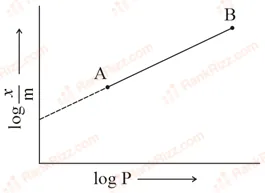
with to
with to
with
with
Most suitable salt which can be used for efficient clotting of blood will be?
Kraft temperature is the temperature:
below which the aqueous solution of detergents starts freezing
below which the formation of micelles takes place
above which the aqueous solution of detergents starts boiling
above which the formation of micelles takes place
For Freundlich adsorption isotherm, a plot of (y-axis) and (x-axis) gives a straight line, the intercept and slope for the line is 0.4771 and 2, respectively. The mass of gas, adsorbed per gram of adsorbent if the initial pressure is 0.04 atm is ______ .
Identify the correct molecular picture showing what happens at the critical micellar concentration (CMC) of an aqueous solution of a surfactant.

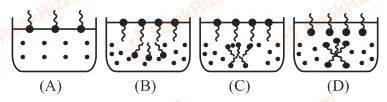
(D)
(B)
(A)
(C)
Adsorption of a gas follows Freundlich adsorption isotherm. If is the mass of the gas adsorbed on mass of the adsorbent, the correct plot of versus is:
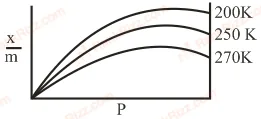
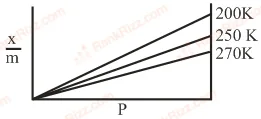
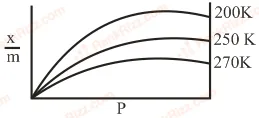
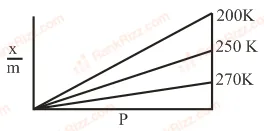
Match the following:
(i) Foam (a) smoke
(ii) Gel (b) cell fluid
(iii) Aerosol (c) jellies
(iv) Emulsion (d) rubber
(e) froth
(f) milk
(i)-(b), (ii)-(c), (iii)-(e), (iv)-(d)
(i)-(d), (ii)-(b), (iii)-(a), (iv)-(e)
(i)-(e), (ii)-(c), (iii)-(a), (iv)-(f)
(i)-(d), (ii)-(b), (iii)-(e), (iv)-(f)
A sample of red ink (a colloidal suspension) is prepared by mixing eosine dye, egg white, HCHO and water. The component which ensures stability of the ink sample is:
Egg white
Water
HCHO
Eosin dye
Tyndall effect is observed when:
The diameter of dispersed particles is much larger than the wavelength of light used.
The diameter of dispersed particles is much smaller than the wavelength of light used
The refractive index of dispersed phase is greater than that of the dispersion medium.
The diameter of dispersed particles is similar to the wavelength of light used.
An ionic micelle is formed on the addition of:
liquid diethyl ether to aqueous NaCl solution
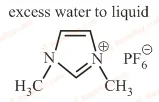
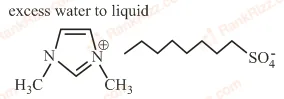
Sodium stearate to pure toluene
Which of the following is used for the preparation of colloids?
Ostwald process
Van Arkel Method
Bredig's Arc Method
Mond Process
The mass of gas adsorbed, x, per unit mass of adsorbate, m, was measured at various pressures, p. A graph between and gives a straight line with slope equal to 2 and the intercept equal to 0.4771. The value of at a pressure of 4 atm is:
(Given )
Amongst the following statements regarding adsorption, those that are valid are:
(a) becomes less negative as adsorption proceeds.
(b) On a given adsorbent, ammonia is adsorbed more than nitrogen gas.
(c) On adsorption, the residual force acting along the surface of the adsorbent increases
(d) With increase in temperature, the equilibrium concentration of adsorbate increases.
(d) and (a)
(b) and (c)
(a) and (b)
(c) and (d)
A mixture of gases , and CO are taken in a closed vessel containing charcoal. The graph that represents the correct behaviour of pressure with time is:
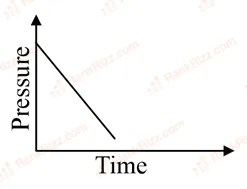
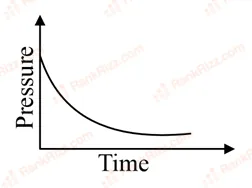
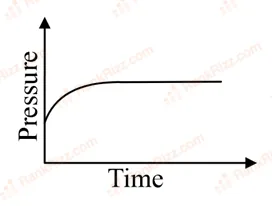
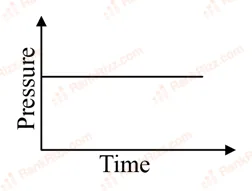
As per Hardy-Schulze formulation, the flocculation values of the following for ferric hydroxide sol are in the order:
K[Fe(CN)] < KCrO < KBr = KNO = AlCl
K[Fe(CN)] < KCrO < AlCl < KBr < KNO
AlCl > K[Fe(CN)] > KCrO > KBr = KNO
K[Fe(CN)] > AlCl > KCrO > KBr > KNO
For the following Assertion and Reason, the correct option is:
Assertion: For hydrogenation reactions, the catalytic activity increases from Group 5 to Group 11 metals with maximum activity shown by Group 7-9 elements.
Reason: The reactants are most strongly adsorbed on group 7-9 elements.
The assertion is true, but the reason is false
Both assertion and reason are false
Both assertion and reason are true and the reason is the correct explanation for the assertion
Both assertion and reason are true but the reason is not the correct explanation for the assertion
The flocculation value of HCl for arsenic sulphide sol is 30 mmolL. If HSO is used for the flocculation of arsenic sulphide, the amount, in grams, of HSO in 250 ml required for the above purpose is (molecular mass of HSO = 98 g/mol)
JEE Advanced has set 16 Surface Chemistry questions too. Surface Chemistry JEE Advanced PYQs →
OTHER CHEMISTRY CHAPTERS