JEE MAIN 2023 · 15 APR S1Properties of colloids and coagulation
mL of M NaCl is required to coagulate mL of AsS solution in 2 hours. The coagulating value of NaCl is _____.
Properties of colloids and coagulation has been asked 71 times in JEE Main, in 13 different years between 2005 and 2023, and in 2 of the last five exam years (2022–2026), 25 questions in all. That is 58% of Surface Chemistry, its most-asked topic. Last asked in JEE Main 15 Apr 2023, Shift 1. 65 are multiple choice and 6 numerical-value; 52 easy, 15 medium and 1 hard by our difficulty labels. All of them are below, newest first, free to read.
Questions
71
Years asked
13
Since
2005
Of the chapter
58%
Questions on Properties of colloids and coagulation in every year it was asked, newest first.
| Year | Relative frequency | Questions |
|---|---|---|
| 2023 | 13 | |
| 2022 | 12 | |
| 2021 | 16 | |
| 2020 | 9 | |
| 2019 | 9 | |
| 2018 | 1 | |
| 2017 | 2 | |
| 2016 | 1 | |
| 2015 | 1 | |
| 2013 | 4 | |
| 2012 | 1 | |
| 2008 | 1 | |
| 2005 | 1 | |
| Total | 71 |
1–20 OF 71 · NEWEST FIRST
mL of M NaCl is required to coagulate mL of AsS solution in 2 hours. The coagulating value of NaCl is _____.
What happens when a lyophilic sol is added to a lyophobic sol?
Film of lyophilic sol is formed over lyophobic sol
Lyophilic sol is dispersed in lyophobic sol
Film of lyophobic sol is formed over lyophilic sol
Lyophobic sol is coagulated
Given below are two statements, one is labelled as Assertion A and the other is labelled as Reason R.
Assertion A : The diameter of colloidal particles in solution should not be much smaller than wavelength of light to show Tyndall effect.
Reason R : The light scatters in all directions when the size of particles is large enough.
In the light of the above statements, choose the correct answer from the options given below :
Both A and R are correct but R is NOT the correct explanation of A
A is true but R is false
A is false but R is true
Both A and R are correct and R is the correct explanation of A
Ferric chloride is applied to stop bleeding because
Blood absorbs FeCl and forms a complex.
Cl ions cause coagulation of blood.
Fe ions coagulate blood which is a negatively charged sol.
FeCl reacts with the constituents of blood which is a positively charged sol.
Coagulating value of the electrolytes AlCl and NaCl for AsS are 0.09 and 50.04 respectively. The coagulating power of AlCl is x times the coagulating power of NaCl. The value of x is _____.
The number of colloidal systems from the following, which will have 'liquid' as the dispersion medium, is ______.
Gem stones, paints, smoke, cheese, milk, hair cream, insecticide sprays, froth, soap lather
Adding surfactants in non polar solvent, the micelles structure will look like
(a)
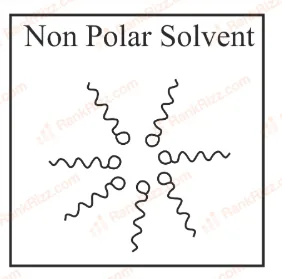
(b)
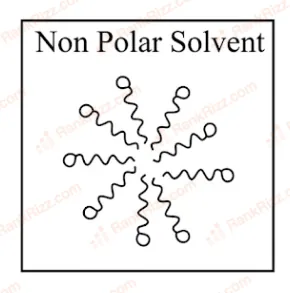
(c)
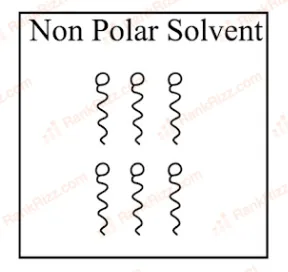
(d)
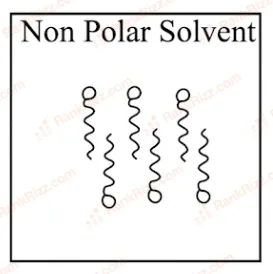
(b)
(c)
(a)
(d)
Given below are two statements: one is labelled as Assertion (A) and the other is labelled as Reason (R).
Assertion (A): In expensive scientific instruments, silica gel is kept in watch-glasses or in semipermeable membrane bags.
Reason (R): Silica gel adsorbs moisture from air via adsorption, thus protects the instrument from water corrosion (rusting) and / or prevents malfunctioning.
In the light of the above statements, choose the correct answer from the options given below:
(A) is false but (R) is true
(A) is true but (R) is false
Both (A) and (R) are true and (R) is the correct explanation of (A)
Both (A) and (R) are true but (R) is not the correct explanation of (A)
Which of the following salt solutions would coagulate the colloid solution formed when FeCl is added to NaOH solution, at the fastest rate?
10 mL of 0.2 mol dm AlCl
10 mL of 0.1 mol dm NaSO
10 mL of 0.1 mol dm Ca(PO)
10 mL of 0.15 mol dm CaCl
Match List-I and List-II
| List-I | List-II |
|---|---|
| A. Osmosis | I. Solvent molecules pass through semi permeable membrane towards solvent side. |
| B. Reverse osmosis | II. Movement of charged colloidal particles under the influence of applied electric potential towards oppositely charged electrodes |
| C. Electro osmosis | III. Solvent molecules pass through semi permeable membrane towards solution side |
| D. Electrophoresis | IV. Dispersion medium moves in an electric field. |
A-I, B-III, C-IV, D-II
A-III, B-I, C-IV, D-II
A-III, B-I, C-II, D-IV
A-I, B-III, C-II, D-IV
Based on the given figure, the number of correct statement/s is/are
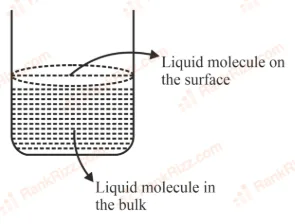
A. Surface tension is the outcome of equal attractive and repulsion forces acting on the liquid molecule in bulk.
B. Surface tension is due to uneven forces acting on the molecules present on the surface.
C. The molecule in the bulk can never come to the liquid surface.
D. The molecules on the surface are responsible for vapour pressure if the system is a closed system.
Statement I: For colloidal particles, the values of colligative properties are of small order as compared to values shown by true solutions at same concentration.
Statement II: For colloidal particles, the potential difference between the fixed layer and the diffused layer of same charges is called the electrokinetic potential or zeta potential.
In the light of the above statements, choose the correct answer from the options given below.
Statement I is true but statement II is false
Statement I is false but Statement II is true
Both Statement I and Statement II are true
Both Statement I and Statement II are false
Statement I: For colloidal particles, the values of colligative properties are of small order as compared to values shown by true solutions at same concentration.
Statement II: For colloidal particles, the potential difference between the fixed layer and the diffused layer of same charges is called the electrokinetic potential or zeta potential.
In the light of the above statements, choose the correct answer from the options given below:
Statement I is true but statement II is false
Statement I is false but Statement II is true
Both Statement I and Statement II are true
Both Statement I and Statement II are false
100 mL of 5% (w/v) solution of NaCl in water was prepared in 250 mL beaker. Albumin from the egg was poured into NaCl solution and stirred well. This resulted in a/an
Lyophilic sol
Lyophobic sol
Emulsion
Precipitate
Given below are two statements: one is labelled as Assertion A and the other is labelled as Reason R
Assertion A: Dissolved substances can be removed from a colloidal solution by diffusion through a parchment paper.
Reason R: Particles in a true solution cannot pass through parchment paper but the colloidal particles can pass through the parchment paper.
In the light of the above statements, choose the correct answer from the options given below:
Both A and R are correct and R is the correct explanation of A
Both A and R are correct but R is not the correct explanation of A
A is correct but R is not correct
A is not correct but R is correct
Given below are two statements:one is labelled as Assertion A and the other is labelled as Reason R.
Assertion A: Finest gold is red in colour, as the size of the particles increases, it appears purple then blue and finally gold.
Reason R: The colour of the colloidal solution depends on the wavelength of light scattered by the dispersed particles.
In the light of the above statements, choose the most appropriate answer from the options given below
Both A and R are true and R is the correct explanation of A
Both A and R are true but R is NOT the correct explanation of A
A is true but R is false
A is false but R is true
For micelle formation, which of the following statements are correct?
(A) Micelle formation is an exothermic process.
(B) Micelle formation is an endothermic process.
(C) The entropy change is positive.
(D) The entropy change is negative.
A and D only
A and C only
B and C only
B and D only
Which of the following is a correct statement?
Brownian motion destabilises sols.
Any amount of dispersed phase can be added to emulsion without destabilising it.
Mixing two oppositely charged sols in equal amount neutralises charges and stabilises colloids.
Presence of equal and similar charges on colloidal particles provides stability to the colloidal solution.
42.12% (w/v) solution of NaCl causes precipitation of a certain sol in 10 hours. The coagulating value of NaCl for the sol is
[Given: Molar mass: Na = 23.0 g mol; Cl = 35.5 g mol]
36 mmol L
36 mol L
1440 mol L
1440 m mol L
The Zeta potential is related to which property of colloids?
Colour
Brownian movement
Charge on surface of colloidal particle
Tyndall effect
RELATED SURFACE CHEMISTRY TOPICS