JEE MAIN 2020 · 08 JAN S2 Extraction of Fe, Cu, Zn, Al, Ag and Au
Among the reactions (a) - (d), the reaction(s) that does/do not occur in the blast furnace during the extraction of iron is/are:2 _2 2 → \rightarrow → 3 _3 3 2 _2 2 3 _3 3 → \rightarrow → 3 _3 3 4 _4 4 2 _2 2 2 _2 2 → \rightarrow → 3 _3 3 → \rightarrow → 1 2 \frac{1}{2} 2 1 2 _2 2
A B C D JEE MAIN 2020 · 07 JAN S1 Extraction of Fe, Cu, Zn, Al, Ag and Au
The purest form of commercial iron is:
A B C D JEE MAIN 2020 · 07 JAN S2 Refining of metals
The refining method used when the metal and the impurities have low and high melting temperatures, respectively, is
A B C D JEE MAIN 2019 · 12 APR S1 Concentration of ores, calcination and roasting
The idea of froth flotation method came from a person X and this method is related to the process Y of ores. X and Y, respectively, are:
A B Fisher women and concentration
C D Washer woman and concentration
JEE MAIN 2019 · 12 APR S2 Extraction of Fe, Cu, Zn, Al, Ag and Au
The correct statement is:
A Pig iron is obtained from cast iron.
B The Hall-Heroult process is used for the production of aluminium and iron.
C leaching of bauxite using concentrated NaOH solution gives sodium aluminate and sodium silicate.
D the blistered appearance of copper during metallurgical process is due to the evolution of CO2 _2 2
JEE MAIN 2019 · 10 APR S1 Refining of metals
Match the refining methods (Column I) with metals (Column II).
A (I) - (b); (II) - (c); (III) - (d); (IV) - (a)
B (I) - (b); (II) - (d); (III) - (a); (IV) - (c)
C (I) - (c); (II) - (d); (III) - (b); (IV) - (a)
D (I) - (c); (II) - (a); (III) - (b); (IV) - (d)
JEE MAIN 2019 · 10 APR S2 Refining of metals
The correct statement is:
A Aniline is a froth stabilizer.
B Zone refining process is used for the refining of titanium.
C Zincite is a carbonate ore.
D Sodium cyanide cannot be used in the metallurgy of silver.
JEE MAIN 2019 · 09 APR S1 Occurrence of metals: minerals and ores
The ore that contains the metal in the form of fluoride is known as which of the following?
A B C D JEE MAIN 2019 · 09 APR S2 Occurrence of metals: minerals and ores
The one that is not a carbonate ore is:
A B C D JEE MAIN 2019 · 09 APR S2 Extraction of Fe, Cu, Zn, Al, Ag and Au
Assertion: For the extraction of iron, haematite ore is used.
A Only the assertion is correct.
B Only the reason is correct.
C Both the assertion and reason are correct and the reason is the correct explanation for the assertion.
D Both the assertion and reason are correct, but the reason is not the correct explanation for the assertion.
JEE MAIN 2019 · 08 APR S1 Thermodynamic principles and Ellingham diagram
Which respect to an ore, Ellingham diagram helps to predict the feasibility of its:
A B C D JEE MAIN 2019 · 08 APR S2 Refining of metals
The Mond process is used for the:
A Purification of Zr and Ti
B C D JEE MAIN 2019 · 12 JAN S1 Extraction of Fe, Cu, Zn, Al, Ag and Au
In the Hall-Heroult process, aluminium is formed at the cathode. The cathode is made out of:
A B C D JEE MAIN 2019 · 12 JAN S2 Extraction of Fe, Cu, Zn, Al, Ag and Au
The pair that does not require calcination is
A ZnO and Fe2 _2 2 3 _3 3 2 _2 2
B C D Fe2 _2 2 3 _3 3 3 _3 3 3 _3 3
JEE MAIN 2019 · 11 JAN S1 Occurrence of metals: minerals and ores
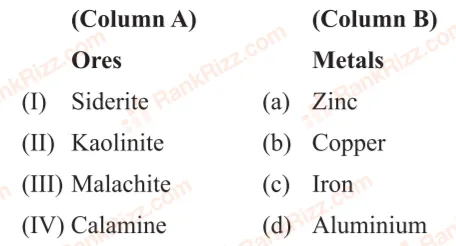
Match the ores (column A) with the metals (column B):
A (I)-(a); (II)-(b); (III)-(c); (IV)-(d)
B (I)-(c); (II)-(d); (III)-(b); (IV)-(a)
C (I)-(c); (II)-(d); (III)-(a); (IV)-(b)
D (I)-(b); (II)-(c); (III)-(d); (IV)-(a)
JEE MAIN 2019 · 11 JAN S2 Extraction of Fe, Cu, Zn, Al, Ag and Au
The reaction that does NOT define calcination is:
A F e 2 O 3 ⋅ x H 2 O → Δ F e 2 O 3 + x H 2 O Fe_2O_3 \cdot xH_2O \xrightarrow{\Delta} Fe_2O_3 + xH_2O F e 2 O 3 ⋅ x H 2 O Δ F e 2 O 3 + x H 2 O
B 2 C u 2 S + 3 O 2 → Δ 2 C u 2 O + 2 S O 2 2Cu_2S + 3O_2 \xrightarrow{\Delta} 2Cu_2O + 2SO_2 2 C u 2 S + 3 O 2 Δ 2 C u 2 O + 2 S O 2
C Z n C O 3 → Δ Z n O + C O 2 ZnCO_3 \xrightarrow{\Delta} ZnO + CO_2 Z n C O 3 Δ Z n O + C O 2
D C a C O 3 ⋅ M g C O 3 → Δ C a O + M g O + 2 C O 2 CaCO_3 \cdot MgCO_3 \xrightarrow{\Delta} CaO + MgO + 2CO_2 C a C O 3 ⋅ M g C O 3 Δ C a O + M g O + 2 C O 2
JEE MAIN 2019 · 10 JAN S1 Extraction of Fe, Cu, Zn, Al, Ag and Au
Hall Heroult's process is given by:
A C r 2 O 3 + 2 A l → A l 2 O 3 + C r Cr_2O_3 + 2Al \rightarrow Al_2O_3 + Cr C r 2 O 3 + 2 A l → A l 2 O 3 + C r
B 2 A l 2 O 3 + 3 C → 4 A l + 3 C O 2 2Al_2O_3 + 3C \rightarrow 4Al + 3CO_2 2 A l 2 O 3 + 3 C → 4 A l + 3 C O 2
C C u 2 + ( a q ) + H 2 ( g ) → C u ( s ) + 2 H + ( a q ) Cu^{2+}(aq) + H_2(g) \rightarrow Cu(s) + 2H^+(aq) C u 2 + ( a q ) + H 2 ( g ) → C u ( s ) + 2 H + ( a q )
D Z n O + C → C o k e , 1673 Z n + C O ZnO + C \xrightarrow{Coke, 1673} Zn + CO Z n O + C C o k e , 1673 Z n + C O
JEE MAIN 2019 · 10 JAN S2 Refining of metals
The electrolytes usually used in the electroplating of gold and silver, respectively, are:
A [ A u ( N H 3 ) 2 ] + [Au(NH_3)_2]^+ [ A u ( N H 3 ) 2 ] + [ A g ( C N ) 2 ] − [Ag(CN)_2]^- [ A g ( C N ) 2 ] −
B [ A u ( C N ) 2 ] − [Au(CN)_2]^- [ A u ( C N ) 2 ] − [ A g C l 2 ] − [AgCl_2]^- [ A g C l 2 ] −
C [ A u ( O H ) 4 ] − [Au(OH)_4]^- [ A u ( O H ) 4 ] − [ A g ( O H ) 2 ] − [Ag(OH)_2]^- [ A g ( O H ) 2 ] −
D [ A u ( C N ) 2 ] − [Au(CN)_2]^- [ A u ( C N ) 2 ] − [ A g ( C N ) 2 ] − [Ag(CN)_2]^- [ A g ( C N ) 2 ] −
JEE MAIN 2019 · 09 JAN S1 Occurrence of metals: minerals and ores
The ore that contains both iron and copper is:
A B C D JEE MAIN 2019 · 09 JAN S2 Thermodynamic principles and Ellingham diagram
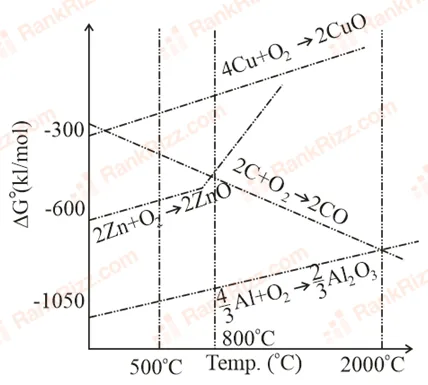
The correct statement regarding the given Ellingham diagram is:
A At 1400∘ ^{\circ} ∘
B At 500∘ ^{\circ} ∘
C At 800∘ ^{\circ} ∘
D Coke cannot be used for the extraction of Cu from Cu2 _2 2