RankRizz

General Principles and Processes of Isolation of Metals — JEE Main Previous Year Questions

Every General Principles and Processes of Isolation of Metals question JEE Main has set from 2004–2023, grouped by the idea it tests rather than the order of the syllabus. 120 questions across 5 distinct ideas. Free to read, answer key on every one.

DATA UPDATED

Questions

120

Distinct ideas

5

Share of marks

0%

Difficulty

EASY

The ideas inside General Principles and Processes of Isolation of Metals

A chapter is not one subject — it is a handful of procedures the examiner reuses. These are the ones General Principles and Processes of Isolation of Metals questions actually test.

Every General Principles and Processes of Isolation of Metals question

61–80 OF 120 · NEWEST FIRST

JEE MAIN 2021 · 17 MAR S2Occurrence of metals: minerals and ores

Match List-I and List-II:
List-I                                                       List-II
a. Haematite                                           i. Al2_2O3_3 . xH2_2O
b. Bauxite                                               ii. Fe2_2O3_3
c. Magnetite                                           iii. CuCO3_3 . Cu(OH)2_2
d. Malachite                                            iv. Fe3_3O4_4
Choose the correct answer from the options given below:

  1. A

    (a)-(ii), (b)-(iii), (c)-(i), (d)-(iv)

  2. B

    (a)-(iv), (b)-(i), (c)-(ii), (d)-(iii)

  3. C

    (a)-(i), (b)-(iii), (c)-(ii), (d)-(iv)

  4. D

    (a)-(ii), (b)-(i), (c)-(iv), (d)-(iii)
JEE MAIN 2021 · 16 MAR S1Thermodynamic principles and Ellingham diagram

The process that involves the removal of sulphur from the ores is:

  1. A

    Smelting

  2. B

    Roasting

  3. C

    Leaching

  4. D

    Refining

JEE MAIN 2021 · 16 MAR S2Thermodynamic principles and Ellingham diagram

Which of the following reduction reaction CANNOT be carried out with coke?

  1. A

    Al2O3→AlAl_2O_3 \to Al

  2. B

    ZnO→ZnZnO \to Zn

  3. C

    Fe2O3→FeFe_2O_3 \to Fe

  4. D

    Cu2O→CuCu_2O \to Cu

JEE MAIN 2021 · 26 FEB S2Extraction of Fe, Cu, Zn, Al, Ag and Au

Match List-I with List-II.

List-IList-II
(a) Sodium Carbonate(i) Deacon
(b) Titanium(ii) Castner-Kellner
(c) Chlorine(iii) van-Arkel
(d) Sodium hydroxide(iv) Solvay

Choose the correct answer from the options given below:
  1. A

    (a)→\rightarrow(i), (b)→\rightarrow(iii), (c)→\rightarrow(iv), (d)→\rightarrow(ii)

  2. B

    (a)→\rightarrow(iii), (b)→\rightarrow(ii), (c)→\rightarrow(i), (d)→\rightarrow(iv)

  3. C

    (a)→\rightarrow(iv), (b)→\rightarrow(i), (c)→\rightarrow(ii), (d)→\rightarrow(iii)

  4. D

    (a)→\rightarrow(iv), (b)→\rightarrow(iii), (c)→\rightarrow(i), (d)→\rightarrow(ii)

JEE MAIN 2021 · 26 FEB S2Occurrence of metals: minerals and ores

Match List-I with List-II.

List-I (Ore)List-II (Metal)
(a) Siderite(i) Cu
(b) Calamine(ii) Ca
(c) Malachite(iii) Fe
(d) Cryolite(iv) Al
(v) Zn

Choose the correct answer from the options given below:
  1. A

    (a)→\rightarrow(iii), (b)→\rightarrow(i), (c)→\rightarrow(v), (d)→\rightarrow(ii)

  2. B

    (a)→\rightarrow(i), (b)→\rightarrow(ii), (c)→\rightarrow(v), (d)→\rightarrow(iii)

  3. C

    (a)→\rightarrow(iii), (b)→\rightarrow(v), (c)→\rightarrow(i), (d)→\rightarrow(iv)

  4. D

    (a)→\rightarrow(i), (b)→\rightarrow(ii), (c)→\rightarrow(iii), (d)→\rightarrow(iv)

JEE MAIN 2021 · 25 FEB S1Thermodynamic principles and Ellingham diagram

Ellingham diagram is a graphical representation of:

  1. A

    ΔG\Delta G vs P

  2. B

    (ΔG−TΔS)(\Delta G - T\Delta S) vs T

  3. C

    ΔH\Delta H vs T

  4. D

    ΔG\Delta G vs T

JEE MAIN 2021 · 25 FEB S2Refining of metals

The method used for the purification of Indium is:

  1. A

    vapour phase refining

  2. B

    liquation

  3. C

    zone refining

  4. D

    van Arkel method

JEE MAIN 2021 · 25 FEB S2Occurrence of metals: minerals and ores

The major components of German Silver are:

  1. A

    Zn, Ni and Ag

  2. B

    Cu, Zn and Ni

  3. C

    Ge, Cu and Ag

  4. D

    Cu, Zn and Ag

JEE MAIN 2021 · 24 FEB S1Concentration of ores, calcination and roasting

Al2O3Al_2O_3 was leached with alkali to get X. The solution of X on passing of gas Y, forms Z. X, Y and Z respectively are

  1. A

    X=AlOH3,Y=CO2,Z=Al2O3X = AlOH_3, Y = CO_2, Z = Al_2O_3

  2. B

    X=NaAlOH4,Y=SO2,Z=Al2O3X = NaAlOH_4, Y = SO_2, Z = Al_2O_3

  3. C

    X=AlOH3,Y=SO2,Z=Al2O3⋅xH2OX = AlOH_3, Y = SO_2, Z = Al_2O_3 \cdot xH_2O

  4. D

    X=NaAlOH4,Y=CO2,Z=Al2O3,xH2OX = NaAlOH_4, Y = CO_2, Z = Al_2O_3, xH_2O

JEE MAIN 2021 · 24 FEB S1Occurrence of metals: minerals and ores

Which of the following ore is concentrated using group 1 cyanide salt?

  1. A

    Malachite

  2. B

    Calamine

  3. C

    Siderite

  4. D

    Sphalerite

JEE MAIN 2021 · 24 FEB S1Occurrence of metals: minerals and ores

The major components in "Gun Metal" are:

  1. A

    Cu, Sn and Zn

  2. B

    Al, Cu, Mg and Mn

  3. C

    Cu, Ni and Fe

  4. D

    Cu, Zn and Ni

JEE MAIN 2021 · 24 FEB S2Occurrence of metals: minerals and ores

Match List - I with List - II.

List-I (Metal)List-II (Ores)
(a) Aluminium(i) Siderite
(b) Iron(ii) Calamine
(c) Copper(iii) Kaolinite
(d) Zinc(iv) Malachite

Choose the correct answer from the options given below:
  1. A

    (a)-(ii), (b)-(iv), (c)-(i), (d)-(iii)

  2. B

    (a)-(iv), (b)-(iii), (c)-(ii), (d)-(i)

  3. C

    (a)-(i), (b)-(ii), (c)-(iii), (d)-(iv)

  4. D

    (a)-(iii), (b)-(i), (c)-(iv), (d)-(ii)

JEE MAIN 2020 · 06 SEP S1Occurrence of metals: minerals and ores

The INCORRECT statement is:

  1. A

    bronze is an alloy of copper and tin

  2. B

    cast iron is used to manufacture wrought iron

  3. C

    german silver is an alloy of zinc, copper and nickel

  4. D

    brass is an alloy of copper and nickel

JEE MAIN 2020 · 06 SEP S2Thermodynamic principles and Ellingham diagram

For a reaction 4M(s)+nO2(g)→2M2On(s)4M(s) + nO_2(g) \to 2M_2O_n(s). The free energy change is plotted as a function of temperature. The temperature below which the oxide is stable could be inferred from the plot as the point at which:

  1. A

    the slope change from negative to positive

  2. B

    the free energy change show a change from negative to positive value

  3. C

    the slope changes from positive to negative

  4. D

    the slope changes from positive to zero

JEE MAIN 2020 · 06 SEP S2Refining of metals

The element that can be refined by distillation is:

  1. A

    nickel

  2. B

    zinc

  3. C

    tin

  4. D

    gallium

JEE MAIN 2020 · 05 SEP S1Thermodynamic principles and Ellingham diagram

An Ellingham diagram provides information about:

  1. A

    the conditions of pH and potential under which a species is thermodynamically stable

  2. B

    the temperature dependence of the standard Gibbs energies of formation of some metal oxides

  3. C

    the pressure dependence of the standard electrode potentials of reduction reactions involved in the extraction of metals

  4. D

    the kinetics of the reduction process

JEE MAIN 2020 · 05 SEP S2Refining of metals

Boron and silicon of very high purity can be obtained through:

  1. A

    liquation

  2. B

    zone refining

  3. C

    vapour phase refining

  4. D

    electrolytic refining

JEE MAIN 2020 · 04 SEP S1Refining of metals

Among statements (a) - (d), the correct ones are:
(a) Lime stone is decomposed to CaO during the extraction of iron from its oxides.
(b) In the extraction of silver, silver is extracted as an anionic complex.
(c) Nickel is purified by Mond's process.
(d) Zr and Ti are purified by Van Arkel method.

  1. A

    (a), (b), (c) and (d)

  2. B

    (a), (c) and (d) only

  3. C

    (b), (c) and (d) only

  4. D

    (c) and (d) only

JEE MAIN 2020 · 02 SEP S2Extraction of Fe, Cu, Zn, Al, Ag and Au

Cast iron is used for the manufacture of:

  1. A

    wrought iron and pig iron

  2. B

    pig iron, scrap iron and steel

  3. C

    wrought iron, pig iron and steel

  4. D

    wrought iron and steel

JEE MAIN 2020 · 09 JAN S1Thermodynamic principles and Ellingham diagram

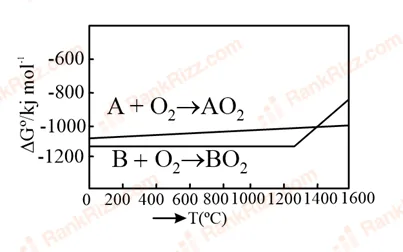
According to the following diagram, A reduces BO2BO_2 when the temperature is:

Figure for JEE Main 2020 Chemistry question on Thermodynamic principles and Ellingham diagram
  1. A

    <1400°C< 1400°C

  2. B

    >1400°C> 1400°C

  3. C

    >1200°C> 1200°C but <1400°C< 1400°C

  4. D

    <1200°C< 1200°C