RankRizz

General Principles and Processes of Isolation of Metals — JEE Advanced Previous Year Questions

General Principles and Processes of Isolation of Metals has been asked in 14 of the 20 JEE Advanced years from 2007 to 2026: 22 questions in all. It was not set in any of the 2 2026 papers. Across the last 20 papers it carried 2.3% of Chemistry questions. By type: 11 multiple-correct, 9 single-correct and 2 match-the-list. Of the 22 with a difficulty tag, 73% are easy, 27% medium and 0% hard. Most asked: Extraction of Fe, Cu, Zn, Al, Ag and Au (17, 77%), Occurrence of metals: minerals and ores (4, 18%) and Refining of metals (1, 5%).

DATA UPDATED

Questions

22

Distinct ideas

3

Share of marks

2.3%

Difficulty

EASY

General Principles and Processes of Isolation of Metals weightage, year by year

The share of each year’s Chemistry questions that came from General Principles and Processes of Isolation of Metals, counted from the 19 papers we hold for the last 10 years, and paper by paper inside a year.

Falling: 0.0% of Chemistry questions in 2024–2026, down from 3.0% in 2017–2023. Its heaviest year was 2019, at 5.6%. Not asked at all in 2017, 2018, 2024, 2025, 2026.

General Principles and Processes of Isolation of Metals questions per year, per paper, and as a share of Chemistry questions
YEARQSPER PAPERSHARE OF CHEMISTRYCHANGE
20260 / 340.00.0%level
20250 / 320.00.0%level
20240 / 340.00.0%−2.9 pts
20231 / 340.52.9%−2.7 pts
20222 / 361.05.6%+3.0 pts
20211 / 380.52.6%−0.2 pts
20201 / 360.52.8%−2.8 pts
20192 / 361.05.6%+5.6 pts
20180 / 180.00.0%level
20170 / 360.00.0%—

“QS” is General Principles and Processes of Isolation of Metals questions out of all Chemistry questions that year; “per paper” is that count over the year’s papers, and “change” is the share against the year before. A year with more sittings asks more questions, which is why the share, not the count, is the number to compare.

The ideas inside General Principles and Processes of Isolation of Metals

A chapter is not one subject — it is a handful of procedures the examiner reuses. These are the ones General Principles and Processes of Isolation of Metals questions actually test.

01Occurrence of metals: minerals and oresset 4×
02Concentration of ores, calcination and roastingNot set in Advanced
03Thermodynamic principles and Ellingham diagramNot set in Advanced
04Extraction of Fe, Cu, Zn, Al, Ag and Auset 17×
05Refining of metalsset 1×

All 22 General Principles and Processes of Isolation of Metals questions, by topic

Every JEE Advanced General Principles and Processes of Isolation of Metals question we hold, newest first inside each topic. Open one for its options, answer key and solution.

Extraction of Fe, Cu, Zn, Al, Ag and Au17 QUESTIONS

  1. The correct statement(s) related to processes involved in the extraction of metals is(are)2023 · PAPER 1
  2. The electrochemical extraction of aluminum from bauxite ore involves2022 · PAPER 1
  3. The correct option(s) related to the extraction of iron from its ore in the blast furnace operating in the temperature range 900 - 1500 K…2022 · PAPER 2
  4. T he correct statement(s) related to the metal extraction processes is(are)2021 · PAPER 1
  5. Which among the following statement(s) is(are) true for the extraction of aluminium from bauxite?2020 · PAPER 2
  6. The cyanide process of gold extraction involves leaching out gold from its ore with CN⁻ in the presence of Q in water to form R…2019 · PAPER 2
  7. Extraction of copper from copper pyrite (CuFeS₂) involves2016 · PAPER 2
  8. Upon heating with Cu₂S, the reagent(s) that give copper metal is/are2014 · PAPER 1
  9. The carbon-based reduction method is NOT used for the extraction of2013 · PAPER 2
  10. In the cyanide extraction process of silver from argentite ore, the oxidizing and reducing agents used are2012 · PAPER 2
  11. Extraction of metal from the ore cassiterite involves -2011 · PAPER 1
  12. Partial roasting of chalcopyrite produces2010 · PAPER 1
  13. Iron is removed from chalcopyrite as2010 · PAPER 1
  14. In self-reduction, the reducing species is2010 · PAPER 1
  15. Native silver metal forms a water soluble complex with a dilute aqueous solution of NaCN in the presence of2008 · PAPER 1
  16. Match the conversions in Column I with the type(s) of reaction(s) given in Column II. Indicate your answer by darkening the appropriate…2008 · PAPER 2
  17. Extraction of zinc from zinc blende is achieved by2007 · PAPER 1

FREE PDF

General Principles and Processes of Isolation of Metals JEE Advanced PYQs with answer key

All 22 questions on A4, by topic, with the answer key at the end. No sign-up, no email: your browser saves it as a PDF.

Download free PDF

UNIQUE CONCEPTS

General Principles and Processes of Isolation of Metals: one question per idea

5 ideas, each with the latest past question that tested it, drawn from 142 JEE Main and Advanced questions.

General Principles and Processes of Isolation of Metals Unique Concepts sheet →

JEE MAIN

General Principles and Processes of Isolation of Metals in JEE Main

JEE Main has set 120 General Principles and Processes of Isolation of Metals questions, 2004–2023.

General Principles and Processes of Isolation of Metals JEE Main PYQs →

General Principles and Processes of Isolation of Metals: quick answers

Is General Principles and Processes of Isolation of Metals asked every year in JEE Advanced?

Not every year. It has been asked in 14 of the 20 JEE Advanced years from 2007 to 2026; the years without a General Principles and Processes of Isolation of Metals question were 2009, 2017, 2018, 2024, 2025 and 2026.

Which General Principles and Processes of Isolation of Metals topic is asked most in JEE Advanced?

Extraction of Fe, Cu, Zn, Al, Ag and Au: 17 of the 22 questions (77%). Next come Occurrence of metals: minerals and ores (4) and Refining of metals (1).

What share of Chemistry questions does General Principles and Processes of Isolation of Metals carry in JEE Advanced?

About 2.3% of Chemistry questions across the last 20 papers. In 2026 it was 0.0% (0 of 34 Chemistry questions).

When was General Principles and Processes of Isolation of Metals last asked in JEE Advanced?

In JEE Advanced 2023 Paper 1, the latest sitting with a General Principles and Processes of Isolation of Metals question. It has not been set since 2023, though the bank holds JEE Advanced papers up to 2026.

How many General Principles and Processes of Isolation of Metals questions has JEE Advanced asked?

22 from 2007 to 2023, across 3 topics. Every one is listed on this page by topic and links to its own page, with the answer key and solution wherever we have them. Free, no sign-up.

Every General Principles and Processes of Isolation of Metals question

1–20 OF 22 · NEWEST FIRST

JEE ADVANCED 2023 · PAPER 1Extraction of Fe, Cu, Zn, Al, Ag and Au

The correct statement(s) related to processes involved in the extraction of metals is(are)

  1. A

    Roasting of Malachite produces Cuprite.

  2. B

    Calcination of Calamine produces Zincite.

  3. C

    Copper pyrites is heated with silica in a reverberatory furnace to remove iron.

  4. D

    Impure silver is treated with aqueous KCN in the presence of oxygen followed by reduction with zinc metal.

JEE ADVANCED 2022 · PAPER 1Extraction of Fe, Cu, Zn, Al, Ag and Au

The electrochemical extraction of aluminum from bauxite ore involves

  1. A

    the reaction of Al2_2O3_3 with coke (C) at a temperature > 2500°C.

  2. B

    the neutralization of aluminate solution by passing CO2_2 gas to precipitate hydrated alumina (Al2_2O3_3.3H2_2O)

  3. C

    the dissolution of Al2_2O3_3 in hot aqueous NaOH.

  4. D

    the electrolysis of Al2_2O3_3 mixed with Na3_3AlF6_6 to give Al and CO2_2.

JEE ADVANCED 2022 · PAPER 2Extraction of Fe, Cu, Zn, Al, Ag and Au

The correct option(s) related to the extraction of iron from its ore in the blast furnace operating in the temperature range 900 - 1500 K is(are)

  1. A

    Limestone is used to remove silicate impurity.

  2. B

    Pig iron obtained from blast furnace contains about 4% carbon.

  3. C

    Coke (C) converts CO2_2 to CO.

  4. D

    Exhaust gases consist of NO2_2 and CO.

JEE ADVANCED 2021 · PAPER 1Extraction of Fe, Cu, Zn, Al, Ag and Au

T he correct statement(s) related to the metal extraction processes is(are)

  1. A

    A mixture of PbS and PbO undergoes self-reduction to produce Pb and SO2SO_2.

  2. B

    In the extraction process of copper from copper pyrites, silica is added to produce copper silicate.

  3. C

    Partial oxidation of sulphide ore of copper by roasting, followed by self-reduction produces blister copper.

  4. D

    In cyanide process, zinc powder is utilized to precipitate gold from Na[Au(CN)2]Na[Au(CN)_2].

JEE ADVANCED 2020 · PAPER 2Extraction of Fe, Cu, Zn, Al, Ag and Au

Which among the following statement(s) is(are) true for the extraction of aluminium from bauxite?

  1. A

    Hydrated Al2O3Al_2O_3 precipitates, when CO2CO_2 is bubbled through a solution of sodium aluminate.

  2. B

    Addition of Na3AlF6Na_3AlF_6 lowers the melting point of alumina.

  3. C

    CO2CO_2 is evolved at the anode during electrolysis.

  4. D

    The cathode is a steel vessel with a lining of carbon.

JEE ADVANCED 2019 · PAPER 2Extraction of Fe, Cu, Zn, Al, Ag and Au

The cyanide process of gold extraction involves leaching out gold from its ore with CN−CN^{-} in the presence of Q in water to form R. Subsequently, R is treated with T to obtain Au and Z. Choose the correct option(s)

  1. A

    Q is O2O_2

  2. B

    T is Zn

  3. C

    Z is [Zn(CN)4]2−[Zn(CN)_4]^{2-}

  4. D

    R is [Au(CN)4]−[Au(CN)_4]^-

JEE ADVANCED 2019 · PAPER 1Occurrence of metals: minerals and ores

Calamine, malachite, magnetite and cryolite, respectively, are

  1. A

    ZnSO4,CuCO3,Fe2O3,AlF3ZnSO_4, CuCO_3, Fe_2O_3, AlF_3

  2. B

    ZnSO4,Cu(OH)2,Fe304,,Na3AlF6ZnSO_4, Cu(OH)_2, Fe_30_4,, Na_3AlF_6

  3. C

    ZnCO3,CuCO3.Cu(OH)2,Fe3O4,Na3AlF6ZnCO_3, CuCO_3.Cu(OH)_2, Fe_3O_4, Na_3AlF_6

  4. D

    ZnCO3,CuCO3,Fe2O3,Na3AlF6ZnCO_3, CuCO_3, Fe_2O_3, Na_3AlF_6

JEE ADVANCED 2016 · PAPER 2Extraction of Fe, Cu, Zn, Al, Ag and Au

Extraction of copper from copper pyrite (CuFeS2)(CuFeS_2) involves

  1. A

    crushing followed by concentration of the ore by froth-flotation.

  2. B

    removal of iron as slag

  3. C

    self-reduction step to produce ‘blister copper’following evolution of SO2SO_2

  4. D

    refining of ‘blister copper’ by carbon reduction

JEE ADVANCED 2015 · PAPER 1Refining of metals

Copper is purified by electrolytic refining of blister copper. The correct statement(s) about this process is (are)

  1. A

    Impure Cu strip is used as cathode

  2. B

    Acidified aqueous CuSO4CuSO_4 is used as electrolyte

  3. C

    Pure Cu deposits at cathode

  4. D

    Impurities settle as anode-mud

JEE ADVANCED 2015 · PAPER 1Occurrence of metals: minerals and ores

Match the anionic species given in Column I that are present in the ore(s) given in Column II.
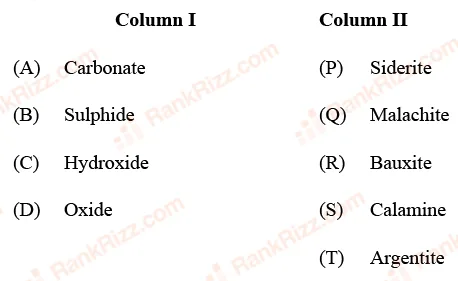
Figure for JEE Advanced 2015 Chemistry question on Occurrence of metals: minerals and ores
JEE ADVANCED 2014 · PAPER 1Extraction of Fe, Cu, Zn, Al, Ag and Au

Upon heating with Cu2SCu_2S, the reagent(s) that give copper metal is/are

  1. A

    CuFeS2CuFeS_2

  2. B

    CuOCuO

  3. C

    Cu2OCu_2O

  4. D

    CuSO4CuSO_4

JEE ADVANCED 2013 · PAPER 2Extraction of Fe, Cu, Zn, Al, Ag and Au

The carbon-based reduction method is NOT used for the extraction of

  1. A

    tin from SnO2SnO_{2}

  2. B

    iron from Fe2O3Fe_{2}O_{3}

  3. C

    aluminium from Al2O3Al_{2}O_{3}

  4. D

    magnesium from MgCO3.CaCO3M_{g}CO_{3}.CaCO_{3}

JEE ADVANCED 2013 · PAPER 1Occurrence of metals: minerals and ores

Sulfide ores are common for the metals

  1. A

    Ag, Cu and Pb

  2. B

    Ag, Cu and Sn

  3. C

    Ag, Mg and Pb

  4. D

    AL, Cu and Pb

JEE ADVANCED 2012 · PAPER 2Extraction of Fe, Cu, Zn, Al, Ag and Au

In the cyanide extraction process of silver from argentite ore, the oxidizing and reducing agents used are

  1. A

    O2O_2 and CO respectively

  2. B

    O2O_2 and Zn dust respectively

  3. C

    HNO3HNO_3 and Zn dust respectively

  4. D

    HNO3HNO_3 and CO respectively

JEE ADVANCED 2011 · PAPER 2Occurrence of metals: minerals and ores

Oxidation states of the metal in the minerals haematite and magnetite, respectively, are

  1. A

    II, III in haematite and III in magnetite

  2. B

    II, III in haematite and II in magnetite

  3. C

    II in haematite and II, III in magnetite

  4. D

    III in haematite and II, III in magnetite

JEE ADVANCED 2011 · PAPER 1Extraction of Fe, Cu, Zn, Al, Ag and Au

Extraction of metal from the ore cassiterite involves -

  1. A

    carbon reduction of an oxide ore

  2. B

    self-reduction of a sulphide ore

  3. C

    removal of copper impurity

  4. D

    removal of iron impurity

JEE ADVANCED 2010 · PAPER 1Extraction of Fe, Cu, Zn, Al, Ag and Au

Partial roasting of chalcopyrite produces

  1. A

    Cu2SCu{2}S and FeOFeO

  2. B

    Cu2OCu{2}O and FeOFeO

  3. C

    CuSCuS and Fe2O3Fe_{2}O_{3}

  4. D

    Cu2OCu_{2}O and Fe2O3Fe_{2}O_{3}

JEE ADVANCED 2010 · PAPER 1Extraction of Fe, Cu, Zn, Al, Ag and Au

Iron is removed from chalcopyrite as

  1. A

    FeOFeO

  2. B

    FeSFeS

  3. C

    Fe2O3Fe_{2}O_{3}

  4. D

    FeSiO3FeSiO_{3}

JEE ADVANCED 2010 · PAPER 1Extraction of Fe, Cu, Zn, Al, Ag and Au

In self-reduction, the reducing species is

  1. A

    SS

  2. B

    O2−O^{2-}

  3. C

    S2−S^{2-}

  4. D

    SO2SO{2}

JEE ADVANCED 2008 · PAPER 1Extraction of Fe, Cu, Zn, Al, Ag and Au

Native silver metal forms a water soluble complex with a dilute aqueous solution of NaCN in the presence of

  1. A

    nitrogen

  2. B

    oxygen

  3. C

    carbon dioxide

  4. D

    argon