General Principles and Processes of Isolation of Metals JEE Main PYQs with answer key
CHEMISTRY · 120 PAST QUESTIONS · 5 TOPICS · 2004–2023
HOW TO USE THIS SHEET
Every JEE Main General Principles and Processes of Isolation of Metals question we hold, grouped by topic, most-asked topic first and newest first inside each. The answer key is at the end (118 of 120 questions have a checked key); the worked solution is on each question’s page, printed beside it.
Extraction of Fe, Cu, Zn, Al, Ag and Au 35
In the extraction process of copper, the product obtained after carrying out the reactions
(i)
(ii) is called- (A)
Blister copper
- (B)
Reduced copper
- (C)
Copper scrap
- (D)
Copper matte
rr2.rankrizz.com/jee-main/chemistry/metallurgy/q/11-apr-2023-s1-q41
- (A)
Which of the following metals can be extracted through alkali leaching technique?
- (A)
Sn
- (B)
Pb
- (C)
Au
- (D)
Cu
rr2.rankrizz.com/jee-main/chemistry/metallurgy/q/8-apr-2023-s1-q40
- (A)
In Hall-Heroult process, the following is used for reducing AlO:-
- (A)
Magnesium
- (B)
NaAlF
- (C)
Graphite
- (D)
CaF
rr2.rankrizz.com/jee-main/chemistry/metallurgy/q/08-apr-2023-s2-q47
- (A)
Among following compounds, the number of those present in copper matte is ______
A. CuCO
B. CuS
C. CuO
D. FeOAnswer: ____________
rr2.rankrizz.com/jee-main/chemistry/metallurgy/q/01-feb-2023-s2-q58
Which one of the following statements is incorrect?
- (A)
van Arkel method is used to purify tungsten.
- (B)
The malleable iron is prepared from cast iron by oxidising impurities in a reverberatory furnace.
- (C)
Cast iron is obtained by melting pig iron with scrap iron and coke using hot air blast.
- (D)
Boron and Indium can be purified by zone refining method.
rr2.rankrizz.com/jee-main/chemistry/metallurgy/q/31-jan-2023-s2-q43
- (A)
In the extraction of copper, its sulphide ore is heated in a reverberatory furnace after mixing with silica to:
- (A)
separate CuO as CuSiO
- (B)
remove calcium as CaSiO
- (C)
decrease the temperature needed for roasting of CuS
- (D)
remove FeO as FeSiO
rr2.rankrizz.com/jee-main/chemistry/metallurgy/q/30-jan-2023-s1-q40
- (A)
Which one of the following reactions does not occur during extraction of copper?
- (A)
2CuS + 3O 2CuO + 2SO
- (B)
2FeS + 3O 2FeO + 2SO
- (C)
CaO + SiO CaSiO
- (D)
FeO + SiO FeSiO
rr2.rankrizz.com/jee-main/chemistry/metallurgy/q/25-jan-2023-s1-q39
- (A)
Match List I with List II.
List I List II
A. Reverberatory furnace I. Pig iron
B. Electrolytic cell II. Aluminium
C. Blast furnace III. Silicon
D. Zone refining furnace IV. Copper- (A)
A - IV, B - II, C - I, D - III
- (B)
A - I, B - IV, C - II, D - III
- (C)
A - I, B - III, C - II, D - IV
- (D)
A - III, B - IV, C - I, D - II
rr2.rankrizz.com/jee-main/chemistry/metallurgy/q/24-jan-2023-s1-q40-494055
- (A)
The metal which is extracted by oxidation and subsequent reduction from its ore is:
- (A)
Al
- (B)
Ag
- (C)
Cu
- (D)
Fe
rr2.rankrizz.com/jee-main/chemistry/metallurgy/q/24-jan-2023-s2-q40
- (A)
The metal that is not extracted from its sulphide ore is
- (A)
Aluminium
- (B)
Iron
- (C)
Lead
- (D)
Zinc
rr2.rankrizz.com/jee-main/chemistry/metallurgy/q/26-jul-2022-s2-q43
- (A)
The compound(s) that is(are) removed as slag during the extraction of copper is:
(1) CaO
(2) FeO
(3) Al₂O₃
(4) ZnO
(5) NiO
Choose the correct answer from the options given below- (A)
(3), (4) only
- (B)
(2) only
- (C)
(1), (2), (5) only
- (D)
(1), (2) only
rr2.rankrizz.com/jee-main/chemistry/metallurgy/q/25-jul-2022-s1-q42
- (A)
Given below are two statements.
Statement I: Pig iron is obtained by heating cast iron with scrap iron.
Statement II: Pig iron has a relatively lower carbon content than that of cast iron.
In the light of the above statements, choose the correct answer from the options given below.- (A)
Both Statement I and Statement II are correct
- (B)
Both Statement I and Statement II are not correct
- (C)
Statement I is correct but Statement II is not correct
- (D)
Statement I is not correct but Statement II is correct
rr2.rankrizz.com/jee-main/chemistry/metallurgy/q/25-jul-2022-s2-q43
- (A)
In isolation of which one of the following metals from their ores, the use of cyanide salt is commonly not involved?
- (A)
Zinc
- (B)
Silver
- (C)
Gold
- (D)
Copper
rr2.rankrizz.com/jee-main/chemistry/metallurgy/q/29-jun-2022-s1-q42
- (A)
In the metallurgical extraction of copper, following reaction is used:
FeO and FeSiO respectively are.- (A)
gangue and flux.
- (B)
flux and slag
- (C)
slag and flux.
- (D)
Gauge and slag
rr2.rankrizz.com/jee-main/chemistry/metallurgy/q/28-jun-2022-s2-q41
- (A)
Which of the following chemical reactions represents Hall-Heroult Process?
- (A)
- (B)
- (C)
- (D)
rr2.rankrizz.com/jee-main/chemistry/metallurgy/q/24-jun-2022-s2-q43
- (A)
Given below are two statements : one is labelled as Assertion (A) and the other is labelled as Reason (R).
Assertion (A) : Aluminium is extracted from bauxite by the electrolysis of molten mixture of AlO with cryolite.
Reason (R) : The oxidation state of Al in cryolite is +3.
In the light of the above statements, choose the most appropriate answer from the options given below:- (A)
Both (A) and (R) are correct and (R) is the correct explanation of (A).
- (B)
(A) is true but (R) is false.
- (C)
Both (A) and (R) are correct but (R) is not the correct explanation of (A).
- (D)
(A) is false but (R) is true.
rr2.rankrizz.com/jee-main/chemistry/metallurgy/q/31-aug-2021-s1-q48
- (A)
The addition of silica during the extraction of copper from its sulphide ore:-
- (A)
converts copper sulphide into copper silicate
- (B)
converts iron oxide into iron silicate
- (C)
reduces copper sulphide into metallic copper
- (D)
reduces the melting point of the reaction mixture
rr2.rankrizz.com/jee-main/chemistry/metallurgy/q/27-jul-2021-s2-q42
- (A)
Match List-I with List-II.
List-I List-II (a) Sodium Carbonate (i) Deacon (b) Titanium (ii) Castner-Kellner (c) Chlorine (iii) van-Arkel (d) Sodium hydroxide (iv) Solvay
Choose the correct answer from the options given below:- (A)
(a)(i), (b)(iii), (c)(iv), (d)(ii)
- (B)
(a)(iii), (b)(ii), (c)(i), (d)(iv)
- (C)
(a)(iv), (b)(i), (c)(ii), (d)(iii)
- (D)
(a)(iv), (b)(iii), (c)(i), (d)(ii)
rr2.rankrizz.com/jee-main/chemistry/metallurgy/q/26-feb-2021-s2-q39
- (A)
Cast iron is used for the manufacture of:
- (A)
wrought iron and pig iron
- (B)
pig iron, scrap iron and steel
- (C)
wrought iron, pig iron and steel
- (D)
wrought iron and steel
rr2.rankrizz.com/jee-main/chemistry/metallurgy/q/2-sep-2020-s2-q38
- (A)
Among the reactions (a) - (d), the reaction(s) that does/do not occur in the blast furnace during the extraction of iron is/are:
(a) CaO + SiO CaSiO
(b) 3FeO + CO 2FeO + CO
(c) FeO + SiO FeSiO
(d) FeO Fe + O- (A)
a
- (B)
a and d
- (C)
c and d
- (D)
d
rr2.rankrizz.com/jee-main/chemistry/metallurgy/q/8-jan-2020-s2-q31
- (A)
The purest form of commercial iron is:
- (A)
pig iron
- (B)
wrought iron
- (C)
cast iron
- (D)
scrap iron and pig iron
rr2.rankrizz.com/jee-main/chemistry/metallurgy/q/7-jan-2020-s1-q38
- (A)
The correct statement is:
- (A)
Pig iron is obtained from cast iron.
- (B)
The Hall-Heroult process is used for the production of aluminium and iron.
- (C)
leaching of bauxite using concentrated NaOH solution gives sodium aluminate and sodium silicate.
- (D)
the blistered appearance of copper during metallurgical process is due to the evolution of CO.
rr2.rankrizz.com/jee-main/chemistry/metallurgy/q/12-apr-2019-s2-q50
- (A)
Assertion: For the extraction of iron, haematite ore is used.
Reason: Haematite is a carbonate ore of iron.- (A)
Only the assertion is correct.
- (B)
Only the reason is correct.
- (C)
Both the assertion and reason are correct and the reason is the correct explanation for the assertion.
- (D)
Both the assertion and reason are correct, but the reason is not the correct explanation for the assertion.
rr2.rankrizz.com/jee-main/chemistry/metallurgy/q/9-apr-2019-s2-q46
- (A)
In the Hall-Heroult process, aluminium is formed at the cathode. The cathode is made out of:
- (A)
Platinum
- (B)
Carbon
- (C)
Copper
- (D)
Pure aluminium
rr2.rankrizz.com/jee-main/chemistry/metallurgy/q/12-jan-2019-s1-q49
- (A)
The pair that does not require calcination is
- (A)
ZnO and FeO . xHO
- (B)
ZnO and MgO
- (C)
ZnCO and CaO
- (D)
FeO and CaCO . MgCO
rr2.rankrizz.com/jee-main/chemistry/metallurgy/q/12-jan-2019-s2-q49
- (A)
The reaction that does NOT define calcination is:
- (A)
- (B)
- (C)
- (D)
rr2.rankrizz.com/jee-main/chemistry/metallurgy/q/11-jan-2019-s2-q49
- (A)
Hall Heroult's process is given by:
- (A)
- (B)
- (C)
- (D)
rr2.rankrizz.com/jee-main/chemistry/metallurgy/q/10-jan-2019-s1-q51
- (A)
In the extraction of copper from its sulphide ore, metal is finally obtained by the oxidation of cuprous sulphide with:
- (A)
SO
- (B)
FeO
- (C)
CuO
- (D)
CO
rr2.rankrizz.com/jee-main/chemistry/metallurgy/q/16-apr-2018-online-q47
- (A)
Extraction of copper by smelting uses silica as an additive to remove.
- (A)
- (B)
FeS
- (C)
FeO
- (D)
rr2.rankrizz.com/jee-main/chemistry/metallurgy/q/10-apr-2016-online-q49
- (A)
The form of iron obtained from blast furnace is:
- (A)
Cast Iron
- (B)
Wrought Iron
- (C)
Steel
- (D)
Pig Iron
rr2.rankrizz.com/jee-main/chemistry/metallurgy/q/9-apr-2014-online-q46
- (A)
In Goldschmidt aluminothermic process which of the following reducing agents is used :
- (A)
calcium
- (B)
coke
- (C)
Al-powder
- (D)
sodium
rr2.rankrizz.com/jee-main/chemistry/metallurgy/q/22-apr-2013-online-q49
- (A)
Calcination is the process in which:
- (A)
ore is heated above its melting point to expel or or
- (B)
ore is heated below its melting point to expel volatile impurities
- (C)
ore is heated above its melting point to remove S, As and Sb as , and respectively
- (D)
ore is heated below its melting point to expel or
rr2.rankrizz.com/jee-main/chemistry/metallurgy/q/9-apr-2013-online-q50
- (A)
Extraction of zinc from zinc blende is achieved by
- (A)
roasting followed by self-reduction
- (B)
electrolytic reduction
- (C)
roasting followed by reduction with carbon
- (D)
roasting followed by reduction with another metal
rr2.rankrizz.com/jee-main/chemistry/metallurgy/q/2012-chemistry-499340
- (A)
In the electrolysis of alumina to obtain aluminium metal, cryolite is added mainly to
- (A)
lower the melting point of alumina
- (B)
dissolve alumina in molten cryolite
- (C)
remove the impurities of alumina
- (D)
increase the electrical conductivity
rr2.rankrizz.com/jee-main/chemistry/metallurgy/q/2012-chemistry-499430
- (A)
Heating mixture of CuO and CuS will give
- (A)
Cu + SO
- (B)
Cu + SO
- (C)
CuO + CuS
- (D)
CuSO
rr2.rankrizz.com/jee-main/chemistry/metallurgy/q/2005-chemistry-500356
- (A)
Occurrence of metals: minerals and ores 23
The major component of which of the following ore is sulphide based mineral?
- (A)
Calamine
- (B)
Siderite
- (C)
Sphalerite
- (D)
Malachite
rr2.rankrizz.com/jee-main/chemistry/metallurgy/q/29-jan-2023-s2-q40
- (A)
In metallurgy the term "gangue" is used for
- (A)
Contamination of undesired earthy materials.
- (B)
Contamination of metals, other than desired metal
- (C)
Minerals which are naturally occurring in pure form
- (D)
Magnetic impurities in an ore.
rr2.rankrizz.com/jee-main/chemistry/metallurgy/q/29-jul-2022-s1-q40
- (A)
Among the following ores Bauxite, Siderite, Cuprite, Calamine, Haematite, Kaolinite, Malachite, Magnetite, Sphalerite, Limonite, Cryolite, the number of principal ores of iron is
Answer: ____________
rr2.rankrizz.com/jee-main/chemistry/metallurgy/q/27-jul-2022-s2-q58
Match List I with List II.
List I With Ore List II Composition
(A) Siderite (I) FeCO
(B) Malachite (II) CuCO · Cu(OH)
(C) Sphalerite (III) ZnS
(D) Calamine (IV) ZnCO
Choose the correct answer from the options given below:- (A)
A-I, B-II, C-III, D-IV
- (B)
A-III, B-IV, C-E, D-I
- (C)
A-IV, B-III, C-I, D-II
- (D)
A-I, B-II, C-IV, D-III
rr2.rankrizz.com/jee-main/chemistry/metallurgy/q/29-jun-2022-s2-q42
- (A)
Match List - I with List - II :
List-I List-II (A) Sphalerite (I) FeCO (B) Calamine (II) PbS (C) Galena (III) ZnCO (D) Siderite (IV) ZnS
Choose the most appropriate answer from the options given below :- (A)
(A) - (IV), (B) - (I), (C) - (II), (D) - (III)
- (B)
(A) - (IV), (B) - (III), (C) - (II), (D) - (I)
- (C)
(A) - (II), (B) - (II), (C) - (I), (D) - (IV)
- (D)
(A) - (III), (B) - (IV), (C) - (II), (D) - (I)
rr2.rankrizz.com/jee-main/chemistry/metallurgy/q/24-jun-2022-s1-q40
- (A)
(a) Baryte, (b) Galena, (c) Zinc blende and (d) Copper pyrites. How many of these minerals are sulphide based? ______
Answer: ____________
rr2.rankrizz.com/jee-main/chemistry/metallurgy/q/24-jun-2022-s2-q58
Calamine and Malachite, respectively, are the ores of:
- (A)
Copper and Iron
- (B)
Zinc and Copper
- (C)
Aluminium and Zinc
- (D)
Nickel and Aluminium
rr2.rankrizz.com/jee-main/chemistry/metallurgy/q/1-sep-2021-s2-q40
- (A)
Match List-I with List-II:
List-I (Name of ore/mineral) List-II (Chemical formula)
(a) Calamine (i) ZnS
(b) Malachite (ii) FeCO
(c) Siderite (iii) ZnCO
(d) Sphalerite (iv) CuCO.Cu(OH)
Choose the most appropriate answer from the options given below:- (A)
(a) - (iv), (b) - (iii), (c) - (i), (d) - (ii)
- (B)
(a) - (iii), (b) - (ii), (c) - (iv), (d) - (i)
- (C)
(a) - (iii), (b) - (iv), (c) - (i), (d) - (ii)
- (D)
(a) - (iii), (b) - (iv), (c) - (ii), (d) - (i)
rr2.rankrizz.com/jee-main/chemistry/metallurgy/q/27-aug-2021-s2-q38
- (A)
Given below are two statements:
Statement I : Sphalerite is a sulphide ore of zinc and copper glance is a sulphide ore of copper.
Statement II : It is possible to separate two sulphide ores by adjusting proportion of oil to water or by using depressants in a froth flotation method.
Choose the most appropriate answer from the options given below:- (A)
Statement I is true but Statement II is false.
- (B)
Both Statement I and Statement II are true.
- (C)
Both Statement I and Statement II are false.
- (D)
Statement I is false but Statement II is true.
rr2.rankrizz.com/jee-main/chemistry/metallurgy/q/26-aug-2021-s2-q41
- (A)
Sulphide ion is soft base and its ores are common for metals
(a) Pb (b) Al (c) Ag (d) Mg
Choose the correct answer from the options given below- (A)
a and c only
- (B)
a and d only
- (C)
a and b only
- (D)
c and d only
rr2.rankrizz.com/jee-main/chemistry/metallurgy/q/22-jul-2021-s1-q43
- (A)
Match List-I and List-II:
List-I List-II
a. Haematite i. AlO . xHO
b. Bauxite ii. FeO
c. Magnetite iii. CuCO . Cu(OH)
d. Malachite iv. FeO
Choose the correct answer from the options given below:- (A)
(a)-(ii), (b)-(iii), (c)-(i), (d)-(iv)
- (B)
(a)-(iv), (b)-(i), (c)-(ii), (d)-(iii)
- (C)
(a)-(i), (b)-(iii), (c)-(ii), (d)-(iv)
- (D)
(a)-(ii), (b)-(i), (c)-(iv), (d)-(iii)
rr2.rankrizz.com/jee-main/chemistry/metallurgy/q/17-mar-2021-s2-q42
- (A)
Match List-I with List-II.
List-I (Ore) List-II (Metal) (a) Siderite (i) Cu (b) Calamine (ii) Ca (c) Malachite (iii) Fe (d) Cryolite (iv) Al (v) Zn
Choose the correct answer from the options given below:- (A)
(a)(iii), (b)(i), (c)(v), (d)(ii)
- (B)
(a)(i), (b)(ii), (c)(v), (d)(iii)
- (C)
(a)(iii), (b)(v), (c)(i), (d)(iv)
- (D)
(a)(i), (b)(ii), (c)(iii), (d)(iv)
rr2.rankrizz.com/jee-main/chemistry/metallurgy/q/26-feb-2021-s2-q40
- (A)
The major components of German Silver are:
- (A)
Zn, Ni and Ag
- (B)
Cu, Zn and Ni
- (C)
Ge, Cu and Ag
- (D)
Cu, Zn and Ag
rr2.rankrizz.com/jee-main/chemistry/metallurgy/q/25-feb-2021-s2-q44
- (A)
Which of the following ore is concentrated using group 1 cyanide salt?
- (A)
Malachite
- (B)
Calamine
- (C)
Siderite
- (D)
Sphalerite
rr2.rankrizz.com/jee-main/chemistry/metallurgy/q/24-feb-2021-s1-q40
- (A)
The major components in "Gun Metal" are:
- (A)
Cu, Sn and Zn
- (B)
Al, Cu, Mg and Mn
- (C)
Cu, Ni and Fe
- (D)
Cu, Zn and Ni
rr2.rankrizz.com/jee-main/chemistry/metallurgy/q/24-feb-2021-s1-q41
- (A)
Match List - I with List - II.
List-I (Metal) List-II (Ores) (a) Aluminium (i) Siderite (b) Iron (ii) Calamine (c) Copper (iii) Kaolinite (d) Zinc (iv) Malachite
Choose the correct answer from the options given below:- (A)
(a)-(ii), (b)-(iv), (c)-(i), (d)-(iii)
- (B)
(a)-(iv), (b)-(iii), (c)-(ii), (d)-(i)
- (C)
(a)-(i), (b)-(ii), (c)-(iii), (d)-(iv)
- (D)
(a)-(iii), (b)-(i), (c)-(iv), (d)-(ii)
rr2.rankrizz.com/jee-main/chemistry/metallurgy/q/24-feb-2021-s2-q41
- (A)
The INCORRECT statement is:
- (A)
bronze is an alloy of copper and tin
- (B)
cast iron is used to manufacture wrought iron
- (C)
german silver is an alloy of zinc, copper and nickel
- (D)
brass is an alloy of copper and nickel
rr2.rankrizz.com/jee-main/chemistry/metallurgy/q/6-sep-2020-s1-q40
- (A)
The ore that contains the metal in the form of fluoride is known as which of the following?
- (A)
cryolite
- (B)
magnetite
- (C)
malachite
- (D)
sphalerite
rr2.rankrizz.com/jee-main/chemistry/metallurgy/q/9-apr-2019-s1-q49
- (A)
The one that is not a carbonate ore is:
- (A)
malachite
- (B)
bauxite
- (C)
calamine
- (D)
siderite
rr2.rankrizz.com/jee-main/chemistry/metallurgy/q/9-apr-2019-s2-q45
- (A)
Match the ores (column A) with the metals (column B):
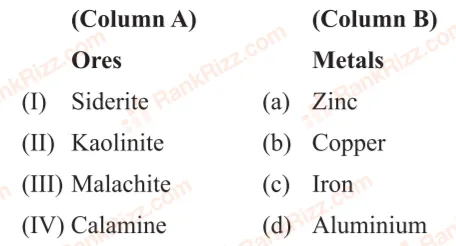
- (A)
(I)-(a); (II)-(b); (III)-(c); (IV)-(d)
- (B)
(I)-(c); (II)-(d); (III)-(b); (IV)-(a)
- (C)
(I)-(c); (II)-(d); (III)-(a); (IV)-(b)
- (D)
(I)-(b); (II)-(c); (III)-(d); (IV)-(a)
rr2.rankrizz.com/jee-main/chemistry/metallurgy/q/11-jan-2019-s1-q50
- (A)
The ore that contains both iron and copper is:
- (A)
Azurite
- (B)
Malachite
- (C)
Dolomite
- (D)
Copper pyrites
rr2.rankrizz.com/jee-main/chemistry/metallurgy/q/9-jan-2019-s1-q51
- (A)
Calamine is an ore of:
- (A)
Iron
- (B)
Copper
- (C)
Aluminium
- (D)
Zinc
rr2.rankrizz.com/jee-main/chemistry/metallurgy/q/11-apr-2015-online-q50
- (A)
Which one of the following ores is known as Malachite:
- (A)
CuS
- (B)
CuO
- (C)
Cu(OH) · CuCO
- (D)
CuFeS
rr2.rankrizz.com/jee-main/chemistry/metallurgy/q/19-apr-2014-online-q48
- (A)
Refining of metals 23
Which one of the following is most likely a mismatch?
- (A)
Zinc-Liquation
- (B)
Copper-Electrolysis
- (C)
Nickel-Mond process
- (D)
Titanium-van Arkel Method
rr2.rankrizz.com/jee-main/chemistry/metallurgy/q/13-apr-2023-s1-q41
- (A)
Given below are two statements:
Statement I: During Electrolytic refining, the pure metal is made to act as anode and its impure metallic form is used as cathode.
Statement II: During the Hall-Heroult electrolysis process, purified AlO is mixed with NaAlF to lower the melting point of the mixture.
In the light of the above statements, choose the most appropriate answer from the options given below:- (A)
Statement I is incorrect but Statement II is correct
- (B)
Both Statement I and Statement II are incorrect
- (C)
Statement I is correct but Statement II is incorrect
- (D)
Both Statement I and Statement II are correct
rr2.rankrizz.com/jee-main/chemistry/metallurgy/q/30-jan-2023-s2-q42
- (A)
The reaction representing the Mond process for metal refining is ______
- (A)
- (B)
- (C)
- (D)
rr2.rankrizz.com/jee-main/chemistry/metallurgy/q/29-jan-2023-s1-q43
- (A)
In liquation process used for tin (Sn), the metal
- (A)
is reacted with acid
- (B)
is dissolved in water
- (C)
is brought to molten form which is made to flow on a slope
- (D)
is fused with NaOH
rr2.rankrizz.com/jee-main/chemistry/metallurgy/q/29-jul-2022-s2-q42
- (A)
Which of the following methods are not used to refine any metal?
(A) Liquation
(B) Calcination
(C) Electrolysis
(D) Leaching
(E) Distillation
Choose the correct answer from the options given below- (A)
B and D only
- (B)
A, B, D and E
- (C)
B, D and E only
- (D)
A, C and E only
rr2.rankrizz.com/jee-main/chemistry/metallurgy/q/27-jul-2022-s1-q42
- (A)
Refining using liquation method is the most suitable for metals with
- (A)
Low melting point
- (B)
High boiling point
- (C)
High electrical conductivity
- (D)
Less tendency to be soluble in melts than impurities
rr2.rankrizz.com/jee-main/chemistry/metallurgy/q/26-jul-2022-s1-q43
- (A)
Given below are two statements.
Statement I: During electrolytic refining, blister copper deposits precious metals.
Statement II: In the process of obtaining pure copper by electrolysis method, copper blister is used to make the anode.
In the light of the above statements, choose the correct answer from the options given below.- (A)
Both Statement I and Statement II are true.
- (B)
Both Statement I and Statement II are false.
- (C)
Statement I is true but Statement II is false.
- (D)
Statement I is false but Statement II is true.
rr2.rankrizz.com/jee-main/chemistry/metallurgy/q/25-jun-2022-s2-q41
- (A)
In the electrolytic refining of blister copper, the total number of main impurities, from the following, removed as anode mud is _________.
Pb, Sb, Se, Te, Ru, Ag, Au and PtAnswer: ____________
rr2.rankrizz.com/jee-main/chemistry/metallurgy/q/31-aug-2021-s2-q60
Which refining process is generally used in the purification of low melting metals?
- (A)
Chromatographic method
- (B)
Electrolysis
- (C)
Zone refining
- (D)
Liquation
rr2.rankrizz.com/jee-main/chemistry/metallurgy/q/27-aug-2021-s1-q39
- (A)
The metal that can be purified economically by fractional distillation method is:
- (A)
Fe
- (B)
Zn
- (C)
Cu
- (D)
Ni
rr2.rankrizz.com/jee-main/chemistry/metallurgy/q/20-jul-2021-s1-q41
- (A)
Match list-I with list-II :
List-I List-II (a) Mercury (i) Vapour phase refining (b) Copper (ii) Distillation refining (c) Silicon (iii) Electrolytic refining (d) Nickel (iv) Zone refining
Choose the most appropriate answer from the option given below:- (A)
a - i, b - iv, c - ii, d - iii
- (B)
a - ii, b - iii, c - i, d - iv
- (C)
a - ii, b - iii, c - iv, d - i
- (D)
a - ii, b - iv, c - iii, d - i
rr2.rankrizz.com/jee-main/chemistry/metallurgy/q/18-mar-2021-s2-q43
- (A)
The method used for the purification of Indium is:
- (A)
vapour phase refining
- (B)
liquation
- (C)
zone refining
- (D)
van Arkel method
rr2.rankrizz.com/jee-main/chemistry/metallurgy/q/25-feb-2021-s2-q41
- (A)
The element that can be refined by distillation is:
- (A)
nickel
- (B)
zinc
- (C)
tin
- (D)
gallium
rr2.rankrizz.com/jee-main/chemistry/metallurgy/q/6-sep-2020-s2-q36
- (A)
Boron and silicon of very high purity can be obtained through:
- (A)
liquation
- (B)
zone refining
- (C)
vapour phase refining
- (D)
electrolytic refining
rr2.rankrizz.com/jee-main/chemistry/metallurgy/q/5-sep-2020-s2-q40
- (A)
Among statements (a) - (d), the correct ones are:
(a) Lime stone is decomposed to CaO during the extraction of iron from its oxides.
(b) In the extraction of silver, silver is extracted as an anionic complex.
(c) Nickel is purified by Mond's process.
(d) Zr and Ti are purified by Van Arkel method.- (A)
(a), (b), (c) and (d)
- (B)
(a), (c) and (d) only
- (C)
(b), (c) and (d) only
- (D)
(c) and (d) only
rr2.rankrizz.com/jee-main/chemistry/metallurgy/q/4-sep-2020-s1-q38
- (A)
The refining method used when the metal and the impurities have low and high melting temperatures, respectively, is
- (A)
liquation
- (B)
vapour phase refining
- (C)
zone refining
- (D)
distillation
rr2.rankrizz.com/jee-main/chemistry/metallurgy/q/7-jan-2020-s2-q37
- (A)
Match the refining methods (Column I) with metals (Column II).
Column I Column II
(Refining methods) (Metals)
(I) Liquation (a) Zr
(II) Zone Refining (b) Ni
(III) Mond Process (c) Sn
(IV) Van Arkel Method (d) Ga- (A)
(I) - (b); (II) - (c); (III) - (d); (IV) - (a)
- (B)
(I) - (b); (II) - (d); (III) - (a); (IV) - (c)
- (C)
(I) - (c); (II) - (d); (III) - (b); (IV) - (a)
- (D)
(I) - (c); (II) - (a); (III) - (b); (IV) - (d)
rr2.rankrizz.com/jee-main/chemistry/metallurgy/q/10-apr-2019-s1-q48
- (A)
The correct statement is:
- (A)
Aniline is a froth stabilizer.
- (B)
Zone refining process is used for the refining of titanium.
- (C)
Zincite is a carbonate ore.
- (D)
Sodium cyanide cannot be used in the metallurgy of silver.
rr2.rankrizz.com/jee-main/chemistry/metallurgy/q/10-apr-2019-s2-q51
- (A)
The Mond process is used for the:
- (A)
Purification of Zr and Ti
- (B)
Purification of Ni
- (C)
Extraction of Zn
- (D)
Extraction of Mo
rr2.rankrizz.com/jee-main/chemistry/metallurgy/q/8-apr-2019-s2-q48
- (A)
The electrolytes usually used in the electroplating of gold and silver, respectively, are:
- (A)
and
- (B)
and
- (C)
and
- (D)
and
rr2.rankrizz.com/jee-main/chemistry/metallurgy/q/10-jan-2019-s2-q47
- (A)
In the context of the Hall-Heroult process for the extraction of Al, which of the following statements is false?
- (A)
serves as the electrolyte.
- (B)
CO and are produced in this process.
- (C)
is mixed with which lowers the melting point of the mixture and brings conductivity.
- (D)
is reduced at the cathode to form Al.
rr2.rankrizz.com/jee-main/chemistry/metallurgy/q/4-apr-2015-offline-q47
- (A)
Which method of purification is represented by the following equation:
- (A)
zone refining
- (B)
cupellation
- (C)
Poling
- (D)
Van Arkel
rr2.rankrizz.com/jee-main/chemistry/metallurgy/q/2012-chemistry-499068
- (A)
During the process of electrolytic refining of copper, some metals present as impurity settle as 'anode mud'. These are
- (A)
Sn and Ag
- (B)
Pb and Zn
- (C)
Ag and Au
- (D)
Fe and Ni
rr2.rankrizz.com/jee-main/chemistry/metallurgy/q/2005-chemistry-500350
- (A)
Thermodynamic principles and Ellingham diagram 20
Given below are two statements related to Ellingham diagram :
Statement I : Ellingham diagrams can be constructed for formation of oxides, sulphides and halides of metals.
Statement II : It consists of plots of vs T for formation of oxides of elements.
In the light of the above statements, choose the most appropriate answer from the options given below :- (A)
Both Statement I and Statement II are correct
- (B)
Both Statement I and Statement II are incorrect
- (C)
Statement I is correct but Statement II is incorrect
- (D)
Statement I is incorrect but Statement II is correct
rr2.rankrizz.com/jee-main/chemistry/metallurgy/q/13-apr-2023-s2-q42
- (A)
Given below are two statements: one is labelled as Assertion A and the other is labelled as Reason R
Assertion A: In the Ellingham diagram, a sharp change in slope of the line is observed from Mg MgO at ~1120°C
Reason R: There is a large change of entropy associated with the change of state
In the light of the above statements, choose the correct answer from the options given below- (A)
Both A and R are true but R is NOT the correct explanation of A
- (B)
A is false but R is true
- (C)
Both A and R are true and R is the correct explanation of A
- (D)
A is true but R is false
rr2.rankrizz.com/jee-main/chemistry/metallurgy/q/12-apr-2023-s1-q44
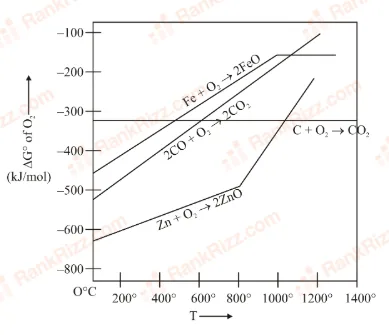
- (A)
Gibbs energy vs T plot for the formation of oxides is given below. For the given diagram, the correct statement is-
- (A)
At 600C, CO cannot reduce FeO
- (B)
At 600C, CO can reduce ZnO
- (C)
At 600C, C can reduce ZnO
- (D)
At 600C, C can reduce FeO
rr2.rankrizz.com/jee-main/chemistry/metallurgy/q/10-apr-2023-s2-q35
- (A)
Given below are two statements:
Assertion A: In an Ellingham diagram, the oxidation of carbon to carbon monoxide shows a negative slope with respect to temperature.
Reason R: CO tends to get decomposed at higher temperature.- (A)
Both A and R are correct and R is the correct explanation of A
- (B)
A is not correct but R is correct
- (C)
Both A and R are correct but R is NOT the correct explanation of A
- (D)
A is correct but R is not correct
rr2.rankrizz.com/jee-main/chemistry/metallurgy/q/01-feb-2023-s1-q39
- (A)
Given are two statements one is labelled as Assertion and other is labelled as Reason.
Assertion: Magnesium can reduce at a temperature below C, while above C aluminium can reduce MgO.
Reason: The melting and boiling points of magnesium are lower than those of aluminium.- (A)
Both Assertion and Reason are correct, and Reason is correct explanation of Assertion.
- (B)
Both Assertion and Reason are correct, but Reason is NOT the correct explanation of Assertion.
- (C)
Assertion is correct Reason is not correct.
- (D)
Assertion is not correct, Reason is correct.
rr2.rankrizz.com/jee-main/chemistry/metallurgy/q/28-jun-2022-s1-q38
- (A)
Given below are two statements :
Statement I : According to the Ellingham diagram, any metal oxide with higher is more stable than the one with lower .
Statement II : The metal involved in the formation of oxide placed lower in the Ellingham diagram can reduce the oxide of a metal placed higher in the diagram.
In the light of the above statements, choose the most appropriate answer from the options given below- (A)
Both Statement I and Statement II are correct.
- (B)
Both Statement I and Statement II are incorrect.
- (C)
Statement I is correct but Statement II is incorrect.
- (D)
Statement I is incorrect but Statement II is correct.
rr2.rankrizz.com/jee-main/chemistry/metallurgy/q/26-jun-2022-s1-q39
- (A)
Given below are two statements.
Statement I: The choice of reducing agents for metals extraction can be made by using the Ellingham diagram, a plot of vs temperature.
Statement II: The value of increases from left to right in the Ellingham diagram.
In the light of the above statements, choose the most appropriate answer from the options given below:- (A)
Statement I is false but Statement II is true
- (B)
Both Statement I and Statement II are true
- (C)
Statement I is true but Statement II is false
- (D)
Both Statement I and Statement II are false
rr2.rankrizz.com/jee-main/chemistry/metallurgy/q/26-aug-2021-s1-q42
- (A)
The statement that is INCORRECT about Ellingham diagram is
- (A)
provides idea about the reaction rate.
- (B)
provides idea about free energy change.
- (C)
provides idea about changes in the phases during the reaction.
- (D)
provides idea about reduction of metal oxide.
rr2.rankrizz.com/jee-main/chemistry/metallurgy/q/27-jul-2021-s1-q42
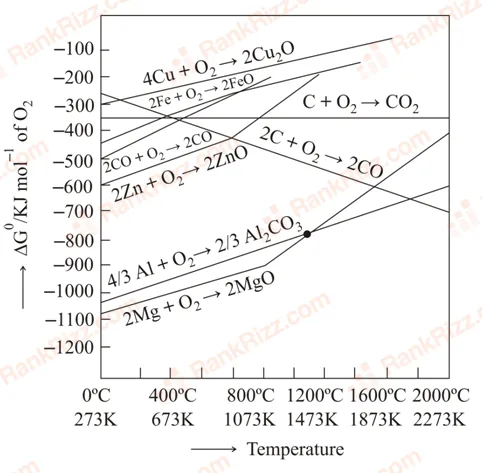
- (A)
The point of intersection and sudden increase in the slope, in the diagram given below, respectively, indicates:
- (A)
and melting or boiling point of the metal oxide
- (B)
and decomposition of the metal oxide
- (C)
and decomposition of the metal oxide
- (D)
and reduction of the metal oxide
rr2.rankrizz.com/jee-main/chemistry/metallurgy/q/17-mar-2021-s1-q42
- (A)
The process that involves the removal of sulphur from the ores is:
- (A)
Smelting
- (B)
Roasting
- (C)
Leaching
- (D)
Refining
rr2.rankrizz.com/jee-main/chemistry/metallurgy/q/16-mar-2021-s1-q41
- (A)
Which of the following reduction reaction CANNOT be carried out with coke?
- (A)
- (B)
- (C)
- (D)
rr2.rankrizz.com/jee-main/chemistry/metallurgy/q/16-mar-2021-s2-q40
- (A)
Ellingham diagram is a graphical representation of:
- (A)
vs P
- (B)
vs T
- (C)
vs T
- (D)
vs T
rr2.rankrizz.com/jee-main/chemistry/metallurgy/q/25-feb-2021-s1-q43
- (A)
For a reaction . The free energy change is plotted as a function of temperature. The temperature below which the oxide is stable could be inferred from the plot as the point at which:
- (A)
the slope change from negative to positive
- (B)
the free energy change show a change from negative to positive value
- (C)
the slope changes from positive to negative
- (D)
the slope changes from positive to zero
rr2.rankrizz.com/jee-main/chemistry/metallurgy/q/6-sep-2020-s2-q27
- (A)
An Ellingham diagram provides information about:
- (A)
the conditions of pH and potential under which a species is thermodynamically stable
- (B)
the temperature dependence of the standard Gibbs energies of formation of some metal oxides
- (C)
the pressure dependence of the standard electrode potentials of reduction reactions involved in the extraction of metals
- (D)
the kinetics of the reduction process
rr2.rankrizz.com/jee-main/chemistry/metallurgy/q/5-sep-2020-s1-q37
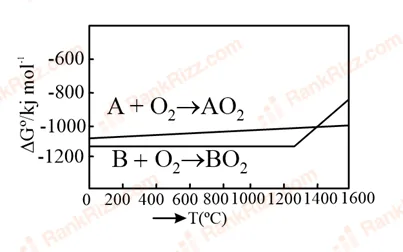
- (A)
According to the following diagram, A reduces when the temperature is:
- (A)
- (B)
- (C)
but
- (D)
rr2.rankrizz.com/jee-main/chemistry/metallurgy/q/9-jan-2020-s1-q38
- (A)
Which respect to an ore, Ellingham diagram helps to predict the feasibility of its:
- (A)
Electrolysis
- (B)
Zone refining
- (C)
Vapour phase refining
- (D)
Thermal reduction
rr2.rankrizz.com/jee-main/chemistry/metallurgy/q/8-apr-2019-s1-q50
- (A)
The correct statement regarding the given Ellingham diagram is:
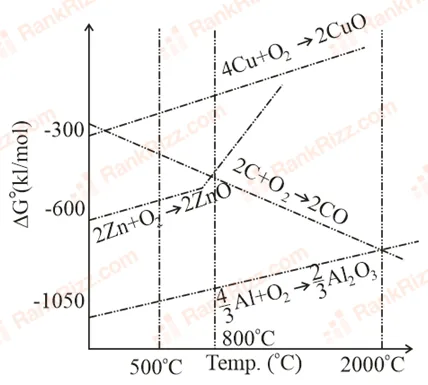
- (A)
At 1400C, Al can be used for the extraction of Zn from ZnO
- (B)
At 500C, coke can be used for the extraction of Zn from ZnO
- (C)
At 800C, Cu can be used for the extraction of Zn from ZnO
- (D)
Coke cannot be used for the extraction of Cu from CuO
rr2.rankrizz.com/jee-main/chemistry/metallurgy/q/9-jan-2019-s2-q48
- (A)
In the isolation of metals, calcination process usually results in:
- (A)
Metal oxide
- (B)
Metal carbonate
- (C)
Metal sulphide
- (D)
Metal hydroxide
rr2.rankrizz.com/jee-main/chemistry/metallurgy/q/10-apr-2015-online-q49
- (A)
Which of the oxide groups among the following cannot be reduced by carbon?
- (A)
- (B)
CaO,
- (C)
PbO,
- (D)
, ZnO
rr2.rankrizz.com/jee-main/chemistry/metallurgy/q/2012-chemistry-499149
- (A)
Which of the following factors is of no significance for roasting sulphide ores to the oxides and not subjecting the sulphide ores to carbon reduction directly?
- (A)
Metal sulphides are thermodynamically more stable than
- (B)
is thermodynamically more stable than
- (C)
Metal sulphides are less stable than the corresponding oxides
- (D)
is more volatile than
rr2.rankrizz.com/jee-main/chemistry/metallurgy/q/2008-chemistry-499924
- (A)
Concentration of ores, calcination and roasting 19
Which one of the following is not an example of calcination?
- (A)
CaCO CaO + CO
- (B)
FeO xHO FeO + xHO
- (C)
2PbS + 3O 2PbO + 2SO
- (D)
CaCO MgCO CaO + MgO + 2CO
rr2.rankrizz.com/jee-main/chemistry/metallurgy/q/15-apr-2023-s1-q42
- (A)
Given below are two statements:
Statement I: In the metallurgy process, sulphide ore is converted to oxide before reduction.
Statement II: Oxide ores in general are easier to reduce.
In the light of the above statements, choose the most appropriate answer from the options below:- (A)
Statement I is correct but Statement II is incorrect
- (B)
Both Statement I and Statement II are incorrect
- (C)
Statement I is incorrect but Statement II is correct
- (D)
Both Statement I and Statement II are correct
rr2.rankrizz.com/jee-main/chemistry/metallurgy/q/11-apr-2023-s2-q41
- (A)
Which of the following is used as a stabilizer during the concentration of sulphide ores?
- (A)
Pine oils
- (B)
Fatty acids
- (C)
Xanthates
- (D)
Cresols
rr2.rankrizz.com/jee-main/chemistry/metallurgy/q/10-apr-2023-s1-q41
- (A)
The methods NOT involved in concentration of ore are
(A) Liquation
(B) Leaching
(C) Electrolysis
(D) Hydraulic washing
(E) Froth floatation
Choose the correct answer from the options given below:- (A)
B, D and C only
- (B)
C, D and E only
- (C)
A and C only
- (D)
B, D and E only
rr2.rankrizz.com/jee-main/chemistry/metallurgy/q/31-jan-2023-s1-q39
- (A)
Given below are two statements:-
Statement I: In froth floatation method a rotating paddle agitates the mixture to drive air out of it.
Statement II: Iron pyrites are generally avoided for extraction of iron due to environmental reasons.
In the light of the above statements, choose the correct answer:- (A)
Both Statement I and Statement II are true
- (B)
Statement I is false but Statement II is true
- (C)
Statement I is true but Statement II is false
- (D)
Both Statement I and Statement II are false
rr2.rankrizz.com/jee-main/chemistry/metallurgy/q/25-jan-2023-s2-q41
- (A)
Which of the reaction is suitable for concentrating ore by leaching process?
- (A)
- (B)
- (C)
- (D)
rr2.rankrizz.com/jee-main/chemistry/metallurgy/q/28-jul-2022-s1-q43
- (A)
Match List - I with List - II.
List-I List-II A Concentration of gold ore I Aniline B Leaching of alumina II NaOH C Froth stabiliser III D Blister copper IV NaCN Choose the correct answer from the options given below
- (A)
A-(IV), B-(III), C-(II), D-(I)
- (B)
A-(IV), B-(II), C-(I), D-(III)
- (C)
A-(III), B-(II), C-(I), D-(IV)
- (D)
A-(II), B-(IV), C-(III), D-(I)
rr2.rankrizz.com/jee-main/chemistry/metallurgy/q/27-jun-2022-s1-q41
- (A)
Statement I: Leaching of gold with cyanide ion in absence of air/ leads to cyano complex of Au(III).
Statement II: Zinc is oxidized during the displacement reaction carried out for gold extraction.
In the light of the above statements, choose the correct answer from the options given below- (A)
Both Statement 1 and statement 2 are correct
- (B)
Both Statement 1 and statement 2 are incorrect
- (C)
Statement 1 is correct but statement 2 is incorrect
- (D)
Statement 1 is incorrect but statement 2 is correct
rr2.rankrizz.com/jee-main/chemistry/metallurgy/q/27-jun-2022-s2-q39
- (A)
The role of depressants in 'Froth Floation method' is to
- (A)
selectively prevent one component of the ore from coming to the froth.
- (B)
reduce the consumption of oil for froth formation.
- (C)
stabilize the froth.
- (D)
enhance non-wettability of the mineral particles.
rr2.rankrizz.com/jee-main/chemistry/metallurgy/q/26-jun-2022-s2-q41
- (A)
Leaching of gold with dilute aqueous solution of NaCN in presence of oxygen gives complex A, which on reaction with zinc forms the elemental gold and another complex B. A and B, respectively are
- (A)
and
- (B)
and
- (C)
and
- (D)
and
rr2.rankrizz.com/jee-main/chemistry/metallurgy/q/25-jun-2022-s1-q41
- (A)
In the leaching of alumina from bauxite, the ore expected to leach out in the process by reacting with NaOH is:
- (A)
TiO
- (B)
FeO
- (C)
ZnO
- (D)
SiO
rr2.rankrizz.com/jee-main/chemistry/metallurgy/q/25-jul-2021-s1-q39
- (A)
Match List I with List II: (Both having metallurgical terms)
List-I List-II
(a) Concentration of Ag ore (i) Reverberatory furnace
(b) Blast furnace (ii) Pig iron
(c) Blister copper (iii) Leaching with dilute NaCN solution
(d) Froth floatation method (iv) Sulfide ores
Choose the correct answer from the options given below:- (A)
(a)-(iii), (b)-(ii), (c)-(i), (d)-(iv)
- (B)
(a)-(iii), (b)-(iv), (c)-(i), (d)-(ii)
- (C)
(a)-(iv), (b)-(i), (c)-(iii), (d)-(ii)
- (D)
(a)-(iv), (b)-(iii), (c)-(ii), (d)-(i)
rr2.rankrizz.com/jee-main/chemistry/metallurgy/q/25-jul-2021-s2-q42
- (A)
Consider two chemical reactions (A) and (B) that take place during metallurgical process:
(A) ZnCO ZnO + CO
(B) 2ZnS + 3O 2ZnO + 2SO
The correct option of names given to them respectively is:- (A)
(A) is calcination and (B) is roasting
- (B)
Both (A) and (B) are producing same product so both are roasting
- (C)
Both (A) and (B) are producing same product so both are calcination
- (D)
(A) is roasting and (B) is calcination
rr2.rankrizz.com/jee-main/chemistry/metallurgy/q/20-jul-2021-s2-q43
- (A)
was leached with alkali to get X. The solution of X on passing of gas Y, forms Z. X, Y and Z respectively are
- (A)
- (B)
- (C)
- (D)
rr2.rankrizz.com/jee-main/chemistry/metallurgy/q/24-feb-2021-s1-q34
- (A)
The idea of froth flotation method came from a person X and this method is related to the process Y of ores. X and Y, respectively, are:
- (A)
Washer man and reduction
- (B)
Fisher women and concentration
- (C)
Fisher man and reduction
- (D)
Washer woman and concentration
rr2.rankrizz.com/jee-main/chemistry/metallurgy/q/12-apr-2019-s1-q51
- (A)
In the leaching method, bauxite ore is digested with a concentrated solution of NaOH that produces 'X'. When CO gas is passed through the aqueous solution of 'X', a hydrated compound 'Y' is precipitated. 'X' and 'Y' respectively are:
- (A)
Na[Al(OH)] and Al(CO) xHO
- (B)
Al(OH) and AlO xHO
- (C)
NaAlO and Al(CO) xHO
- (D)
Na[Al(OH)] and AlO xHO
rr2.rankrizz.com/jee-main/chemistry/metallurgy/q/15-apr-2018-s2-q51
- (A)
Which one of the following ores is best concentrated by froth flotation method?
- (A)
Galena
- (B)
Malachite
- (C)
Magnetite
- (D)
Siderite
rr2.rankrizz.com/jee-main/chemistry/metallurgy/q/3-apr-2016-offline-q49
- (A)
The substance used as froth stabilisers in forth-floatation process is
- (A)
Potassium ethyl xanthate
- (B)
Aniline
- (C)
Sodium cyanide
- (D)
Copper sulphate
rr2.rankrizz.com/jee-main/chemistry/metallurgy/q/2012-chemistry-499249
- (A)
Which one of the following ores is best concentrated by froth-flotation method?
- (A)
Magnetite
- (B)
Malachite
- (C)
Galena
- (D)
Cassiterite
rr2.rankrizz.com/jee-main/chemistry/metallurgy/q/2004-chemistry-500395
- (A)
Answer key
- 01 A
- 02 —
- 03 D
- 04 1
- 05 A
- 06 D
- 07 C
- 08 A
- 09 B
- 10 A
- 11 B
- 12 B
- 13 D
- 14 D
- 15 B
- 16 C
- 17 B
- 18 D
- 19 —
- 20 C
- 21 B
- 22 C
- 23 A
- 24 B
- 25 B
- 26 B
- 27 B
- 28 C
- 29 C
- 30 D
- 31 C
- 32 D
- 33 C
- 34 A
- 35 A
- 36 C
- 37 A
- 38 4
- 39 A
- 40 B
- 41 3
- 42 B
- 43 D
- 44 B
- 45 A
- 46 D
- 47 C
- 48 B
- 49 D
- 50 A
- 51 D
- 52 D
- 53 A
- 54 B
- 55 B
- 56 D
- 57 D
- 58 C
- 59 A
- 60 A
- 61 A
- 62 C
- 63 A
- 64 A
- 65 A
- 66 6
- 67 D
- 68 B
- 69 C
- 70 C
- 71 B
- 72 B
- 73 A
- 74 A
- 75 C
- 76 A
- 77 B
- 78 D
- 79 A
- 80 D
- 81 C
- 82 C
- 83 C
- 84 D
- 85 D
- 86 B
- 87 D
- 88 C
- 89 A
- 90 A
- 91 B
- 92 A
- 93 D
- 94 B
- 95 B
- 96 B
- 97 D
- 98 A
- 99 A
- 100 B
- 101 A
- 102 C
- 103 D
- 104 D
- 105 C
- 106 B
- 107 C
- 108 B
- 109 D
- 110 A
- 111 A
- 112 D
- 113 A
- 114 A
- 115 D
- 116 D
- 117 D
- 118 A
- 119 B
- 120 C
“—” marks a question whose key we have not checked yet; its page shows the latest on it.
Past questions are reproduced with their sitting. Not affiliated with NTA or the IITs. Every question, online and free: rr2.rankrizz.com/jee-main/chemistry/metallurgy