RankRizz

General Principles and Processes of Isolation of Metals — JEE Main Previous Year Questions

Every General Principles and Processes of Isolation of Metals question JEE Main has set from 2004–2023, grouped by the idea it tests rather than the order of the syllabus. 120 questions across 5 distinct ideas. Free to read, answer key on every one.

DATA UPDATED

Questions

120

Distinct ideas

5

Share of marks

0%

Difficulty

EASY

The ideas inside General Principles and Processes of Isolation of Metals

A chapter is not one subject — it is a handful of procedures the examiner reuses. These are the ones General Principles and Processes of Isolation of Metals questions actually test.

Every General Principles and Processes of Isolation of Metals question

41–60 OF 120 · NEWEST FIRST

JEE MAIN 2022 · 25 JUN S2Refining of metals

Given below are two statements.
Statement I: During electrolytic refining, blister copper deposits precious metals.
Statement II: In the process of obtaining pure copper by electrolysis method, copper blister is used to make the anode.
In the light of the above statements, choose the correct answer from the options given below.

  1. A

    Both Statement I and Statement II are true.

  2. B

    Both Statement I and Statement II are false.

  3. C

    Statement I is true but Statement II is false.

  4. D

    Statement I is false but Statement II is true.
JEE MAIN 2022 · 24 JUN S1Occurrence of metals: minerals and ores

Match List - I with List - II :

List-IList-II
(A)Sphalerite(I)FeCO3_3
(B)Calamine(II)PbS
(C)Galena(III)ZnCO3_3
(D)Siderite(IV)ZnS

Choose the most appropriate answer from the options given below :
  1. A

    (A) - (IV), (B) - (I), (C) - (II), (D) - (III)

  2. B

    (A) - (IV), (B) - (III), (C) - (II), (D) - (I)

  3. C

    (A) - (II), (B) - (II), (C) - (I), (D) - (IV)

  4. D

    (A) - (III), (B) - (IV), (C) - (II), (D) - (I)

JEE MAIN 2022 · 24 JUN S2Extraction of Fe, Cu, Zn, Al, Ag and Au

Which of the following chemical reactions represents Hall-Heroult Process?

  1. A

    Cr2O3+2Al→Al2O3+2CrCr_2O_3 + 2Al \to Al_2O_3 + 2Cr

  2. B

    2Al2O3+3C→4Al+3CO22Al_2O_3 + 3C \to 4Al + 3CO_2

  3. C

    FeO+CO→Fe+CO2FeO + CO \to Fe + CO_2

  4. D

    2[Au(CN)2]−(aq)+Zn(s)→2Au(s)+[Zn(CN)4]2−2[Au(CN)_2]^-(aq) + Zn(s) \to 2Au(s) + [Zn(CN)_4]^{2-}

JEE MAIN 2022 · 24 JUN S2Occurrence of metals: minerals and ores

(a) Baryte, (b) Galena, (c) Zinc blende and (d) Copper pyrites. How many of these minerals are sulphide based? ______

JEE MAIN 2021 · 01 SEP S2Occurrence of metals: minerals and ores

Calamine and Malachite, respectively, are the ores of:

  1. A

    Copper and Iron

  2. B

    Zinc and Copper

  3. C

    Aluminium and Zinc

  4. D

    Nickel and Aluminium

JEE MAIN 2021 · 31 AUG S1Extraction of Fe, Cu, Zn, Al, Ag and Au

Given below are two statements : one is labelled as Assertion (A) and the other is labelled as Reason (R).
Assertion (A) : Aluminium is extracted from bauxite by the electrolysis of molten mixture of Al2_2O3_3 with cryolite.
Reason (R) : The oxidation state of Al in cryolite is +3.
In the light of the above statements, choose the most appropriate answer from the options given below:

  1. A

    Both (A) and (R) are correct and (R) is the correct explanation of (A).

  2. B

    (A) is true but (R) is false.

  3. C

    Both (A) and (R) are correct but (R) is not the correct explanation of (A).

  4. D

    (A) is false but (R) is true.

JEE MAIN 2021 · 31 AUG S2Refining of metals

In the electrolytic refining of blister copper, the total number of main impurities, from the following, removed as anode mud is _________.
Pb, Sb, Se, Te, Ru, Ag, Au and Pt

JEE MAIN 2021 · 27 AUG S1Refining of metals

Which refining process is generally used in the purification of low melting metals?

  1. A

    Chromatographic method

  2. B

    Electrolysis

  3. C

    Zone refining

  4. D

    Liquation

JEE MAIN 2021 · 27 AUG S2Occurrence of metals: minerals and ores

Match List-I with List-II:
List-I (Name of ore/mineral)     List-II (Chemical formula)
(a) Calamine                             (i) ZnS
(b) Malachite                            (ii) FeCO3_3
(c) Siderite                              (iii) ZnCO3_3
(d) Sphalerite                           (iv) CuCO3_3.Cu(OH)2_2
Choose the most appropriate answer from the options given below:

  1. A

    (a) - (iv), (b) - (iii), (c) - (i), (d) - (ii)

  2. B

    (a) - (iii), (b) - (ii), (c) - (iv), (d) - (i)

  3. C

    (a) - (iii), (b) - (iv), (c) - (i), (d) - (ii)

  4. D

    (a) - (iii), (b) - (iv), (c) - (ii), (d) - (i)

JEE MAIN 2021 · 26 AUG S1Thermodynamic principles and Ellingham diagram

Given below are two statements.
Statement I: The choice of reducing agents for metals extraction can be made by using the Ellingham diagram, a plot of ΔG\Delta G vs temperature.
Statement II: The value of ΔS\Delta S increases from left to right in the Ellingham diagram.
In the light of the above statements, choose the most appropriate answer from the options given below:

  1. A

    Statement I is false but Statement II is true

  2. B

    Both Statement I and Statement II are true

  3. C

    Statement I is true but Statement II is false

  4. D

    Both Statement I and Statement II are false

JEE MAIN 2021 · 26 AUG S2Occurrence of metals: minerals and ores

Given below are two statements:
Statement I : Sphalerite is a sulphide ore of zinc and copper glance is a sulphide ore of copper.
Statement II : It is possible to separate two sulphide ores by adjusting proportion of oil to water or by using depressants in a froth flotation method.
Choose the most appropriate answer from the options given below:

  1. A

    Statement I is true but Statement II is false.

  2. B

    Both Statement I and Statement II are true.

  3. C

    Both Statement I and Statement II are false.

  4. D

    Statement I is false but Statement II is true.

JEE MAIN 2021 · 27 JUL S1Thermodynamic principles and Ellingham diagram

The statement that is INCORRECT about Ellingham diagram is

  1. A

    provides idea about the reaction rate.

  2. B

    provides idea about free energy change.

  3. C

    provides idea about changes in the phases during the reaction.

  4. D

    provides idea about reduction of metal oxide.

JEE MAIN 2021 · 27 JUL S2Extraction of Fe, Cu, Zn, Al, Ag and Au

The addition of silica during the extraction of copper from its sulphide ore:-

  1. A

    converts copper sulphide into copper silicate

  2. B

    converts iron oxide into iron silicate

  3. C

    reduces copper sulphide into metallic copper

  4. D

    reduces the melting point of the reaction mixture

JEE MAIN 2021 · 25 JUL S1Concentration of ores, calcination and roasting

In the leaching of alumina from bauxite, the ore expected to leach out in the process by reacting with NaOH is:

  1. A

    TiO2_2

  2. B

    Fe2_2O3_3

  3. C

    ZnO

  4. D

    SiO2_2

JEE MAIN 2021 · 25 JUL S2Concentration of ores, calcination and roasting

Match List I with List II: (Both having metallurgical terms)
List-I                                      List-II
(a) Concentration of Ag ore    (i) Reverberatory furnace
(b) Blast furnace                   (ii) Pig iron
(c) Blister copper                  (iii) Leaching with dilute NaCN solution
(d) Froth floatation method   (iv) Sulfide ores
Choose the correct answer from the options given below:

  1. A

    (a)-(iii), (b)-(ii), (c)-(i), (d)-(iv)

  2. B

    (a)-(iii), (b)-(iv), (c)-(i), (d)-(ii)

  3. C

    (a)-(iv), (b)-(i), (c)-(iii), (d)-(ii)

  4. D

    (a)-(iv), (b)-(iii), (c)-(ii), (d)-(i)

JEE MAIN 2021 · 22 JUL S1Occurrence of metals: minerals and ores

Sulphide ion is soft base and its ores are common for metals
(a) Pb (b) Al (c) Ag (d) Mg
Choose the correct answer from the options given below

  1. A

    a and c only

  2. B

    a and d only

  3. C

    a and b only

  4. D

    c and d only

JEE MAIN 2021 · 20 JUL S1Refining of metals

The metal that can be purified economically by fractional distillation method is:

  1. A

    Fe

  2. B

    Zn

  3. C

    Cu

  4. D

    Ni

JEE MAIN 2021 · 20 JUL S2Concentration of ores, calcination and roasting

Consider two chemical reactions (A) and (B) that take place during metallurgical process:
(A) ZnCO3(s)→Δ_{3(s)} \xrightarrow{\Delta} ZnO(s)_{(s)} + CO2(g)_{2(g)}
(B) 2ZnS(s)_{(s)} + 3O2(g)→Δ_{2(g)} \xrightarrow{\Delta} 2ZnO(s)_{(s)} + 2SO2(g)_{2(g)}
The correct option of names given to them respectively is:

  1. A

    (A) is calcination and (B) is roasting

  2. B

    Both (A) and (B) are producing same product so both are roasting

  3. C

    Both (A) and (B) are producing same product so both are calcination

  4. D

    (A) is roasting and (B) is calcination

JEE MAIN 2021 · 18 MAR S2Refining of metals

Match list-I with list-II :

    List-I   List-II
(a)   Mercury   (i)   Vapour phase refining
(b)   Copper   (ii)   Distillation refining
(c)   Silicon   (iii)   Electrolytic refining
(d)   Nickel   (iv)   Zone refining


Choose the most appropriate answer from the option given below:

  1. A

    a - i, b - iv, c - ii, d - iii

  2. B

    a - ii, b - iii, c - i, d - iv

  3. C

    a - ii, b - iii, c - iv, d - i

  4. D

    a - ii, b - iv, c - iii, d - i

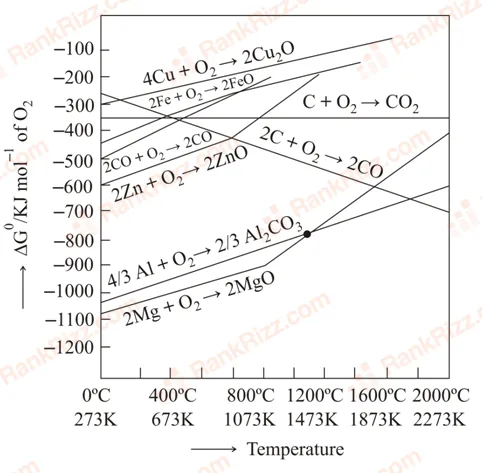
JEE MAIN 2021 · 17 MAR S1Thermodynamic principles and Ellingham diagram

The point of intersection and sudden increase in the slope, in the diagram given below, respectively, indicates:

Figure for JEE Main 2021 Chemistry question on Thermodynamic principles and Ellingham diagram
  1. A

    ΔG=0\Delta G = 0 and melting or boiling point of the metal oxide

  2. B

    ΔG>0\Delta G > 0 and decomposition of the metal oxide

  3. C

    ΔG<0\Delta G < 0 and decomposition of the metal oxide

  4. D

    ΔG=0\Delta G = 0 and reduction of the metal oxide