JEE MAIN 2021 · 26 AUG S2Haloarenes
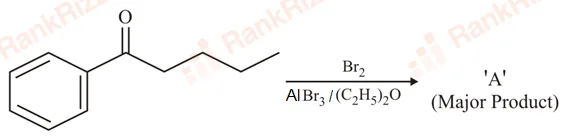
Consider the given reaction, the Product A is:
- A
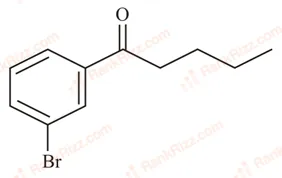
- B
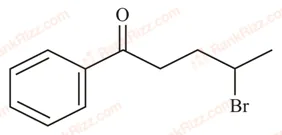
- C
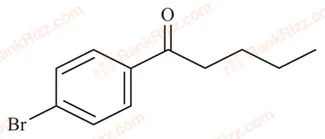
- D
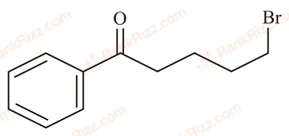
Every Haloalkanes and Haloarenes question JEE Main has set from 2004–2026, grouped by the idea it tests rather than the order of the syllabus. 188 questions across 6 distinct ideas. Free to read, answer key on every one.
DATA UPDATED
Questions
188
Distinct ideas
6
Share of marks
3.4%
Difficulty
MEDIUM
A chapter is not one subject — it is a handful of procedures the examiner reuses. These are the ones Haloalkanes and Haloarenes questions actually test.
101–120 OF 188 · NEWEST FIRST
A chloro compound "A".
(i) forms aldehydes on ozonolysis followed by the hydrolysis.
(ii) when vaporized completely 1.53 g of A, gives 448 mL of vapour at STP. The number of carbon atoms in a molecule of compound A is _________
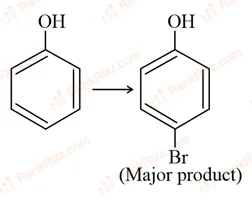
The given reaction can occur in the presence of:
(a) Bromine water
(b) in , 273 K
(c)
(d) in , 273 K
Choose the correct answer from the options given below:
(b) and (d) only
(a) and (c) only
(b), (c) and (d) only
(a), (b) and (d) only
The correct decreasing order of densities of the following compounds is:
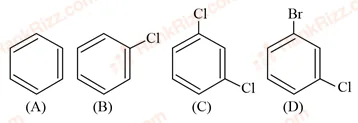
(D) > (C) > (B) > (A)
(C) > (D) > (A) > (B)
(C) > (B) > (A) > (D)
(A) > (B) > (C) > (D)
Given below are two statements :
Statement I : CHOH and AgCN both can generate nucleophile.
Statement II : KCN and AgCN both will generate nitrile nucleophile with all reaction conditions.
Choose the most appropriate option :
Statement I is true but statement II is false
Both statement I and statement II are true
Statement I is false but statement II is true
Both statement I and statement II are false
The above reaction requires which of the following reaction conditions?
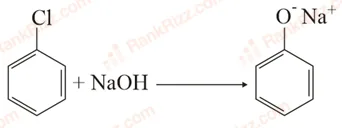
573 K, Cu, 300 atm
623 K, Cu, 300 atm
573 K, 300 atm
623 K, 300 atm
The correct pair(s) of the ambident nucleophiles is (are):
(A) AgCN / KCN
(B) RCOOAg / RCOOK
(C) AgNO / KNO
(D) AgI / KI
(B) and (C) only
(A) only
(A) and (C) only
(B) only
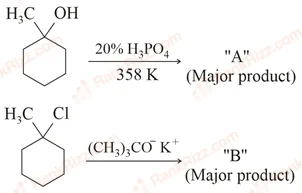
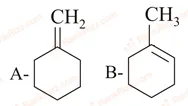
The product "A" and "B" formed in below reactions are:
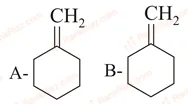
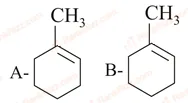
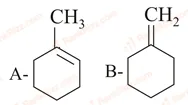
Match List-I with List-II.
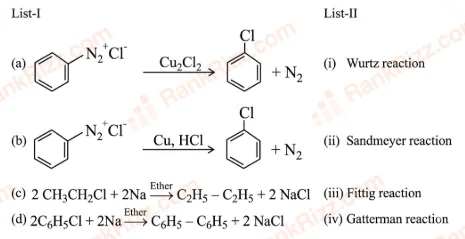
Choose the correct answer from the options given below :
(a)(iii), (b)(iv), (c)(i), (d)(ii)
(a)(ii), (b)(i), (c)(iv), (d)(iii)
(a)(iii), (b)(i), (c)(iv), (d)(ii)
(a)(ii), (b)(iv), (c)(i), (d)(iii)
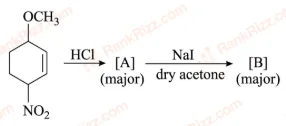
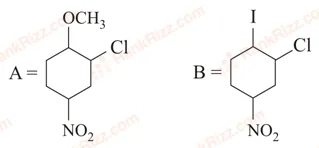
Identify A and B in the chemical reaction.
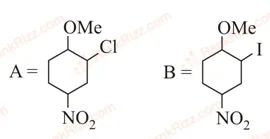
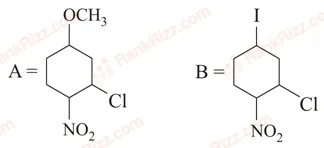
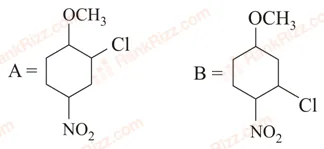
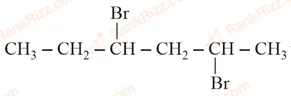
The product formed in the first step of the reaction with excess Mg / EtO / Et = is
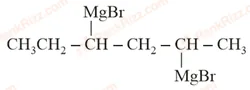

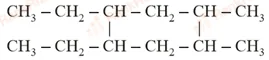
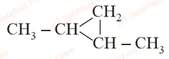
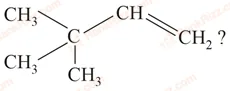
What is the major product formed by HI on reaction with the above compound?
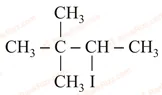
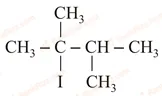
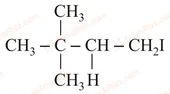
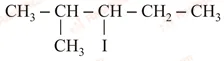
The correct order of the following compounds showing increasing tendency towards nucleophilic substitution reaction is:
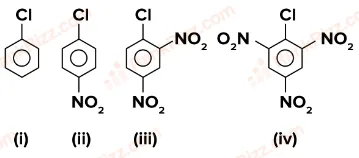
(iv) < (i) < (ii) < (iii)
(i) < (ii) < (iii) < (iv)
(iv) < (i) < (iii) < (ii)
(iv) < (iii) < (ii) < (i)
The increasing order of the boiling points of the major products A, B and C of the following reactions will be:
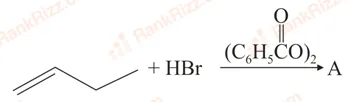
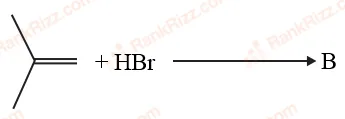
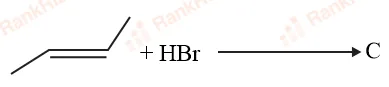
The major product formed in the following reaction is:
The decreasing order of reactivity of the following organic molecules towards AgNO solution is:
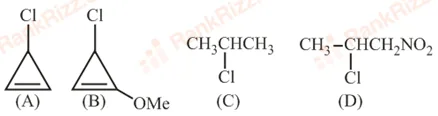
(C) > (D) > (A) > (B)
(A) > (B) > (D) > (C)
(A) > (B) > (C) > (D)
(B) > (A) > (C) > (D)
Which of the following compounds will form the precipitate with aq. AgNO solution most readily?
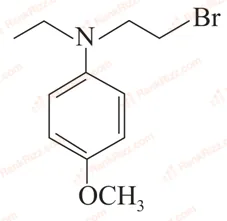
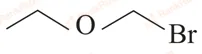
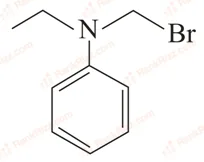
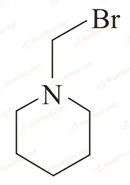
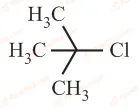
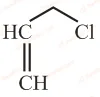
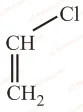
Among the following compounds, which one has the shortest C-Cl bond?
The mechanism of Sn1 reaction is given as:
Ion pair Solvent separated ion pair
A student writes general characteristics based on the given mechanism as:
(a) The reaction is favoured by weak nucleophiles.
(b) would be easily formed if the substituents are bulky
(c) The reaction is accompanied by racemization
(d) The reaction is favoured by non-polar solvents.
Which observations are correct?
(a) and (b)
(a) and (c)
(a), (b) and (c)
(b) and (d)
The decreasing order of reactivity of the following compounds towards nucleophilic substitution () is:
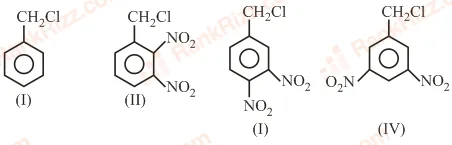
(II) > (III) > (I) > (IV)
(II) > (III) > (IV) > (I)
(III) > (II) > (IV) > (I)
(IV) > (II) > (III) > (I)
JEE Advanced has set 8 Haloalkanes and Haloarenes questions too. Haloalkanes and Haloarenes JEE Advanced PYQs →
OTHER CHEMISTRY CHAPTERS