RankRizz

Haloalkanes and Haloarenes — JEE Advanced Previous Year Questions

Haloalkanes and Haloarenes has been asked in 6 of the 20 JEE Advanced years from 2007 to 2026: 8 questions in all. It was not set in any of the 2 2026 papers, after 3.1% of Chemistry questions in 2025. Across the last 20 papers it carried 1.1% of Chemistry questions. By type: 5 single-correct and 3 multiple-correct. Most asked: Nucleophilic substitution (SN1 and SN2) (6, 75%) and Haloarenes (2, 25%).

DATA UPDATED

Questions

8

Distinct ideas

2

Share of marks

1.1%

Difficulty

HARD

Haloalkanes and Haloarenes weightage, year by year

The share of each year’s Chemistry questions that came from Haloalkanes and Haloarenes, counted from the 19 papers we hold for the last 10 years, and paper by paper inside a year.

Steady: 1.0% of Chemistry questions in 2024–2026 against 1.3% in 2017–2023, and between 0.0% and 5.9% in every year shown. Not asked at all in 2018, 2019, 2020, 2021, 2022, 2024, 2026.

Haloalkanes and Haloarenes questions per year, per paper, and as a share of Chemistry questions
YEARQSPER PAPERSHARE OF CHEMISTRYCHANGE
20260 / 340.00.0%−3.1 pts
20251 / 320.53.1%+3.1 pts
20240 / 340.00.0%−5.9 pts
20232 / 341.05.9%+5.9 pts
20220 / 360.00.0%level
20210 / 380.00.0%level
20200 / 360.00.0%level
20190 / 360.00.0%level
20180 / 180.00.0%−2.8 pts
20171 / 360.52.8%—

“QS” is Haloalkanes and Haloarenes questions out of all Chemistry questions that year; “per paper” is that count over the year’s papers, and “change” is the share against the year before. A year with more sittings asks more questions, which is why the share, not the count, is the number to compare.

The ideas inside Haloalkanes and Haloarenes

A chapter is not one subject — it is a handful of procedures the examiner reuses. These are the ones Haloalkanes and Haloarenes questions actually test.

01Haloalkanes: preparation and physical propertiesNot set in Advanced
02Nucleophilic substitution (SN1 and SN2)set 6×
03Elimination reactions (E1 and E2)Not set in Advanced
04Grignard reagents and other organometallic reactionsNot set in Advanced
05Haloarenesset 2×
06Polyhalogen compoundsNot set in Advanced

All 8 Haloalkanes and Haloarenes questions, by topic

Every JEE Advanced Haloalkanes and Haloarenes question we hold, newest first inside each topic. Open one for its options, answer key and solution.

FREE PDF

Haloalkanes and Haloarenes JEE Advanced PYQs with answer key

All 8 questions on A4, by topic, with the answer key at the end. No sign-up, no email: your browser saves it as a PDF.

Download free PDF

UNIQUE CONCEPTS

Haloalkanes and Haloarenes: one question per idea

6 ideas, each with the latest past question that tested it, drawn from 194 JEE Main and Advanced questions.

Haloalkanes and Haloarenes Unique Concepts sheet →

JEE MAIN

Haloalkanes and Haloarenes in JEE Main

JEE Main has set 188 Haloalkanes and Haloarenes questions, 2004–2026.

Haloalkanes and Haloarenes JEE Main PYQs →

Haloalkanes and Haloarenes: quick answers

Is Haloalkanes and Haloarenes asked every year in JEE Advanced?

Not every year. It has been asked in 6 of the 20 JEE Advanced years from 2007 to 2026; it was missing in 14 of them, most recently 2026.

Which Haloalkanes and Haloarenes topic is asked most in JEE Advanced?

Nucleophilic substitution (SN1 and SN2): 6 of the 8 questions (75%). Next come Haloarenes (2).

What share of Chemistry questions does Haloalkanes and Haloarenes carry in JEE Advanced?

About 1.1% of Chemistry questions across the last 20 papers. In 2026 it was 0.0% (0 of 34 Chemistry questions).

When was Haloalkanes and Haloarenes last asked in JEE Advanced?

In JEE Advanced 2025 Paper 1, the latest sitting with a Haloalkanes and Haloarenes question. It has not been set since 2025, though the bank holds JEE Advanced papers up to 2026.

How many Haloalkanes and Haloarenes questions has JEE Advanced asked?

8 from 2008 to 2025, across 2 topics. Every one is listed on this page by topic and links to its own page, with the answer key and solution wherever we have them. Free, no sign-up.

Every Haloalkanes and Haloarenes question

1–8 OF 8 · NEWEST FIRST

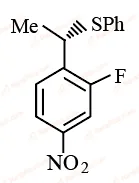
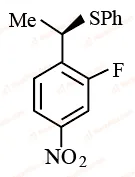
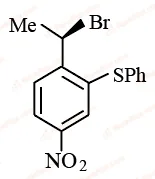
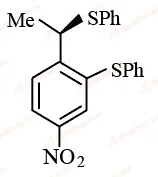
JEE ADVANCED 2025 · PAPER 1Nucleophilic substitution (SN1 and SN2)

For the reaction sequence given below, the correct statement(s) is(are)
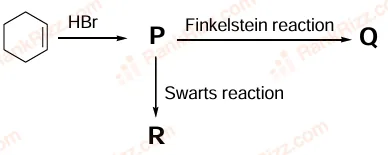
Figure for JEE Advanced 2025 Chemistry question on Nucleophilic substitution (SN1 and SN2)

(In the options, X is any atom other than carbon and hydrogen, and it is different in P, Q and R)

  1. A

    C-X bond length in P, Q and R follows the order Q > R > P.

  2. B

    C-X bond enthalpy in P, Q and R follows the order R > P > Q.

  3. C

    Relative reactivity toward SN_N2 reaction in P, Q and R follows the order P > R > Q.

  4. D

    pKaK_a value of the conjugate acids of the leaving groups in P, Q and R follows the order R > Q > P.
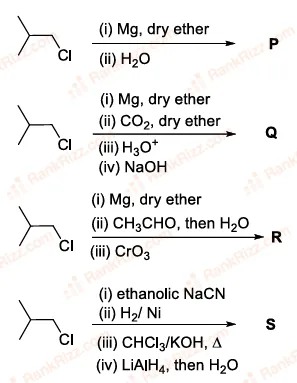
JEE ADVANCED 2023 · PAPER 2Nucleophilic substitution (SN1 and SN2)

In the following reactions, P, Q, R, and S are the major products.

Figure for JEE Advanced 2023 Chemistry question on Nucleophilic substitution (SN1 and SN2)

The correct statement about P, Q, R, and S is

  1. A

    P is a primary alcohol with four carbons.

  2. B

    Q undergoes Kolbe's electrolysis to give an eight-carbon product.

  3. C

    R has six carbons and it undergoes Cannizzaro reaction.

  4. D

    S is a primary amine with six carbons.

JEE ADVANCED 2023 · PAPER 1Nucleophilic substitution (SN1 and SN2)

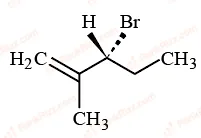
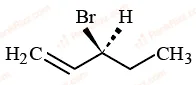
Match the reactions in List-I with the features of their products in List-II and choose the correct option.

List-IList-II
(P)(-)-1-Bromo-2-ethylpentane (single enantiomer) →SN2 reactionaq. NaOH\xrightarrow[S_N2 \text{ reaction}]{\text{aq. NaOH}}(1)Inversion of configuration
(Q)(-)-2-Bromopentane (single enantiomer) →SN2 reactionaq. NaOH\xrightarrow[S_N2 \text{ reaction}]{\text{aq. NaOH}}(2)Retention of configuration
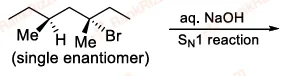
(R)(-)-3-Bromo-3-methylhexane (single enantiomer) →SN1 reactionaq. NaOH\xrightarrow[S_N1 \text{ reaction}]{\text{aq. NaOH}}(3)Mixture of enantiomers
(S)
Figure for JEE Advanced 2023 Chemistry question on Nucleophilic substitution (SN1 and SN2)
(4)Mixture of structural isomers
(5)Mixture of diastereomers
  1. A

    P →\to 1; Q →\to 2; R →\to 5; S →\to 3

  2. B

    P →\to 2; Q →\to 1; R →\to 3; S →\to 5

  3. C

    P →\to 1; Q →\to 2; R →\to 5; S →\to 4

  4. D

    P →\to 2; Q →\to 4; R →\to 3; S →\to 5

JEE ADVANCED 2017 · PAPER 2Nucleophilic substitution (SN1 and SN2)

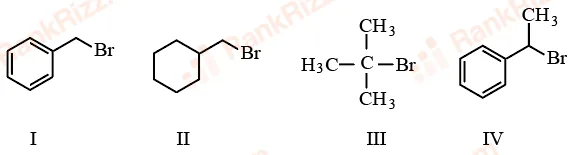
For the following compounds, the correct statement(s) with respect to nucleophilic substitution reactions is(are)

Figure for JEE Advanced 2017 Chemistry question on Nucleophilic substitution (SN1 and SN2)
  1. A

    I and III follow SN1S_{N}1 mechanism

  2. B

    I and II follow SN2S_{N}2 mechanism

  3. C

    Compound IV undergoes inversion of configuration

  4. D

    The order of reactivity for I, III and IV is: IV > I > III

JEE ADVANCED 2015 · PAPER 1Nucleophilic substitution (SN1 and SN2)

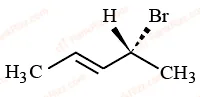
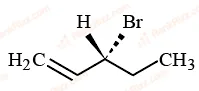
Compound(s) that on hydrogenation produce(s) optically inactive compound(s) is(are)

  1. A
    Figure for JEE Advanced 2015 Chemistry question on Nucleophilic substitution (SN1 and SN2)
  2. B
    Figure for JEE Advanced 2015 Chemistry question on Nucleophilic substitution (SN1 and SN2)
  3. C
    Figure for JEE Advanced 2015 Chemistry question on Nucleophilic substitution (SN1 and SN2)
  4. D
    Figure for JEE Advanced 2015 Chemistry question on Nucleophilic substitution (SN1 and SN2)
JEE ADVANCED 2013 · PAPER 1Nucleophilic substitution (SN1 and SN2)

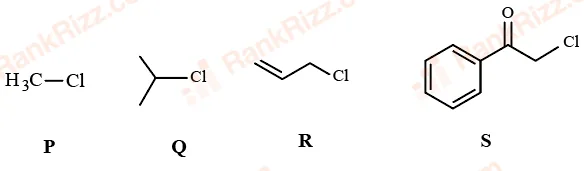
KJ in acetone, undergoes SN2S_N2 reaction with each of P, Q, R and S. The rates of the reaction vary as

Figure for JEE Advanced 2013 Chemistry question on Nucleophilic substitution (SN1 and SN2)
  1. A

    P > Q > R > S

  2. B

    S > P > R > Q

  3. C

    P > R > Q > S

  4. D

    R > P > s > Q

JEE ADVANCED 2008 · PAPER 1Haloarenes

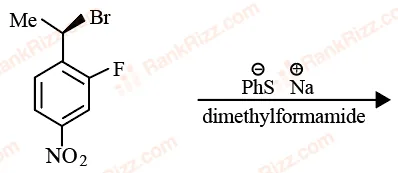
The major product of the following reaction is

Figure for JEE Advanced 2008 Chemistry question on Haloarenes
  1. A
    Figure for JEE Advanced 2008 Chemistry question on Haloarenes
  2. B
    Figure for JEE Advanced 2008 Chemistry question on Haloarenes
  3. C
    Figure for JEE Advanced 2008 Chemistry question on Haloarenes
  4. D
    Figure for JEE Advanced 2008 Chemistry question on Haloarenes
JEE ADVANCED 2008 · PAPER 1Haloarenes

STATEMENT-1: Bromobenzene upon reaction with Br,/Fe gives 1,4-dibromobenzene as the major product.
and
STATEMENT-2: In bromobenzene, the inductive effect of the bromo group is more dominant than the mesomeric effect in directing the incoming electrophile.

  1. A

    STATEMENT-1 is True, STATEMENT-2 is True: STATEMENT-2 is a correct explanation for STATEMENT-1

  2. B

    STATEMENT-1 is True, STATEMENT-2 is True: STATEMENT-2 is NOT a correct explanation for STATEMENT-1

  3. C

    STATEMENT-1 is True, STATEMENT-2 is False

  4. D

    STATEMENT-1 is False, STATEMENT-2 is True