JEE MAIN 2025 · 02 APR S1+4 / −1MEDIUM
JEE Main 2025 Chemistry question — Reactions of carboxylic acids
Consider the following molecules:
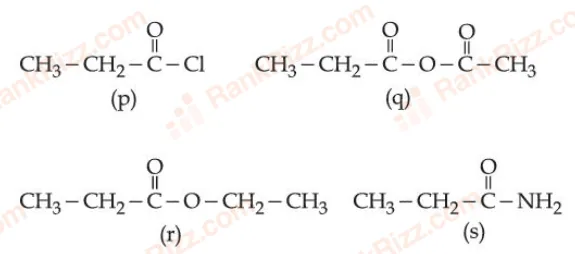
The correct order of rate of hydrolysis is:
SOLUTION
The compounds are:
- (acid chloride)
- (acid anhydride)
- (ester)
- (amide)
The rate of hydrolysis of carboxylic acid derivatives depends on the leaving group attached to the carbonyl carbon.
Greater the leaving ability of the group, faster is the hydrolysis.
The leaving groups in the given compounds are:
- In , leaving group is
- In , leaving group is
- In , leaving group is
- In , leaving group is
The leaving group ability follows:
Hence, the ease of hydrolysis follows:
Therefore,
Hence, the correct order of rate of hydrolysis is
Therefore, the correct answer is Option (D).