RankRizz

Carboxylic Acids and Derivatives — JEE Advanced Previous Year Questions

Carboxylic Acids and Derivatives has been asked in 12 of the 20 JEE Advanced years from 2007 to 2026: 27 questions in all. In 2026 it averaged 1.0 questions per paper (2 across 2 papers), 5.9% of Chemistry questions, up from 3.1% in 2025. Across the last 20 papers it carried 4.5% of Chemistry questions. By type: 18 single-correct, 5 multiple-correct and 4 numerical. Of the 27 with a difficulty tag, 11% are easy, 44% medium and 44% hard. Most asked: Reactions of carboxylic acids (23, 85%), Acidity of carboxylic acids (3, 11%) and Acid derivatives: esters, amides, anhydrides and acid chlorides (1, 4%).

DATA UPDATED

Questions

27

Distinct ideas

3

Share of marks

4.5%

Difficulty

HARD

Carboxylic Acids and Derivatives weightage, year by year

The share of each year’s Chemistry questions that came from Carboxylic Acids and Derivatives, counted from the 19 papers we hold for the last 10 years, and paper by paper inside a year.

Steady: 4.0% of Chemistry questions in 2024–2026 against 4.3% in 2017–2023, and between 0.0% and 13.9% in every year shown. Not asked at all in 2018, 2020, 2021.

Carboxylic Acids and Derivatives questions per year, per paper, and as a share of Chemistry questions
YEARQSPER PAPERSHARE OF CHEMISTRYCHANGE
20262 / 341.05.9%+2.8 pts
20251 / 320.53.1%+0.2 pts
20241 / 340.52.9%level
20231 / 340.52.9%+0.1 pts
20221 / 360.52.8%+2.8 pts
20210 / 380.00.0%level
20200 / 360.00.0%−8.3 pts
20193 / 361.58.3%+8.3 pts
20180 / 180.00.0%−13.9 pts
20175 / 362.513.9%—

“QS” is Carboxylic Acids and Derivatives questions out of all Chemistry questions that year; “per paper” is that count over the year’s papers, and “change” is the share against the year before. A year with more sittings asks more questions, which is why the share, not the count, is the number to compare.

The ideas inside Carboxylic Acids and Derivatives

A chapter is not one subject — it is a handful of procedures the examiner reuses. These are the ones Carboxylic Acids and Derivatives questions actually test.

01Preparation of carboxylic acidsNot set in Advanced
02Acidity of carboxylic acidsset 3×
03Reactions of carboxylic acidsset 23×
04Acid derivatives: esters, amides, anhydrides and acid chloridesset 1×

All 27 Carboxylic Acids and Derivatives questions, by topic

Every JEE Advanced Carboxylic Acids and Derivatives question we hold, newest first inside each topic. Open one for its options, answer key and solution.

Reactions of carboxylic acids23 QUESTIONS

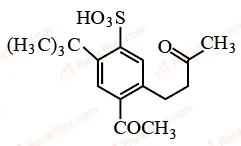
  1. The correct reaction/reaction sequence that would produce a dicarboxylic acid as the major product is2025 · PAPER 2
  2. Considering the reaction sequence given below, the correct statement(s) is(are)2022 · PAPER 1
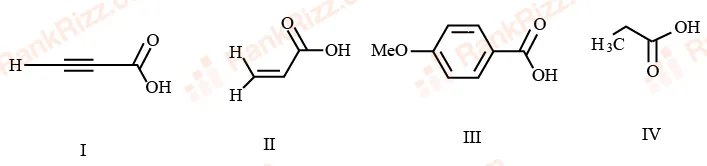
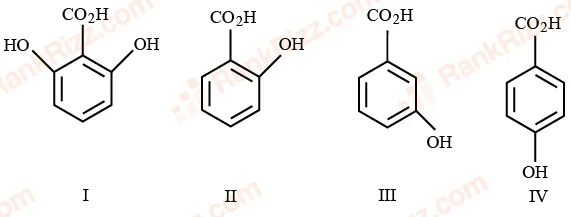
  3. The correct order of acid strength of the following carboxylic acids is2019 · PAPER 1
  4. Which of the following options has correct combination considering List-I and List-II?2019 · PAPER 2
  5. Which of the following options has correct combination considering List-I and List-II?2019 · PAPER 2
  6. For the synthesis of benzoic acid, the only CORRECT combination is2017 · PAPER 1
  7. The only CORRECT combination that gives two different carboxylic acids is2017 · PAPER 1
  8. The product S is2017 · PAPER 2
  9. The only CORRECT combination in which the reaction proceeds through radical mechanism is2017 · PAPER 1
  10. The reactions, Q to R and R to S, are2017 · PAPER 2
  11. The correct order of acidity for the following compounds is2016 · PAPER 2
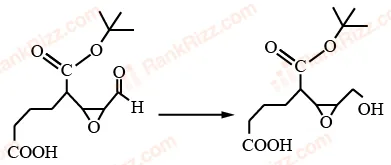
  12. Reagent(s) which can be used to bring about the following transformation is(are)2016 · PAPER 2
  13. Compounds formed from P and @Q are, respectively2013 · PAPER 2
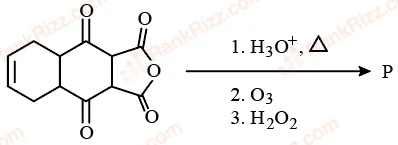
  14. The total number of carboxylic acid groups in the product P is2013 · PAPER 1
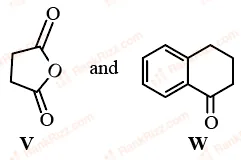
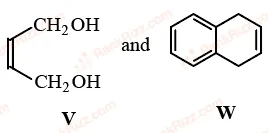
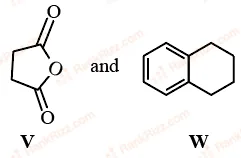
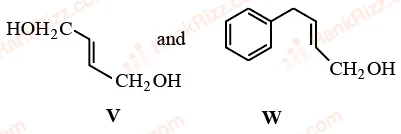
  15. In the following reaction sequences V and W are, respectively2013 · PAPER 2
  16. The compound that undergoes decarboxlylationmost readily under mild condition is2012 · PAPER 2
  17. The carboxyl functional group (-COOH) is present in2012 · PAPER 1
  18. Identify the binary mixture(s) that can be separatedinto individual compounds, by differential extraction, as shown in the given scheme.2012 · PAPER 1
  19. The compound K is2012 · PAPER 2
  20. The compound I is2012 · PAPER 2
  21. With reference to the scheme given, which of the given statements(s) about T, U, V and W is (are) correct?2012 · PAPER 2
  22. Amongst the following, the total number of compounds soluble in aqueous NaOH is2010 · PAPER 1
  23. STATEMENT-1: p-Hydroxybenzoic acid has a lower boiling point than o-hydroxybenzoic acid. because STATEMENT-2: o-Hydroxybenzoic acid has…2007 · PAPER 1

Acid derivatives: esters, amides, anhydrides and acid chlorides1 QUESTION

  1. The sum of total number of carbonyl groups (>C=O) present in the major products X and Y in the following reactions is ___.2026 · PAPER 1

FREE PDF

Carboxylic Acids and Derivatives JEE Advanced PYQs with answer key

All 27 questions on A4, by topic, with the answer key at the end. No sign-up, no email: your browser saves it as a PDF.

Download free PDF

UNIQUE CONCEPTS

Carboxylic Acids and Derivatives: one question per idea

4 ideas, each with the latest past question that tested it, drawn from 103 JEE Main and Advanced questions.

Carboxylic Acids and Derivatives Unique Concepts sheet →

JEE MAIN

Carboxylic Acids and Derivatives in JEE Main

JEE Main has set 76 Carboxylic Acids and Derivatives questions, 2004–2026.

Carboxylic Acids and Derivatives JEE Main PYQs →

Carboxylic Acids and Derivatives: quick answers

Is Carboxylic Acids and Derivatives asked every year in JEE Advanced?

Not every year. It has been asked in 12 of the 20 JEE Advanced years from 2007 to 2026; the years without a Carboxylic Acids and Derivatives question were 2008, 2009, 2011, 2014, 2015, 2018, 2020 and 2021.

Which Carboxylic Acids and Derivatives topic is asked most in JEE Advanced?

Reactions of carboxylic acids: 23 of the 27 questions (85%). Next come Acidity of carboxylic acids (3) and Acid derivatives: esters, amides, anhydrides and acid chlorides (1).

What share of Chemistry questions does Carboxylic Acids and Derivatives carry in JEE Advanced?

About 4.5% of Chemistry questions across the last 20 papers. In 2026 it was 5.9% (2 of 34 Chemistry questions).

When was Carboxylic Acids and Derivatives last asked in JEE Advanced?

In JEE Advanced 2026 Paper 1, the latest sitting with a Carboxylic Acids and Derivatives question.

How many Carboxylic Acids and Derivatives questions has JEE Advanced asked?

27 from 2007 to 2026, across 3 topics. Every one is listed on this page by topic and links to its own page, with the answer key and solution wherever we have them. Free, no sign-up.

Every Carboxylic Acids and Derivatives question

1–20 OF 27 · NEWEST FIRST

JEE ADVANCED 2026 · PAPER 1Acidity of carboxylic acids

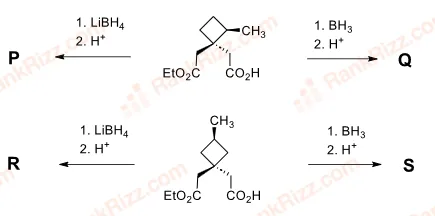
Considering LiBH4LiBH_4 reduces an ester group to the corresponding alcohol and does not reduce a carboxylic acid group, the correct statement about the major products P\mathbf{P}, Q\mathbf{Q}, R\mathbf{R} and S\mathbf{S} is

Figure for JEE Advanced 2026 Chemistry question on Acidity of carboxylic acids
  1. A

    P\mathbf{P} & Q\mathbf{Q} are identical, and R\mathbf{R} & S\mathbf{S} are diastereomers.

  2. B

    P\mathbf{P} & Q\mathbf{Q} are diastereomers, and R\mathbf{R} & S\mathbf{S} are identical.

  3. C

    P\mathbf{P} & Q\mathbf{Q} are diastereomers, and R\mathbf{R} & S\mathbf{S} are diastereomers.

  4. D

    P\mathbf{P} & Q\mathbf{Q} are identical, and R\mathbf{R} & S\mathbf{S} are identical.

JEE ADVANCED 2026 · PAPER 1Acid derivatives: esters, amides, anhydrides and acid chlorides

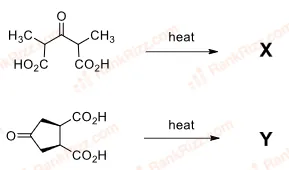
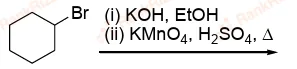
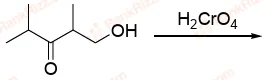
The sum of total number of carbonyl groups (>C=O)(>C=O) present in the major products X\mathbf{X} and Y\mathbf{Y} in the following reactions is ___.

Figure for JEE Advanced 2026 Chemistry question on Acid derivatives: esters, amides, anhydrides and acid chlorides
JEE ADVANCED 2025 · PAPER 2Reactions of carboxylic acids

The correct reaction/reaction sequence that would produce a dicarboxylic acid as the major product is

  1. A
    Figure for JEE Advanced 2025 Chemistry question on Reactions of carboxylic acids
  2. B
    Figure for JEE Advanced 2025 Chemistry question on Reactions of carboxylic acids
  3. C
    Figure for JEE Advanced 2025 Chemistry question on Reactions of carboxylic acids
  4. D
    Figure for JEE Advanced 2025 Chemistry question on Reactions of carboxylic acids
JEE ADVANCED 2023 · PAPER 2Acidity of carboxylic acids

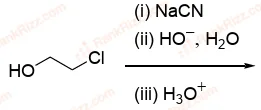
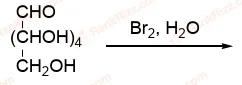
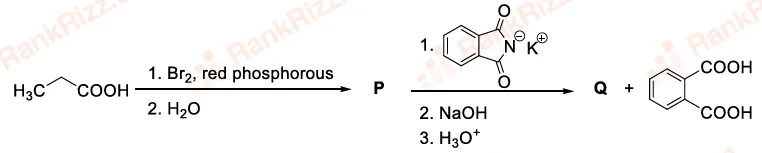
In the following reactions, P, Q, R, and S are the major products.

Figure for JEE Advanced 2023 Chemistry question on Acidity of carboxylic acids

The correct statement(s) about P, Q, R, and S is (are)

  1. A

    P and Q are monomers of polymers dacron and glyptal, respectively.

  2. B

    P, Q, and R are dicarboxylic acids.

  3. C

    Compounds Q and R are the same.

  4. D

    R does not undergo aldol condensation and S does not undergo Cannizzaro reaction.

JEE ADVANCED 2022 · PAPER 1Reactions of carboxylic acids

Considering the reaction sequence given below, the correct statement(s) is(are)

Figure for JEE Advanced 2022 Chemistry question on Reactions of carboxylic acids
  1. A

    P can be reduced to a primary alcohol using NaBH4_4.

  2. B

    Treating P with conc. NH4_4OH solution followed by acidification gives Q.

  3. C

    Treating Q with a solution of NaNO2_2 in aq. HCl liberates N2_2.

  4. D

    P is more acidic than CH3_3CH2_2COOH.

JEE ADVANCED 2019 · PAPER 1Reactions of carboxylic acids

The correct order of acid strength of the following carboxylic acids is

Figure for JEE Advanced 2019 Chemistry question on Reactions of carboxylic acids
  1. A

    III > II > I > IV

  2. B

    I > II > III > IV

  3. C

    I > III > II > IV

  4. D

    II > I > IV > III

JEE ADVANCED 2019 · PAPER 2Reactions of carboxylic acids

Which of the following options has correct combination considering List-I and List-II?

  1. A

    (I), (Q), (T), (U)

  2. B

    (II), (P), (S), (T)

  3. C

    (II), (P), (S), (U)

  4. D

    (I), (S), (Q), (R)

JEE ADVANCED 2019 · PAPER 2Reactions of carboxylic acids

Which of the following options has correct combination considering List-I and List-II?

  1. A

    (III), (S), (R)

  2. B

    (IV), (Q), (U)

  3. C

    (III), (T), (U)

  4. D

    (IV), (Q), (R)

JEE ADVANCED 2017 · PAPER 1Reactions of carboxylic acids

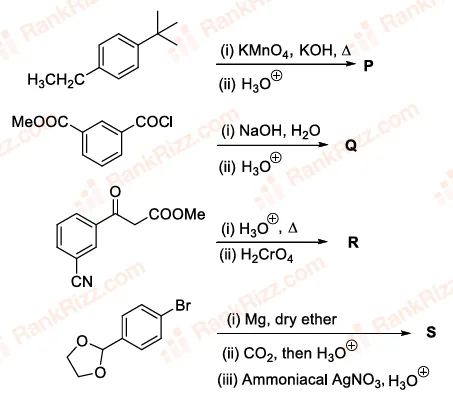
For the synthesis of benzoic acid, the only CORRECT combination is

  1. A

    (II) (i) (S)

  2. B

    (IV) (ii) (P)

  3. C

    (I) (iv) (Q)

  4. D

    (III) (iv) (R)

JEE ADVANCED 2017 · PAPER 1Reactions of carboxylic acids

The only CORRECT combination that gives two different carboxylic acids is

  1. A

    (II) (iv) (R)

  2. B

    (IV) (iii) (Q)

  3. C

    (III) (iii) (P)

  4. D

    (I) (i) (S)

JEE ADVANCED 2017 · PAPER 1Reactions of carboxylic acids

The only CORRECT combination in which the reaction proceeds through radical mechanism is

  1. A

    (III) (ii) (P)

  2. B

    (IV) (i) (Q)

  3. C

    (II) (iii) (R)

  4. D

    (I) (ii) (R)

JEE ADVANCED 2017 · PAPER 2Reactions of carboxylic acids

The reactions, Q to R and R to S, are

  1. A

    Dehydration and Friedel-Crafts acylation

  2. B

    Aromatic sulfonation and Friedel-Crafts acylation

  3. C

    Friedel-Crafts alkylation, dehydration and Friedel-Crafts acylation

  4. D

    Friedel-Crafts alkylation and Friedel-Crafts acylation

JEE ADVANCED 2016 · PAPER 2Reactions of carboxylic acids

The correct order of acidity for the following compounds is

Figure for JEE Advanced 2016 Chemistry question on Reactions of carboxylic acids
  1. A

    I>II>III>IVI > II > III > IV

  2. B

    III>I>II>IVIII > I > II > IV

  3. C

    III>IV>II>IIII > IV > II > I

  4. D

    I>III>IV>III > III > IV > II

JEE ADVANCED 2016 · PAPER 2Reactions of carboxylic acids

Reagent(s) which can be used to bring about the following transformation is(are)

Figure for JEE Advanced 2016 Chemistry question on Reactions of carboxylic acids
  1. A

    LiAlH4LiAlH_4 in (C2H5)2O(C_2H_5)_2O

  2. B

    BH3BH_3 in THFTHF

  3. C

    NaBH4NaBH_4 in C2H5OHC_2H_5OH

  4. D

    Raney NiH2\frac{Ni}{H_2} in THFTHF

JEE ADVANCED 2013 · PAPER 2Reactions of carboxylic acids

Compounds formed from P and @Q are, respectively

  1. A

    Optically active S and optically active pair (T,U)

  2. B

    Optically inactive S and optically inactive pair (T, U)

  3. C

    Optically active pair (T, U) and optically active S

  4. D

    Optically inactive pair (T, U) and optically inactive S

JEE ADVANCED 2013 · PAPER 1Reactions of carboxylic acids

The total number of carboxylic acid groups in the product P is

Figure for JEE Advanced 2013 Chemistry question on Reactions of carboxylic acids
JEE ADVANCED 2013 · PAPER 2Reactions of carboxylic acids

In the following reaction sequences V and W are, respectively

Figure for JEE Advanced 2013 Chemistry question on Reactions of carboxylic acids
  1. A
    Figure for JEE Advanced 2013 Chemistry question on Reactions of carboxylic acids
  2. B
    Figure for JEE Advanced 2013 Chemistry question on Reactions of carboxylic acids
  3. C
    Figure for JEE Advanced 2013 Chemistry question on Reactions of carboxylic acids
  4. D
    Figure for JEE Advanced 2013 Chemistry question on Reactions of carboxylic acids
JEE ADVANCED 2012 · PAPER 2Reactions of carboxylic acids

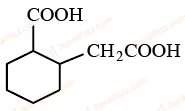
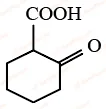
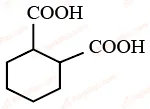
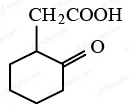
The compound that undergoes decarboxlylationmost readily under mild condition is

  1. A
    Figure for JEE Advanced 2012 Chemistry question on Reactions of carboxylic acids
  2. B
    Figure for JEE Advanced 2012 Chemistry question on Reactions of carboxylic acids
  3. C
    Figure for JEE Advanced 2012 Chemistry question on Reactions of carboxylic acids
  4. D
    Figure for JEE Advanced 2012 Chemistry question on Reactions of carboxylic acids