JEE Main 2019 Chemistry question — Nucleophilic addition reactions of carbonyl compounds
The major product obtained in the following reaction is:
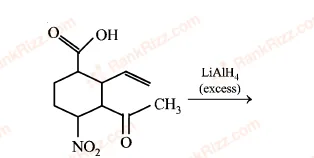
SOLUTION
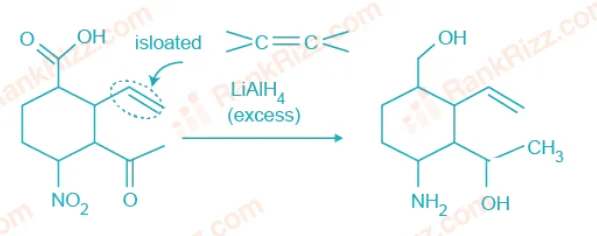
Lithium aluminum hydride () is an exceptionally powerful, non-selective reducing agent. When used in excess, it reduces a wide variety of carbonyl-containing and nitrogenous functional groups:
- Carboxylic Acid (): Reduced completely down to a primary alcohol ().
- Ketone (): Reduced down to a secondary alcohol ().
- Nitro Group (): When attached to an aliphatic (non-aromatic) carbon ring template, it is reduced cleanly to a primary amine ().
- Isolated Carbon-Carbon Double Bond () or Triple Bond (): Generally, isolated alkenes and alkynes are inert to because they lack an electrophilic center for a hydride ion () to attack.
-
1. Carboxylic Acid Conversion:
The top carboxylic acid group is transformed into a primary hydroxymethyl substituent.
-
2. Aliphatic Nitro Conversion:
The nitro group attached to the bottom-left of the cyclohexane ring is reduced to an amino group.
-
3. Ketone Conversion:
The acetyl/ketone side chain at the bottom-right is reduced to a secondary alcohol.
-
4. Isolated Alkene Behaviour:
The isolated carbon-carbon double bond shown in the upper right arm of the ring lacks any strong electron-withdrawing conjugation. As a result, it remains completely untouched by the hydride reduction mechanism.
Topic: Nucleophilic addition reactions of carbonyl compounds