Ray Optics & Optical Instruments — JEE Main Previous Year Questions
Every Ray Optics & Optical Instruments question JEE Main has set from 2004–2026, grouped by the idea it tests rather than the order of the syllabus. 272 questions across 9 distinct ideas. Free to read, answer key on every one.
A chapter is not one subject — it is a handful of procedures the examiner reuses. These are the ones Ray Optics & Optical Instruments questions actually test.
JEE MAIN 2022 · 25 JUL S2Thin lenses: lens formula, lens maker's formula and power
A convex lens of focal length 20 cm is placed in front of convex mirror with principal axis coinciding each other. The distance between the lens and mirror is 10 cm. A point object is placed on principal axis at a distance of 60 cm from the convex lens. The image formed by combination coincides the object itself. The focal length of the convex mirror is ______ cm.
JEE MAIN 2022 · 29 JUN S1Thin lenses: lens formula, lens maker's formula and power
A parallel beam of light is allowed to fall on a transparent spherical globe of diameter 30 cm and refractive index 1.5. The distance from the centre of the globe at which beam of light can converge is ______ mm.
JEE MAIN 2022 · 29 JUN S2Total internal reflection and critical angle
The speed of light in media 'A' and 'B' are 2.0×1010 cm s−1 and 1.5×1010 cm s−1 respectively. A ray of light enters from the medium B to A at an incident angle θ. If the ray suffers total internal reflection, then
JEE MAIN 2022 · 27 JUN S1Refraction at plane surfaces, Snell's law and apparent depth
Consider a light ray travelling in air is incident into a medium of refractive index 2n. The incident angle is twice that of refracting angle. Then, the angle of incidence will be
JEE MAIN 2022 · 27 JUN S2Thin lenses: lens formula, lens maker's formula and power
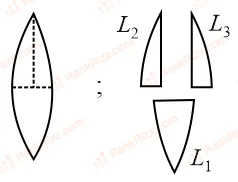
A convex lens has power P. It is cut into two halves along its principal axis. Further one piece (out of the two halves) is cut into two halves perpendicular to the principal axis (as shown in figures). Choose the incorrect option for the reported pieces.
JEE MAIN 2022 · 26 JUN S1Spherical mirrors: mirror formula and magnification
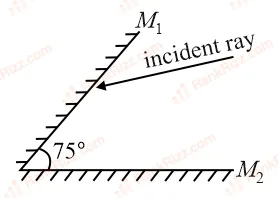
A light ray is incident, at an incident angle θ1, on the system of two plane mirrors M1 and M2 having an inclination angle 75° between them (as shown in figure). After reflecting from mirror M1 it gets reflected back by the mirror M2 with an angle of reflection 30°. The total deviation of the ray will be ______ degree.
JEE MAIN 2022 · 26 JUN S2Refraction at plane surfaces, Snell's law and apparent depth
A small bulb is placed at the bottom of a tank containing water to a depth of 7 m. The refractive index of water is 34. The area of the surface of water through which light from the bulb can emerge out is xπ m2. The value of x is ______
JEE MAIN 2022 · 25 JUN S1Refraction at plane surfaces, Snell's law and apparent depth
A light wave travelling linearly in a medium of dielectric constant 4, incidents on the horizontal interface separating medium with air. The angle of incidence for which the total intensity of incident wave will be reflected back into the same medium will be : (Given : relative permeability of medium μr=1)
JEE MAIN 2022 · 25 JUN S1Refraction at plane surfaces, Snell's law and apparent depth
The difference of speed of light in the two media A and B (vA−vB) is 2.6×10⁷ m s−1. If the refractive index of medium B is 1.47, then the ratio of refractive index of medium B to medium A is: (Given : speed of light in vacuum c=3×10⁸ m s−1)
JEE MAIN 2022 · 24 JUN S1Thin lenses: lens formula, lens maker's formula and power
Two identical thin biconvex lenses of focal length 15 cm and refractive index 1.5 are in contact with each other. The space between the lenses is filled with a liquid of refractive index 1.25. The focal length of the combination is ______ cm.
JEE MAIN 2022 · 24 JUN S2Refraction at plane surfaces, Snell's law and apparent depth
A ray of light is incident at an angle of incidence 60° on the glass slab of refractive index 3. After refraction, the light ray emerges out from other parallel faces and lateral shift between incident ray and emergent ray is 43 cm. The thickness of the glass slab is ______ cm.
JEE MAIN 2021 · 01 SEP S2Refraction at plane surfaces, Snell's law and apparent depth
A glass tumbler having inner depth of 17.5 cm is kept on a table. A student starts pouring water (μ=34) into it while looking at the surface of water from the above. When he feels that the tumbler is half filled, he stops pouring water. Up to what height, the tumbler is actually filled?
JEE MAIN 2021 · 31 AUG S1Thin lenses: lens formula, lens maker's formula and power
An object is placed at the focus of concave lens having focal length f. What is the magnification and distance of the image from the optical centre of the lens?
JEE MAIN 2021 · 31 AUG S1Spherical mirrors: mirror formula and magnification
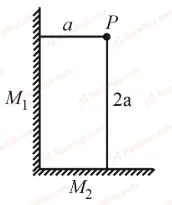
Two plane mirrors M1 and M2 are at right angle to each other as shown. A point source P is placed at a and 2a meter away from M1 and M2 respectively. The shortest distance between any two images thus formed is: (Take 5=2.3)
JEE MAIN 2021 · 31 AUG S2Refraction at plane surfaces, Snell's law and apparent depth
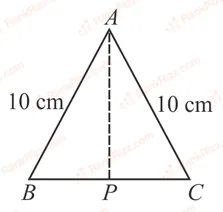
Cross-section view of a prism is the equilateral triangle ABC shown in the figure. The minimum deviation is observed using this prism when the angle of incidence is equal to the prism angle. The time taken by light to travel from P (midpoint of BC) to A is _________ ×10−10 s. (Given, speed of light in vacuum = 3×10⁸ m s−1 and cos30°=23)
JEE MAIN 2021 · 27 AUG S1Spherical mirrors: mirror formula and magnification
An object is placed beyond the centre of curvature C of the given concave mirror. If the distance of the object is d1 from C and the distance of the image formed is d2 from C, the radius of curvature of this mirror is:
JEE MAIN 2021 · 27 AUG S2Thin lenses: lens formula, lens maker's formula and power
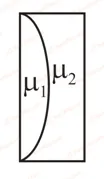
Curved surfaces of a plano-convex lens of refractive index μ1 and a plano-concave lens of refractive index μ2 have equal radius of curvature as shown in figure. Find the ratio of radius of curvature to the focal length of the combined lenses.
JEE MAIN 2021 · 26 AUG S1Spherical mirrors: mirror formula and magnification
Car B overtakes another car A at a relative speed of 40 m s−1. How fast will the image of car B appear to move in the mirror of focal length 10 cm fitted in car A, when the car B is 1.9 m away from the car A?