RankRizz

Ray Optics & Optical Instruments — JEE Main Previous Year Questions

Every Ray Optics & Optical Instruments question JEE Main has set from 2004–2026, grouped by the idea it tests rather than the order of the syllabus. 272 questions across 9 distinct ideas. Free to read, answer key on every one.

DATA UPDATED

Questions

272

Distinct ideas

9

Share of marks

7%

Difficulty

MEDIUM

The ideas inside Ray Optics & Optical Instruments

A chapter is not one subject — it is a handful of procedures the examiner reuses. These are the ones Ray Optics & Optical Instruments questions actually test.

Every Ray Optics & Optical Instruments question

221–240 OF 272 · NEWEST FIRST

JEE MAIN 2019 · 10 JAN S2Thin lenses: lens formula, lens maker's formula and power

The eye can be regarded as a single refracting surface. The radius of curvature of this surface is equal to that of the cornea (7.8 mm). This surface separates two media of refractive indices 1 and 1.34. Calculate the distance from the refracting surface at which a parallel beam of light will come to focus.

  1. A

    4.0 cm

  2. B

    1 cm

  3. C

    2 cm

  4. D

    3.07 cm

JEE MAIN 2019 · 09 JAN S1Thin lenses: lens formula, lens maker's formula and power

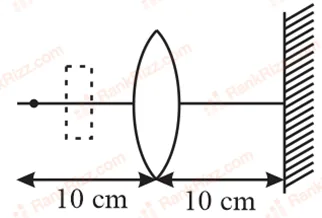
A convex lens is put 10 cm from a light source and it makes a sharp image on a screen, kept 10 cm from the lens. Now a glass block (refractive index 1.5) of 1.5 cm thickness is placed in between the light source and the lens. To get the sharp image again, the screen is shifted by a distance dd. Then dd is:

Figure for JEE Main 2019 Physics question on Thin lenses: lens formula, lens maker's formula and power
  1. A

    0

  2. B

    0.55 cm away from the lens

  3. C

    0.55 cm towards the lens

  4. D

    1.1 cm away from the lens

JEE MAIN 2019 · 09 JAN S2Reflection and plane mirrors

Two plane mirrors are inclined to each other such that a ray of light incident on the first mirror (M1)(M_1) and parallel to the second mirror (M2)(M_2) is finally reflected from the second mirror (M2)(M_2) and parallel to the first mirror (M1)(M_1). The angle between the two mirrors will be:

  1. A

    60∘^{\circ}

  2. B

    45∘^{\circ}

  3. C

    90∘^{\circ}

  4. D

    75∘^{\circ}

JEE MAIN 2018 · 16 APR ONLINERefraction at plane surfaces, Snell's law and apparent depth

A ray of light is incident at an angle of 60∘^\circ on one face of a prism of angle 30∘^\circ. The emergent ray of light makes an angle of 30∘^\circ with incident ray. The angle made by the emergent ray with second face of prism will be:

  1. A

    0∘^\circ

  2. B

    90∘^\circ

  3. C

    30∘^\circ

  4. D

    45∘^\circ

JEE MAIN 2018 · 15 APR S1Thin lenses: lens formula, lens maker's formula and power

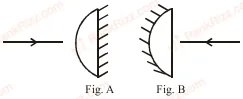
A planoconvex lens becomes an optical system of 28 cm focal length when its plane surface is silvered and illuminated from left to right as shown in Fig. A. If the same lens is instead silvered on the curved surface and illuminated from other side as in Fig. B, it acts like an optical system of focal length 10 cm. The refractive index of the material of lens is:

Figure for JEE Main 2018 Physics question on Thin lenses: lens formula, lens maker's formula and power
  1. A

    1.50

  2. B

    1.55

  3. C

    1.75

  4. D

    1.51

JEE MAIN 2018 · 15 APR S1Spherical mirrors: mirror formula and magnification

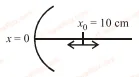
A particle is oscillating on the X-axis with an amplitude 2 cm about the point x0=10x_0 = 10 cm with a frequency ω\omega. A concave mirror of focal length 5 cm is placed at the origin (see figure). Identify the correct statements: (A) The image executes periodic motion (B) The image executes non-periodic motion (C) The turning points of the image are asymmetric w.r.t the image of the point at x = 10 cm (D) The distance between the turning points of the oscillation of the image is 10021\frac{100}{21} cm.
Figure for JEE Main 2018 Physics question on Spherical mirrors: mirror formula and magnification

  1. A

    (B), (D)

  2. B

    (B), (C)

  3. C

    (A), (C), (D)

  4. D

    (A), (D)

JEE MAIN 2018 · 15 APR S2Thin lenses: lens formula, lens maker's formula and power

A convergent doublet of separated lenses, corrected for spherical aberration, has resultant focal length of 10 cm. The separation between the two lenses is 2 cm. The focal lengths of the component lenses are:

  1. A

    18 cm, 20 cm

  2. B

    10 cm, 12 cm

  3. C

    12 cm, 14 cm

  4. D

    16 cm, 18 cm

JEE MAIN 2017 · 09 APR ONLINEThin lenses: lens formula, lens maker's formula and power

In an experiment a convex lens of focal length 15 cm is placed coaxially on an optical bench in front of a convex mirror at a distance of 5 cm from it. It is found that an object and its image coincide, if the object is placed at a distance of 20 cm from the lens. The focal length of the convex mirror is-

  1. A

    20.0 cm

  2. B

    30.5 cm

  3. C

    25.0 cm

  4. D

    27.5 cm

JEE MAIN 2017 · 08 APR ONLINERefraction at plane surfaces, Snell's law and apparent depth

Let the refractive index of a denser medium with respect to a rarer medium be n12n_{12} and its critical angle be θC\theta_C. At an angle of incidence AA when light is travelling from denser medium to rarer medium, a part of the light is reflected and the rest is refracted and the angle between reflected and refracted rays is 90°. Angle AA is given by:

  1. A

    tan⁡−1(sin⁡θC)\tan^{-1}(\sin \theta_C)

  2. B

    1tan⁡−1(sin⁡θC)\frac{1}{\tan^{-1}(\sin \theta_C)}

  3. C

    cos⁡−1(sin⁡θC)\cos^{-1}(\sin \theta_C)

  4. D

    1cos⁡−1(sin⁡θC)\frac{1}{\cos^{-1}(\sin \theta_C)}

JEE MAIN 2017 · 02 APR OFFLINEThin lenses: lens formula, lens maker's formula and power

A diverging lens with magnitude of focal length 25 cm is placed at a distance of 15 cm from a converging lens of magnitude of focal length 20 cm. A beam of parallel light falls on the diverging lens. The final image formed is:

  1. A

    Real and at a distance of 6 cm from the convergent lens

  2. B

    Real and at a distance of 40 cm from the convergent lens

  3. C

    Virtual and at a distance of 40 cm from the convergent lens

  4. D

    Real and at a distance of 40 cm from the divergent lens

JEE MAIN 2016 · 10 APR ONLINERefraction at plane surfaces, Snell's law and apparent depth

To determine refractive index of glass slab using a travelling microscope, minimum number of readings required are:

  1. A

    Two

  2. B

    Four

  3. C

    Three

  4. D

    Five

JEE MAIN 2016 · 10 APR ONLINESpherical mirrors: mirror formula and magnification

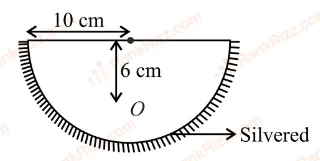
A hemispherical glass body of radius 10 cm and refractive index 1.5 is silvered on its curved surface. A small air bubble is 6 cm below the flat surface inside it along the axis. The position of the image of the air bubble made by the mirror is seen:

Figure for JEE Main 2016 Physics question on Spherical mirrors: mirror formula and magnification
  1. A

    14 cm below flat surface

  2. B

    20 cm below flat surface

  3. C

    16 cm below flat surface

  4. D

    30 cm below flat surface

JEE MAIN 2016 · 09 APR ONLINEThin lenses: lens formula, lens maker's formula and power

To find the focal length of a convex mirror, a student records the following data:
Object pin: 22.2 cm, Convex Lens: 32.2 cm, Convex Mirror: 45.8 cm, Image Pin: 71.2 cm
The focal length of the convex lens is f1f_1 and that of mirror is f2f_2. Then taking index correction to be negligibly small, f1f_1 and f2f_2 are close to:

  1. A

    f1=7.8f_1 = 7.8 cm, f2=12.7f_2 = 12.7 cm

  2. B

    f1=12.7f_1 = 12.7 cm, f2=7.8f_2 = 7.8 cm

  3. C

    f1=15.6f_1 = 15.6 cm, f2=25.4f_2 = 25.4 cm

  4. D

    f1=7.8f_1 = 7.8 cm, f2=25.4f_2 = 25.4 cm

JEE MAIN 2016 · 09 APR ONLINEThin lenses: lens formula, lens maker's formula and power

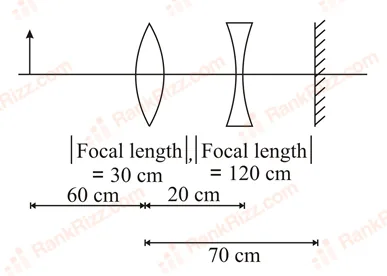
A convex lens, of focal length 30 cm, a concave lens of focal length 120 cm, and a plane mirror are arranged as shown. For an object kept at a distance of 60 cm from the convex lens, the final image, formed by the combination, is a real image, at a distance of:

Figure for JEE Main 2016 Physics question on Thin lenses: lens formula, lens maker's formula and power
  1. A

    60 cm from the convex lens

  2. B

    60 cm from the concave lens

  3. C

    70 cm from the convex lens

  4. D

    70 cm from the concave lens

JEE MAIN 2016 · 03 APR OFFLINEOptical instruments: microscopes and telescopes

An observer looks at a distant tree of height 10 m with a telescope of magnifying power of 20. To the observer, the tree appears as

  1. A

    20 times taller.

  2. B

    20 times nearer.

  3. C

    10 times taller.

  4. D

    10 times nearer.

JEE MAIN 2016 · 03 APR OFFLINERefraction at plane surfaces, Snell's law and apparent depth

In an experiment for determination of refractive index of glass of a prism by i v/s δ\delta plot, it was found that a ray incident at angle 35°, suffers a deviation of 40° and that it emerges at angle 79°. In that case which of the following is closest to the maximum possible value of the refractive index?

  1. A

    1.7

  2. B

    1.8

  3. C

    1.5

  4. D

    1.6

JEE MAIN 2015 · 11 APR ONLINEThin lenses: lens formula, lens maker's formula and power

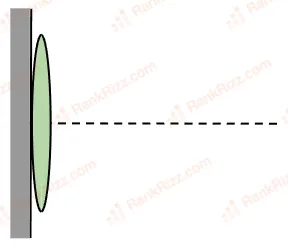
A thin convex lens of focal length ff is put on a plane mirror as shown in the figure. When an object is kept at a distance aa from the lens-mirror combination, its image is formed at a distance a3\dfrac{a}{3} in front of the combination. The value of aa is:

Figure for JEE Main 2015 Physics question on Thin lenses: lens formula, lens maker's formula and power
  1. A

    2f2f

  2. B

    32f\frac{3}{2}f

  3. C

    3f3f

  4. D

    ff

JEE MAIN 2015 · 10 APR ONLINEOptical instruments: microscopes and telescopes

A telescope has an objective lens of focal length 150 cm and an eyepiece of focal length 5 cm. If a 50 m tall tower at a distance of 1 km is observed through this telescope in a normal setting, the angle formed by the image of the tower is θ\theta, then θ\theta is close to

  1. A

    30∘^\circ

  2. B

    15∘^\circ

  3. C

    1∘^\circ

  4. D

    86∘^\circ

JEE MAIN 2015 · 10 APR ONLINESpherical mirrors: mirror formula and magnification

You are asked to design a shaving mirror assuming that a person keeps it at 10 cm from his face and views the magnified image of the face at the closest comfortable distance of 25 cm. The radius of curvature of the mirror would then be:

  1. A

    24 cm

  2. B

    30 cm

  3. C

    60 cm

  4. D

    -24 cm

JEE MAIN 2015 · 04 APR OFFLINERefraction at plane surfaces, Snell's law and apparent depth

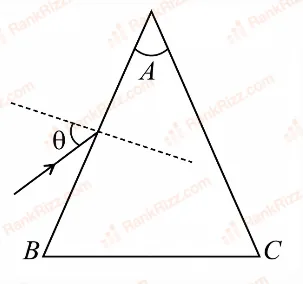
Monochromatic light is incident on a glass prism of angle A. If the refractive index of the material of the prism is μ\mu, a ray, incident at an angle θ\theta, on the face AB would get transmitted through the face AC of the prism provided:

Figure for JEE Main 2015 Physics question on Refraction at plane surfaces, Snell's law and apparent depth
  1. A

    θ<cos⁡−1[μsin⁡(A+sin⁡−1(1μ))]\theta < \cos^{-1}\left[\mu \sin\left(A + \sin^{-1}\left(\frac{1}{\mu}\right)\right)\right]

  2. B

    θ>sin⁡−1[μsin⁡(A−sin⁡−1(1μ))]\theta > \sin^{-1}\left[\mu \sin\left(A - \sin^{-1}\left(\frac{1}{\mu}\right)\right)\right]

  3. C

    θ<sin⁡−1[μsin⁡(A−sin⁡−1(1μ))]\theta < \sin^{-1}\left[\mu \sin\left(A - \sin^{-1}\left(\frac{1}{\mu}\right)\right)\right]

  4. D

    θ>cos⁡−1[μsin⁡(A+sin⁡−1(1μ))]\theta > \cos^{-1}\left[\mu \sin\left(A + \sin^{-1}\left(\frac{1}{\mu}\right)\right)\right]