Ray Optics & Optical Instruments — JEE Main Previous Year Questions
Every Ray Optics & Optical Instruments question JEE Main has set from 2004–2026, grouped by the idea it tests rather than the order of the syllabus. 272 questions across 9 distinct ideas. Free to read, answer key on every one.
A chapter is not one subject — it is a handful of procedures the examiner reuses. These are the ones Ray Optics & Optical Instruments questions actually test.
JEE MAIN 2024 · 06 APR S1Refraction at plane surfaces, Snell's law and apparent depth
The refractive index of prism is μ=3 and the ratio of the angle of minimum deviation to the angle of prism is one. The value of angle of prism is _______.
JEE MAIN 2024 · 06 APR S2Thin lenses: lens formula, lens maker's formula and power
For the thin convex lens, the radii of curvature are at 15 cm and 30 cm respectively. The focal length the lens is 20 cm. The refractive index of the material is :
JEE MAIN 2024 · 05 APR S2Refraction at plane surfaces, Snell's law and apparent depth
Given below are two statements : Statement I : When the white light passed through a prism, the red light bends lesser than yellow and violet. Statement II : The refractive indices are different for different wavelengths in dispersive medium. In the light of the above statements, choose the correct answer from the options given below :
JEE MAIN 2024 · 04 APR S1Thin lenses: lens formula, lens maker's formula and power
An effective power of a combination of 5 identical convex lenses which are kept in contact along the principal axis is 25D. Focal length of each of the convex lens is:
JEE MAIN 2024 · 04 APR S2Refraction at plane surfaces, Snell's law and apparent depth
A light ray is incident on a glass slab of thickness 43 cm and refractive index 2. The angle of incidence is equal to the critical angle for the glass slab with air. The lateral displacement of ray after passing through glass slab is _____ cm. (Given sin15°=0.25)
JEE MAIN 2024 · 01 FEB S1Thin lenses: lens formula, lens maker's formula and power
The distance between object and its 3 times magnified virtual image as produced by a convex lens is 20 cm. The focal length of the lens used is ________ cm.
JEE MAIN 2024 · 31 JAN S2Refraction at plane surfaces, Snell's law and apparent depth
Light from a point source in air falls on a convex curved surface of radius 20 cm and refractive index 1.5. If the source is located at 100 cm from the convex surface, the image will be formed at ______ cm from the object.
JEE MAIN 2024 · 30 JAN S1Thin lenses: lens formula, lens maker's formula and power
The distance between object and its two times magnified real image as produced by a convex lens is 45 cm. The focal length of the lens used is ________ cm.
JEE MAIN 2024 · 30 JAN S2Thin lenses: lens formula, lens maker's formula and power
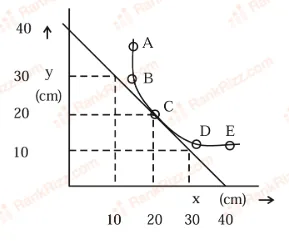
In an experiment to measure the focal length (f) of a convex lens, the magnitude of object distance (x) and the image distance (y) are measured with reference to the focal point of the lens. The y−x plot is shown in figure. The focal length of the lens is ____ cm.
JEE MAIN 2024 · 29 JAN S1Thin lenses: lens formula, lens maker's formula and power
A biconvex lens of refractive index 1.5 has a focal length of 20 cm in air. Its focal length when immersed in a liquid of refractive index 1.6 will be:
JEE MAIN 2024 · 27 JAN S1Thin lenses: lens formula, lens maker's formula and power
A convex lens of focal length 40 cm forms an image of an extended source of light on a photoelectric cell. A current I is produced. The lens is replaced by another convex lens having the same diameter but focal length 20 cm. The photoelectric current now is
JEE MAIN 2024 · 27 JAN S1Refraction at plane surfaces, Snell's law and apparent depth
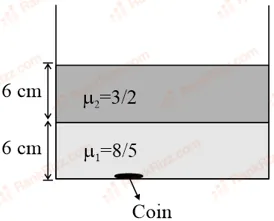
Two immiscible liquids of refractive indices 58 and 23 respectively are put in a beaker as shown in the figure. The height of each column is 6 cm. A coin is placed at the bottom of the beaker. For near normal vision, the apparent depth of the coin is 4α cm. The value of α is _______.
JEE MAIN 2023 · 15 APR S1Refraction at plane surfaces, Snell's law and apparent depth
The refractive index of a transparent liquid filled in an equilateral hollow prism is 2. The angle of minimum deviation for the liquid will be _____°.
JEE MAIN 2023 · 13 APR S1Refraction at plane surfaces, Snell's law and apparent depth
A vessel of depth d is half filled with oil of refractive index n1 and the other half is filled with water of refractive index n2. The apparent depth of this vessel when viewed from above will be-
JEE MAIN 2023 · 13 APR S1Refraction at plane surfaces, Snell's law and apparent depth
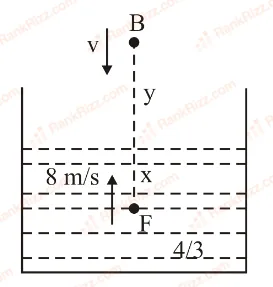
A fish rising vertically upward with a uniform velocity of 8 m s−1, observes that a bird is diving vertically downward towards the fish with the velocity of 12 m s−1. If the refractive index of water is 34, then the actual velocity of the diving bird to pick the fish, will be _____ m s−1.