RankRizz

Ray Optics & Optical Instruments — JEE Main Previous Year Questions

Every Ray Optics & Optical Instruments question JEE Main has set from 2004–2026, grouped by the idea it tests rather than the order of the syllabus. 272 questions across 9 distinct ideas. Free to read, answer key on every one.

DATA UPDATED

Questions

272

Distinct ideas

9

Share of marks

7%

Difficulty

MEDIUM

The ideas inside Ray Optics & Optical Instruments

A chapter is not one subject — it is a handful of procedures the examiner reuses. These are the ones Ray Optics & Optical Instruments questions actually test.

Every Ray Optics & Optical Instruments question

261–272 OF 272 · NEWEST FIRST

JEE MAIN 2012Optical instruments: microscopes and telescopes

We wish to make a microscope with the help of two positive lenses both with a focal length of 2020 mm each and the object is positioned 2525 mm from the objective lens. How far apart the lenses should be so that the final image is formed at infinity?

  1. A

    2020 mm

  2. B

    100100 mm

  3. C

    120120 mm

  4. D

    8080 mm

JEE MAIN 2011Refraction at plane surfaces, Snell's law and apparent depth

Let the x−zx-z plane be the boundary between two transparent media. Medium 1 in z≥0z \geq 0 has a refractive index of 2\sqrt{2} and medium 2 with z<0z < 0 has a refractive index of 3\sqrt{3}. A ray of light in medium 1 given by the vector A⃗=63 i^+83 j^−10k^\vec{A} = 6\sqrt{3}\,\hat{i} + 8\sqrt{3}\,\hat{j} - 10\hat{k} is incident on the plane of separation. The angle of refraction in medium 2 is:

  1. A

    45∘45^\circ

  2. B

    60∘60^\circ

  3. C

    75∘75^\circ

  4. D

    30∘30^\circ

JEE MAIN 2011Spherical mirrors: mirror formula and magnification

A car is fitted with a convex side-view mirror of focal length 20 cm20 \, \text{cm}. A second car 2.8 m2.8 \, \text{m} behind the first car is overtaking the first car at relative speed of 15 m/s15 \, \text{m/s}. The speed of the image of the second car as seen in the mirror of the first one is:

  1. A

    115 m/s\dfrac{1}{15} \, \text{m/s}

  2. B

    10 m/s10 \, \text{m/s}

  3. C

    15 m/s15 \, \text{m/s}

  4. D

    110 m/s\dfrac{1}{10} \, \text{m/s}

JEE MAIN 2010Refraction at plane surfaces, Snell's law and apparent depth

An initially parallel cylindrical beam travels in a medium of refractive index μ(I)=μ0+μ2I\mu(I) = \mu_0 + \mu_2 I, where μ0\mu_0 and μ2\mu_2 are positive constants and II is the intensity of the light beam. The intensity of the beam is decreasing with increasing radius. As the beam enters the medium, it will

  1. A

    diverge

  2. B

    converge

  3. C

    diverge near the axis and converge near the periphery

  4. D

    travel as a cylindrical beam

JEE MAIN 2010Refraction at plane surfaces, Snell's law and apparent depth

An initially parallel cylindrical beam travels in a medium of refractive index μ(I)=μ0+μ2I\mu(I) = \mu_0 + \mu_2 I, where μ0\mu_0 and μ2\mu_2 are positive constants and II is the intensity of the light beam. The intensity of the beam is decreasing with increasing radius. The speed of light in the medium is

  1. A

    minimum on the axis of the beam

  2. B

    the same everywhere in the beam

  3. C

    directly proportional to the intensity II

  4. D

    maximum on the axis of the beam

JEE MAIN 2009Total internal reflection and critical angle

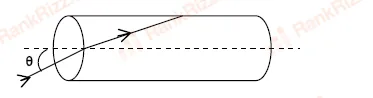
A transparent solid cylindrical rod has a refractive index of 23\frac{2}{\sqrt{3}}. It is surrounded by air. A light ray is incident at the mid point of one end of the rod as shown in the figure. The incident angle θ\theta for which the light ray Figure for JEE Main 2009 Physics question on Total internal reflection and critical angle grazes along the wall of the rod is

  1. A

    sin⁡−1(12)\sin^{-1}\left(\frac{1}{2}\right)

  2. B

    sin⁡−1(32)\sin^{-1}\left(\frac{\sqrt{3}}{2}\right)

  3. C

    sin⁡−1(23)\sin^{-1}\left(\frac{2}{\sqrt{3}}\right)

  4. D

    sin⁡−1(13)\sin^{-1}\left(\frac{1}{\sqrt{3}}\right)

JEE MAIN 2007Combinations of lenses and mirrors

Two lenses of power −15D-15 D and +5D+5 D are in contact with each other. The focal length of the combination is

  1. A

    −20-20 cm

  2. B

    −10-10 cm

  3. C

    +20+20 cm

  4. D

    +10+10 cm

JEE MAIN 2006Prism: deviation and dispersion

The refractive index of glass is 1.5201.520 for red light and 1.5251.525 for blue light. Let D1D_1 and D2D_2 be the angles of minimum deviation for red and blue light respectively in a prism of this glass. Then

  1. A

    D1>D2D_1 > D_2

  2. B

    D1<D2D_1 < D_2

  3. C

    D1=D2D_1 = D_2

  4. D

    D1D_1 can be less than or greater than depending upon the angle of prism

JEE MAIN 2005Total internal reflection and critical angle

A fish looking up through the water sees the outside world contained in a circular horizon. If the refractive index of water is 4/34/3 and the fish is 1212 cm below the surface, the radius of this circle in cm is

  1. A

    36736\sqrt{7}

  2. B

    36/736/\sqrt{7}

  3. C

    36536\sqrt{5}

  4. D

    454\sqrt{5}

JEE MAIN 2005Thin lenses: lens formula, lens maker's formula and power

A thin glass (refractive index 1.51.5) lens has optical power of −5D-5D in air. Its optical power in a liquid medium with refractive index 1.61.6 will be

  1. A

    1D1D

  2. B

    −1D-1D

  3. C

    25D25D

  4. D

    None of these

JEE MAIN 2004Total internal reflection and critical angle

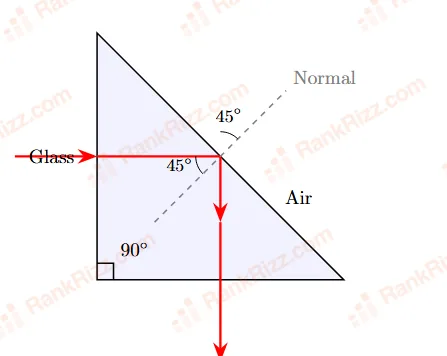
A light ray is incident perpendicular to one face of a 90∘90^\circ prism and is totally internally reflected at the glass-air interface. If the angle of reflection is 45∘45^\circ, we conclude that the refractive index nn

Figure for JEE Main 2004 Physics question on Total internal reflection and critical angle
  1. A

    n<12n < \frac{1}{2}

  2. B

    n>2n > \sqrt{2}

  3. C

    n>12n > \frac{1}{\sqrt{2}}

  4. D

    n<2n < \sqrt{2}

JEE MAIN 2004Combinations of lenses and mirrors

A plane convex lens of refractive index 1.51.5 and radius of curvature 3030 cm is silvered at the curved surface. Now this lens has been used to form the image of an object. At what distance from this lens an object be placed in order to have a real image of the size of the object?

  1. A

    2020 cm

  2. B

    3030 cm

  3. C

    6060 cm

  4. D

    8080 cm