JEE MAIN 2023 · 13 APR S2Thin lenses: lens formula, lens maker's formula and power
A bi convex lens of focal length cm is cut in two identical parts along a plane perpendicular to the principal axis. The power of each lens after cut is _____ D.
Every Ray Optics & Optical Instruments question JEE Main has set from 2004–2026, grouped by the idea it tests rather than the order of the syllabus. 272 questions across 9 distinct ideas. Free to read, answer key on every one.
DATA UPDATED
Questions
272
Distinct ideas
9
Share of marks
7%
Difficulty
MEDIUM
A chapter is not one subject — it is a handful of procedures the examiner reuses. These are the ones Ray Optics & Optical Instruments questions actually test.
101–120 OF 272 · NEWEST FIRST
A bi convex lens of focal length cm is cut in two identical parts along a plane perpendicular to the principal axis. The power of each lens after cut is _____ D.
An ice cube has a bubble inside. When viewed from one side the apparent distance of the bubble is cm. When viewed from the opposite side, the apparent distance of the bubble is observed as cm. If the side of the ice cube is cm, the refractive index of the ice cube is
Two convex lenses of focal length cm each are placed coaxially with a separation of cm between them. The image of the distant object formed by the combination is at _____ cm from the first lens.
The critical angle for a denser-rarer interface is 45. The speed of light in rarer medium is m s. The speed of light in the denser medium is:
m s
m s
m s
m s
The radius of curvature of each surface of a convex lens having refractive index 1.8 is 20 cm. The lens is now immersed in a liquid of refractive index 1.5. The ratio of power of lens in air to its power in the liquid will be : 1. The value of is _______
When one light ray is reflected from a plane mirror with 30 angle of reflection, the angle of deviation of the ray after reflection is:
120
110
140
130
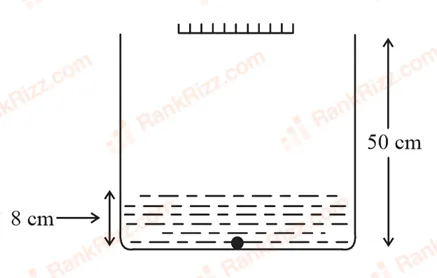
As shown in the figure, a plane mirror is fixed at a height of 50 cm from the bottom of tank containing water (). The height of water in the tank is 8 cm. A small bulb is placed at the bottom of the water tank. The distance of image of the bulb formed by mirror from the bottom of the tank is _______ cm.
An object is placed at a distance of 12 cm in front of a plane mirror. The virtual and erect image is formed by the mirror. Now the mirror is moved by 4 cm towards the stationary object. The distance by which the position of image would be shifted, will be
4 cm towards mirror
8 cm towards mirror
8 cm away from mirror
2 cm towards mirror
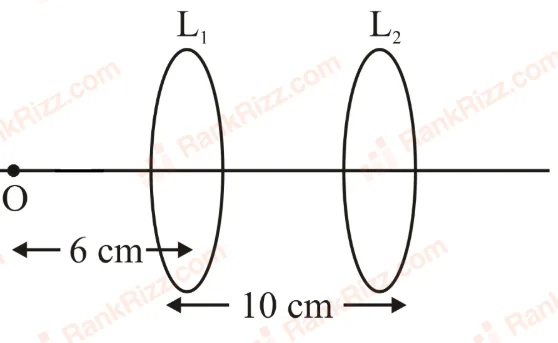
A point object O is placed in front of two thin symmetrical coaxial convex lenses and with focal length 24 cm and 9 cm respectively. The distance between two lenses is 10 cm and the object is placed 6 cm away from lens as shown in the figure. The distance between the object and the image formed by the system of two lenses is _______ cm.
In a reflecting telescope, a secondary mirror is used to:
reduce the problem of mechanical support
make chromatic aberration zero
move the eyepiece outside the telescopic tube
remove spherical aberration
Two vertical parallel mirrors A and B are separated by 10 cm. A point object O is placed at a distance of 2 cm from mirror A. The distance of the second nearest image behind mirror A from the mirror A is ______ cm.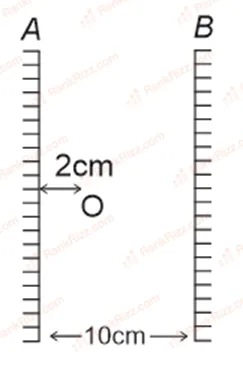
Two transparent media having refractive indices 1.0 and 1.5 are separated by a spherical refracting surface of radius of curvature 30 cm. The centre of curvature of surface is towards denser medium and a point object is placed on the principal axis in rarer medium at a distance of 15 cm from the pole of the surface. The distance of image from the pole of the surface is _______ cm.
A monochromatic light wave with wavelength and frequency in air enters another medium. If the angle of incidence and angle of refraction at the interface are 45° and 30° respectively, then the wavelength and frequency of the refracted wave are:
A pole is vertically submerged in swimming pool, such that it gives a length of shadow 2.15 m within water when sunlight is incident at an angle of 30° with the surface of water. If swimming pool is filled to a height of 1.5 m, then the height of the pole above the water surface in centimeters is ______.
A thin cylindrical rod of length 10 cm is placed horizontally on the principle axis of a concave mirror of focal length 20 cm. The rod is placed in a such a way that mid point of the rod is at 40 cm from the pole of mirror. The length of the image formed by the mirror will be cm. The value of is _____.
Two objects and are placed at cm and cm from the pole in front of a concave mirror having radius of curvature cm. The distance between images formed by the mirror is:
cm
cm
cm
cm
A microscope is focused on an object at the bottom of a bucket. If liquid with refractive index is poured inside the bucket, then microscope have to be raised by 30 cm to focus the object again. The height of the liquid in the bucket is:
75 cm
50 cm
18 cm
12 cm
A person has been using spectacles of power diopter for distant vision and a separate reading glass of power diopters. What is the least distance of distinct vision for this person:
cm
cm
cm
cm
A thin prism with an angle and made of glass of refractive index is combined with another prism made from glass of refractive index to produce dispersion without average deviation. The angle of prism is:
A scientist is observing a bacteria through a compound microscope. For better analysis and to improve its resolving power he should. (Select the best option)
Increase the wave length of the light
Increase the refractive index of the medium between the object and objective lens
Decrease the focal length of the eye piece
Decrease the diameter of the objective lens
JEE Advanced has set 61 Ray Optics & Optical Instruments questions too. Ray Optics & Optical Instruments JEE Advanced PYQs →
OTHER PHYSICS CHAPTERS