Ray Optics & Optical Instruments — JEE Main Previous Year Questions
Every Ray Optics & Optical Instruments question JEE Main has set from 2004–2026, grouped by the idea it tests rather than the order of the syllabus. 272 questions across 9 distinct ideas. Free to read, answer key on every one.
A chapter is not one subject — it is a handful of procedures the examiner reuses. These are the ones Ray Optics & Optical Instruments questions actually test.
JEE MAIN 2025 · 07 APR S2Spherical mirrors: mirror formula and magnification
A mirror is used to produce an image with magnification of 41. If the distance between object and its image is 40 cm, then the focal length of the mirror is :
JEE MAIN 2025 · 07 APR S2Refraction at plane surfaces, Snell's law and apparent depth
Given below are two statements : one is labelled as Assertion (A) and the other is labelled as Reason(R). Assertion (A) : Refractive index of glass is higher than that of air. Reason (R) : Optical density of a medium is directly proportionate to its mass density which results in a proportionate refractive index. In the light of the above statements, choose the most appropriate answer from the options given below :
A
(A) is not correct but (R) is correct
B
Both (A) and (R) are correct and (R) is the correct explanation of (A)
C
(A) is correct but (R) is not correct
D
Both (A) and (R) are correct but (R) is not the correct explanation of (A)
JEE MAIN 2025 · 07 APR S2Refraction at plane surfaces, Snell's law and apparent depth
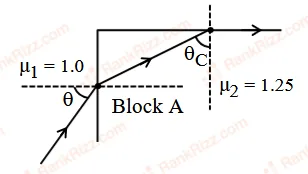
A transparent block A having refractive index μ=1.25 is surrounded by another medium of refractive index μ=1.0. A light ray is incident on the flat face of the block with incident angle θ. What is the maximum value of θ for which light suffers total internal reflection at the top surface of the block?
JEE MAIN 2025 · 04 APR S1Spherical mirrors: mirror formula and magnification
When an object is placed 40 cm away from a spherical mirror an image of magnification 21 is produced. To obtain an image with magnification of 31, the object is to be moved:
JEE MAIN 2025 · 04 APR S1Spherical mirrors: mirror formula and magnification
Distance between object and its image (magnified by −31) is 30 cm. The focal length of the mirror used is (4x) cm, where magnitude of value of x is ________.
JEE MAIN 2025 · 04 APR S2Spherical mirrors: mirror formula and magnification
A finite size object is placed normal to the principal axis at a distance of 30 cm from a convex mirror of focal length 30 cm. A plane mirror is now placed in such a way that the image produced by both the mirrors coincide with each other. The distance between the two mirrors is :
JEE MAIN 2025 · 03 APR S1Thin lenses: lens formula, lens maker's formula and power
The radii of curvature for a thin convex lens are 10 cm and 15 cm respectively. The focal length of the lens is 12 cm. The refractive index of the lens material is
JEE MAIN 2025 · 03 APR S1Refraction at plane surfaces, Snell's law and apparent depth
Consider following statements for refraction of light through prism, when angle of deviation is minimum. (A) The refracted ray inside prism becomes parallel to the base. (B) Larger angle prisms provide smaller angle of minimum deviation. (C) Angle of incidence and angle of emergence becomes equal. (D) There are always two sets of angle of incidence for which deviation will be same except at minimum deviation setting. (E) Angle of refraction becomes double of prism angle.
Choose the correct answer from the options given below.
JEE MAIN 2025 · 03 APR S2Refraction at plane surfaces, Snell's law and apparent depth
Light from a point source in air falls on a spherical glass surface (refractive index, μ=1.5 and radius of curvature = 50 cm). The image is formed at a distance of 200 cm inside the glass. The magnitude of distance of the light source from the glass surface is ________ m.
JEE MAIN 2025 · 02 APR S1Thin lenses: lens formula, lens maker's formula and power
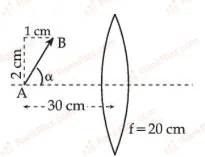
A slanted object AB is placed on one side of convex lens as shown in the diagram. The image is formed on the opposite side. Angle made by the image with principal axis is:
JEE MAIN 2025 · 02 APR S1Refraction at plane surfaces, Snell's law and apparent depth
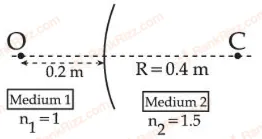
A spherical surface separates two media of refractive indices 1 and 1.5 as shown in figure. Distance of the image of an object 'O', is: (C is the center of curvature of the spherical surface and R is the radius of curvature)
JEE MAIN 2025 · 02 APR S2Spherical mirrors: mirror formula and magnification
Two identical objects are placed in front of convex mirror and concave mirror having same radii of curvature of 12 cm, at same distance of 18 cm from the respective mirrors. The ratio of the sizes of images formed by convex mirror and by concave mirror is :
JEE MAIN 2025 · 02 APR S2Thin lenses: lens formula, lens maker's formula and power
A bi-convex lens has radius of curvature of both the surfaces same as 1/6 cm. If this lens is required to be replaced by another convex lens having different radii of curvatures on both sides (R1=R2), without any change in lens power then possible combination of R1 and R2 is :
JEE MAIN 2025 · 02 APR S2Refraction at plane surfaces, Snell's law and apparent depth
A ray of light suffers minimum deviation when incident on a prism having angle of the prism equal to 60°. The refractive index of the prism material is 2. The angle of incidence (in degrees) is _________.
JEE MAIN 2025 · 29 JAN S1Total internal reflection and critical angle
At the interface between two materials having refractive indices n1 and n2, the critical angle for reflection of an em wave is θ1C. The n2 material is replaced by another material having refractive index n3 such that the critical angle at the interface between n1 and n3 materials is θ2C. If n3>n2>n1;n3n2=52 and sinθ2C−sinθ1C=21, then θ1C is
JEE MAIN 2025 · 29 JAN S1Thin lenses: lens formula, lens maker's formula and power
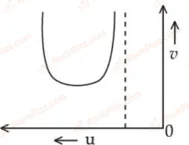
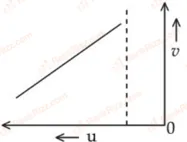
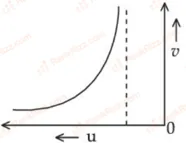
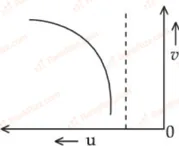
Let u and υ be the distances of the object and the image from a lens of focal length f. The correct graphical representation of u and υ for a convex lens when ∣u∣>f, is
JEE MAIN 2025 · 29 JAN S1Refraction at plane surfaces, Snell's law and apparent depth
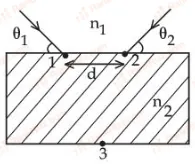
Two light beams fall on a transparent material block at point 1 and 2 with angle θ1 and θ2, respectively, as shown in figure. After refraction, the beams intersect at point 3 which is exactly on the interface at other end of the block. Given : the distance between 1 and 2, d=43cm and θ1=θ2=cos−1(2n1n2), where refractive index of the block n2> refractive index of the outside medium n1, then the thickness of the block is ________cm.
JEE MAIN 2025 · 29 JAN S2Thin lenses: lens formula, lens maker's formula and power
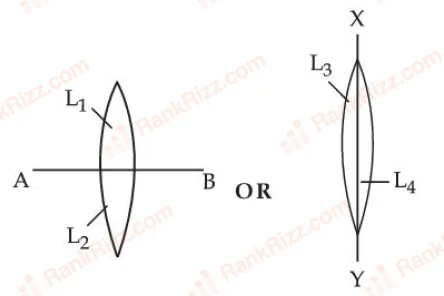
Two identical symmetric double convex lenses of focal length f are cut into two equal parts L1,L2 by AB plane and L3,L4 by XY plane as shown in figure respectively. The ratio of focal lengths of lenses L1 and L3 is
JEE MAIN 2025 · 29 JAN S2Thin lenses: lens formula, lens maker's formula and power
A convex lens made of glass (refractive index = 1.5) has focal length 24 cm in air. When it is totally immersed in water (refractive index 1.33), its focal length changes to
JEE MAIN 2025 · 29 JAN S2Refraction at plane surfaces, Snell's law and apparent depth
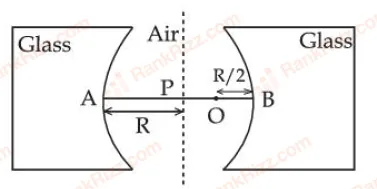
Two concave refracting surfaces of equal radii of curvature and refractive index 1.5 face each other in air as shown in figure. A point object O is placed midway, between P and B . The separation between the images of O , formed by each refracting surface is :