Ray Optics & Optical Instruments — JEE Advanced Previous Year Questions
Ray Optics & Optical Instruments has been asked in every one of the 20 JEE Advanced years from 2007 to 2026: 61 questions in all. In 2026 it averaged 1.5 questions per paper (3 across 2 papers), 8.8% of Physics questions, up from 6.3% in 2025. Across the last 20 papers it carried 8% of Physics questions. By type: 24 single-correct, 18 multiple-correct, 17 numerical and 2 match-the-list. Of the 61 with a difficulty tag, 16% are easy, 46% medium and 38% hard. Most asked: Prism: deviation and dispersion (26, 43%), Combinations of lenses and mirrors (15, 25%) and Refraction at plane surfaces, Snell's law and apparent depth (7, 11%).
Ray Optics & Optical Instruments weightage, year by year
The share of each year’s Physics questions that came from Ray Optics & Optical Instruments, counted from the 19 papers we hold for the last 10 years, and paper by paper inside a year.
Steady: 8.0% of Physics questions in 2024–2026 against 8.1% in 2017–2023, and between 5.6% and 13.9% in every year shown.
Ray Optics & Optical Instruments questions per year, per paper, and as a share of Physics questions
YEAR
QS
PER PAPER
SHARE OF PHYSICS
CHANGE
BY PAPER
2026
3 / 34
1.5
8.8%
+2.5 pts
PAPER 1 6.3%PAPER 2 11.1%
2025
2 / 32
1.0
6.3%
−2.5 pts
PAPER 1 6.3%PAPER 2 6.3%
2024
3 / 34
1.5
8.8%
+2.9 pts
PAPER 1 11.8%PAPER 2 5.9%
2023
2 / 34
1.0
5.9%
−8.0 pts
PAPER 1 11.8%PAPER 2 0.0%
2022
5 / 36
2.5
13.9%
+6.0 pts
PAPER 1 16.7%PAPER 2 11.1%
2021
3 / 38
1.5
7.9%
+2.3 pts
PAPER 1 10.5%PAPER 2 5.3%
2020
2 / 36
1.0
5.6%
−5.5 pts
PAPER 1 0.0%PAPER 2 11.1%
2019
4 / 36
2.0
11.1%
+5.5 pts
PAPER 1 11.1%PAPER 2 11.1%
2018
1 / 18
1.0
5.6%
level
1 PAPER
2017
2 / 36
1.0
5.6%
—
PAPER 1 11.1%PAPER 2 0.0%
“QS” is Ray Optics & Optical Instruments questions out of all Physics questions that year; “per paper” is that count over the year’s papers, and “change” is the share against the year before. A year with more sittings asks more questions, which is why the share, not the count, is the number to compare.
The ideas inside Ray Optics & Optical Instruments
A chapter is not one subject — it is a handful of procedures the examiner reuses. These are the ones Ray Optics & Optical Instruments questions actually test.
01Reflection and plane mirrorsset 5×
02Spherical mirrors: mirror formula and magnificationset 4×
03Refraction at plane surfaces, Snell's law and apparent depthset 7×
04Total internal reflection and critical angleNot set in Advanced
05Refraction at spherical surfacesNot set in Advanced
06Thin lenses: lens formula, lens maker's formula and powerset 4×
07Combinations of lenses and mirrorsset 15×
08Prism: deviation and dispersionset 26×
09Optical instruments: microscopes and telescopesNot set in Advanced
All 61 Ray Optics & Optical Instruments questions, by topic
Every JEE Advanced Ray Optics & Optical Instruments question we hold, newest first inside each topic. Open one for its options, answer key and solution.
Is Ray Optics & Optical Instruments asked every year in JEE Advanced?+
Yes. It has been asked in every one of the 20 JEE Advanced years from 2007 to 2026, 61 questions in all.
Which Ray Optics & Optical Instruments topic is asked most in JEE Advanced?+
Prism: deviation and dispersion: 26 of the 61 questions (43%). Next come Combinations of lenses and mirrors (15) and Refraction at plane surfaces, Snell's law and apparent depth (7).
What share of Physics questions does Ray Optics & Optical Instruments carry in JEE Advanced?+
About 8% of Physics questions across the last 20 papers. In 2026 it was 8.8% (3 of 34 Physics questions).
When was Ray Optics & Optical Instruments last asked in JEE Advanced?+
In JEE Advanced 2026 Paper 2, the latest sitting with a Ray Optics & Optical Instruments question.
How many Ray Optics & Optical Instruments questions has JEE Advanced asked?+
61 from 2007 to 2026, across 6 topics. Every one is listed on this page by topic and links to its own page, with the answer key and solution wherever we have them. Free, no sign-up.
Every Ray Optics & Optical Instruments question
1–20 OF 61 · NEWEST FIRST
JEE ADVANCED 2026 · PAPER 2Refraction at plane surfaces, Snell's law and apparent depth
A beam of polychromatic light passes through a thin prism of prism angle 6∘. The refractive index of the material of the prism varies with wavelength (λ) as n(λ)=αλ+λ2β, where α=3μm−1 and β=0.096μm2. If λmin is the wavelength at which the angle of minimum deviation Dm is smallest, then the correct value of Dm at λmin is
JEE ADVANCED 2026 · PAPER 1Thin lenses: lens formula, lens maker's formula and power
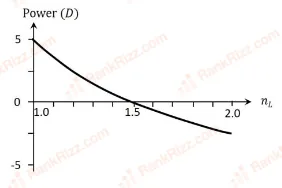
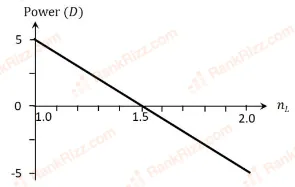
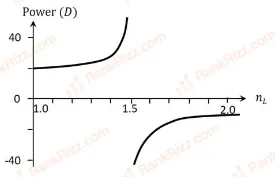
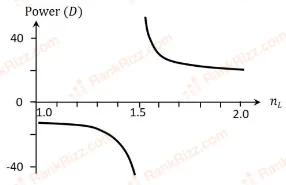
A double convex lens made of glass of refractive index 1.5 and radii of curvature of the curved surfaces 20cm each is immersed in a liquid of refractive index nL. The correct plot showing the variation of the power, in the units of diopter (D), as a function of nL is:
JEE ADVANCED 2026 · PAPER 2Refraction at plane surfaces, Snell's law and apparent depth
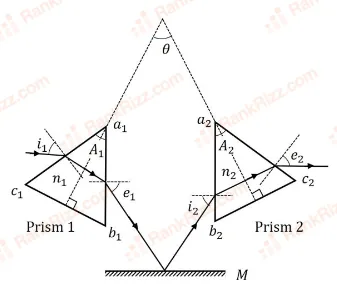
Consider two isosceles prisms 1 and 2 with prism angles A1 and A2 and refractive indices n1 and n2, respectively, as shown in the figure. The faces a1b1 and a2b2 are parallel to each other and perpendicular to the mirror M. If a ray of light is incident on the face a1c1 and emerges from the face a2c2, then the correct statement(s) is/are:
A
If both the prisms are at minimum deviation condition, then n1n2=sin(2A1)/sin(2A2).
B
If prism 2 is at minimum deviation condition, then sini1=n2sin(2A2) is always true.
C
If both the prisms 1 and 2 are at minimum deviation condition with angles of deviation δm1 and δm2, respectively, then θ=2(n1−1)δm1+2(n2−1)δm2.
D
If prism 1 is at minimum deviation condition, then sini2=n1sin(2A1) is always true.
JEE ADVANCED 2025 · PAPER 2Spherical mirrors: mirror formula and magnification
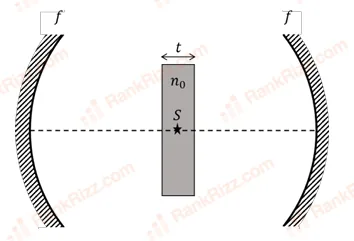
Two identical concave mirrors each of focal length f are facing each other as shown in the schematic diagram. The focal length f is much larger than the size of the mirrors. A glass slab of thickness t and refractive index n0 is kept equidistant from the mirrors and perpendicular to their common principal axis. A monochromatic point light source S is embedded at the center of the slab on the principal axis, as shown in the schematic diagram. For the image to be formed on S itself, which of the following distances between the two mirrors is/are correct:
JEE ADVANCED 2025 · PAPER 1Spherical mirrors: mirror formula and magnification
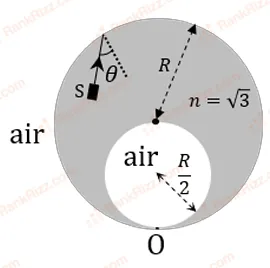
A solid glass sphere of refractive index n=3 and radius R contains a spherical air cavity of radius 2R, as shown in the figure. A very thin glass layer is present at the point O so that the air cavity (refractive index n=1) remains inside the glass sphere. An unpolarized, unidirectional and monochromatic light source S emits a light ray from a point inside the glass sphere towards the periphery of the glass sphere. If the light is reflected from the point O and is fully polarized, then the angle of incidence at the inner surface of the glass sphere is θ. The value of sinθ is ________.
JEE ADVANCED 2024 · PAPER 1Refraction at plane surfaces, Snell's law and apparent depth
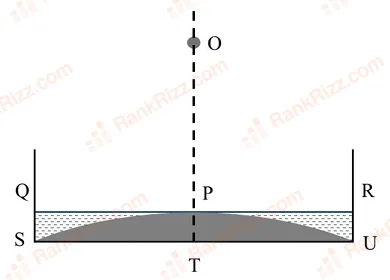
A glass beaker has a solid, plano-convex base of refractive index 1.60, as shown in the figure. The radius of curvature of the convex surface (SPU) is 9 cm, while the planar surface (STU) acts as a mirror. This beaker is filled with a liquid of refractive index n up to the level QPR. If the image of a point object O at a height of h (OT in the figure) is formed onto itself, then, which of the following option(s) is (are) correct?
JEE ADVANCED 2024 · PAPER 2Refraction at plane surfaces, Snell's law and apparent depth
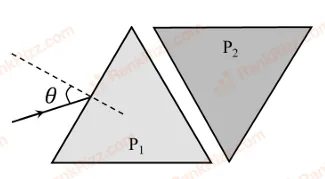
Two equilateral-triangular prisms P1 and P2 are kept with their sides parallel to each other, in vacuum, as shown in the figure. A light ray enters prism P1 at an angle of incidence θ such that the outgoing ray undergoes minimum deviation in prism P2. If the respective refractive indices of P1 and P2 are 23 and 3, θ=sin−1[23sin(βπ)], where the value of β is ________.
JEE ADVANCED 2024 · PAPER 1Refraction at plane surfaces, Snell's law and apparent depth
A light ray is incident on the surface of a sphere of refractive index n at an angle of incidence θ0. The ray partially refracts into the sphere with angle of refraction ϕ0 and then partly reflects from the back surface. The reflected ray then emerges out of the sphere after a partial refraction. The total angle of deviation of the emergent ray with respect to the incident ray is α. Match the quantities mentioned in List-I with their values in List-II and choose the correct option.
List-I
List-II
(P)
If n=2 and α=180°, then all the possible values of θ0 will be
(1)
30° and 0°
(Q)
If n=3 and α=180°, then all the possible values of θ0 will be
(2)
60° and 0°
(R)
If n=3 and α=180°, then all the possible values of ϕ0 will be
(3)
45° and 0°
(S)
If n=2 and θ0=45°, then all the possible values of α will be
JEE ADVANCED 2023 · PAPER 1Refraction at plane surfaces, Snell's law and apparent depth
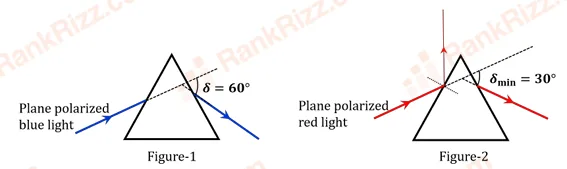
A plane polarized blue light ray is incident on a prism such that there is no reflection from the surface of the prism. The angle of deviation of the emergent ray is δ=60∘ (see Figure-1). The angle of minimum deviation for red light from the same prism is δmin=30∘ (see Figure-2). The refractive index of the prism material for blue light is 3. Which of the following statement(s) is(are) correct?
A
The blue light is polarized in the plane of incidence.
B
The angle of the prism is 45°.
C
The refractive index of the material of the prism for red light is 2.
D
The angle of refraction for blue light in air at the exit plane of the prism is 60°.
JEE ADVANCED 2023 · PAPER 1Thin lenses: lens formula, lens maker's formula and power
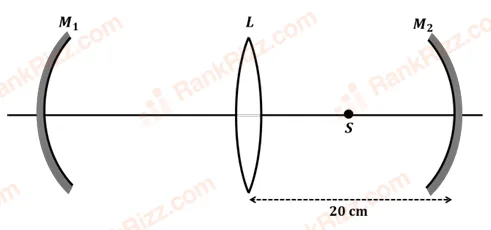
An optical arrangement consists of two concave mirrors M1 and M2, and a convex lens L with a common principal axis, as shown in the figure. The focal length of L is 10 cm. The radii of curvature of M1 and M2 are 20 cm and 24 cm, respectively. The distance between L and M2 is 20 cm. A point object S is placed at the mid-point between L and M2 on the axis. When the distance between L and M1 is n/7 cm, one of the images coincides with S. The value of n is ______.
JEE ADVANCED 2022 · PAPER 1Thin lenses: lens formula, lens maker's formula and power
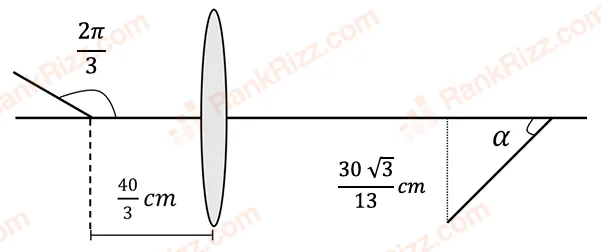
A rod of length 2 cm makes an angle 32π rad with the principal axis of a thin convex lens. The lens has a focal length of 10 cm and is placed at a distance of 340 cm from the object as shown in the figure. The height of the image is 13303 cm and the angle made by it with respect to the principal axis is α rad. The value of α is nπ rad, where n is ______.
JEE ADVANCED 2022 · PAPER 2Refraction at plane surfaces, Snell's law and apparent depth
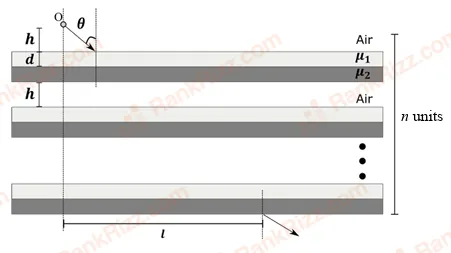
Consider a configuration of n identical units, each consisting of three layers. The first layer is a column of air of height h=31 cm, and the second and third layers are of equal thickness d=23−1 cm, and refractive indices μ1=23 and μ2=3, respectively. A light source O is placed on the top of the first unit as shown in the figure. A Ray of light from O is incident on the second layer of the first unit at an angle of θ=60∘ to the normal. For a specific value of n, the ray of light emerges from the bottom of the configuration at a distance l=38 cm, as shown in the figure. The value of n is _______.
JEE ADVANCED 2022 · PAPER 2Spherical mirrors: mirror formula and magnification
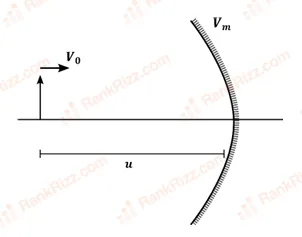
An object and a concave mirror of focal length f=10 cm both move along the principal axis of the mirror with constant speeds. The object moves with speed V0=15 cm s−1 towards the mirror with respect to a laboratory frame. The distance between the object and the mirror at a given moment is denoted by u. When u=30 cm, the speed of the mirror Vm is such that the image is instantaneously at rest with respect to the laboratory frame, and the object forms a real image. The magnitude of Vm is _______ cm s−1.
JEE ADVANCED 2022 · PAPER 1Spherical mirrors: mirror formula and magnification
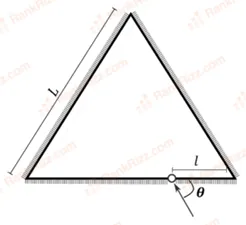
Three plane mirrors form an equilateral triangle with each side of length L. There is a small hole at a distance l>0 from one of the corners as shown in the figure. A ray of light is passed through the hole at an angle θ and can only come out through the same hole. The cross section of the mirror configuration and the ray of light lie on the same plane.
Which of the following statement(s) is(are) correct?
A
The ray of light will come out for θ=30∘, for 0<l<L.
B
There is an angle for l=2L at which the ray of light will come out after two reflections.
C
The ray of light will NEVER come out for θ=60∘, and l=3L.
D
The ray of light will come out for θ=60∘, and 0<l<2L after six reflections.
JEE ADVANCED 2022 · PAPER 1Thin lenses: lens formula, lens maker's formula and power
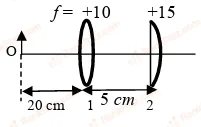
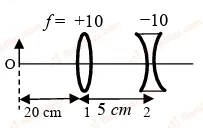
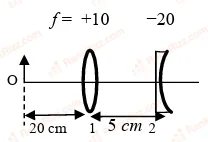
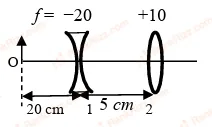
List I contains four combinations of two lenses (1 and 2) whose focal lengths (in cm) are indicated in the figures. In all cases, the object is placed 20 cm from the first lens on the left, and the distance between the two lenses is 5 cm. List II contains the positions of the final images.
List-I
List-II
(I)
(P) Final image is formed at 7.5 cm on the right side of lens 2.
(II)
(Q) Final image is formed at 60.0 cm on the right side of lens 2.
(III)
(R) Final image is formed at 30.0 cm on the left side of lens 2.
(IV)
(S) Final image is formed at 6.0 cm on the right side of lens 2.
(T) Final image is formed at 30.0 cm on the right side of lens 2.
JEE ADVANCED 2021 · PAPER 1Combinations of lenses and mirrors
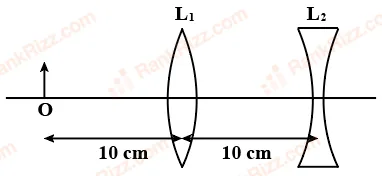
An extended object is placed at point O, 10 cm in front of a convex lens L1 and a concave lens L2 is placed 10 cm behind it, as shown in the figure. The radii of curvature of all the curved surfaces in both the lenses are 20 cm. The refractive index of both the lenses is 1.5. The total magnification of this lens system is
JEE ADVANCED 2021 · PAPER 2Prism: deviation and dispersion
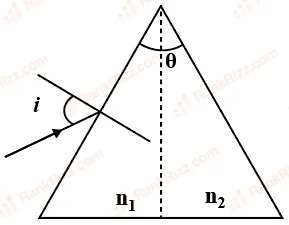
For a prism of prism angle θ=60∘, the refractive indices of the left half and the right half are, respectively, n1 and n2(n2≥n1) as shown in the figure. The angle of incidence 𝑖 is chosen such that the incident light rays will have minimum deviation if n1=n2=n=1.5. For the case of unequal refractive indices, n1=n and n2=n+△n (where △n≪n), the angle of emergence e=i+△e. Which of the following statement(s) is(are) correct?
A
The value of △e (in radians) is greater than that of △n
B
△e is proportional to △n
C
△e lies between 2.0 and 3.0 milliradians, if △n=2.8×10⁻³
D
△e lies between 1.0 and 1.6 milliradians, if △n=2.8×10⁻³
JEE ADVANCED 2021 · PAPER 1Prism: deviation and dispersion
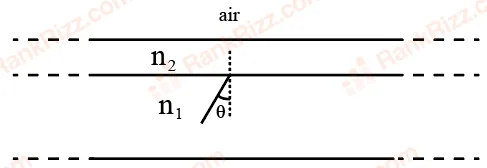
A wide slab consisting of two media of refractive indices n1 and n2 is placed in air as shown in the figure. A ray of light is incident from medium n1 to n2 at an angle θ, where sinθ is slightly larger than n11. Take refractive index of air as 1. Which of the following statement(s) is(are) correct?
A
The light ray enters air if n2=n1
B
The light ray is finally reflected back into the medium of refractive index n1 if n2<n1
C
The light ray is finally reflected back into the medium of refractive index n1 if n2>n1
D
The light ray is reflected back into the medium of refractive index n1 if n2=1
JEE ADVANCED 2020 · PAPER 2Prism: deviation and dispersion
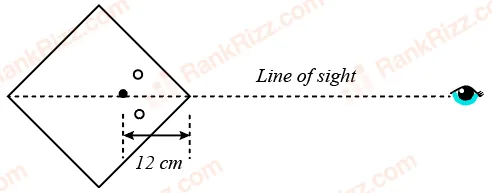
A large square container with thin transparent vertical walls and filled with water (refractive index 34) is kept on a horizontal table. A student holds a thin straight wire vertically inside the water 12 cm from one of its corners, as shown schematically in the figure. Looking at the wire from this corner, another student sees two images of the wire, located symmetrically on each side of the line of sight as shown. The separation (in cm) between these images is ____________.
JEE ADVANCED 2020 · PAPER 2Prism: deviation and dispersion
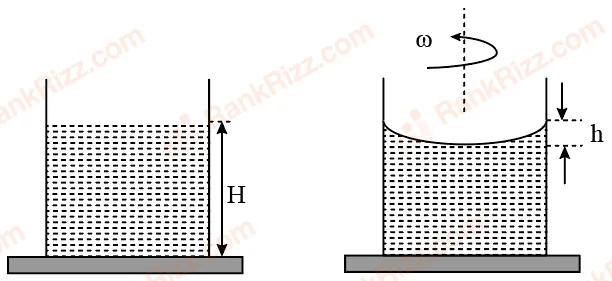
A beaker of radius 𝑟 is filled with water (refractive index 34) up to a height 𝐻 as shown in the figure on the left. The beaker is kept on a horizontal table rotating with angular speed ω. This makes the water surface curved so that the difference in the height of water level at the center and at the circumference of the beaker is h(h≪H,h≪r), as shown in the figure on the right. Take this surface to be approximately spherical with a radius of curvature 𝑅. Which of the following is/are correct? (g is the acceleration due to gravity)
A
R=2hh2+r2
B
R=2h3r2
C
Apparent depth of the bottom of the beaker is close to 23H(1+2gω2H)−1
D
Apparent depth of the bottom of the beaker is close to 43H(1+4gω2H)−1