RankRizz

Ray Optics & Optical Instruments — JEE Main Previous Year Questions

Every Ray Optics & Optical Instruments question JEE Main has set from 2004–2026, grouped by the idea it tests rather than the order of the syllabus. 272 questions across 9 distinct ideas. Free to read, answer key on every one.

DATA UPDATED

Questions

272

Distinct ideas

9

Share of marks

7%

Difficulty

MEDIUM

The ideas inside Ray Optics & Optical Instruments

A chapter is not one subject — it is a handful of procedures the examiner reuses. These are the ones Ray Optics & Optical Instruments questions actually test.

Every Ray Optics & Optical Instruments question

61–80 OF 272 · NEWEST FIRST

JEE MAIN 2025 · 28 JAN S1Refraction at plane surfaces, Snell's law and apparent depth

A thin prism P1P_{1} with angle 4∘4^{\circ} made of glass having refractive index 1.54 , is combined with another thin prism P2P_{2} made of glass having refractive index 1.72 to get dispersion without deviation. The angle of the prism P2P_{2} in degrees is

  1. A

    3

  2. B

    16/3

  3. C

    4

  4. D

    1.5

JEE MAIN 2025 · 28 JAN S1Refraction at plane surfaces, Snell's law and apparent depth

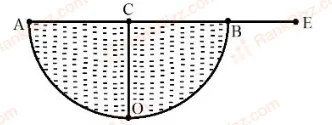
A hemispherical vessel is completely filled with a liquid of refractive index μ\mu. A small coin is kept at the lowest point (O) of the vessel as shown in figure. The minimum value of the refractive index of the liquid so that a person can see the coin from point E (at the level of the vessel) is

page5_img1
  1. A

    3\sqrt{3}

  2. B

    32\frac{\sqrt{3}}{2}

  3. C

    32\frac{3}{2}

  4. D

    2\sqrt{2}

JEE MAIN 2025 · 28 JAN S2Spherical mirrors: mirror formula and magnification

A concave mirror produces an image of an object such that the distance between the object and image is 20 cm . If the magnification of the image is ' -3 ', then the magnitude of the radius of curvature of the mirror is :

  1. A

    30 cm

  2. B

    3.75 cm

  3. C

    15 cm

  4. D

    7.5 cm

JEE MAIN 2025 · 28 JAN S2Refraction at plane surfaces, Snell's law and apparent depth

In a long glass tube, mixture of two liquids A and B with refractive indices 1.3 and 1.4 respectively, forms a convex refractive meniscus towards . If an object placed at 13 cm from the vertex of the meniscus in A forms an image with a magnification of '-2' then the radius of curvature of meniscus is :

  1. A

    13\frac{1}{3}cm

  2. B

    43\frac{4}{3}cm

  3. C

    1 cm

  4. D

    23\frac{2}{3}cm

JEE MAIN 2025 · 24 JAN S1Thin lenses: lens formula, lens maker's formula and power

What is the relative decrease in focal length of a lens for an increase in optical power  by 0.1 D0.1\,D from  2.5 D?[’D’ stands for dioptre]2.5\,D? \quad [\text{'D' stands for dioptre}]

  1. A

    0.01

  2. B

    0.04

  3. C

    0.40

  4. D

    0.1

JEE MAIN 2025 · 24 JAN S1Thin lenses: lens formula, lens maker's formula and power

A thin plano convex lens made of glass of refractive index 1.5 is immersed in a liquid of refractive index 1.2. When the plane side of the lens is silver coated for complete reflection, the lens immersed in the liquid behaves like a concave mirror of focal length 0.2 m. The radius of curvature of the curved surface of the lens is

  1. A

    0.20 m

  2. B

    0.25 m

  3. C

    0.15 m

  4. D

    0.10 m

JEE MAIN 2025 · 24 JAN S1Thin lenses: lens formula, lens maker's formula and power

A plano-convex lens having radius of curvature of first surface  2 cm2\,cm exhibits focal length f1f_1 in air. Another plano-convex lens with first surface radius of curvature  3 cm3\,cm has focal length f2f_2 when it is immersed in a liquid of refractive index  1.2.1.2. If both the lenses are made of same glass of refractive index  1.5,1.5, then the ratio f1:f2f_1:f_2 will be:

  1. A

    1 : 2

  2. B

    1 : 3

  3. C

    3 : 5

  4. D

    2 : 3

JEE MAIN 2025 · 24 JAN S2Optical instruments: microscopes and telescopes

A photograph of a landscape is captured by a drone camera at a height of 18 km . The size of the camera film is 2cm×2cm2 cm \times 2 cm and the area of the landscape photographed is 400km2400 km^{2}. The focal length of the lens in the drone camera is :

  1. A

    1.8 cm

  2. B

    0.9 cm

  3. C

    2.8 cm

  4. D

    2.5 cm

JEE MAIN 2025 · 23 JAN S1Refraction at plane surfaces, Snell's law and apparent depth

A spherical surface of radius of curvature R, separates air from glass (refractive index = 1.5). The centre of curvature is in the glass medium. A point object ′O′'O' placed in air on the optical axis of the surface, so that its real image is formed at ′I′'I' inside glass. The line OIOI intersects the spherical surface at PP and PO=PIPO=PI . The distance POPO equals to

  1. A

    5R

  2. B

    3R

  3. C

    1.5R

  4. D

    2R

JEE MAIN 2025 · 23 JAN S1Thin lenses: lens formula, lens maker's formula and power

Given a thin convex lens (refractive index μ2\mu_{2}), kept in a liquid (refractive index μ1,μ1<μ2\mu_{1},\mu_{1}<\mu_{2}) having radii of curvatures ∣R1∣|R_{1}| and ∣R2∣|R_{2}| . Its second surface is silver polished. Where should an object be placed on the optic axis so that a real and inverted image is formed at the same place?

  1. A

    μ1∣R1∣⋅∣R2∣μ2(∣R1∣+∣R2∣)−μ1∣R2∣\frac{\mu_{1}|R_{1}|\cdot|R_{2}|}{\mu_{2}(|R_{1}|+|R_{2}|)-\mu_{1}|R_{2}|}

  2. B

    μ1∣R1∣⋅∣R2∣μ2(∣R1∣+∣R2∣)−μ1∣R1∣\frac{\mu_{1}|R_{1}|\cdot|R_{2}|}{\mu_{2}(|R_{1}|+|R_{2}|)-\mu_{1}|R_{1}|}

  3. C

    (μ2+μ1)∣R1∣(μ2−μ1)\frac{(\mu_{2}+\mu_{1})|R_{1}|}{(\mu_{2}-\mu_{1})}

  4. D

    μ1∣R1∣⋅∣R2∣μ2(2∣R1∣+∣R2∣)−μ1∣R1∣⋅∣R2∣\frac{\mu_{1}|R_{1}|\cdot|R_{2}|}{\mu_{2}(2|R_{1}|+|R_{2}|)-\mu_{1}\sqrt{|R_{1}|\cdot|R_{2}|}}

JEE MAIN 2025 · 23 JAN S1Refraction at plane surfaces, Snell's law and apparent depth

What is the lateral shift of a ray refracted through a parallel-sided glass slab of thickness 'h' in terms of the angle of incidence 'i' and angle of refraction 'r', if the glass slab is placed in air medium?

  1. A

    htan⁡(i−r)tan⁡r\frac{h\tan(i-r)}{\tan r}

  2. B

    hsin⁡(i−r)cos⁡r\frac{h\sin(i-r)}{\cos r}

  3. C

    h

  4. D

    hcos⁡(i−r)sin⁡r\frac{h\cos(i-r)}{\sin r}

JEE MAIN 2025 · 23 JAN S2Spherical mirrors: mirror formula and magnification

A concave mirror of focal length ff in air is dipped in a liquid of refractive index μ\mu. Its focal length in the liquid will be:

  1. A

    μf\mu f

  2. B

    f

  3. C

    f(μ−1)\frac{f}{(\mu -1)}

  4. D

    fμ\frac{f}{\mu}

JEE MAIN 2025 · 23 JAN S2Refraction at plane surfaces, Snell's law and apparent depth

The refractive index of the material of a glass prism is 3\sqrt{3}. The angle of minimum deviation is equal to the angle of the prism. What is the angle of the prism?

  1. A

    60∘60^{\circ}

  2. B

    58∘58^{\circ}

  3. C

    48∘48^{\circ}

  4. D

    50∘50^{\circ}

JEE MAIN 2025 · 22 JAN S1Thin lenses: lens formula, lens maker's formula and power

Given is a thin convex lens of glass (refractive index μ\mu) and each side having radius of curvature R. One side is polished for complete reflection. At what distance from the lens, an object be placed on the optic axis so that the image gets formed on the object itself ?

  1. A

    R/μR/\mu

  2. B

    μR\mu R

  3. C

    R/(2μ−3)R/(2\mu-3)

  4. D

    R/(2μ−1)R/(2\mu-1)

JEE MAIN 2025 · 22 JAN S1Thin lenses: lens formula, lens maker's formula and power

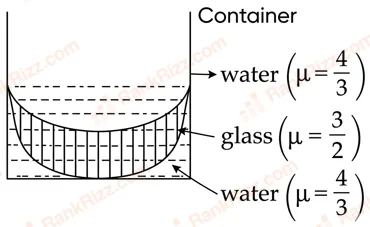
In the diagram given below, there are three lenses formed. Considering negligible thickness of each of them as compared to ∣R1∣ and ∣R2∣\mid R_1 \mid \text{ and } \mid R_2 \mid, i.e., the radii of curvature for upper and lower surfaces of the glass lens, the power of the combination is

Figure for JEE Main 2025 Physics question on Thin lenses: lens formula, lens maker's formula and power
  1. A

    16(1∣R1∣−1∣R2∣)\frac{1}{6}\left(\frac{1}{\mid R_1 \mid}-\frac{1}{\mid R_2 \mid} \right)

  2. B

    −16(1∣R1∣+1∣R2∣)-\frac{1}{6}\left(\frac{1}{\mid R_1 \mid}+\frac{1}{\mid R_2 \mid} \right)

  3. C

    16(1∣R1∣+1∣R2∣)\frac{1}{6}\left(\frac{1}{\mid R_1 \mid}+\frac{1}{\mid R_2 \mid} \right)

  4. D

    −16(1∣R1∣−1∣R2∣)-\frac{1}{6}\left(\frac{1}{\mid R_1 \mid}-\frac{1}{\mid R_2 \mid} \right)

JEE MAIN 2025 · 22 JAN S1Spherical mirrors: mirror formula and magnification

The driver sitting inside a parked car is watching vehicles approaching from behind with the help of his side view mirror, which is a convex mirror with radius of curvature R=2 m. Another car approaches him from behind with a uniform speed of 90 km/hr. When the car is at a distance of 24 m from him, the magnitude of the acceleration of the image of the car in the side view mirror is ' a '. The value of 100 a is ________ m/s2m/s^{2}.

JEE MAIN 2025 · 22 JAN S2Thin lenses: lens formula, lens maker's formula and power

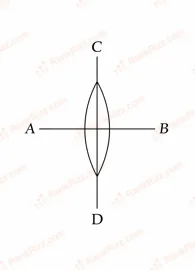
A symmetric thin biconvex lens is cut into four equal parts by two planes AB and CD as shown in figure. If the power of original lens is 4 D then the power of a part of the divided lens is

Figure for JEE Main 2025 Physics question on Thin lenses: lens formula, lens maker's formula and power
  1. A

    D

  2. B

    8D

  3. C

    2D

  4. D

    4D

JEE MAIN 2024 · 09 APR S1Thin lenses: lens formula, lens maker's formula and power

Given below are two statements : 

Statement (I) : When an object is placed at the centre of curvature of a concave lens, image is formed at the centre of curvature of the lens on the other side. 

Statement (II) : Concave lens always forms a virtual and erect image. 

In the light of the above statements, choose the correct answer from the options given below :

  1. A

    Both Statement I and Statement II are true

  2. B

    Both Statement I and Statement II are false

  3. C

    Statement I is true but Statement II is false

  4. D

    Statement I is false but Statement II is true

JEE MAIN 2024 · 09 APR S2Thin lenses: lens formula, lens maker's formula and power

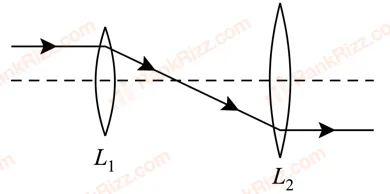
The following figure represents two biconvex lenses L1L_1 and L2L_2 having focal length 10 cm10 \text{ cm} and 15 cm15 \text{ cm} respectively. The distance between L1L_1 & L2L_2 is 

Figure for JEE Main 2024 Physics question on Thin lenses: lens formula, lens maker's formula and power
  1. A

    10 cm10 \text{ cm}

  2. B

    35 cm35 \text{ cm}

  3. C

    25 cm25 \text{ cm}

  4. D

    15 cm15 \text{ cm}

JEE MAIN 2024 · 08 APR S1Refraction at plane surfaces, Snell's law and apparent depth

Critical angle of incidence for a pair of optical media is 45°45°. The refractive indices of first and second media are in the ratio:

  1. A

    1:21 : \sqrt{2}

  2. B

    2:1\sqrt{2} : 1

  3. C

    2:12 : 1

  4. D

    1:21 : 2