A thin lens made of glass (refractive index = 1.5) of focal length cm is immersed in a liquid of refractive index 1.42. If its focal length in liquid is , then the ratio is closest to the integer:
- A
1
- B
9
- C
5
- D
17
Every Ray Optics & Optical Instruments question JEE Main has set from 2004–2026, grouped by the idea it tests rather than the order of the syllabus. 272 questions across 9 distinct ideas. Free to read, answer key on every one.
DATA UPDATED
Questions
272
Distinct ideas
9
Share of marks
7%
Difficulty
MEDIUM
A chapter is not one subject — it is a handful of procedures the examiner reuses. These are the ones Ray Optics & Optical Instruments questions actually test.
201–220 OF 272 · NEWEST FIRST
A thin lens made of glass (refractive index = 1.5) of focal length cm is immersed in a liquid of refractive index 1.42. If its focal length in liquid is , then the ratio is closest to the integer:
1
9
5
17
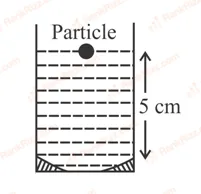
A concave mirror has radius of curvature of 40 cm. It is at the bottom of a glass that has water filled up to 5 cm (see figure). If a small particle is floating on the surface of water, its image as seen, from directly above the glass, is at a distance d from the surface of water. The value of d is close to: (Refractive index of water = 1.33)

13.4 cm
8.8 cm
6.7 cm
11.7 cm
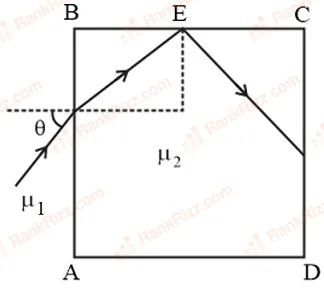
A transparent cube of side d, made of a material of refractive index , is immersed in a liquid of refractive index (). A ray is incident on the face AB at an angle (shown in the figure). Total internal reflection takes place at point E on the face BC.
Then must satisfy
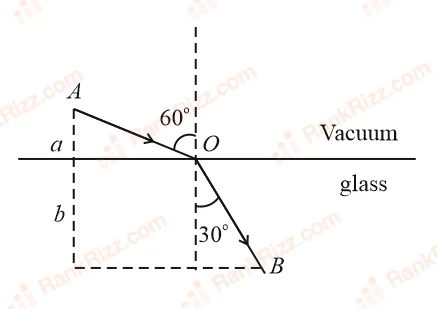
A ray of light AO in vacuum is incident on a glass slab at angle 60° and refracted at angle 30° along OB as shown in the figure. The optical path length of light ray from A to B is:

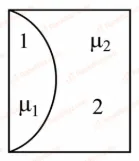
One plano-convex and one plano-concave lens of the same radius of curvature R but of different materials are joined side by side as shown in the figure. If the refractive index of the material of 1 is and that of 2 is , then the focal length of the combination is:

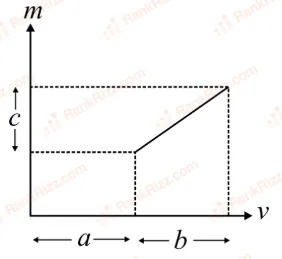
The graph shows how the magnification m produced by a thin lens varies with image distance v. The focal length of the lens used is

A concave mirror for face viewing has a focal length of 0.4 m. The distance at which you hold the mirror from your face in order to see your image upright with a magnification of 5 is:
1.60 m
0.16 m
0.32 m
0.24 m
A convex lens of focal length 20 cm produces images of the same magnification 2 when an object is kept at two distances and () from the lens. The ratio of and is:
2 : 1
5 : 3
4 : 3
3 : 1
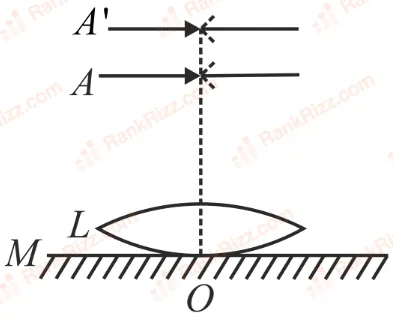
A thin convex lens L (refractive index = 1.5) is placed on a plane mirror M. When a pin is placed at A, such that OA = 18 cm, its real inverted image is formed at A itself, as shown in figure. When liquid of refractive index is put between the lens and the mirror, the pin has to be moved to A', such that OA' = 27 cm, to get its inverted real image at A' itself. The value of will be:

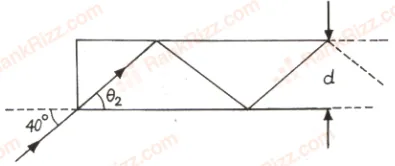
In figure, the optical fiber is m long and has a diameter of m. If a ray of light is incident on one end of the fiber at angle , the number of reflections it makes before emerging from the other end is close to: (refractive index of fiber is 1.31, sin 40° = 0.64 and sin(0.49) = 30°.)

55000
57000
45000
66000
An upright object is placed at a distance of 40 cm in front of a convergent lens of focal length 20 cm. A convergent mirror of focal length 10 cm is placed at a distance of 60 cm on the other side of the lens. The position and size of the final image will be:
40 cm from the convergent lens, twice the size of the object
20 cm from the convergent mirror, twice the size of the object
40 cm from the convergent lens, same size of the object
20 cm from the convergent mirror, same size of the object
A convex lens (of focal length 20 cm) and a concave mirror, having their principal axes along the same lines, are kept 80 cm apart from each other. The concave mirror is to the right of the convex lens. When an object is kept at a distance of 30 cm to the left of the convex lens, its image remains at the same position even if the concave mirror is removed. The maximum distance of the object for which this concave mirror, by itself would produce a virtual image would be:
30 cm
25 cm
20 cm
10 cm
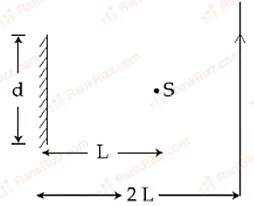
A point source of light, S is placed at a distance L in front of the center of plane mirror of width d which is hanging vertically on a wall. A man walks in front of the mirror along a line parallel to the mirror, at a distance 2L as shown below. The distance over which the man can see the image of the light source in the mirror is:

3d
2d
d
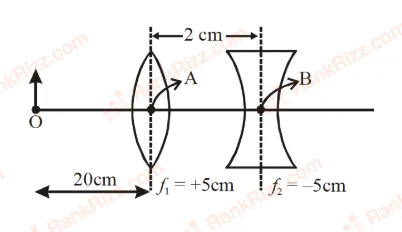
What is the position and nature of image formed by lens combination shown in figure? (, are focal lengths)

40 cm from point B at right; real
cm from point B at right, real
70 cm from point B at right; real
70 cm from point B at left; virtual
A plano-convex lens (focal length , refractive index , radius of curvature R) fits exactly into a plano-concave lens (focal length , refractive index , radius of curvature R). Their plane surfaces are parallel to each other. Then, the focal length of the combination will be:
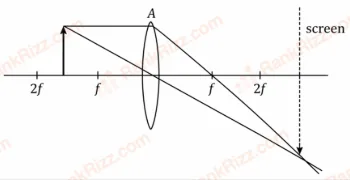
Formation of real image using a biconvex lens is shown below.

If the whole set up is immersed in water without disturbing the object and the screen positions, what will one observe on the screen?
Image disappears
Magnified image
Erect real image
No change
An object is at a distance of 20 m from a convex lens of focal length 0.3 m. The lens forms an image of the object. If the object moves away from the lens at a speed of 5 m/s the speed and direction of the image will be
m/s away from the lens
m/s towards the lens
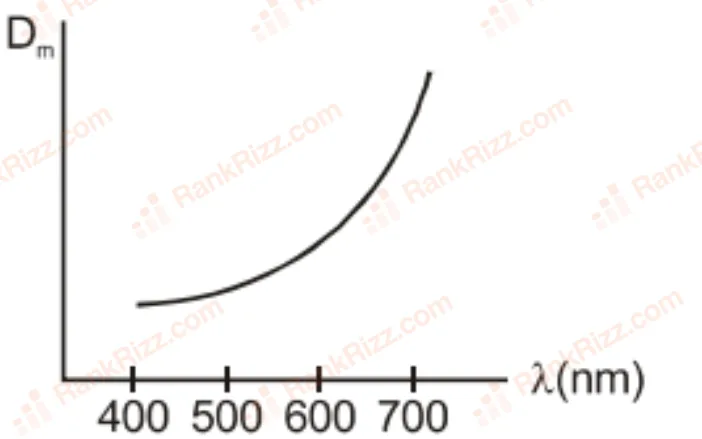
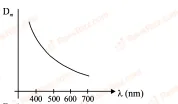
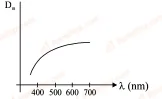
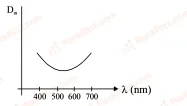
The variation of refractive index of a crown glass thin prism with wavelength of the incident light is shown. Which of the following graphs is the correct one, if is the angle of minimum deviation?


A monochromatic light is incident at a certain angle on an equilateral triangular prism and suffers minimum deviation. If the refractive index of the material of the prism is , then the angle of incidence is:
A plano-convex lens of refractive index and focal length is kept in contact with another plano-concave lens of refractive index and focal length . If the radius of curvature of their spherical faces is each and , the and are related as:
JEE Advanced has set 61 Ray Optics & Optical Instruments questions too. Ray Optics & Optical Instruments JEE Advanced PYQs →
OTHER PHYSICS CHAPTERS