JEE MAIN 2026 · 24 JAN S2Spherical mirrors: mirror formula and magnification
Distance between an object and three times magnified real image is 40 cm. The focal length of the mirror used is ___ cm.
- A
-10
- B
-15
- C
-15/2
- D
-20
Every Ray Optics & Optical Instruments question JEE Main has set from 2004–2026, grouped by the idea it tests rather than the order of the syllabus. 272 questions across 9 distinct ideas. Free to read, answer key on every one.
DATA UPDATED
Questions
272
Distinct ideas
9
Share of marks
7%
Difficulty
MEDIUM
A chapter is not one subject — it is a handful of procedures the examiner reuses. These are the ones Ray Optics & Optical Instruments questions actually test.
21–40 OF 272 · NEWEST FIRST
Distance between an object and three times magnified real image is 40 cm. The focal length of the mirror used is ___ cm.
-10
-15
-15/2
-20
Five persons recorded object distance (u) and image distance (v) using same convex lens having powei· +5D as (25,96), (30,62), (35,37), (45,35)
and (50,32) respectively. Identify correct statement
Readings recorded by all persons are correct
Readings recorded by and persons are incorrect
Readings recorded by and perso11S are incorrect
Readings recorded by person are incorrect
Consider light travelling from a medium A to medium B separated by a plane interface. If the light undergoes total internal reflection during its travel from medium A to B and the speed of light in media A and B are respecti vely, then the value of critical angle is :
A thin prism with angle 5° of refractive index 1.72 is combined with another prism of refractive index 1.9 to produce dispersion w ithout deviation. The angle of second prism is ____ .
A prism of angle and refractive index is coated with thin film of refractive index 1.5 only at the back exit surface. To have total internal reflection at the back exit surface the incident angle must be______.
( = 0.25 and = 0.43)
between and
The size of the images of an object, formed by a thin lens are equal when the object is placed at two different positions 8 cm and 24 cm from the lens. The focal length of the lens is _______ cm.
Consider an equilateral prism (refractive index ). A ray of light is incident on its one surface at a certain angle . If the emergent ray is found to graze along the other surface then the angle of refraction at the incident surface is close to ______.
A thin convex lens of focal length 5 cm and a thin concave lens of focal length 4 cm are combined together (without any gap) and this combination has magnification when an object is placed 10 cm before the convex lens. Keeping the positions of convex lens and object undisturbed a gap of 1 cm is introduced between the lenses by moving the concave lens away, which lead to a change in magnification of total lens system to .
The value of is______.
A parallel beam of light travelling in air (refractive index 1.0) is incident on a convex spherical glass surface of radius of curvature 50 cm. Refractive index of glass is 1.5. The rays converge to a point at a distance cm from the centre of the curvature of the spherical surface. The value of is ____ cm
In parallax method for the determination of focal length of a concave mirror, the object should always be placed:
beyond the centre of the curvature (C) of the mirror ONLY
at any point beyond the focus(F) of the mirror
between the focus(F) and the centre of curvature(C) of the mirror ONLY
between the pole(P) and the focus(F) of the concave mirror ONLY
A collimated beam of light of diameter 2 mm is propagating along x-axis. The beam is required to be expanded in a collimated beam of diameter 14 mm using a system of two convex lenses. lf first lens has focal length 40 mm, then the focal length of second lens is ____ mm.
In a microscope the objective is having focal length and eye-piece is having focal length The tube length is 32 cm. the magnification produced by this microscope for normal adjustment is _______.
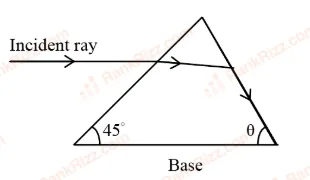
As shown in the diagram, when the incident ray is parallel to base of the prism, the emergent ray grazes along the second surface.If refractive index of the material of prism is , the angle of prism is.
A narrow parallel beam of light is incident paraxially on a solid transparent sphere of radius R . What should be the refractive index if the beam is to be focused at the surface of the sphere,
Not Possible
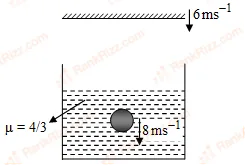
Object O is moving with a velocity inside water and mirror is moving with a velocity of as shown in the figure. Then find the velocity of image formed by the plane mirror with respect to object in )
A concave-convex lens of refractive index and the radii of curvature of its surfaces are and , respectively. The concave surface is upwards and is filled with a liquid of refractive index . The focal length of the liquid-glass combination will be
cm
cm
cm
cm
A convex lens of focal length 30 cm is placed in contact with a concave lens of focal length 20 cm. An object is placed at 20 cm to the left of this lens system. The distance of the image from the lens in cm is _____.
30
45
15
A lens having refractive index 1.6 has focal length of 12 cm, when it is in air. Find the focal length of the lens when it is placed in water. (Take refractive index of water as 1.28)
355 mm
288 mm
555 mm
655 mm
Two thin convex lenses of focal lengths 30 cm and 10 cm are placed coaxially, 10 cm apart. The power of this combination is :
5 D
1 D
20 D
10 D
A container contains a liquid with refractive index of 1.2 up to a height of 60 cm and another liquid having refractive index 1.6 is added to height H above first liquid. If viewed from above, the apparent shift in the position of bottom of container is 40 cm. The value of H is ___ cm.
(Consider liquids are immisible)
JEE Advanced has set 61 Ray Optics & Optical Instruments questions too. Ray Optics & Optical Instruments JEE Advanced PYQs →
OTHER PHYSICS CHAPTERS