JEE MAIN 2021 · 25 FEB S1Thin lenses: lens formula, lens maker's formula and power
The same size images are formed by a convex lens when the object is placed at 20 cm or at 10 cm from the lens. The focal length of convex lens is ______
Every Ray Optics & Optical Instruments question JEE Main has set from 2004–2026, grouped by the idea it tests rather than the order of the syllabus. 272 questions across 9 distinct ideas. Free to read, answer key on every one.
DATA UPDATED
Questions
272
Distinct ideas
9
Share of marks
7%
Difficulty
MEDIUM
A chapter is not one subject — it is a handful of procedures the examiner reuses. These are the ones Ray Optics & Optical Instruments questions actually test.
181–200 OF 272 · NEWEST FIRST
The same size images are formed by a convex lens when the object is placed at 20 cm or at 10 cm from the lens. The focal length of convex lens is ______
The focal length is related to the radius of curvature of the spherical convex mirror by:
A point like object is placed at distance of in front of a convex lens of focal length . A plane mirror is placed at a distance of behind the lens. The position and nature of the image formed by the system is:
from the mirror, real
from the mirror, virtual
from the mirror, real
from the mirror, virtual
A double convex lens has power P and same radii of curvature R of both the surfaces. The radius of curvature of a surface of a plano-convex lens made of the same material with power is:
2R
For a concave lens of focal length , the relation between object and image distance and , respectively, from its pole can best be represented by ( is the reference line):
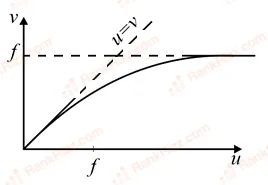
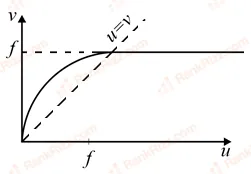
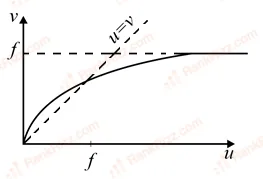
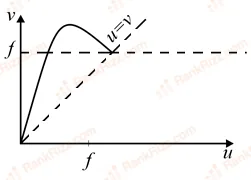
A compound microscope consists of an objective lens of focal length and an eye piece of focal length with a separation of . The distance between an object and the objective lens, at which the strain on the eye is minimum is . The value of is.......
A prism of angle , . A good estimate for the minimum angle of deviation (in degrees) is close to . Value of N is.........
In a compound microscope, the magnified virtual image is formed at a distance of 25 cm from the eye-piece. The focal length of its objective lens is 1 cm. If the magnification is 100 and the tube length of the microscope is 20 cm, then the focal length of the eye-piece lens (in cm) is __________
The distance between an object and a screen is 100 cm. A lens can produce real image of the object on the screen for two different positions between the screen and the object. The distance between these two positions is 40 cm. If the power of the lens is close to D where N is an integer, the value of N is __________
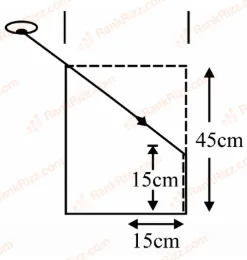
An observer can see through a small hole on the side of a jar (radius 15 cm) at a point at height of 15 cm from the bottom (see figure). The hole is at a height of 45 cm. When the jar is filled with a liquid up to a height of 30 cm the same observer can see the edge at the bottom of the jar. If the refractive index of the liquid is , where N is an integer, the value of N i
When an object is kept at a distance of 30 cm from a concave mirror, the image is formed at a distance of 10 cm from the mirror. If the object is moved with a speed of 9 cm s, the speed (in cm s) with which image moves at that instant is
A spherical mirror is obtained as shown in the figure from a hollow glass sphere, if an object is positioned in front of the mirror, what will be the nature and magnification of the image of the object? (Figure down as schematic and not to scale)
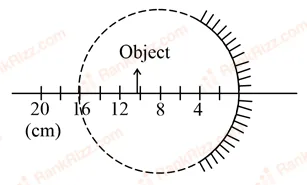
Inverted, real and magnified
Erect, virtual and magnified
Erect, virtual and unmagnified
Inverted, real and unmagnified
A light ray enters a solid glass sphere of refractive index at an angle of incidence 60. The ray is both reflected and refracted at the farther surface of the sphere. The angle (in degrees) between the reflected and refracted rays at this surface is ___________.
A vessel of depth is half filled with a liquid of refractive index and the upper half with another liquid of refractive index . The liquids are immiscible. The apparent depth of the inner surface of the bottom of the vessel will be:
There is a small source of light at some depth below the surface of water (refractive index ) in a tank of large cross sectional surface area. Neglecting any reflection from the bottom and absorption by water, percentage of light that emerges out of surface is (nearly):
[Use the fact that surface area of a spherical cap of height and radius of curvature is ]
21%
34%
17%
50%
The critical angle of a medium for a specific wavelength, if the medium has relative permittivity 3 and relative permeability for this wavelength, will be:
15
30
45
60
The magnifying power of a telescope with tube length 60 cm is 5. What is the focal length of its eye piece?
20 cm
40 cm
30 cm
10 cm
A point object in air is in front of the curved surface of a plano-convex lens. The radius of curvature of the curved surface is 30 cm and the refractive index of the lens material is 1.5, then the focal length of the lens (in cm) is
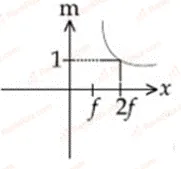
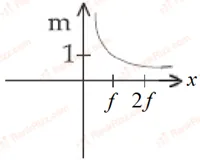
An object is gradually moving away from the focal point of a concave mirror along the axis of the mirror. The graphical representation of the magnitude of linear magnification (m) versus distance of the object from the mirror (x) is correctly given by (Graphs are drawn schematically and are not to scale)
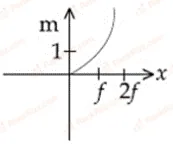
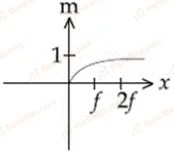
If we need a magnification of 375 from a compound microscope of tube length 150mm and an objective of focal length 5mm, the focal length of the eye-piece, should be close to:
22 mm
2 mm
4 mm
33 mm
JEE Advanced has set 61 Ray Optics & Optical Instruments questions too. Ray Optics & Optical Instruments JEE Advanced PYQs →
OTHER PHYSICS CHAPTERS