RankRizz

Solutions — JEE Main Previous Year Questions

Every Solutions question JEE Main has set from 2004–2026, grouped by the idea it tests rather than the order of the syllabus. 200 questions across 7 distinct ideas. Free to read, answer key on every one.

DATA UPDATED

Questions

200

Distinct ideas

7

Share of marks

4.8%

Difficulty

MEDIUM

The ideas inside Solutions

A chapter is not one subject — it is a handful of procedures the examiner reuses. These are the ones Solutions questions actually test.

Every Solutions question

141–160 OF 200 · NEWEST FIRST

JEE MAIN 2020 · 08 JAN S1Solubility of gases and Henry's law

A graph of vapour pressure and temperature for three different liquids X, Y and Z is shown below:
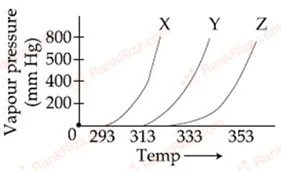
Figure for JEE Main 2020 Chemistry question on Solubility of gases and Henry's law


The following inferences are made:
(A) X has higher intermolecular interactions compared to Y.
(B) X has lower intermolecular interactions compared to Y.
(C) Z has lower intermolecular interactions compared to Y.
The correct inferences is/are:

  1. A

    (A) and (C)

  2. B

    (A)

  3. C

    (B)

  4. D

    (C)

JEE MAIN 2020 · 07 JAN S1Relative lowering of vapour pressure

At 35 ∘^\circC, the vapour pressure of CS2_2 is 512 mmHg and that of acetone is 144 mmHg. A solution of CS2_2 in acetone has a total vapour pressure of 600 mmHg. The false statement amongst the following is:

  1. A

    Raoult's law is not obeyed by this system

  2. B

    a mixture of 100 mL CS2_2 and 100 mL acetone has a volume < 200 mL

  3. C

    CS2_2 and acetone are less attracted to each other than to themselves

  4. D

    heat must be absorbed in order to produce the solution at 35∘^\circC

JEE MAIN 2020 · 07 JAN S2Relative lowering of vapour pressure

Two open beakers one containing a solvent and the other containing a mixture of that solvent with a non volatile solute are together sealed in a container. Over time:

  1. A

    the volume of the solution increases and the volume of the solvent decreases

  2. B

    the volume of the solution decreases and the volume of the solvent increases

  3. C

    the volume of the solution and the solvent does not change the volume of the solution does not

  4. D

    change and the volume of the solvent decreases

JEE MAIN 2019 · 12 APR S2Osmosis and osmotic pressure

A solution is prepared by dissolving 0.6 g of urea (molar mass = 60 g mol−1^{-1}) and 1.8 g of glucose (molar mass = 180 g mol−1^{-1}) in 100 mL of water at 27°C. The osmotic pressure of the solution is:
(R = 0.08206 L atm K−1^{-1} mol−1^{-1})

  1. A

    8.2 atm

  2. B

    2.46 atm

  3. C

    4.92 atm

  4. D

    1.64 atm

JEE MAIN 2019 · 10 APR S1Relative lowering of vapour pressure

At room temperature, a dilute solution of urea is prepared by dissolving 0.60 g of urea in 360 g of water. If the vapour pressure of pure water at this temperature is 35 mm Hg, lowering of vapour pressure will be:
(molar mass of urea = 60 g mol−1^{-1})

  1. A

    0.028 mm Hg

  2. B

    0.027 mm Hg

  3. C

    0.031 mm Hg

  4. D

    0.017 mm Hg

JEE MAIN 2019 · 10 APR S2Elevation in boiling point

1 g of a non-volatile non-electrolyte solute is dissolved in 100 g of two different solvents A and B whose ebullioscopic constants are in the ratio of 1:5. The ratio of the elevation in their boiling points, ΔTbAΔTbB\frac{\Delta T_{bA}}{\Delta T_{bB}}, is:
(assuming they have the same molar mass)

  1. A

    10:1

  2. B

    1:5

  3. C

    1:0.2

  4. D

    5:1

JEE MAIN 2019 · 09 APR S1Osmosis and osmotic pressure

The osmotic pressure of a dilute solution of an ionic compound XY in water is four times that of a solution of 0.01 M BaCl2_2 in water. Assuming complete dissociation of the given ionic compounds in water, the concentration of XY (in mol L−1^{-1}) in solution is:

  1. A

    4×10⁻²⁴ \times 10^{-2}

  2. B

    16×10−416 \times 10^{-4}

  3. C

    4×10−44 \times 10^{-4}

  4. D

    6×10⁻²⁶ \times 10^{-2}

JEE MAIN 2019 · 09 APR S1Relative lowering of vapour pressure

Liquid M and liquid N form an ideal solution. The vapour pressures of pure liquids M and N are 450 and 700 mmHg, respectively, at the same temperature. Then correct statements is:
(xM_M = Mole fraction of 'M' in solution; xN_N = Mole fraction of 'N' in solution; yM_M = Mole fraction of 'M' in vapour phase; yN_N = Mole fraction of 'N' in vapour phase)

  1. A

    xMxN>yMyN\frac{x_M}{x_N} > \frac{y_M}{y_N}

  2. B

    xMxN=yMyN\frac{x_M}{x_N} = \frac{y_M}{y_N}

  3. C

    xMxN<yMyN\frac{x_M}{x_N} < \frac{y_M}{y_N}

  4. D

    (xM−yM)<(xN−yN)(x_M - y_M) < (x_N - y_N)

JEE MAIN 2019 · 09 APR S2Abnormal molar mass and van't Hoff factor

Molal depression constant for a solvent is 4.0 K kg mol−1^{-1}. The depression in the freezing point of the solvent for 0.03 mol kg−1^{-1} solution of K2_2SO4_4 is: (Assume complete dissociation of the electrolyte)

  1. A

    0.36 K

  2. B

    0.24 K

  3. C

    0.18 K

  4. D

    0.12 K

JEE MAIN 2019 · 08 APR S1Relative lowering of vapour pressure

The vapour pressures of pure liquids A and B are 400 and 600 mm Hg respectively at 298 K. On mixing the two liquids, the sum of their volumes is equal to the volume of the final mixture. The mole fraction of liquid B is 0.5 in the mixture. The vapour pressure of the final solution, the mole fractions of components A and B in the vapour phase, respectively are:

  1. A

    500 mm Hg, 0.5, 0.5

  2. B

    450 mm Hg, 0.4, 0.6

  3. C

    450 mm Hg, 0.5, 0.5

  4. D

    500 mm Hg, 0.4, 0.6

JEE MAIN 2019 · 08 APR S2Solubility of gases and Henry's law

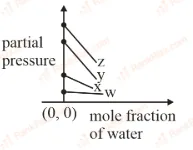
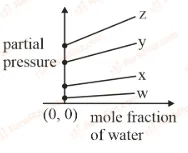
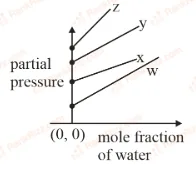
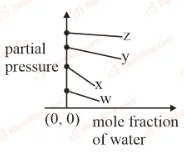
For the solution of the gases w, x, y and z in water at 298 K, the Henry's law constants (KH_H) are 0.5, 2, 35 and 40 kbar, respectively. The correct plot for the given data is:

  1. A
    Figure for JEE Main 2019 Chemistry question on Solubility of gases and Henry's law
  2. B
    Figure for JEE Main 2019 Chemistry question on Solubility of gases and Henry's law
  3. C
    Figure for JEE Main 2019 Chemistry question on Solubility of gases and Henry's law
  4. D
    Figure for JEE Main 2019 Chemistry question on Solubility of gases and Henry's law
JEE MAIN 2019 · 12 JAN S1Depression in freezing point

The freezing point of a 4% aqueous solution of X is equal to the freezing point of a 12% aqueous solution of Y. If the molecular weight of X is A, then the molecular weight of Y will be

  1. A

    2A

  2. B

    A

  3. C

    4A

  4. D

    3A

JEE MAIN 2019 · 12 JAN S2Abnormal molar mass and van't Hoff factor

Molecules of benzoic acid (C6H5COOHC_6H_5COOH) dimerise in 30 g of benzene. 'w' g of benzoic acid shows a depression in freezing point equal to 2 K. If the percentage association of the acid to form dimer in the solution is 80, then w is: (Given that Kf=5K_f = 5 K mol−1^{-1}, molar mass of benzoic acid = 122 g mol−1^{-1})

  1. A

    1.0 g

  2. B

    2.4 g

  3. C

    1.8 g

  4. D

    1.5 g

JEE MAIN 2019 · 11 JAN S1Abnormal molar mass and van't Hoff factor

The freezing point of a diluted milk sample is found to be −0.2°C-0.2°C, while it should have been −0.5°C-0.5°C for pure milk. How much water has been added to pure milk to make the diluted sample?

  1. A

    1 cup of water to 2 cups of pure milk

  2. B

    3 cups of water to 2 cups of pure milk

  3. C

    1 cup of water to 3 cups of pure milk

  4. D

    2 cups of water to 3 cups of pure milk

JEE MAIN 2019 · 11 JAN S2Abnormal molar mass and van't Hoff factor

K2HgI4K_2HgI_4 is 40% ionised in aqueous solution. The value of its van't Hoff factor (i) is:

  1. A

    1.6

  2. B

    1.8

  3. C

    20

  4. D

    22

JEE MAIN 2019 · 10 JAN S1Relative lowering of vapour pressure

Liquids A and B form an ideal solution in the entire composition range. At 350K, the vapour pressure of pure A and pure B are 7×1037 \times 10^3 Pa and 12×10312 \times 10^3 Pa, respectively. The composition of the vapour in equilibrium with a solution containing 40 mole percent of A at this temperature is:

  1. A

    xA=0.4;xB=0.6x_A = 0.4; x_B = 0.6

  2. B

    xA=0.76;xB=0.24x_A = 0.76; x_B = 0.24

  3. C

    xA=0.28;xB=0.72x_A = 0.28; x_B = 0.72

  4. D

    xA=0.37;xB=0.63x_A = 0.37; x_B = 0.63

JEE MAIN 2019 · 10 JAN S2Depression in freezing point

The elevation in boiling point for 1 molal solution of glucose is 2 K. The depression in freezing point for 2 molal solution of glucose in the same solvent is 2 K. The relation between KbK_b and KfK_f is:

  1. A

    Kb=2KfK_b = 2K_f

  2. B

    Kb=1.5KfK_b = 1.5K_f

  3. C

    Kb=KfK_b = K_f

  4. D

    Kb=0.5KfK_b = 0.5K_f

JEE MAIN 2019 · 09 JAN S1Solubility of gases and Henry's law

Which one of the following statements regarding Henry's law is not correct?

  1. A

    Different gases have different KHK_H (Henry's law constant) values at the same temperature

  2. B

    The partial pressure of the gas in vapour phase is proportional to the mole fraction of the gas in the solution

  3. C

    Higher the value of KHK_H at a given pressure, higher is the solubility of the gas in the liquids

  4. D

    The value of KHK_H increases with increase of temperature and KHK_H is function of the nature of the gas

JEE MAIN 2019 · 09 JAN S2Depression in freezing point

A solution containing 62 g ethylene glycol in 250 g water is cooled to −10∘-10^{\circ}C. If KfK_f for water is 1.86 K kg mol−1^{-1}, the amount of water (in g) separated as ice is:

  1. A

    48

  2. B

    64

  3. C

    16

  4. D

    32

JEE MAIN 2018 · 16 APR ONLINERelative lowering of vapour pressure

The mass of a non-volatile, non-electrolyte solute (molar mass = 50 g mol−1^{-1}) needed to be dissolved in 114 g octane to reduce its vapour pressure by 75%, is:

  1. A

    37.5 g

  2. B

    75 g

  3. C

    150 g

  4. D

    50 g