JEE Main 2020 Chemistry question — Solubility of gases and Henry's law
A graph of vapour pressure and temperature for three different liquids X, Y and Z is shown below:
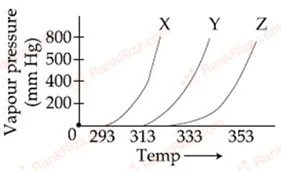
The following inferences are made:
(A) X has higher intermolecular interactions compared to Y.
(B) X has lower intermolecular interactions compared to Y.
(C) Z has lower intermolecular interactions compared to Y.
The correct inferences is/are:
SOLUTION
The vapor pressure of a liquid is determined by the kinetic energy of its molecules and the strength of the attractive forces holding them together in the liquid phase:
- Strong Intermolecular Forces: Molecules are held together tightly, making it harder for them to escape into the gas phase. Consequently, the liquid will have a lower vapor pressure at any given temperature and a higher boiling point.
- Weak Intermolecular Forces: Molecules escape easily into the gas phase, resulting in a higher vapor pressure at a given temperature.
Therefore, at any fixed temperature point, the relationship is inversely proportional:
Step-by-Step Analysis of the Graph:
If we draw a vertical line at a constant temperature (for example, at or ), we can compare the vapor pressures of the three liquids directly:
Applying our inverse relationship rule, we can deduce the true relative strength of their intermolecular interactions:
Evaluating the Inferences:
- (A) X has higher intermolecular interactions compared to Y: Incorrect (X has a higher vapor pressure, so its forces are weaker than Y).
- (B) X has lower intermolecular interactions compared to Y: Correct (Matches our derived order where ).
- (C) Z has lower intermolecular interactions compared to Y: Incorrect (Z has the lowest vapor pressure, meaning it possesses the strongest forces).
Conclusion:
Only statement (B) accurately describes the trend shown in the vapor pressure curves.
Answer: Option C — (B)