JEE MAIN 2025 · 24 JAN S2Abnormal molar mass and van't Hoff factor
The observed and normal molar masses of compound are and respectively. The percent degree of ionisation of is (Nearest integer)
Every Solutions question JEE Main has set from 2004–2026, grouped by the idea it tests rather than the order of the syllabus. 200 questions across 7 distinct ideas. Free to read, answer key on every one.
DATA UPDATED
Questions
200
Distinct ideas
7
Share of marks
4.8%
Difficulty
MEDIUM
A chapter is not one subject — it is a handful of procedures the examiner reuses. These are the ones Solutions questions actually test.
41–60 OF 200 · NEWEST FIRST
The observed and normal molar masses of compound are and respectively. The percent degree of ionisation of is (Nearest integer)
can exist as a complex. 0.1 molal aqueous solution of this complex shows a depression in freezing point of . Assuming 100% ionisation of this complex and coordination number of Cr is 6 , the complex will be (Given = 1.86 K kg )
Consider a binary solution of two volatile liquid components 1 and 2. and are the mole fractions of component 1 in liquid and vapour phase, respectively. The slope and intercept of the linear plot of vs are given respectively as:
When a non-volatile solute is added to the solvent, the vapour pressure of the solvent decreases by 10 mm of Hg . The mole fraction of the solute in the solution is 0.2 . What would be the mole fraction of the solvent if decrease in vapour pressure is 20 mm of Hg ?
0.8
0.4
0.2
0.6
Arrange the following solutions in order of their increasing boiling points. (i) (ii) (iii) (iv)
M when treated with M gives green colour solution of .
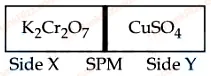
The two solutions are separated as shown below : [SPM : Semi Permeable Membrane]. Due to osmosis :
Molarity of solution is lowered.
Molarity of solution is lowered.
Green colour formation observed on side Y.
Green colour formation observed on side X.
The vapour pressure of pure benzene and methyl benzene at is given as 80 Torr and 24 Torr, respectively. The mole fraction of methyl benzene in vapour phase, in equilibrium with an equimolar mixture of those two liquids (ideal solution) at the same temperature is ______ (nearest integer)
A solution containing of an electrolyte in of water boils at . The degree of ionization of the electrolyte is ______ . (nearest integer) [Given: Molar mass of , (molal boiling point elevation const. of water) , boiling point of water ; ionises as ]
Consider the dissociation of the weak acid HX as given below , [ : dissociation constant]. The osmotic pressure of M aqueous solution of HX at is _______ bar (nearest integer). [Given : ]
When '' mL methanol (molar mass ; density ) is added to water (density ), the following diagram is obtained. ___________ (nearest integer).
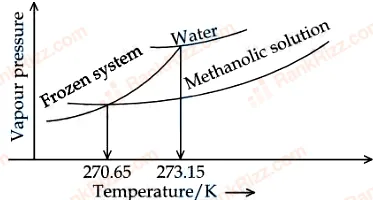
[Given : Molal freezing point depression constant of water at is ]
An artificial cell is made by encapsulating glucose solution within a semipermeable membrane. The osmotic pressure developed when the artificial cell is placed within a solution at is ______ . (nearest integer). [Given : ] Assume complete dissociation of
Considering acetic acid dissociates in water, its dissociation constant is . If mL of acetic acid is dissolved in 1 litre water, the solution will freeze at , provided pure water freezes at . ______ . (Nearest integer) Given : , density of acetic acid is , molar mass of water , molar mass of acetic acid , density of water . Acetic acid dissociates as
2.5 g of a non-volatile, non-electrolyte is dissolved in 100 g of water at 25°C. The solution showed a boiling point elevation by 2°C. Assuming the solute concentration is negligible with respect to the solvent concentration, the vapor pressure of the resulting aqueous solution is ______ mm of Hg (nearest integer). [Given: Kb = 0.52 K·kgmol⁻¹, 1 atm = 760 mm Hg, molar mass of water = 18 g mol⁻¹]
kg of each of water and acetic acid are mixed. The freezing point of the solution will be . Consider the acetic acid does not dimerise in water, nor dissociates in water. ______ (nearest integer) [Given: Molar mass of water g mol, acetic acid g mol, HO: K kg mol, acetic acid: K kg mol, freezing point: HO K, acetic acid K]
We have three aqueous solutions of NaCl labelled as 'A', 'B' and 'C' with concentration M, M and M, respectively. The value of van't Hoff factor for these solutions will be in the order:
Mass of ethylene glycol (antifreeze) to be added to 18.6 kg of water to protect the freezing point at is ______ kg (Molar mass in g mol for ethylene glycol 62, of water = )
Identify the mixture that shows positive deviations from Raoult's Law
What happens to freezing point of benzene when small quantity of naphthalene is added to benzene?
Increases
Remains unchanged
First decreases and then increases
Decreases
The solution from the following with highest depression in freezing point/lowest freezing point is
180 g of acetic acid dissolved in 1 L of aqueous solution
180 g of acetic acid dissolved in benzene
180 g of benzoic acid dissolved in benzene
180 g of glucose dissolved in water
The osmotic pressure of a dilute solution is Pa at K. Osmotic pressure of the same solution at K is _______ Nm. (Nearest integer)
JEE Advanced has set 26 Solutions questions too. Solutions JEE Advanced PYQs →
OTHER CHEMISTRY CHAPTERS