RankRizz

Solutions — JEE Advanced Previous Year Questions

Solutions has been asked in 18 of the 20 JEE Advanced years from 2007 to 2026: 26 questions in all. In 2026 it averaged 1.5 questions per paper (3 across 2 papers), 8.8% of Chemistry questions, up from 3.1% in 2025. Across the last 20 papers it carried 4.5% of Chemistry questions. By type: 16 numerical, 8 single-correct and 2 multiple-correct. Of the 26 with a difficulty tag, 19% are easy, 69% medium and 12% hard. Most asked: Abnormal molar mass and van't Hoff factor (6, 23%), Elevation in boiling point (5, 19%) and Raoult's law, ideal and non-ideal solutions (4, 15%).

DATA UPDATED

Questions

26

Distinct ideas

7

Share of marks

4.5%

Difficulty

MEDIUM

Solutions weightage, year by year

The share of each year’s Chemistry questions that came from Solutions, counted from the 19 papers we hold for the last 10 years, and paper by paper inside a year.

Rising: 5.0% of Chemistry questions in 2024–2026, up from 4.3% in 2017–2023. Its heaviest year was 2018, at 11.1%.

Solutions questions per year, per paper, and as a share of Chemistry questions
YEARQSPER PAPERSHARE OF CHEMISTRYCHANGE
20263 / 341.58.8%+5.7 pts
20251 / 320.53.1%+0.2 pts
20241 / 340.52.9%level
20231 / 340.52.9%+0.1 pts
20221 / 360.52.8%−2.5 pts
20212 / 381.05.3%+2.5 pts
20201 / 360.52.8%level
20191 / 360.52.8%−8.3 pts
20182 / 182.011.1%+5.5 pts
20172 / 361.05.6%—

“QS” is Solutions questions out of all Chemistry questions that year; “per paper” is that count over the year’s papers, and “change” is the share against the year before. A year with more sittings asks more questions, which is why the share, not the count, is the number to compare.

The ideas inside Solutions

A chapter is not one subject — it is a handful of procedures the examiner reuses. These are the ones Solutions questions actually test.

01Solubility of gases and Henry's lawset 1×
02Raoult's law, ideal and non-ideal solutionsset 4×
03Relative lowering of vapour pressureset 4×
04Elevation in boiling pointset 5×
05Depression in freezing pointset 4×
06Osmosis and osmotic pressureset 2×
07Abnormal molar mass and van't Hoff factorset 6×

All 26 Solutions questions, by topic

Every JEE Advanced Solutions question we hold, newest first inside each topic. Open one for its options, answer key and solution.

FREE PDF

Solutions JEE Advanced PYQs with answer key

All 26 questions on A4, by topic, with the answer key at the end. No sign-up, no email: your browser saves it as a PDF.

Download free PDF

UNIQUE CONCEPTS

Solutions: one question per idea

7 ideas, each with the latest past question that tested it, drawn from 225 JEE Main and Advanced questions.

Solutions Unique Concepts sheet →

JEE MAIN

Solutions in JEE Main

JEE Main has set 200 Solutions questions, 2004–2026.

Solutions JEE Main PYQs →

Solutions: quick answers

Is Solutions asked every year in JEE Advanced?

Not every year. It has been asked in 18 of the 20 JEE Advanced years from 2007 to 2026; the years without a Solutions question were 2010 and 2013.

Which Solutions topic is asked most in JEE Advanced?

Abnormal molar mass and van't Hoff factor: 6 of the 26 questions (23%). Next come Elevation in boiling point (5) and Raoult's law, ideal and non-ideal solutions (4).

What share of Chemistry questions does Solutions carry in JEE Advanced?

About 4.5% of Chemistry questions across the last 20 papers. In 2026 it was 8.8% (3 of 34 Chemistry questions).

When was Solutions last asked in JEE Advanced?

In JEE Advanced 2026 Paper 2, the latest sitting with a Solutions question.

How many Solutions questions has JEE Advanced asked?

26 from 2007 to 2026, across 7 topics. Every one is listed on this page by topic and links to its own page, with the answer key and solution wherever we have them. Free, no sign-up.

Every Solutions question

1–20 OF 26 · NEWEST FIRST

JEE ADVANCED 2026 · PAPER 2Abnormal molar mass and van't Hoff factor

In a solvent S, a compound B is partially dissociated into C and D as given below:

B⇌2C+2D\mathbf{B}\rightleftharpoons 2\mathbf{C}+2\mathbf{D}

B, C and D are non-volatile in nature. The molar mass of B is 10 times the molar mass of S. The standard boiling point and the standard enthalpy of vaporization of S are 400 K and 10R10R J mol−1^{-1}, respectively (RR is the gas constant in J K−1^{-1} mol−1^{-1}). A solution of B in S with an initial concentration of B as 0.25% (mass/mass) has a boiling point of 408 K at 1 bar pressure. In this solution, the mole percent of B that has been dissociated is ___.
JEE ADVANCED 2026 · PAPER 2Raoult's law, ideal and non-ideal solutions

Question Stem (Q15 & Q16): Two volatile liquids A and B form an ideal solution. Consider a 5 molal solution of B in A inside a closed container having a total vapour pressure of 100 mm Hg at 300 K. The vapour pressure of pure A at 300 K is 105 mm Hg. Assume that A and B behave as ideal gases in the vapour phase.

Given: The gas constant R=0.08R=0.08 L atm K−1^{-1} mol−1^{-1};
Molar mass of A is 50 g mol−1^{-1};
Molar mass of B is 57 g mol−1^{-1};
Density of liquid B at 300 K is 0.5 g/mL; 1 atm =760=760 mm Hg.

At 300 K, the ratio of the molar volume of pure B in vapour phase to its molar volume in liquid phase is ___.

JEE ADVANCED 2026 · PAPER 2Raoult's law, ideal and non-ideal solutions

Question Stem (Q15 & Q16): Two volatile liquids A and B form an ideal solution. Consider a 5 molal solution of B in A inside a closed container having a total vapour pressure of 100 mm Hg at 300 K. The vapour pressure of pure A at 300 K is 105 mm Hg. Assume that A and B behave as ideal gases in the vapour phase.

Given: The gas constant R=0.08R=0.08 L atm K−1^{-1} mol−1^{-1};
Molar mass of A is 50 g mol−1^{-1};
Molar mass of B is 57 g mol−1^{-1};
Density of liquid B at 300 K is 0.5 g/mL; 1 atm =760=760 mm Hg.

The mole fraction of B in vapour phase which is in equilibrium with this solution is ___.

JEE ADVANCED 2025 · PAPER 2Osmosis and osmotic pressure

At 300 K, an ideal dilute solution of a macromolecule exerts osmotic pressure that is expressed in terms of the height (h) of the solution (density = 1.00 g cm−3^{-3}) where h is equal to 2.00 cm. If the concentration of the dilute solution of the macromolecule is 2.00 g dm−3^{-3}, the molar mass of the macromolecule is X×104X \times 10^4 g mol−1^{-1}. The value of XX is ______.

Use: Universal gas constant (R) = 8.3 J K−1^{-1} mol−1^{-1} and acceleration due to gravity (g) = 10 m s−2^{-2}

JEE ADVANCED 2024 · PAPER 2Elevation in boiling point

Vessel-1 contains w2w_2 g of a non-volatile solute X dissolved in w1w_1 g of water. Vessel-2 contains w2w_2 g of another non-volatile solute Y dissolved in w1w_1 g of water. Both the vessels are at the same temperature and pressure. The molar mass of X is 80% of that of Y. The van't Hoff factor for X is 1.2 times of that of Y for their respective concentrations.

The elevation of boiling point for solution in Vessel-1 is ______ % of the solution in Vessel-2.

JEE ADVANCED 2023 · PAPER 2Osmosis and osmotic pressure

50 mL of 0.2 molal urea solution (density = 1.012 g mL−1^{-1} at 300 K) is mixed with 250 mL of a solution containing 0.06 g of urea. Both the solutions were prepared in the same solvent. The osmotic pressure (in Torr) of the resulting solution at 300 K is ____.

[Use: Molar mass of urea = 60 g mol−1^{-1}; gas constant, R = 62 L Torr K−1^{-1} mol−1^{-1}; Assume, ΔmixH=0\Delta_{mix}H = 0, ΔmixV=0\Delta_{mix}V = 0]

JEE ADVANCED 2022 · PAPER 2Abnormal molar mass and van't Hoff factor

An aqueous solution is prepared by dissolving 0.1 mol of an ionic salt in 1.8 kg of water at 35 ∘^\circC. The salt remains 90% dissociated in the solution. The vapour pressure of the solution is 59.724 mm of Hg. Vapor pressure of water at 35 ∘^\circC is 60.000 mm of Hg. The number of ions present per formula unit of the ionic salt is _______.

JEE ADVANCED 2021 · PAPER 1Elevation in boiling point

The value of ∣y∣\mid y \mid is ___.

JEE ADVANCED 2020 · PAPER 2Relative lowering of vapour pressure

Liquids A and B form ideal solution for all compositions of A and B at 25 ∘C^\circ C. Two such solutions with 0.25 and 0.50 mole fractions of A have the total vapor pressures of 0.3 and 0.4 bar, respectively. What is the vapor pressure of pure liquid B in bar?

JEE ADVANCED 2019 · PAPER 1Depression in freezing point

On dissolving 0.5 g of a non-volatile non-ionic solute to 39 g of benzene, its vapor pressure decreases from 650 mm Hg to 640 mm Hg. The depression of freezing point of benzene (in K) upon addition of the solute is ___________ .
(Given data: Molar mass and the molal freezing point depression constant of benzene are 78gmol−1and5.12Kkgmol−178 g mol^{-1} and 5.12 K kg mol^{-1} respectively)

JEE ADVANCED 2018 · PAPER 1Relative lowering of vapour pressure

Liquids A and B form ideal solution over the entire range of composition. At temperature T, equimolar binary solution of liquids A and B has vapour pressure 45 Torr. At the same temperature, a new solution of A and B having mole fractions x𝐴andx𝐵x_{𝐴} and x_{𝐵}, respectively, has vapour pressure of 22.5 Torr. The value of xAxB\frac{x_{A}}{x_{B}} in the new solution is ____.
(given that the vapour pressure of pure liquid A is 20 Torr at temperature T)

JEE ADVANCED 2018 · PAPER 1Abnormal molar mass and van't Hoff factor

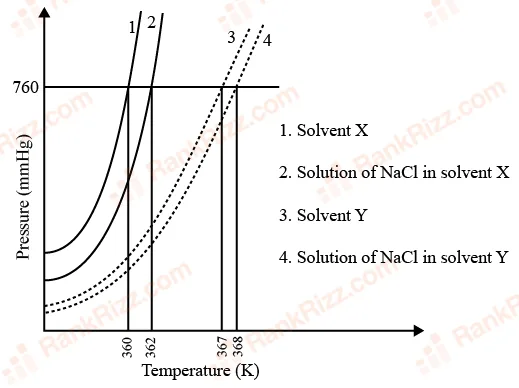
The plot given below shows 𝑃 − 𝑇 curves (where P is the pressure and T is the temperature) for two solvents X and Y and isomolal solutions of NaCl in these solvents. NaCl completely dissociates in both the solvents.

Figure for JEE Advanced 2018 Chemistry question on Abnormal molar mass and van't Hoff factor


On addition of equal number of moles of a non-volatile solute S in equal amount (in kg) of
these solvents, the elevation of boiling point of solvent X is three times that of solvent Y.
Solute S is known to undergo dimerization in these solvents. If the degree of dimerization is
0.7 in solvent Y, the degree of dimerization in solvent X is ____.

JEE ADVANCED 2017 · PAPER 2Depression in freezing point

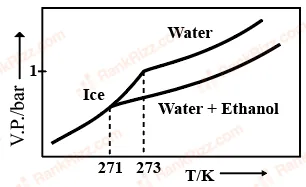
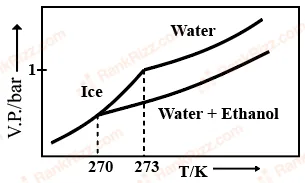
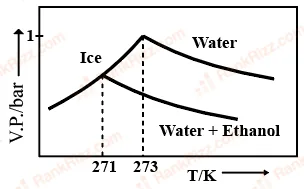
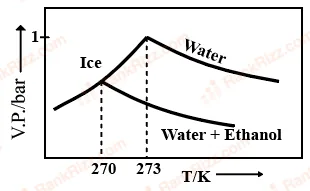
Pure water freezes at 273 K and 1 bar. The addition of 34.5 g of ethanol to 500 g of water changes the freezing point of the solution. Use the freezing point depression constant of water as 2 K kg mol−1mol^{-1} . The figures shown below represent plots of vapour pressure (V.P.) versus temperature (T). [molecular weight of ethanol is 46 g mol−1mol^{-1}] Among the following, the option representing change in the freezing point is

  1. A
    Figure for JEE Advanced 2017 Chemistry question on Depression in freezing point
  2. B
    Figure for JEE Advanced 2017 Chemistry question on Depression in freezing point
  3. C
    Figure for JEE Advanced 2017 Chemistry question on Depression in freezing point
  4. D
    Figure for JEE Advanced 2017 Chemistry question on Depression in freezing point
JEE ADVANCED 2017 · PAPER 1Relative lowering of vapour pressure

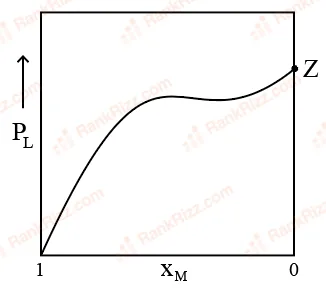
For a solution formed by mixing liquids L and M, the vapour pressure of L plotted against the mole fraction of M in solution is shown in the following figure. Here xLx_L and xMx_M represent mole fractions of L and M, respectively, in the solution. The correct statement(s) applicable to this system is(are)

Figure for JEE Advanced 2017 Chemistry question on Relative lowering of vapour pressure
  1. A

    The point Z represents vapour pressure of pure liquid M and Raoult’s law is obeyed from xL=0x_L = 0 to xL=1x_L = 1

  2. B

    The point Z represents vapour pressure of pure liquid L and Raoult’s law is obeyed when xL→1x_L \rightarrow 1

  3. C

    The point Z represents vapour pressure of pure liquid M and Raoult’s law is obeyed when xL→0x_L \rightarrow 0

  4. D

    Attractive intermolecular interactions between L-L in pure liquid L and M-M in pure liquid M are stronger than those between L-M when mixed in solution

JEE ADVANCED 2016 · PAPER 2Raoult's law, ideal and non-ideal solutions

Mixture(s) showing positive deviation from Raoult’s law at 35∘C35^\circ C is(are)

  1. A

    carbon tetrachloride + methanol

  2. B

    carbon disulphide + acetone

  3. C

    benzene + toluene

  4. D

    phenol + aniline

JEE ADVANCED 2016 · PAPER 1Raoult's law, ideal and non-ideal solutions

The mole fraction of a solute in a solution is 0.1. At 298 K, molarity of this solution is the sameas its molality. Density of this solution at 298 K is 2.0 gcm−3^{-3}. Theratio of the molecular weights of the solute and solvent, (MWsoluteMWsolvent)\left(\frac{MW_{solute}}{MW_{solvent}}\right), is

JEE ADVANCED 2015 · PAPER 1Depression in freezing point

If the freezing point of a 0.01 molal aqueous solution of a cobalt(III) chloride-ammonia complex (which behaves as a strong electrolyte) is −0.0558C∘-0.0558 ^\circ_C the numberof chloride(s) in the coordination sphere of the complex is [Kf[K_f of water = 1.86 K kg mol−1mol^{-1}]

JEE ADVANCED 2014 · PAPER 1Abnormal molar mass and van't Hoff factor

MX2MX_2 dissociates into M2+M^{2+} and X−X^- ions in an aqueous solution, with a degree of dissociation (α)(\alpha) of 0.5. The ratio of the observed depression of freezing point of the aqueous solution to the value of the depression of freezing point in the absence of ionic dissociation is

JEE ADVANCED 2012 · PAPER 2Elevation in boiling point

For a dilute solution containing 2.5 g of a non- volatile non- electrolyte solute in 100 g of water, the elevation in boiling point at 1 atm pressure is 2∘C2^\circ C. Assuming concentration of solute is much lower than the concentration of solvent, the vapour pressure (mm of Hg) of the solution is (take Kb=0.76K_b = 0.76 K kg mol−1mol^{-1})

  1. A

    724

  2. B

    740

  3. C

    736

  4. D

    718