RankRizz

p-Block Elements: Groups 13 and 14 — JEE Main Previous Year Questions

Every p-Block Elements: Groups 13 and 14 question JEE Main has set from 2004–2026, grouped by the idea it tests rather than the order of the syllabus. 92 questions across 5 distinct ideas. Free to read, answer key on every one.

DATA UPDATED

Questions

92

Distinct ideas

5

Share of marks

1.4%

Difficulty

EASY

The ideas inside p-Block Elements: Groups 13 and 14

A chapter is not one subject — it is a handful of procedures the examiner reuses. These are the ones p-Block Elements: Groups 13 and 14 questions actually test.

Every p-Block Elements: Groups 13 and 14 question

61–80 OF 92 · NEWEST FIRST

JEE MAIN 2019 · 09 APR S2Group 13: general trends and inert pair effect

The correct statements among I to III regarding group 13 element oxides are,
(I) Boron trioxide is acidic.
(II) Oxides of aluminum and gallium are amphoteric.
(III) Oxides of indium and thallium are basic.

  1. A

    (I) and (III) only

  2. B

    (I) and (II) only

  3. C

    (I), (II) and (III)

  4. D

    (II) and (III) only

JEE MAIN 2019 · 09 APR S2Group 14: trends and carbon allotropes

The amorphous form of silica is:

  1. A

    quartz

  2. B

    kieselguhr

  3. C

    tridymite

  4. D

    cristobalite

JEE MAIN 2019 · 08 APR S1Group 13: general trends and inert pair effect

Diborane B2_2H6_6 reacts independently with O2_2 and H2_2O to produce, respectively:

  1. A

    HBO2_2 and H3_3BO3_3

  2. B

    H3_3BO3_3 and B2_2O3_3

  3. C

    B2_2O3_3 and [BH4_4]−^{-}

  4. D

    B2_2O3_3 and H3_3BO3_3

JEE MAIN 2019 · 12 JAN S2Group 14: trends and carbon allotropes

The element that does not show catenation is

  1. A

    Sn

  2. B

    Si

  3. C

    Ge

  4. D

    Pb

JEE MAIN 2019 · 12 JAN S2Group 14: trends and carbon allotropes

The element that shows greater ability to form pπ−pπp\pi - p\pi multiple bonds is:

  1. A

    Sn

  2. B

    C

  3. C

    Si

  4. D

    Ge

JEE MAIN 2019 · 11 JAN S1Group 14: trends and carbon allotropes

The chloride that CANNOT get hydrolysed is:

  1. A

    PbCl4PbCl_4

  2. B

    CCl4CCl_4

  3. C

    SnCl4SnCl_4

  4. D

    SiCl4SiCl_4

JEE MAIN 2019 · 11 JAN S2Aluminium and its compounds

The hydride that is NOT electron deficient is:

  1. A

    SiH4SiH_4

  2. B

    B2H6B_2H_6

  3. C

    GaH3GaH_3

  4. D

    AlH3AlH_3

JEE MAIN 2019 · 11 JAN S2Group 13: general trends and inert pair effect

The relative stability of +1 oxidation state of group 13 elements follows the order

  1. A

    Al < Ga < Tl < In

  2. B

    Tl < In < Ga < Al

  3. C

    Ga < Al < In < Tl

  4. D

    Al < Ga < In < Tl

JEE MAIN 2019 · 10 JAN S2Aluminium and its compounds

The number of 2-centre-2-electron and 3-centre-2-electron bonds in B2H6B_2H_6, respectively, are:

  1. A

    4 and 2

  2. B

    2 and 4

  3. C

    2 and 2

  4. D

    2 and 1

JEE MAIN 2019 · 09 JAN S1Group 13: general trends and inert pair effect

Aluminium is usually found in +3 oxidation state. In contrast, thallium exists in +1 and +3 oxidation states. This is due to:

  1. A

    Diagonal relationship

  2. B

    Lattice effect

  3. C

    Lanthanoid contraction

  4. D

    Inert pair effect

JEE MAIN 2019 · 09 JAN S1Group 14: trends and carbon allotropes

Correct statements among regarding silicones are:
(a) They are polymers with hydrophobic character.
(b) They are biocompatible.
(c) In general, they have high thermal stability and low dielectric strength.
(d) Usually, they are resistant to oxidation and used as greases.

  1. A

    (a), (b) and (c) only

  2. B

    (a) and (b) only

  3. C

    (a), (b), (c) and (d)

  4. D

    (a), (b) and (d) only

JEE MAIN 2019 · 09 JAN S1Group 14: trends and carbon allotropes

The one that is extensively used as a piezoelectric material is:

  1. A

    Tridymite

  2. B

    Quartz

  3. C

    Amorphous silica

  4. D

    Mica

JEE MAIN 2018 · 16 APR ONLINEGroup 13: general trends and inert pair effect

A group 13 element 'X' reacts with chlorine gas to produce a compound XCl3_3. XCl3_3 is electron deficient and easily reacts with NH3_3 to form Cl3_3X ←\leftarrow NH3_3 adduct; however, XCl3_3 does not dimerize. X is:

  1. A

    B

  2. B

    Al

  3. C

    In

  4. D

    Ga

JEE MAIN 2018 · 15 APR S1Group 14: trends and carbon allotropes

In graphite and diamond, the percentage of p characters of the hybrid orbitals in hybridization are respectively:

  1. A

    33 and 25

  2. B

    67 and 75

  3. C

    50 and 75

  4. D

    33 and 75

JEE MAIN 2018 · 15 APR S2Group 14: trends and carbon allotropes

Lithium aluminium hydride reacts with silicon tetrachloride to form:

  1. A

    LiCl, AlH3_3 and SiH4_4

  2. B

    LiCl, AlCl3_3 and SiH4_4

  3. C

    LiH, AlCl3_3 and SiCl2_2

  4. D

    LiH, AlH3_3 and SiH4_4

JEE MAIN 2016 · 10 APR ONLINEGroup 14: trends and carbon allotropes

Assertion: Among the carbon allotropes, diamond is an insulator, whereas, graphite is a good conductor of electricity.
Reason: Hybridization of carbon in diamond and graphite are sp3^3 and sp2^2 respectively.

  1. A

    Both assertion and reason are correct, but the reason is not the correct explanation for the assertion.

  2. B

    Both assertion and reason are correct, but the reason is the correct explanation for the assertion.

  3. C

    Both assertion and reason are incorrect.

  4. D

    Assertion is incorrect statement, but the reason is correct.

JEE MAIN 2016 · 09 APR ONLINEGroup 14: trends and carbon allotropes

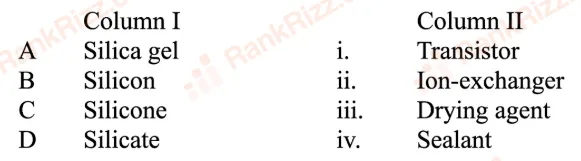
Match the items in Column I with its main use listed in Column II:

Figure for JEE Main 2016 Chemistry question on Group 14: trends and carbon allotropes
  1. A

    A - iii, B - i, C - iv, D - ii

  2. B

    A - iv, B - i, C - ii, D - iii

  3. C

    A - ii, B - i, C - iv, D - iii

  4. D

    A - ii, B - iv, C - i, D - iii

JEE MAIN 2014 · 19 APR ONLINEGroup 14: trends and carbon allotropes

Example of a three-dimensional silicate is:

  1. A

    Ultramarines

  2. B

    Feldspars

  3. C

    Zeolites

  4. D

    All of these

JEE MAIN 2014 · 19 APR ONLINEGroup 13: general trends and inert pair effect

Which of these statements is not true?

  1. A

    LiAlH4_4 is versatile reducing agent in organic synthesis.

  2. B

    NO+^+ is isoelectronic with O2_2

  3. C

    Boron is always covalent in its compounds

  4. D

    In aqueous solution, the Tl+^+ ion is much more stable than Tl (III)

JEE MAIN 2014 · 09 APR ONLINEGroup 13: general trends and inert pair effect

In the following sets of reactants which two sets best exhibit the amphoteric character of Al2_2O3_3 · xH2_2O?
Set I: Al2_2O3_3 · xH2_2O(s)_{(s)} + OH(aq)−^-_{(aq)}
Set II: Al2_2O3_3x · H2_2O(s)_{(s)} + H2_2O(l)_{(l)}
Set III: Al2_2O3_3x · H2_2O(s)_{(s)} + H(aq)+^+_{(aq)}
Set IV: Al2_2O3_3 · xH2_2O(s)_{(s)} + NH3(aq)_{3(aq)}

  1. A

    2 and 4

  2. B

    1 and 2

  3. C

    1 and 3

  4. D

    3 and 4