RankRizz

Group 13: general trends and inert pair effect — JEE Main Previous Year Questions

Group 13: general trends and inert pair effect has been asked 41 times in JEE Main, in 10 different years between 2014 and 2026, and in all of the last five exam years (2022–2026), 30 questions in all. That is 45% of p-Block Elements: Groups 13 and 14, its most-asked topic. Last asked in JEE Main 06 Apr 2026, Shift 1. 40 are multiple choice and 1 numerical-value; 19 easy and 22 medium by our difficulty labels. All of them are below, newest first, free to read.

Questions

41

Years asked

10

Since

2014

Of the chapter

45%

When JEE Main asked it

Questions on Group 13: general trends and inert pair effect in every year it was asked, newest first.

JEE Main questions on Group 13: general trends and inert pair effect by year, 2014–2026
YearRelative frequencyQuestions
20264
20254
20248
20235
20229
20213
20201
20194
20181
20142
Total41

Every Group 13: general trends and inert pair effect question

1–20 OF 41 · NEWEST FIRST

JEE MAIN 2026 · 06 APR S1Group 13: general trends and inert pair effect

Given below are two statements:

Statement I: Aluminium is more electropositive than thallium as the standard electrode potential value of EAl3+/Al∘^\circ_{Al^{3+}/Al} is negative and ETl3+/Tl∘^\circ_{Tl^{3+}/Tl} is positive.

Statement II: The sum of first three ionization enthalpies of boron is very high when compared to that of aluminium. Due to this reason boron forms covalent compounds only and aluminium forms Al3+^{3+} ion.

In the light of the above statements, choose the correct answer from the options given below:

  1. A

    Both Statement I and Statement II are true

  2. B

    Both Statement I and Statement II are false

  3. C

    Statement I is true but Statement II is false

  4. D

    Statement I is false but Statement II is true
JEE MAIN 2026 · 04 APR S2Group 13: general trends and inert pair effect

The electronegativity of a group 13 element 'E' is same as that of Ge (on Pauling scale and upto one decimal point). The CORRECT statements about E3+^{3+} are

A. It can act as a reducing agent.

B. It can act as an oxidizing agent.

C. E3+^{3+} is more stable than E+^+.

D. The standard electrode potential value for E3+^{3+}/E is positive.
choose the correct answer from the options given below 

  1. A

    A, C Only

  2. B

    B, C Only

  3. C

    B, D Only

  4. D

    A, D Only

JEE MAIN 2026 · 02 APR S2Group 13: general trends and inert pair effect

Given below are two statements :
Statement I : The second ionization enthalpy of B, Al and Ga is in the order of B>Al>GaB > Al > Ga.
Statement II : The correct order in terms of first ionization enthalpy is Si<Ge<Pb<SnSi < Ge < Pb < Sn.
In the light of the above statements, choose the correct answer from the options given below:

  1. A

    Both Statement I and Statement II are true

  2. B

    Both Statement I and Statement II are false

  3. C

    Statement I is true but Statement II is false

  4. D

    Statement I is false but Statement II is true

JEE MAIN 2026 · 23 JAN S1Group 13: general trends and inert pair effect

The correct statements from the following are:
A. Ionic radii of trivalent cations of group 13 elements decreases down the group.
B. Electronegativity of group 13 elements decreases down the group.
C. Among the group 13 elements, Boron has highest first ionisation enthalpy.
D. The trichloride and triiodide of group 13 elements are covalent in nature.
Choose the correct answer from the options given below :

  1. A

    A and D Only

  2. B

    A and C Only

  3. C

    B and D Only

  4. D

    C and D Only

JEE MAIN 2025 · 07 APR S2Group 13: general trends and inert pair effect

The correct statements from the following are :
(A) Tl3+Tl^{3+} is a powerful oxidising agent
(B) Al3+Al^{3+} does not get reduced easily
(C) Both Al3+Al^{3+} and Tl3+Tl^{3+} are very stable in solution
(D) Tl+Tl^+ is more stable than Tl3+Tl^{3+}
(E) Al3+Al^{3+} and Tl+Tl^+ are highly stable

  1. A

    (A), (B), (C), (D) and (E)

  2. B

    (A), (B), (D) and (E) only

  3. C

    (B), (D) and (E) only

  4. D

    (A), (C) and (D) only

JEE MAIN 2025 · 04 APR S1Group 13: general trends and inert pair effect

Given below are the pairs of group 13 elements showing their relation in terms of atomic radius. (B<Al),(Al<Ga),(Ga<In)(B \lt Al), (Al \lt Ga), (Ga \lt In) and (In<Tl)(In \lt Tl). Identify the elements present in the incorrect pair and in that pair find out the element (X) that has higher ionic radius (M3+M^{3+}) than the other one. The atomic number of the element (X) is

  1. A

    31

  2. B

    49

  3. C

    13

  4. D

    81

JEE MAIN 2025 · 04 APR S2Group 13: general trends and inert pair effect

The elements of Group 13 with highest and lowest first ionisation enthalpies are respectively:

  1. A

    B & Ga

  2. B

    B & Tl

  3. C

    Tl & B

  4. D

    B & In

JEE MAIN 2025 · 03 APR S2Group 13: general trends and inert pair effect

The correct orders among the following are:
Atomic radius: B<Al<Ga<In<TlB \lt Al \lt Ga \lt In \lt Tl
Electronegativity: Al<Ga<In<Tl<BAl \lt Ga \lt In \lt Tl \lt B
Density: Tl<In<Ga<Al<BTl \lt In \lt Ga \lt Al \lt B
1st Ionisation Energy: In<Al<Ga<Tl<BIn \lt Al \lt Ga \lt Tl \lt B
Choose the correct answer from the options given below :

  1. A

    B and D Only

  2. B

    A and C Only

  3. C

    C and D Only

  4. D

    A and B Only

JEE MAIN 2024 · 09 APR S2Group 13: general trends and inert pair effect

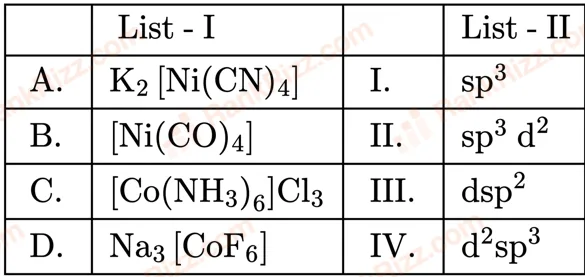
Match List I with List II:

Figure for JEE Main 2024 Chemistry question on Group 13: general trends and inert pair effect


Choose the correct answer from the options given below:

  1. A

    A-III, B-I, C-IV, D-II

  2. B

    A-III, B-I, C-II, D-IV

  3. C

    A-I, B-III, C-II, D-IV

  4. D

    A-III, B-II, C-IV, D-I

JEE MAIN 2024 · 08 APR S1Group 13: general trends and inert pair effect

Given below are two statements: One is labelled as Assertion A and the other is labelled as Reason R: Assertion A: The stability order of +1 oxidation state of Ga, In and Tl is Ga<In<TlGa < In < Tl. Reason R: The inert pair effect stabilizes the lower oxidation state down the group. In the light of the above statements, choose the correct answer from the options given below:

  1. A

    A is true but R is false.

  2. B

    A is false but R is true.

  3. C

    Both A and R are true and R is the correct explanation of A.

  4. D

    Both A and R are true but R is NOT the correct explanation of A.

JEE MAIN 2024 · 06 APR S1Group 13: general trends and inert pair effect

Given below are two statements: Statement I : Gallium is used in the manufacturing of thermometers. Statement II : A thermometer containing gallium is useful for measuring the freezing point of brine solution (256 K). In the light of the above statements, choose the correct answer from the options given below :

  1. A

    Both Statement I and Statement II are true

  2. B

    Statement I is false but Statement II is true

  3. C

    Both Statement I and Statement II are false

  4. D

    Statement I is true but Statement II is false

JEE MAIN 2024 · 05 APR S1Group 13: general trends and inert pair effect

Given below are two statements :

Statement I : In group 13, the stability of +1 oxidation state increases down the group. 

Statement II : The atomic size of gallium is greater than that of aluminium. 

In the light of the above statements, choose the most appropriate answer from the options given below :

  1. A

    Both Statement I and Statement II are correct

  2. B

    Statement I is incorrect but Statement II is correct

  3. C

    Both Statement I and Statement II are incorrect

  4. D

    Statement I is correct but Statement II is incorrect

JEE MAIN 2024 · 05 APR S1Group 13: general trends and inert pair effect

The number of neutrons present in the more abundant isotope of boron is 'xx'. Amorphous boron upon heating with air forms a product, in which the oxidation state of boron is 'yy'. The value of x+yx + y is ______

  1. A

    3

  2. B

    9

  3. C

    4

  4. D

    6

JEE MAIN 2024 · 05 APR S2Group 13: general trends and inert pair effect

The correct statements from the following are : (A) The decreasing order of atomic radii of group 13 elements is Tl>In>Ga>Al>BTl > In > Ga > Al > B. (B) Down the group 13 electronegativity decreases from top to bottom. (C) Al dissolves in dil. HCl and liberates H2H_2 but conc. HNO3HNO_3 renders Al passive by forming a protective oxide layer on the surface. (D) All elements of group 13 exhibits highly stable +1 oxidation state. (E) Hybridisation of Al in [Al(H2O)6]3+[Al(H_2O)_6]^{3+} ion is sp3d2sp^3d^2. Choose the correct answer from the options given below :

  1. A

    (A), (C) and (E) only

  2. B

    (A) and (C) only

  3. C

    (C) and (E) only

  4. D

    (A), (B), (C) and (E) only

JEE MAIN 2024 · 31 JAN S2Group 13: general trends and inert pair effect

Given below are two statements:
Statement I: Group 13 trivalent halides get easily hydrolysed by water due to their covalent nature.
Statement II: AlCl3_3 upon hydrolysis in acidified aqueous solution forms octahedral [Al(H2O)6]3+[Al(H_2O)_6]^{3+} ion.
In the light of the above statements, choose the correct answer from the options given below:

  1. A

    Statement I is true but statement II is false

  2. B

    Statement I is false but statement II is true

  3. C

    Both statement I and statement II are false

  4. D

    Both statement I and statement II are true

JEE MAIN 2024 · 27 JAN S1Group 13: general trends and inert pair effect

Given below are two statements : one is labelled as Assertion (A) and the other is labelled as Reason (R).

Assertion (A) : Melting point of Boron (2453 K) is unusually high in group 13 elements. 

Reason (R) : Solid Boron has very strong crystalline lattice.

In the light of the above statements, choose the most appropriate answer from the options given below:

  1. A

    Both (A) and (R) are correct but (R) is not the correct explanation of (A)

  2. B

    Both (A) and (R) are correct and (R) is the correct explanation of (A)

  3. C

    (A) is true but (R) is false

  4. D

    (A) is false but (R) is true

JEE MAIN 2023 · 13 APR S1Group 13: general trends and inert pair effect

The incorrect statement from the following for borazine is:

  1. A

    It contains banana bonds

  2. B

    It can react with water

  3. C

    It is a cyclic compound

  4. D

    It has electronic delocalization

JEE MAIN 2023 · 13 APR S2Group 13: general trends and inert pair effect

The covalency and oxidation state respectively of boron in BF4−_4^-, are

  1. A

    33 and 55

  2. B

    33 and 44

  3. C

    44 and 44

  4. D

    44 and 33

JEE MAIN 2023 · 13 APR S2Group 13: general trends and inert pair effect

If the formula of Borax is Na2_2 B4_4Ox_x(OH)y_y ⋅\cdot zH2_2O, then x + y + z = _____

JEE MAIN 2023 · 12 APR S1Group 13: general trends and inert pair effect

Given below are two statements:
Statement I: Boron is extremely hard indicating its high lattice energy.
Statement II: Boron has highest melting and boiling point compared to its other group members.
In the light of the above statements, choose the most appropriate answer from the options given below

  1. A

    Both Statement I and Statement II are incorrect

  2. B

    Statement I is correct but Statement II is incorrect

  3. C

    Both statement I and Statement II are correct

  4. D

    Statement I is incorrect but Statement II is correct

Group 13: general trends and inert pair effect: common questions

How many Group 13 questions have come in JEE Main?
Group 13 has been asked 41 times in JEE Main, in 10 different years between 2014 and 2026. It came up in all of the last five exam years (2022–2026), 30 questions in all.
Is Group 13 important for JEE Main?
It is the most-asked topic in p-Block Elements: Groups 13 and 14: 41 of the chapter's 92 JEE Main questions (45%). It came up in all of the last five exam years (2022–2026), 30 questions in all.
When was Group 13 last asked in JEE Main?
Most recently in JEE Main 06 Apr 2026, Shift 1. Questions on this page are newest first, so the latest ones are at the top.
What kind of Group 13 questions does JEE Main ask?
40 are multiple choice and 1 numerical-value; 19 easy and 22 medium by our difficulty labels. Each question shows its answer key and worked solution where we have them.