JEE ADVANCED 2022 · PAPER 2Group 13: general trends and inert pair effect
The compound(s) which react(s) with NH to give boron nitride (BN) is(are)
- A
B
- B
BH
- C
BO
- D
HBF
p-Block Elements: Groups 13 and 14 has been asked in 11 of the 20 JEE Advanced years from 2007 to 2026: 14 questions in all. It was not set in any of the 2 2026 papers. Across the last 20 papers it carried 0.9% of Chemistry questions. By type: 6 multiple-correct, 5 single-correct, 2 numerical and 1 match-the-list. Of the 14 with a difficulty tag, 50% are easy, 50% medium and 0% hard. Most asked: Group 13: general trends and inert pair effect (8, 57%) and Oxides of carbon, silica, silicones and silicates (6, 43%).
DATA UPDATED
Questions
14
Distinct ideas
2
Share of marks
0.9%
Difficulty
EASY
The share of each year’s Chemistry questions that came from p-Block Elements: Groups 13 and 14, counted from the 19 papers we hold for the last 10 years, and paper by paper inside a year.
Falling: 0.0% of Chemistry questions in 2024–2026, down from 1.3% in 2017–2023. Its heaviest year was 2017, at 2.8%. Not asked at all in 2018, 2020, 2021, 2023, 2024, 2025, 2026.
| YEAR | QS | PER PAPER | SHARE OF CHEMISTRY | CHANGE | |
|---|---|---|---|---|---|
| 2026 | 0 / 34 | 0.0 | 0.0% | level | PAPER 1 0.0%PAPER 2 0.0% |
| 2025 | 0 / 32 | 0.0 | 0.0% | level | PAPER 1 0.0%PAPER 2 0.0% |
| 2024 | 0 / 34 | 0.0 | 0.0% | level | PAPER 1 0.0%PAPER 2 0.0% |
| 2023 | 0 / 34 | 0.0 | 0.0% | −2.8 pts | PAPER 1 0.0%PAPER 2 0.0% |
| 2022 | 1 / 36 | 0.5 | 2.8% | +2.8 pts | PAPER 1 0.0%PAPER 2 5.6% |
| 2021 | 0 / 38 | 0.0 | 0.0% | level | PAPER 1 0.0%PAPER 2 0.0% |
| 2020 | 0 / 36 | 0.0 | 0.0% | −2.8 pts | PAPER 1 0.0%PAPER 2 0.0% |
| 2019 | 1 / 36 | 0.5 | 2.8% | +2.8 pts | PAPER 1 5.6%PAPER 2 0.0% |
| 2018 | 0 / 18 | 0.0 | 0.0% | −2.8 pts | 1 PAPER |
| 2017 | 1 / 36 | 0.5 | 2.8% | — | PAPER 1 0.0%PAPER 2 5.6% |
“QS” is p-Block Elements: Groups 13 and 14 questions out of all Chemistry questions that year; “per paper” is that count over the year’s papers, and “change” is the share against the year before. A year with more sittings asks more questions, which is why the share, not the count, is the number to compare.
A chapter is not one subject — it is a handful of procedures the examiner reuses. These are the ones p-Block Elements: Groups 13 and 14 questions actually test.
Every JEE Advanced p-Block Elements: Groups 13 and 14 question we hold, newest first inside each topic. Open one for its options, answer key and solution.
FREE PDF
All 14 questions on A4, by topic, with the answer key at the end. No sign-up, no email: your browser saves it as a PDF.
Download free PDFUNIQUE CONCEPTS
5 ideas, each with the latest past question that tested it, drawn from 106 JEE Main and Advanced questions.
p-Block Elements: Groups 13 and 14 Unique Concepts sheet →JEE MAIN
JEE Main has set 92 p-Block Elements: Groups 13 and 14 questions, 2004–2026.
p-Block Elements: Groups 13 and 14 JEE Main PYQs →Not every year. It has been asked in 11 of the 20 JEE Advanced years from 2007 to 2026; it was missing in 9 of them, most recently 2026.
Group 13: general trends and inert pair effect: 8 of the 14 questions (57%). Next come Oxides of carbon, silica, silicones and silicates (6).
About 0.9% of Chemistry questions across the last 20 papers. In 2026 it was 0.0% (0 of 34 Chemistry questions).
In JEE Advanced 2022 Paper 2, the latest sitting with a p-Block Elements: Groups 13 and 14 question. It has not been set since 2022, though the bank holds JEE Advanced papers up to 2026.
14 from 2007 to 2022, across 2 topics. Every one is listed on this page by topic and links to its own page, with the answer key and solution wherever we have them. Free, no sign-up.
1–14 OF 14 · NEWEST FIRST
The compound(s) which react(s) with NH to give boron nitride (BN) is(are)
B
BH
BO
HBF
A tin chloride Q undergoes the following reactions (not balanced)
X is a monoanion having pyramidal geometry. Both Y and Z are neutral compounds. Choose the correct option(s)
The central atom in X is hybridized
There is a coordinate bond in Y
The oxidation state of the central atom in Z is +2
The central atom in Z has one lone pair of electrons
Among the following, the correct statement(s) is(are)
has the three-centre two-electron bonds in its dimeric structure
has the three-centre two-electron bonds in its dimeric structure
has the three-centre two-electron bonds in its dimeric structure
The Lewis acidity of is greater than that of
The increasing order of atomic radii of the following Group 13 elements is
Al < Ga < In < Tl
Ga < Al < In < Tl
Al < In < Ga < Tl
Al < Ga < Tl < In
The crystalline form of borax has
tetranuclear unit
all boron atoms in the same plane
equal number of and hybridized boron atoms
one terminal hydroxide per boron atom
Three moles of are completely reacted with methanol. The number of moles of boron containing product formed is
The correct statement(s) for orthoboric acid is/are
It behaves as a weak acid in water due to self ionization.
Acidity of its aqueous solution increases upon addition of ethylene glycol.
It has a three dimensional structure due to hydrogen bonding.
It is a weak electrolyte in water.
With respect to graphite and diamond, which of the statement(s) given below is (are) correct ?
Graphite is harder than diamond.
Graphite has higher electrical conductivity than diamond
Graphite has higher thermal conductivity than diamond
Graphite has higher C-C bond order than diamond
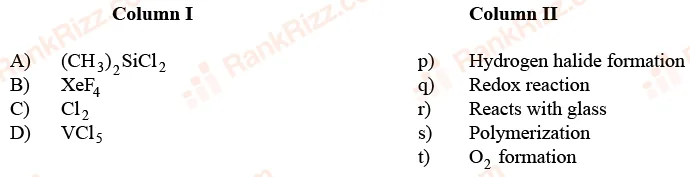
All the compounds listed in Column I react with water. Match the result of the respective reactions with the appropriate options listed in Column II.
The value of n in the molecular formula is
In the reaction
the amine(s) X is (are)
STATEMENT-1: compounds are stronger oxidizing agents than compounds.
and
STATEMENT-2: The higher oxidation states for the group 14 elements are more stable for the heavier members of the group due to ‘inert pair effect’.
STATEMENT-1 is True, STATEMENT-2 is True; STATEMENT-2 is a correct explanation for STATEMENT-1
STATEMENT-1 is True, STATEMENT-2 is True; STATEMENT-2 is NOT a correct explanation for STATEMENT-1
STATEMENT-1 is True, STATEMENT-2 is False
STATEMENT-1 is False, STATEMENT-2 is True
STATEMENT-1: In water, orthoboric acid behaves as a weak monobasic acid.
because
STATEMENT-2: In water, orthoboric acid acts as a proton donor.
Statement-1 is True, Statement-2 is True; Statement-2 is a correct explanation for Statement-1
Statement-1 is True, Statement-2 is True; Statement-2 is NOT a correct explanation for Statement-1
Statement-1 is True, Statement-2 is False
Statement-1 is False, Statement-2 is True
STATEMENT-1: Band gap in germanium is small.
because
STATEMENT-2: The energy spread of each germanium atomic energy level is infinitesimally small.
Statement-1 is True, Statement-2 is True; Statement-2 is a correct explanation for Statement-1
Statement-1 is True, Statement-2 is True; Statement-2 is NOT a correct explanation for Statement-1
Statement-1 is True, Statement-2 is False
Statement-1 is False, Statement-2 is True
OTHER CHEMISTRY CHAPTERS