RankRizz

General Organic Chemistry — JEE Main Previous Year Questions

Every General Organic Chemistry question JEE Main has set from 2004–2026, grouped by the idea it tests rather than the order of the syllabus. 258 questions across 12 distinct ideas. Free to read, answer key on every one.

DATA UPDATED

Questions

258

Distinct ideas

12

Share of marks

5.7%

Difficulty

MEDIUM

The ideas inside General Organic Chemistry

A chapter is not one subject — it is a handful of procedures the examiner reuses. These are the ones General Organic Chemistry questions actually test.

01Classification, functional groups and hybridisation in organic compoundsset 5×
02IUPAC nomenclature of organic compoundsset 47×03Structural isomerismset 57×
04Geometrical isomerismset 2×
05Optical isomerism and chiralityset 19×
06Conformationsset 2×
07Inductive and electromeric effectsset 1×
08Resonance and hyperconjugationset 26×09Reactive intermediates and rearrangementsset 36×10Acidity and basicity of organic compoundsset 35×11Aromaticityset 27×
12Types of organic reactions, electrophiles and nucleophilesset 1×

Every General Organic Chemistry question

41–60 OF 258 · NEWEST FIRST

JEE MAIN 2025 · 03 APR S2Reactive intermediates and rearrangements

Given below are two statements:
Statement I: Hyperconjugation is not a permanent effect.
Statement II: In general, greater the number of alkyl groups attached to a positively charged C-atom, greater is the hyperconjugation interaction and stabilization of the cation.
In the light of above statements, Choose the correct answer from the options given below :

  1. A

    Statement I is true and Statement II is false

  2. B

    Both Statement I and Statement II are false

  3. C

    Statement I is false but Statement II is true

  4. D

    Both Statement I and Statement II are true
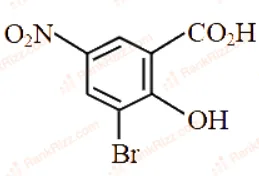
JEE MAIN 2025 · 03 APR S2IUPAC nomenclature of organic compounds

What is the correct IUPAC name of the following compound?

Figure for JEE Main 2025 Chemistry question on IUPAC nomenclature of organic compounds
  1. A

    3-Bromo-2-hydroxy-5-nitrobenzoic acid

  2. B

    3-Bromo-4-hydroxy-1-nitrobenzoic acid

  3. C

    2-Hydroxy-3-bromo-5-nitrobenzoic acid

  4. D

    5-Nitro-3-bromo-2-hydroxybenzoic acid

JEE MAIN 2025 · 03 APR S2Structural isomerism

The total number of structural isomers possible for the substituted benzene derivatives with the molecular formula C9H12C_9H_{12} is ________.

JEE MAIN 2025 · 02 APR S1Aromaticity

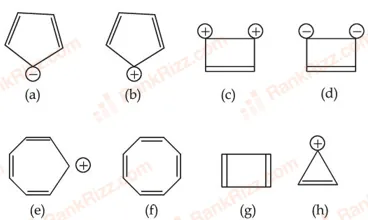
Designate whether each of the following compounds is aromatic or not aromatic.

Figure for JEE Main 2025 Chemistry question on Aromaticity
  1. A

    e, g aromatic and a, b, c, d, f, h not aromatic

  2. B

    b, e, f, g aromatic and a, c, d, h not aromatic

  3. C

    a, b, c, d aromatic and e, f, g, h not aromatic

  4. D

    a, c, d, e, h aromatic and b, f, g not aromatic

JEE MAIN 2025 · 02 APR S1Reactive intermediates and rearrangements

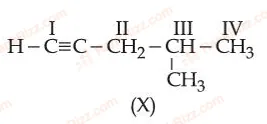
Consider the following compound (X):

Figure for JEE Main 2025 Chemistry question on Reactive intermediates and rearrangements


The most stable and least stable carbon radicals, respectively, produced by homolytic cleavage of corresponding C-H bond are:

  1. A

    II, IV

  2. B

    III, II

  3. C

    I, IV

  4. D

    II, I

JEE MAIN 2025 · 02 APR S2IUPAC nomenclature of organic compounds

In 3,3-dimethylhex-1-ene-4-yne, there are _____ sp3sp^3, _____ sp2sp^2 and _____ spsp hybridised carbon atoms respectively :

  1. A

    4, 2, 2

  2. B

    3, 3, 2

  3. C

    2, 4, 2

  4. D

    2, 2, 4

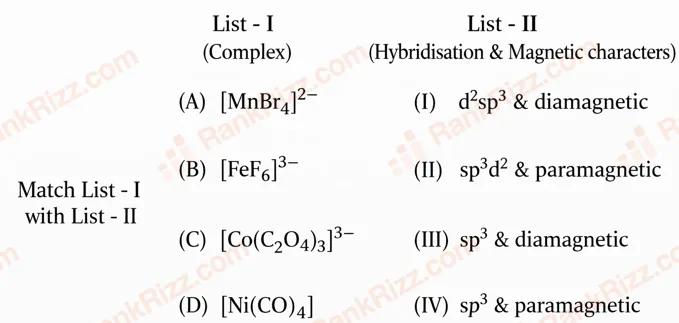
JEE MAIN 2025 · 29 JAN S1IUPAC nomenclature of organic compounds
Figure for JEE Main 2025 Chemistry question on IUPAC nomenclature of organic compounds


Choose the correct answer from the options given below :

  1. A

    (A) - (IV), (B) − (II), (C) − (I), (D) − (III)

  2. B

    (A) − (III), (B) − (I), (C) − (II), (D) − (IV)

  3. C

    (A) - (IV), (B) − (I), (C) − (II), (D) − (III)

  4. D

    (A) − (III), (B) − (II), (C) − (I), (D) − (IV)

JEE MAIN 2025 · 29 JAN S1Resonance and hyperconjugation

Total number of nucleophiles from the following is :
NH3,PhSH,(H3C)2S,H2C=CH2,⊖OH,H3O⊕,(CH3)2CO,⇌NCH3NH_{3},PhSH,(H_{3}C)_{2}S,H_{2}C=CH_{2},\ominus\\O H,H_{3}O^{\oplus},(CH_{3})_{2}CO,\rightleftharpoons NCH_{3}

  1. A

    7

  2. B

    4

  3. C

    6

  4. D

    5

JEE MAIN 2025 · 29 JAN S1Classification, functional groups and hybridisation in organic compounds

The sum of sigma (σ)(\sigma) and pi(π)(\pi) bonds in Hex-1,3-dien-5-yne is _______.

JEE MAIN 2025 · 29 JAN S2Classification, functional groups and hybridisation in organic compounds

Total number of sigma (σ\sigma) and pi(π\pi) bonds respectively present in hex-1-en-4-yne are :

  1. A

    3 and 13

  2. B

    11 and 3

  3. C

    13 and 3

  4. D

    14 and 3

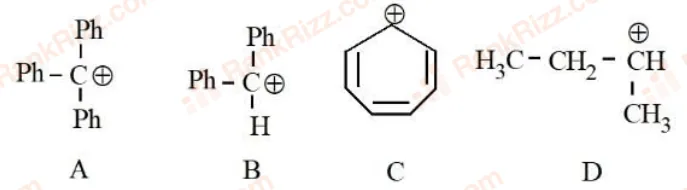
JEE MAIN 2025 · 28 JAN S1Reactive intermediates and rearrangements

The correct order of stability of following carbocations is :

page10_img1
  1. A

    C > B > A > D

  2. B

    A > B > C > D

  3. C

    B > C > A > D

  4. D

    C > A > B > D

JEE MAIN 2025 · 28 JAN S2Structural isomerism

Given below are two statements : Statement (I) :

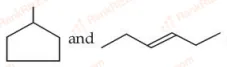
page7_img3

are isomeric compounds. Statement (II) :

page7_img4


are functional group isomers.

  1. A

    Both Statement (I) and Statement (II) are false.

  2. B

    Both Statement (I) and Statement (II) are true.

  3. C

    Statement (I) is false but Statement (II) is true.

  4. D

    Statement (I) is true but Statement (II) is false.

JEE MAIN 2025 · 24 JAN S1Reactive intermediates and rearrangements

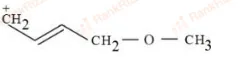
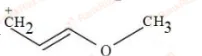
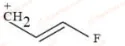
Which one of the carbocations from the following is most stable?

  1. A
    page9_img1
  2. B
    page9_img2
  3. C
    page9_img3
  4. D
    page9_img4
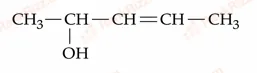
JEE MAIN 2025 · 24 JAN S2Structural isomerism

The possible number of stereoisomers for 5-phenylpent -4-en-2-ol is ‾.\underline{\hspace{2cm}}.

JEE MAIN 2025 · 24 JAN S2IUPAC nomenclature of organic compounds

The hydrocarbon  (X)(X)  with molar mass  80 g mol−180\,g\,mol^{-1} and  90%90\% carbon has ‾\underline{\hspace{2cm}}  degree of unsaturation.

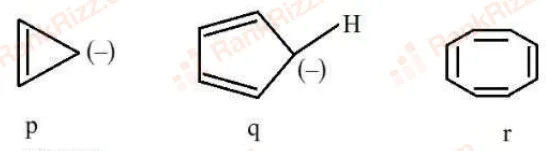
JEE MAIN 2025 · 23 JAN S1Aromaticity

The correct stability order of the following species/molecules is:

page12_img1
  1. A

    q > r > p

  2. B

    r > q > p

  3. C

    q > p > r

  4. D

    p > q > r

JEE MAIN 2025 · 22 JAN S1Optical isomerism and chirality

The incorrect statements regarding geometrical isomerism are :
(A) Propene shows geometrical isomerism.
(B) Trans isomer has identical atoms/groups on the opposite sides of the double bond.
(C) Cis-but-2-ene has higher dipole moment than trans-but-2-ene.
(D) 2-methylbut-2-ene shows two geometrical isomers.
(E) Trans-isomer has lower melting point than cis isomer.
Choose the correct answer from the options given below :

  1. A

    (A) and (E) Only

  2. B

    (A), (D) and (E) Only

  3. C

    (B) and (C) Only

  4. D

    (C), (D) and (E) Only

JEE MAIN 2025 · 22 JAN S1Structural isomerism

How many different stereoisomers are possible for the given molecule?

Figure for JEE Main 2025 Chemistry question on Structural isomerism
  1. A

    2

  2. B

    1

  3. C

    4

  4. D

    3

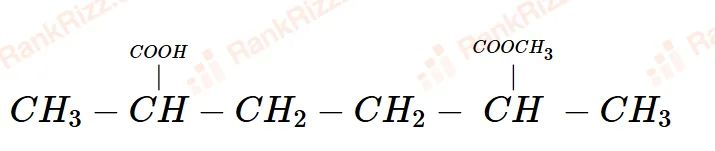
JEE MAIN 2025 · 22 JAN S1IUPAC nomenclature of organic compounds
Figure for JEE Main 2025 Chemistry question on IUPAC nomenclature of organic compounds

The IUPAC name of the following compound is :

  1. A

    Methyl-6-carboxy-2,5-dimethylhexanoate.

  2. B

    2-Carboxy-5-methoxycarbonylhexane.

  3. C

    6-Methoxycarbonyl-2,5-dimethylhexanoic acid.

  4. D

    Methyl-5-carboxy-2-methylhexanoate.

JEE MAIN 2025 · 22 JAN S2Reactive intermediates and rearrangements

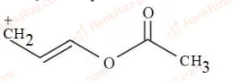
The most stable carbocation from the following is :

  1. A
    Figure for JEE Main 2025 Chemistry question on Reactive intermediates and rearrangements
  2. B
    Figure for JEE Main 2025 Chemistry question on Reactive intermediates and rearrangements
  3. C
    Figure for JEE Main 2025 Chemistry question on Reactive intermediates and rearrangements
  4. D
    Figure for JEE Main 2025 Chemistry question on Reactive intermediates and rearrangements