RankRizz

Reactive intermediates and rearrangements — JEE Main Previous Year Questions

Reactive intermediates and rearrangements has been asked 36 times in JEE Main, in 11 different years between 2005 and 2026, and in all of the last five exam years (2022–2026), 28 questions in all. That is 14% of General Organic Chemistry, one of its three most-asked topics. Last asked in JEE Main 08 Apr 2026, Shift 2. 35 are multiple choice and 1 numerical-value; 11 easy and 19 medium by our difficulty labels. All of them are below, newest first, free to read.

Questions

36

Years asked

11

Since

2005

Of the chapter

14%

When JEE Main asked it

Questions on Reactive intermediates and rearrangements in every year it was asked, newest first.

JEE Main questions on Reactive intermediates and rearrangements by year, 2005–2026
YearRelative frequencyQuestions
20268
20257
20247
20234
20222
20212
20141
20132
20091
20061
20051
Total36

Every Reactive intermediates and rearrangements question

1–20 OF 36 · NEWEST FIRST

JEE MAIN 2026 · 08 APR S2Reactive intermediates and rearrangements

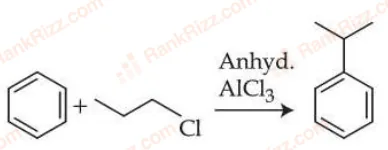
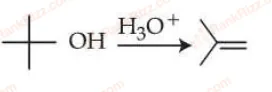
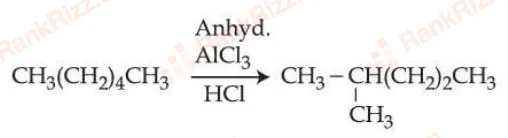
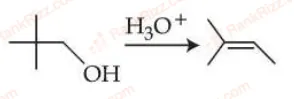
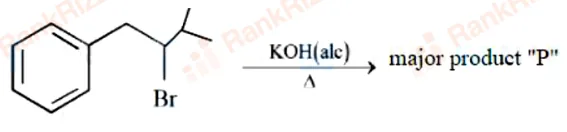
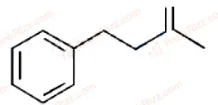
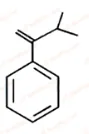
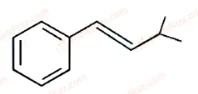
The major product of which of the following reaction is not obtained by rearrangement reaction?

  1. A
    Figure for JEE Main 2026 Chemistry question on Reactive intermediates and rearrangements
  2. B
    Figure for JEE Main 2026 Chemistry question on Reactive intermediates and rearrangements
  3. C
    Figure for JEE Main 2026 Chemistry question on Reactive intermediates and rearrangements
  4. D
    Figure for JEE Main 2026 Chemistry question on Reactive intermediates and rearrangements
JEE MAIN 2026 · 05 APR S1Reactive intermediates and rearrangements

Given below are two statements:
Statement I: On the basis of inductive effect, the order of stability of alkyl carbanions is CH3−>CH3CH2−>(CH3)2CH−>(CH3)3C−CH_3^- > CH_3CH_2^- > (CH_3)_2CH^- > (CH_3)_3C^-.
Statement II: Allyl and benzyl carbanions are more stabilised by inductive effect and not by resonance effect.
In the light of the above statements, choose the correct answer from the options given below

  1. A

    Both Statement I and Statement II are correct

  2. B

    Both Statement I and Statement II are incorrect

  3. C

    Statement I is correct but Statement II is incorrect

  4. D

    Statement I is incorrect but Statement II is correct

JEE MAIN 2026 · 04 APR S2Reactive intermediates and rearrangements

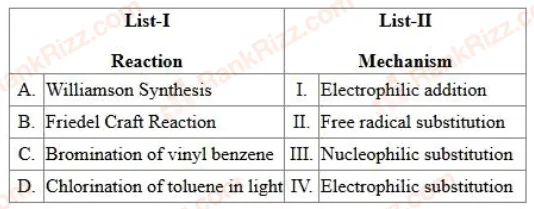
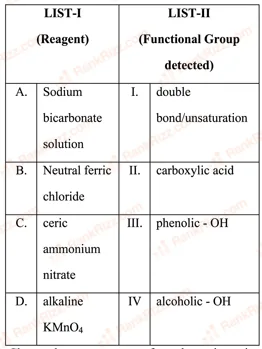
Match the List I with List II: 

Figure for JEE Main 2026 Chemistry question on Reactive intermediates and rearrangements

Choose the correct answer from the options given below 

  1. A

    A-III, B-I, C-II, D-IV

  2. B

    A-III, B-IV, C-II, D-I

  3. C

    A-III, B-IV, C-I, D-II

  4. D

    A-I, B-III, C-IV, D-II

JEE MAIN 2026 · 02 APR S2Reactive intermediates and rearrangements

Given below are two statements :

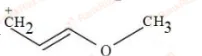
Statement I : In
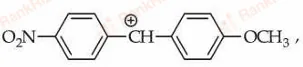
Figure for JEE Main 2026 Chemistry question on Reactive intermediates and rearrangements

the carbocation is stabilised by +R effect of −OCH3-OCH_3 group.

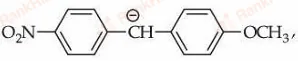
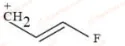
Statement II : In 

Figure for JEE Main 2026 Chemistry question on Reactive intermediates and rearrangements

the carbanion is stabilised by −R-R effect of −NO2-NO_2 group.

  1. A

    Both Statement I and Statement II are true

  2. B

    Both Statement I and Statement II are false

  3. C

    Statement I is true but Statement II is false

  4. D

    Statement I is false but Statement II is true

JEE MAIN 2026 · 28 JAN S1Reactive intermediates and rearrangements

CORRECT order of stability for the following is
CH2=CH−,CH3−CH2−,CH≡C−CH_{2}=CH^{-},CH_{3}-CH_{2}^{-},CH\equiv C^{-}

  1. A

    CH≡C−>CH3−CH2−>CH2=CH−CH\equiv C^{-} > CH_{3} - CH_{2}^{-} > CH_{2} = CH^{-}

  2. B

    CH≡C−>CH2=CH−>CH3−CH2−CH\equiv C^{-} > CH_{2} = CH^{-} > CH_{3}-CH_{2}^{-}

  3. C

    CH2=CH−>CH≡C−>CH3−CH2−CH_{2} = CH^{-} > CH\equiv C^{-} > CH_{3} - CH_{2}^{-}

  4. D

    CH3−CH2−>CH2=CH−>CH≡C−CH_{3} - CH_{2}^{-} > CH_{2} = CH^{-} > CH\equiv C^{-}

JEE MAIN 2026 · 28 JAN S2Reactive intermediates and rearrangements

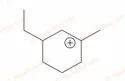
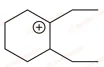
The cyclic cations having the same number of hyperconjugalion are :
A.
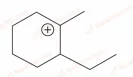
Figure for JEE Main 2026 Chemistry question on Reactive intermediates and rearrangements


B. 

Figure for JEE Main 2026 Chemistry question on Reactive intermediates and rearrangements


C. 

Figure for JEE Main 2026 Chemistry question on Reactive intermediates and rearrangements


D. 

Figure for JEE Main 2026 Chemistry question on Reactive intermediates and rearrangements


Choose the correct answer from the options given below :

  1. A

    A, C and D only

  2. B

    B and C Only

  3. C

    A and C Only

  4. D

    A and B Only

JEE MAIN 2026 · 24 JAN S1Reactive intermediates and rearrangements

Arrange the following carbanions in the decreasing order of stability.
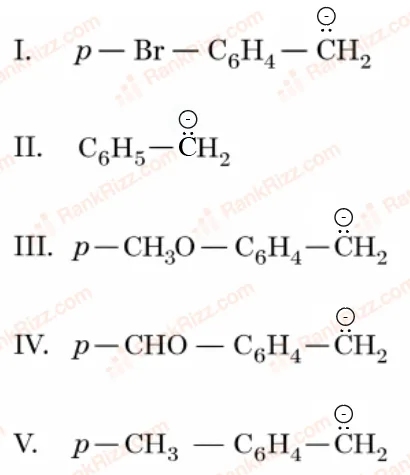
24th shift 1 52


Choose the correct answer from the options given below:

  1. A

    I > II > IV > V > III

  2. B

    I > IV > II > V > III

  3. C

    IV > II > I > III > V

  4. D

    IV > I > II > V > III

JEE MAIN 2026 · 23 JAN S2Reactive intermediates and rearrangements

Given below are two statements:

Statement I: (CH3)3C+(CH_3)_3C^+ is more stable than CH3+CH_3^+ as nine hyperconjugation interactions are possible in (CH3)3C+(CH_3)_3C^+.
Statement II: CH3+CH_3^+ is less stable than (CH3)3C+(CH_3)_3C^+ as only three hyperconjugation interactions are possible in CH3+CH_3^+.

In the light of the above statements, choose the correct answer from the options given below

  1. A

    Both Statement I and Statement II are false

  2. B

    Statement I is false but Statement II is true

  3. C

    Statement I is true but Statement II is false

  4. D

    Both Statement I and Statement II are true

JEE MAIN 2025 · 08 APR S2Reactive intermediates and rearrangements

Match the LIST-I with LIST-II 

Figure for JEE Main 2025 Chemistry question on Reactive intermediates and rearrangements

Choose the correct answer from the options given below :

  1. A

    A-II, B-III, C-IV, D-I

  2. B

    A-II, B-III, C-I, D-IV

  3. C

    A-III, B-II, C-IV, D-I

  4. D

    A-II, B-IV, C-III, D-I

JEE MAIN 2025 · 04 APR S2Reactive intermediates and rearrangements

In which pairs, the first ion is more stable than the second?
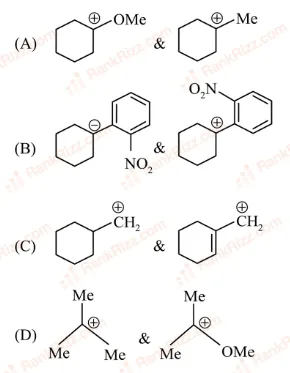
Figure for JEE Main 2025 Chemistry question on Reactive intermediates and rearrangements
  1. A

    (B) & (D) only

  2. B

    (A) & (B) only

  3. C

    (B) & (C) only

  4. D

    (A) & (C) only

JEE MAIN 2025 · 03 APR S2Reactive intermediates and rearrangements

Given below are two statements:
Statement I: Hyperconjugation is not a permanent effect.
Statement II: In general, greater the number of alkyl groups attached to a positively charged C-atom, greater is the hyperconjugation interaction and stabilization of the cation.
In the light of above statements, Choose the correct answer from the options given below :

  1. A

    Statement I is true and Statement II is false

  2. B

    Both Statement I and Statement II are false

  3. C

    Statement I is false but Statement II is true

  4. D

    Both Statement I and Statement II are true

JEE MAIN 2025 · 02 APR S1Reactive intermediates and rearrangements

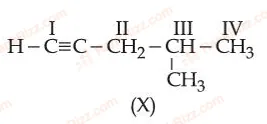
Consider the following compound (X):

Figure for JEE Main 2025 Chemistry question on Reactive intermediates and rearrangements


The most stable and least stable carbon radicals, respectively, produced by homolytic cleavage of corresponding C-H bond are:

  1. A

    II, IV

  2. B

    III, II

  3. C

    I, IV

  4. D

    II, I

JEE MAIN 2025 · 28 JAN S1Reactive intermediates and rearrangements

The correct order of stability of following carbocations is :
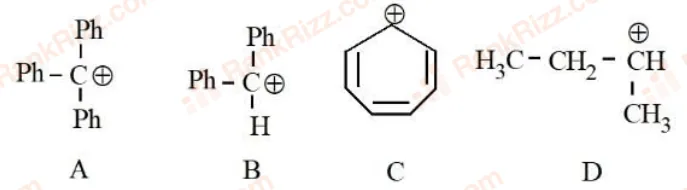
page10_img1
  1. A

    C > B > A > D

  2. B

    A > B > C > D

  3. C

    B > C > A > D

  4. D

    C > A > B > D

JEE MAIN 2025 · 24 JAN S1Reactive intermediates and rearrangements

Which one of the carbocations from the following is most stable?
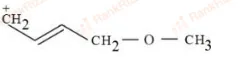
  1. A
    page9_img1
  2. B
    page9_img2
  3. C
    page9_img3
  4. D
    page9_img4
JEE MAIN 2025 · 22 JAN S2Reactive intermediates and rearrangements

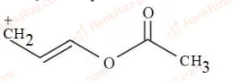
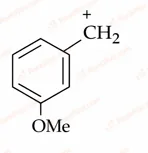
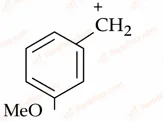
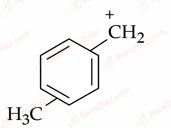
The most stable carbocation from the following is :
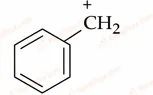
  1. A
    Figure for JEE Main 2025 Chemistry question on Reactive intermediates and rearrangements
  2. B
    Figure for JEE Main 2025 Chemistry question on Reactive intermediates and rearrangements
  3. C
    Figure for JEE Main 2025 Chemistry question on Reactive intermediates and rearrangements
  4. D
    Figure for JEE Main 2025 Chemistry question on Reactive intermediates and rearrangements
JEE MAIN 2024 · 09 APR S1Reactive intermediates and rearrangements

Relative stability of the contributing structures is 

page6_img1
  1. A

    (I) > (II) > (III)

  2. B

    (I) > (III) > (II)

  3. C

    (II) > (I) > (III)

  4. D

    (III) > (II) > (I)

JEE MAIN 2024 · 06 APR S2Reactive intermediates and rearrangements

Number of carbocations from the following that are not stabilized by hyperconjugation is __________
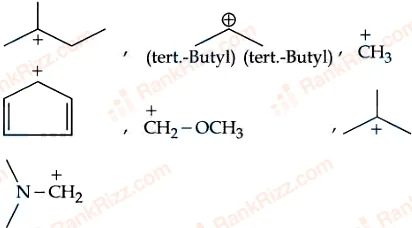
Figure for JEE Main 2024 Chemistry question on Reactive intermediates and rearrangements

_

JEE MAIN 2024 · 04 APR S2Reactive intermediates and rearrangements

Correct order of stability of carbanion is
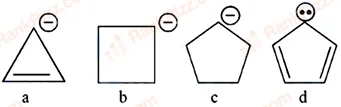
page6_img1
  1. A

    d>a>c>bd > a > c > b

  2. B

    a>b>c>da > b > c > d

  3. C

    d>c>b>ad > c > b > a

  4. D

    c>b>d>ac > b > d > a

JEE MAIN 2024 · 31 JAN S1Reactive intermediates and rearrangements

A species having carbon with sextet of electrons and can act as electrophile is called

  1. A

    carbon free radical

  2. B

    carbanion

  3. C

    carbocation

  4. D

    pentavalent carbon

Reactive intermediates and rearrangements: common questions

How many Reactive intermediates and rearrangements questions have come in JEE Main?
Reactive intermediates and rearrangements has been asked 36 times in JEE Main, in 11 different years between 2005 and 2026. It came up in all of the last five exam years (2022–2026), 28 questions in all.
Is Reactive intermediates and rearrangements important for JEE Main?
It is one of the three most-asked topics in General Organic Chemistry: 36 of the chapter's 258 JEE Main questions (14%). It came up in all of the last five exam years (2022–2026), 28 questions in all.
When was Reactive intermediates and rearrangements last asked in JEE Main?
Most recently in JEE Main 08 Apr 2026, Shift 2. Questions on this page are newest first, so the latest ones are at the top.
What kind of Reactive intermediates and rearrangements questions does JEE Main ask?
35 are multiple choice and 1 numerical-value; 11 easy and 19 medium by our difficulty labels. Each question shows its answer key and worked solution where we have them.