JEE Main 2025 Chemistry question — Reactive intermediates and rearrangements
Consider the following compound (X):
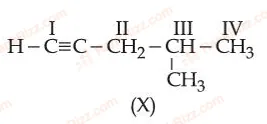
The most stable and least stable carbon radicals, respectively, produced by homolytic cleavage of corresponding C-H bond are:
SOLUTION
Position I (sp hybridized carbon): Homolytic cleavage at this position forms an acetylenic radical (−C≡C˙). Because sp hybridized carbons are highly electronegative, they hold the unshared electron very tightly, making this radical highly unstable (least stable).
Position II (Propargylic position): The radical formed here (−C≡C−C˙H−) is stabilized by resonance with the adjacent triple bond, similar to an allylic radical. Resonance stabilization is significantly stronger than hyperconjugation, making this radical the most stable.
Position III (3∘ carbon): This forms a tertiary free radical. It is stabilized via hyperconjugation by 8α-hydrogens, but it lacks resonance stabilization, making it less stable than the propargylic radical at position II.
Position IV (1∘ carbon): This forms a primary free radical stabilized by only 1α-hydrogen, making it less stable than III but more stable than I.