RankRizz

General Organic Chemistry — JEE Main Previous Year Questions

Every General Organic Chemistry question JEE Main has set from 2004–2026, grouped by the idea it tests rather than the order of the syllabus. 258 questions across 12 distinct ideas. Free to read, answer key on every one.

DATA UPDATED

Questions

258

Distinct ideas

12

Share of marks

5.7%

Difficulty

MEDIUM

The ideas inside General Organic Chemistry

A chapter is not one subject — it is a handful of procedures the examiner reuses. These are the ones General Organic Chemistry questions actually test.

01Classification, functional groups and hybridisation in organic compoundsset 5×
02IUPAC nomenclature of organic compoundsset 47×03Structural isomerismset 57×
04Geometrical isomerismset 2×
05Optical isomerism and chiralityset 19×
06Conformationsset 2×
07Inductive and electromeric effectsset 1×
08Resonance and hyperconjugationset 26×09Reactive intermediates and rearrangementsset 36×10Acidity and basicity of organic compoundsset 35×11Aromaticityset 27×
12Types of organic reactions, electrophiles and nucleophilesset 1×

Every General Organic Chemistry question

61–80 OF 258 · NEWEST FIRST

JEE MAIN 2024 · 09 APR S1Acidity and basicity of organic compounds

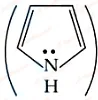
Correct order of basic strength of Pyrrole,
page5_img1

Pyridine,

page5_img2

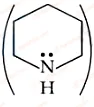
and Piperidine

page5_img3

is:

  1. A

    Pyrrole > Piperidine > Pyridine

  2. B

    Pyrrole > Pyridine > Piperidine

  3. C

    Pyridine > Piperidine > Pyrrole

  4. D

    Piperidine > Pyridine > Pyrrole
JEE MAIN 2024 · 09 APR S1Acidity and basicity of organic compounds

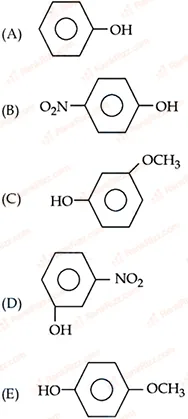
For the given compounds, the correct order of increasing pKapK_a value :

page5_img4


Choose the correct answer from the options given below :

  1. A

    (B) < (D) < (C) < (A) < (E)

  2. B

    (D) < (E) < (C) < (B) < (A)

  3. C

    (E) < (D) < (C) < (B) < (A)

  4. D

    (E) < (D) < (B) < (A) < (C)

JEE MAIN 2024 · 09 APR S1Reactive intermediates and rearrangements

Relative stability of the contributing structures is 

page6_img1
  1. A

    (I) > (II) > (III)

  2. B

    (I) > (III) > (II)

  3. C

    (II) > (I) > (III)

  4. D

    (III) > (II) > (I)

JEE MAIN 2024 · 09 APR S1Resonance and hyperconjugation


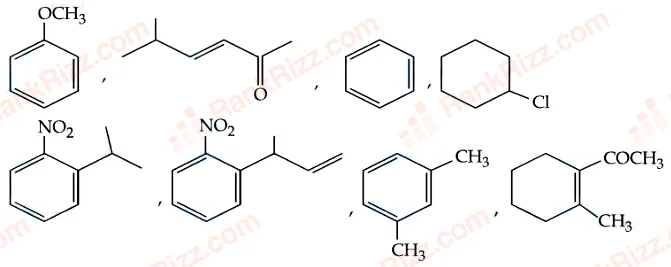
How many compounds among the following compounds show inductive, mesomeric as well as hyperconjugation effects?

page9_img5
JEE MAIN 2024 · 09 APR S2Resonance and hyperconjugation

The correct stability order of the following resonance structures of CH3−CH=CH−CHOCH_3 - CH = CH - CHO i

page6_img1
  1. A

    I>II>IIII > II > III

  2. B

    II>III>III > III > I

  3. C

    II>I>IIIII > I > III

  4. D

    III>II>IIII > II > I

JEE MAIN 2024 · 09 APR S2Structural isomerism


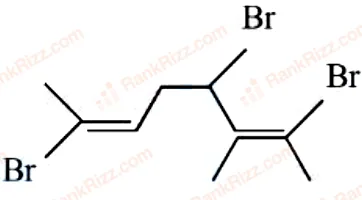
Total number of stereo isomers possible for the given structure :

page6_img2
  1. A

    2

  2. B

    4

  3. C

    3

  4. D

    8

JEE MAIN 2024 · 08 APR S1Aromaticity

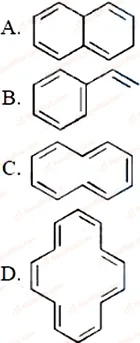
Which of the following are aromatic?

Figure for JEE Main 2024 Chemistry question on Aromaticity
  1. A

    A and C only

  2. B

    B and D only

  3. C

    C and D only

  4. D

    A and B only

JEE MAIN 2024 · 08 APR S1IUPAC nomenclature of organic compounds


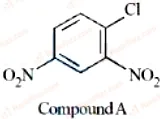
Given below are two statements:

Figure for JEE Main 2024 Chemistry question on IUPAC nomenclature of organic compounds

Statement I: IUPAC name of Compound A is 4-chloro-1,3-dinitrobenzene.

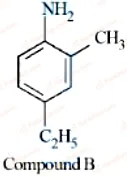
Figure for JEE Main 2024 Chemistry question on IUPAC nomenclature of organic compounds

Statement II: IUPAC name of Compound B is 4-ethyl-2-methylaniline. In the light of the above statements, choose the most appropriate answer from the options given below:

  1. A

    Both Statement I and Statement II are incorrect.

  2. B

    Both Statement I and Statement II are correct.

  3. C

    Statement I is correct but Statement II is incorrect.

  4. D

    Statement I is incorrect but Statement II is correct.

JEE MAIN 2024 · 08 APR S1Classification, functional groups and hybridisation in organic compounds

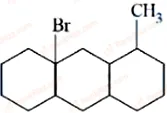
In the given compound, the number of 2°2° carbon atom/s is _______.

Figure for JEE Main 2024 Chemistry question on Classification, functional groups and hybridisation in organic compounds
  1. A

    Four

  2. B

    Two

  3. C

    One

  4. D

    Three

JEE MAIN 2024 · 08 APR S1Structural isomerism
Figure for JEE Main 2024 Chemistry question on Structural isomerism

The number of optical isomers in following compound is: ________

JEE MAIN 2024 · 08 APR S2Acidity and basicity of organic compounds

The correct sequence of acidic strength of the following aliphatic acids in their decreasing order is: CH3CH2COOHCH_3CH_2COOH, CH3COOHCH_3COOH, CH3CH2CH2COOHCH_3CH_2CH_2COOH, HCOOHHCOOH

  1. A

    CH3CH2CH2COOH>CH3CH2COOH>CH3COOH>HCOOHCH_3CH_2CH_2COOH > CH_3CH_2COOH > CH_3COOH > HCOOH

  2. B

    CH3COOH>CH3CH2COOH>CH3CH2CH2COOH>HCOOHCH_3COOH > CH_3CH_2COOH > CH_3CH_2CH_2COOH > HCOOH

  3. C

    HCOOH>CH3COOH>CH3CH2COOH>CH3CH2CH2COOHHCOOH > CH_3COOH > CH_3CH_2COOH > CH_3CH_2CH_2COOH

  4. D

    HCOOH>CH3CH2CH2COOH>CH3CH2COOH>CH3COOHHCOOH > CH_3CH_2CH_2COOH > CH_3CH_2COOH > CH_3COOH

JEE MAIN 2024 · 08 APR S2IUPAC nomenclature of organic compounds
page6_img1


IUPAC name of following hydrocarbon (X) is :

  1. A

    2-Ethyl-3,6-dimethylheptane

  2. B

    2,5,6-Trimethyloctane

    1. C

      3,4,7-Trimethyloctane

    2. D

      2-Ethyl-2,6-diethylheptane

    JEE MAIN 2024 · 08 APR S2Structural isomerism

    Total number of optically active compounds from the following is ____

    page9_img1
    JEE MAIN 2024 · 08 APR S2Aromaticity

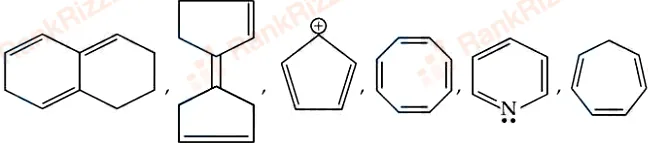
    Total number of aromatic compounds among the following compounds is _____

    page9_img2
    JEE MAIN 2024 · 06 APR S1IUPAC nomenclature of organic compounds

    Functional group present in sulphonic acids is :

    1. A

      −SO4H-SO_4H

    2. B

      −SO3H-SO_3H

    3. C
      Figure for JEE Main 2024 Chemistry question on IUPAC nomenclature of organic compounds
    4. D

      −SO2-SO_2

    JEE MAIN 2024 · 06 APR S1Structural isomerism
    Figure for JEE Main 2024 Chemistry question on Structural isomerism

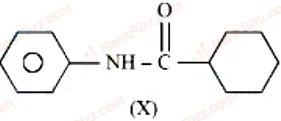
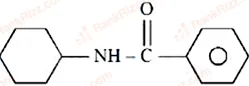
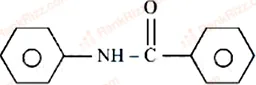
    Which of the following is metamer of the given compound (X)?

    1. A
      Figure for JEE Main 2024 Chemistry question on Structural isomerism
    2. B
      Figure for JEE Main 2024 Chemistry question on Structural isomerism
    3. C
      Figure for JEE Main 2024 Chemistry question on Structural isomerism
    4. D
      Figure for JEE Main 2024 Chemistry question on Structural isomerism
    JEE MAIN 2024 · 06 APR S2Optical isomerism and chirality

    The incorrect statement regarding the geometrical isomers of 2-butene is :

    1. A

      cis-2-butene and trans-2-butene are not interconvertible at room temperature.

    2. B

      cis-2-butene and trans-2-butene are stereoisomers.

    3. C

      cis-2-butene has less dipole moment than trans-2-butene.

    4. D

      trans-2-butene is more stable than cis-2-butene.

    JEE MAIN 2024 · 06 APR S2Reactive intermediates and rearrangements

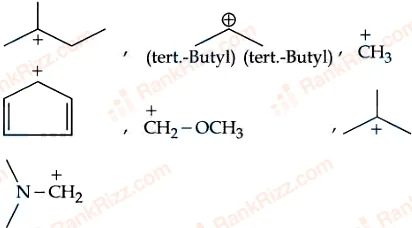
    Number of carbocations from the following that are not stabilized by hyperconjugation is __________

    Figure for JEE Main 2024 Chemistry question on Reactive intermediates and rearrangements

    _

    JEE MAIN 2024 · 05 APR S1Optical isomerism and chirality

    Given below are two statements : one is labelled as Assertion (A) and the other is labelled as Reason (R). Assertion (A) : Cis form of alkene is found to be more polar than the trans form. Reason (R) : Dipole moment of trans isomer of 2-butene is zero. In the light of the above statements, choose the correct answer from the options given below :

    1. A

      (A) is false but (R) is true

    2. B

      Both (A) and (R) are true and (R) is the correct explanation of (A)

    3. C

      (A) is true but (R) is false

    4. D

      Both (A) and (R) are true but (R) is NOT the correct explanation of (A)

    JEE MAIN 2024 · 05 APR S2Structural isomerism

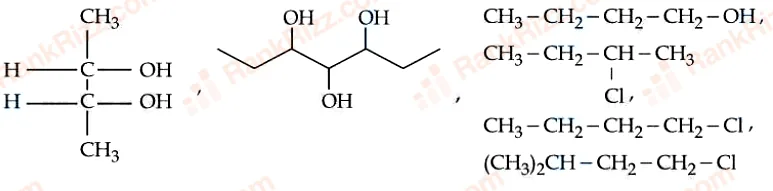
    Match List I with List II :

    Figure for JEE Main 2024 Chemistry question on Structural isomerism

    Choose the correct answer from the options given below :

    1. A

      (A)-(IV), (B)-(I), (C)-(II), (D)-(III)

    2. B

      (A)-(I), (B)-(IV), (C)-(III), (D)-(II)

    3. C

      (A)-(IV), (B)-(III), (C)-(II), (D)-(I)

    4. D

      (A)-(I), (B)-(III), (C)-(II), (D)-(IV)