RankRizz

Wave Optics — JEE Main Previous Year Questions

Every Wave Optics question JEE Main has set from 2004–2026, grouped by the idea it tests rather than the order of the syllabus. 198 questions across 6 distinct ideas. Free to read, answer key on every one.

DATA UPDATED

Questions

198

Distinct ideas

6

Share of marks

4.8%

Difficulty

MEDIUM

The ideas inside Wave Optics

A chapter is not one subject — it is a handful of procedures the examiner reuses. These are the ones Wave Optics questions actually test.

Every Wave Optics question

161–180 OF 198 · NEWEST FIRST

JEE MAIN 2015 · 11 APR ONLINEYoung's double slit experiment: fringe width and intensity

In a Young's double slit experiment with light of wavelength λ\lambda, the separation of slits is dd and distance of screen is DD such that D≫d≫λD \gg d \gg \lambda. If the Fringe width is β\beta, the distance from point of maximum intensity to the point where intensity falls to half of the maximum intensity on either side is:

  1. A

    β4\frac{\beta}{4}

  2. B

    β3\frac{\beta}{3}

  3. C

    β6\frac{\beta}{6}

  4. D

    β2\frac{\beta}{2}

JEE MAIN 2015 · 11 APR ONLINEPolarisation: Malus's law and Brewster's law

Unpolarized light of intensity I0I_0 is incident on surface of a block of glass at Brewster's angle. In that case, which one of the following statements is true?

  1. A

    transmitted light is partially polarized with intensity I02\frac{I_0}{2}

  2. B

    transmitted light is completely polarized with intensity less than I02\frac{I_0}{2}

  3. C

    reflected light is partially polarized with intensity I02\frac{I_0}{2}

  4. D

    reflected light is completely polarized with intensity less than I02\frac{I_0}{2}

JEE MAIN 2015 · 04 APR OFFLINEYoung's double slit experiment: fringe width and intensity

On a hot summer night, the refractive index of air is the smallest near the ground and increases with a height from the ground. When a light beam is directed horizontally, the Huygens' principle leads us to conclude that as it travels, the light beam,

  1. A

    bends upward.

  2. B

    becomes narrower.

  3. C

    goes horizontally without any deflection.

  4. D

    bends downward.

JEE MAIN 2015 · 04 APR OFFLINEResolving power of microscopes and telescopes

Assuming that the human pupil has a radius of 0.25 cm and a comfortable viewing distance of 25 cm. The minimum separation between two point objects that the human eye can resolve for the light of wavelength 500 nm is

  1. A

    300 μ\mum

  2. B

    1 μ\mum

  3. C

    30 μ\mum

  4. D

    100 μ\mum

JEE MAIN 2014 · 19 APR ONLINEPolarisation: Malus's law and Brewster's law

A ray of light is incident from a denser to a rarer medium. The critical angle for total internal reflection is θiC\theta_{iC} and Brewster's angle of incidence is θiB\theta_{iB}, such that sin⁡θiCsin⁡θiB=η=1.28\frac{\sin\theta_{iC}}{\sin\theta_{iB}} = \eta = 1.28. The relative refractive index of the two media is:

  1. A

    0.4

  2. B

    0.2

  3. C

    0.9

  4. D

    0.8

JEE MAIN 2014 · 19 APR ONLINESingle slit diffraction

In Young's double-slit experiment, the distance between the two identical slits is 6.1 times larger than the slit width. Then the number of intensity maxima observed within the central maximum of the single-slit diffraction pattern is:

  1. A

    3

  2. B

    6

  3. C

    24

  4. D

    12

JEE MAIN 2014 · 12 APR ONLINEYoung's double slit experiment: fringe width and intensity

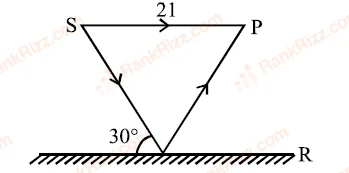
Interference pattern is observed at 'P' due to superimposition of two rays coming out from a source 'S' as shown in the figure. The value of 'l' for which maxima is obtained at 'P' is: (R is perfect reflecting surface)

Figure for JEE Main 2014 Physics question on Young's double slit experiment: fringe width and intensity
  1. A

    l=2nλ3−1l = \frac{2n\lambda}{\sqrt{3}-1}

  2. B

    l=(2n−1)λ2(3−1)l = \frac{(2n-1)\lambda}{2(\sqrt{3}-1)}

  3. C

    l=(2n−1λ)34(2−3)l = \frac{(2n-1\lambda)\sqrt{3}}{4(2-\sqrt{3})}

  4. D

    l=(2n−1)λ3−1l = \frac{(2n-1)\lambda}{\sqrt{3}-1}

JEE MAIN 2014 · 12 APR ONLINESingle slit diffraction

In an experiment of single slit diffraction pattern, first minimum for red light coincides with first maximum of some other wavelength. If wavelength of red light is 6600 A˚\text{Å}, then wavelength of first maximum will be:

  1. A

    3300 A˚\text{Å}

  2. B

    4400 A˚\text{Å}

  3. C

    5500 A˚\text{Å}

  4. D

    6600 A˚\text{Å}

JEE MAIN 2014 · 11 APR ONLINEYoung's double slit experiment: fringe width and intensity

Two monochromatic light beams of intensity 16 and 9 units are interfering. The ratio of intensities of bright and dark parts of the resultant pattern is:

  1. A

    169\frac{16}{9}

  2. B

    43\frac{4}{3}

  3. C

    71\frac{7}{1}

  4. D

    491\frac{49}{1}

JEE MAIN 2014 · 09 APR ONLINEYoung's double slit experiment: fringe width and intensity

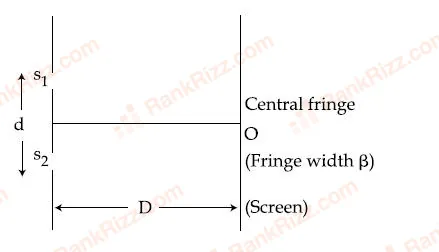
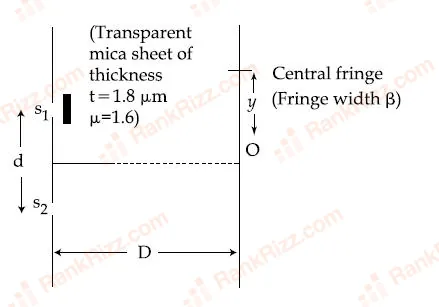
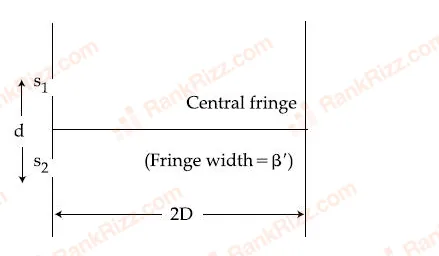
Using monochromatic light of wavelength λ\lambda, an experimentalist sets up the Young's double slit experiment in three ways as shown. If she observes that y=β′y = \beta', the wavelength of light used is:

Figure for JEE Main 2014 Physics question on Young's double slit experiment: fringe width and intensity Figure for JEE Main 2014 Physics question on Young's double slit experiment: fringe width and intensity Figure for JEE Main 2014 Physics question on Young's double slit experiment: fringe width and intensity
  1. A

    520 nm

  2. B

    580 nm

  3. C

    540 nm

  4. D

    560 nm

JEE MAIN 2014 · 06 APR OFFLINEPolarisation: Malus's law and Brewster's law

Two beams, A and B of plane polarized light with mutually perpendicular planes of polarization are seen through a polaroid. From the position when the beam A has maximum intensity (and beam B has zero intensity), a rotation of polaroid through 30° makes the two beams appear equally bright. If the initial intensities of the two beams are IAI_A and IBI_B respectively, then IAIB\frac{I_A}{I_B} equals:

  1. A

    3

  2. B

    32\frac{3}{2}

  3. C

    1

  4. D

    13\frac{1}{3}

JEE MAIN 2013 · 25 APR ONLINEYoung's double slit experiment: fringe width and intensity

A thin glass plate of thickness 25003λ\frac{2500}{3}\lambda (λ\lambda is wavelength of light used) and refractive index μ=1.5\mu = 1.5 is inserted between one of the slits and the screen in Young's double slit experiment. At a point on the screen equidistant from the slits, the ratio of the intensities before and after the introduction of the glass plate is :

  1. A

    2 : 1

  2. B

    1 : 4

  3. C

    4 : 1

  4. D

    4 : 3

JEE MAIN 2013 · 25 APR ONLINEYoung's double slit experiment: fringe width and intensity

The source that illuminates the double-slit in 'double-slit interference experiment' emits two distinct monochromatic waves of wavelength 500 nm and 600 nm, each of them producing its own pattern on the screen. At the central point of the pattern when path difference is zero, maxima of both the patterns coincide and the resulting interference pattern is most distinct at the region of zero path difference. But as one moves out of this central region, the two fringe systems are gradually out of step such that maximum due to one wavelength coincides with the minimum due to the other and the combined fringe system becomes completely indistinct. This may happen when path difference in nm is:

  1. A

    2000

  2. B

    3000

  3. C

    1000

  4. D

    1500

JEE MAIN 2013 · 23 APR ONLINEYoung's double slit experiment: fringe width and intensity

nn identical waves each of intensity I0I_0 interfere with each other. The ratio of maximum intensities if the interference is (i) coherent and (ii) incoherent is :

  1. A

    n2n^2

  2. B

    1n\frac{1}{n}

  3. C

    1n2\frac{1}{n^2}

  4. D

    nn

JEE MAIN 2013 · 22 APR ONLINEYoung's double slit experiment: fringe width and intensity

This question has Statement-1 and Statement-2. Of the four choices given after the Statements, choose the one that best describes the two Statements.
Statement-1: In Young's double slit experiment, the number of fringes observed in the field of view is small with longer wavelength of light and is large with shorter wavelength of light.
Statement-2: In the double slit experiment the fringe width depends directly on the wavelength of light.

  1. A

    Statement-1 is true, Statement-2 is true and the Statement-2 is correct explanation of the Statement-1.

  2. B

    Statement-1 is false and the Statement-2 is true.

  3. C

    Statement-1 is true Statement-2 is true and the Statement-2 is not correct explanation of the Statement-1.

  4. D

    Statement-1 is true and the Statement-2 is false.

JEE MAIN 2013 · 09 APR ONLINEYoung's double slit experiment: fringe width and intensity

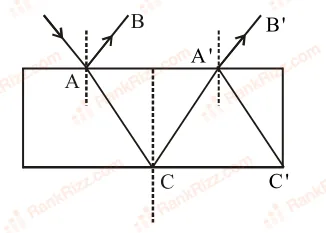
A ray of light of intensity I is incident on a parallel glass slab at point A as shown in the diagram. It undergoes partial reflection and refraction. At each reflection, 25% of incident energy is reflected. The rays AB and A'B' undergo interference. The ratio of ImaxI_{max} and IminI_{min} is :

Figure for JEE Main 2013 Physics question on Young's double slit experiment: fringe width and intensity
  1. A

    49 : 1

  2. B

    7 : 1

  3. C

    4 : 1

  4. D

    8 : 1

JEE MAIN 2013 · 09 APR ONLINEPolarisation: Malus's law and Brewster's law

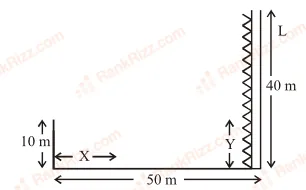
A person lives in a high-rise building on the bank of a river 50 m wide. Across the river is a well lit tower of height 40 m. When the person, who is at a height of 10 m, looks through a polarizer at an appropriate angle at light of the tower reflecting from the river surface, he notes that intensity of light coming from distance X from his building is the least and this corresponds to the light coming from light bulbs at height 'Y' on the tower. The values of X and Y are respectively close to (refractive index of water ∼43\sim \frac{4}{3})

Figure for JEE Main 2013 Physics question on Polarisation: Malus's law and Brewster's law
  1. A

    25 m, 10 m

  2. B

    13 m, 27 m

  3. C

    22 m, 13 m

  4. D

    17 m, 20 m

JEE MAIN 2013 · 07 APR ONLINEPolarisation: Malus's law and Brewster's law

A beam of unpolarised light of intensity I0I_0 is passed through a polaroid A and then through another polaroid B which is oriented so that its principle plane makes an angle of 45° relative to that of A. The intensity of the emergent light is:

  1. A

    I04\frac{I_0}{4}

  2. B

    I08\frac{I_0}{8}

  3. C

    I0I_0

  4. D

    I02\frac{I_0}{2}

JEE MAIN 2013 · 07 APR ONLINEYoung's double slit experiment: fringe width and intensity

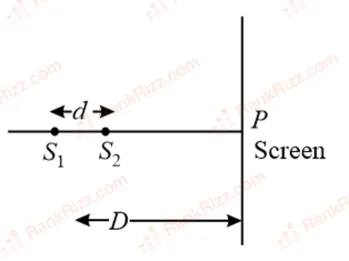
Two coherent point sources S1S_1 and S2S_2 are separated by a small distance dd as shown in the figure. The fringes obtained on the screen will be

Figure for JEE Main 2013 Physics question on Young's double slit experiment: fringe width and intensity
  1. A

    semi-circles

  2. B

    concentric circles

  3. C

    points

  4. D

    straight lines

JEE MAIN 2012Young's double slit experiment: fringe width and intensity

In Young's double slit experiment, one of the slit is wider than other, so that the amplitude of the light from one slit is double of that from other slit. If ImI_m be the maximum intensity, the resultant intensity II when they interfere at phase difference ϕ\phi is given by

  1. A

    Im9(4+5cos⁡ϕ)\frac{I_m}{9}(4 + 5\cos\phi)

  2. B

    Im3(1+2cos⁡2ϕ2)\frac{I_m}{3}\left(1 + 2\cos^2\frac{\phi}{2}\right)

  3. C

    Im5(1+4cos⁡2ϕ2)\frac{I_m}{5}\left(1 + 4\cos^2\frac{\phi}{2}\right)

  4. D

    Im9(1+8cos⁡2ϕ2)\frac{I_m}{9}\left(1 + 8\cos^2\frac{\phi}{2}\right)