JEE MAIN 2019 · 08 APR S1Wavefronts and Huygens' principle
In an interference experiment the ratio of amplitudes of coherent waves is . The ratio of maximum and minimum intensities of fringes will be:
- A
4
- B
9
- C
2
- D
18
Every Wave Optics question JEE Main has set from 2004–2026, grouped by the idea it tests rather than the order of the syllabus. 198 questions across 6 distinct ideas. Free to read, answer key on every one.
DATA UPDATED
Questions
198
Distinct ideas
6
Share of marks
4.8%
Difficulty
MEDIUM
A chapter is not one subject — it is a handful of procedures the examiner reuses. These are the ones Wave Optics questions actually test.
141–160 OF 198 · NEWEST FIRST
In an interference experiment the ratio of amplitudes of coherent waves is . The ratio of maximum and minimum intensities of fringes will be:
4
9
2
18
Calculate the limit of resolution of a telescope objective having a diameter of 200 cm, if it has to detect light of wavelength 500 nm coming from a star.
radian
radian
radian
radian
In a Young's double slit experiment, the path difference, at a certain point on the screen, between two interfering waves is th of wavelength. The ratio of the intensity at this point to that at the centre of a bright fringe is close to:
0.74
0.85
0.94
0.8
In a double-slit experiment, green light (5303 Å) falls on a double slit having a separation of and a width of . The number of bright fringes between the first and the second diffraction minima is
10
5
4
9
In a Young's double slit experiment slit separation 0.1 mm, one observes a bright fringe at angle rad by using light of wavelength . When the light of wavelength is used a bright fringe is seen at the same angle in the same set up. Given that and are in visible range (380 nm to 740 nm), their values are:
400 nm, 500 nm
380 nm, 525 nm
625 nm, 500 nm
380 nm, 500 nm
Consider a Young's double slit experiment as shown in figure. What should be the slit separation in terms of wavelength such that the first minima occurs directly in front of the slit ()?
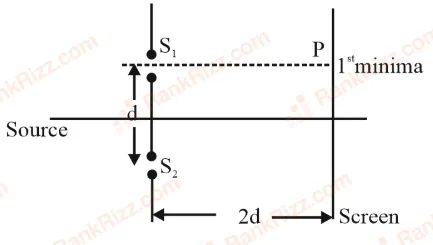
Two coherent sources produce waves of different intensities which interfere. After interference, the ratio of the maximum intensity to the minimum intensity is 16. The intensity of the waves are in the ratio:
25 : 9
16 : 9
5 : 3
4 : 1
Consider a tank made of glass (refractive index 1.5) with a thick bottom. It is filled with a liquid of refractive index . A student finds that, irrespective of what the incident angle (see figure) is for a beam of light entering the liquid, the light reflected from the liquid glass interface is never completely polarized. For this to happen, the minimum value of is:
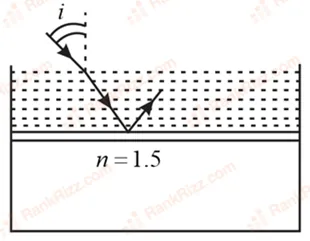
In a young's double slit experiment, the slits are placed 0.320 mm apart. Light of wavelength nm is incident on the slits. The total number of bright fringes that are observed in the angular range is:
321
641
320
640
Unpolarized light of intensity I is incident on a system of two polarizers, A followed by B. The intensity of emergent light is . If a third polarizer C is placed between A and B, the intensity of emergent light is reduced to . The angle between the polarizers A and C is , then:
Light of wavelength 550 nm falls normally on a slit of width cm. The angular position of the second minima from the central maximum will be (in radians):
A plane polarized light is incident on a polariser with its pass axis making angle with x-axis, as shown in the figure. At four different values of , = 8, 38, 188 and 218, the observed intensities are same. What is the angle between the direction of polarization and x-axis?
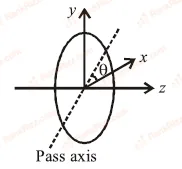
203
45
98
128
Unpolarized light of intensity I passes through an ideal polariser A. Another identical polariser B is placed behind A. The intensity of light beyond B is found to be . Now another identical polariser C is placed between A and B. The intensity beyond B is now found to be . The angle between polariser A and C is:
60
0
30
45
The angular width of the central maximum in a single slit diffraction pattern is 60. The width of the slit is 1 m. The slit is illuminated by monochromatic plane waves. If another slit of the same width is made near it, Young's fringes can be observed on a screen placed at a distance 50 cm from the slits. If the observed fringe width is 1 cm, what is slit separation distance? (i.e., the distance between the centres of each slit.)
100 m
25 m
50 m
75 m
A single slit of width 0.1 mm is illuminated by a parallel beam of light of wavelength 6000 Å and diffraction bands are observed on a screen 0.5 m from the slit. The distance of the third dark band from the central bright band is:
9 mm
3 mm
4.5 mm
1.5 mm
A single slit of width is illuminated by a coherent monochromatic light of wavelength . If the second and fourth minima in the diffraction pattern at a distance 1 cm from the slit are at 3 cm and 6 cm respectively from the central maximum, what is the width of the central maximum? (i.e. distance between first minimum on either side of the central maximum)
4.5 cm
1.5 cm
6.0 cm
3.0 cm
In a Young's double slit experiment, slits are separated by 0.5 mm, and the screen is placed 150 cm away. A beam of light consisting of two wavelengths, 650 nm and 520 nm, is used to obtain interference fringes on the screen. The least distance from the common central maximum to the point where the bright fringes due to both the wavelengths coincide is:
15.6 mm
1.56 mm
7.8 mm
9.75 mm
Two stars are 10 light years away from the earth. They are seen through a telescope of objective diameter 30 cm. The wavelength of light is 600 nm. To see the stars just resolved by the telescope, the minimum distance between them should be (1 light year = m) of the order of:
km
km
km
km
In Young's double-slit experiment, the distance between slits and the screen is 1 m and monochromatic light of wavelength 600 nm is being used. A person standing near the slits is looking at the fringe pattern. When the separation between the slits is varied, the interference pattern disappears for a particular distance between the slits. If the angular resolution of the eye is , then the value of is close to
1 mm
3 mm
2 mm
4 mm
The box of a pin hole camera, of length L, has a hole of radius a. It is assumed that when the hole is illuminated by a parallel beam of light of wavelength the spread of the spot (obtained on the opposite wall of the camera) is the sum of its geometrical spread and the spread due to diffraction. The spot would then have its minimum size (say ) when:
and
and
and
and
JEE Advanced has set 21 Wave Optics questions too. Wave Optics JEE Advanced PYQs →
OTHER PHYSICS CHAPTERS