RankRizz

Wave Optics — JEE Main Previous Year Questions

Every Wave Optics question JEE Main has set from 2004–2026, grouped by the idea it tests rather than the order of the syllabus. 198 questions across 6 distinct ideas. Free to read, answer key on every one.

DATA UPDATED

Questions

198

Distinct ideas

6

Share of marks

4.8%

Difficulty

MEDIUM

The ideas inside Wave Optics

A chapter is not one subject — it is a handful of procedures the examiner reuses. These are the ones Wave Optics questions actually test.

Every Wave Optics question

181–198 OF 198 · NEWEST FIRST

JEE MAIN 2012YDSE with slabs, white light and modified setups

In a Young's double slit experiment with light of wavelength λ\lambda, fringe pattern on the screen has fringe width β\beta. When two thin transparent glass (refractive index μ\mu) plates of thickness t1t_1 and t2t_2 (t1>t2t_1 > t_2) are placed in the path of the two beams respectively, the fringe pattern will shift by a distance

  1. A

    β(μ−1)λ(t1t2)\dfrac{\beta(\mu-1)}{\lambda}\left(\dfrac{t_1}{t_2}\right)

  2. B

    μβλt1t2\dfrac{\mu \beta}{\lambda}\dfrac{t_1}{t_2}

  3. C

    β(μ−1)λ(t1−t2)\dfrac{\beta(\mu-1)}{\lambda}(t_1 - t_2)

  4. D

    (μ−1λβ)(t1+t2)\left(\mu - 1\dfrac{\lambda}{\beta}\right)(t_1 + t_2)

JEE MAIN 2012Polarisation: Malus's law and Brewster's law

Two polaroids have their polarizing directions parallel so that the intensity of a transmitted light is maximum. The angle through which either polaroid must be turned if the intensity is to drop by one-half is

  1. A

    135∘135^\circ

  2. B

    90∘90^\circ

  3. C

    120∘120^\circ

  4. D

    180∘180^\circ

JEE MAIN 2012Resolving power of microscopes and telescopes

A telescope of aperture 3×10⁻²³ \times 10^{-2} m diameter is focused on a window at 80 m distance fitted with a wire mesh of spacing 2×10⁻³² \times 10^{-3} m. Given: λ=5.5×10⁻⁷\lambda = 5.5 \times 10^{-7} m, which of the following is true for observing the mesh through the telescope?

  1. A

    Yes, it is possible with the same aperture size.

  2. B

    Possible also with an aperture half the present diameter.

  3. C

    No, it is not possible.

  4. D

    Given data is not sufficient.

JEE MAIN 2012Young's double slit experiment: fringe width and intensity

In Young's double slit interference experiment, the slit widths are in the ratio 1:251 : 25. Then the ratio of intensity at the maxima and minima in the interference pattern is

  1. A

    3:23 : 2

  2. B

    1:251 : 25

  3. C

    9:49 : 4

  4. D

    1:51 : 5

JEE MAIN 2012Young's double slit experiment: fringe width and intensity

In Young's double slit experiment, the two slits act as coherent sources of equal amplitude A and wavelength λ\lambda . In another experiment with the same setup the two slits are sources of equal amplitude A and wavelength λ\lambda but are incoherent. The ratio of the intensity of light at the midpoint of the screen in the first case to that in the second case is

  1. A

    1:1

  2. B

    2:1

  3. C

    4:1

  4. D

    1:4

JEE MAIN 2012Single slit diffraction

The first diffraction minimum due to the single slit diffraction is seen at θ=30°\theta = 30° for a light of wavelength 5000A˚5000\text{\AA} falling perpendicularly on the slit. The width of the slit is

  1. A

    2.5×10−52.5\times 10^{-5} cm

  2. B

    1.25×10−51.25\times 10^{-5} cm

  3. C

    10×10−510\times 10^{-5} cm

  4. D

    5×10−55\times 10^{-5} cm

JEE MAIN 2012Young's double slit experiment: fringe width and intensity

The maximum number of possible interference maxima for slit separation equal to 1.8λ1.8\lambda, where λ\lambda is the wavelength of light used, in a Young's double slit experiment is

  1. A

    zero

  2. B

    33

  3. C

    infinite

  4. D

    55

JEE MAIN 2011Young's double slit experiment: fringe width and intensity

Direction: The question has a paragraph followed by two statements, Statement-1 and Statement-2. Of the given four alternatives after the statements, choose the one that describes the statements. A thin air film is formed by putting the convex surface of a plane-convex lens over a plane glass plate. With monochromatic light, this film gives an interference pattern due to light reflected from the top (convex) surface and the bottom (glass plate) surface of the film. Statement-1: When light reflects from the air-glass plate interface, the reflected wave suffers a phase change of π\pi. Statement-2: The centre of the interference pattern is dark.

  1. A

    Statement-1 is true, Statement-2 is true; Statement-2 is the correct explanation of Statement-1.

  2. B

    Statement-1 is true, Statement-2 is true; Statement-2 is not the correct explanation of Statement-1.

  3. C

    Statement-1 is false. Statement-2 is true.

  4. D

    Statement-1 is true, Statement-2 is false.

JEE MAIN 2010Wavefronts and Huygens' principle

An initially parallel cylindrical beam travels in a medium of refractive index μ(I)=μ0+μ2I\mu(I) = \mu_0 + \mu_2 I, where μ0\mu_0 and μ2\mu_2 are positive constants and II is the intensity of the light beam. The intensity of the beam is decreasing with increasing radius. The initial shape of the wave front of the beam is

  1. A

    convex

  2. B

    concave

  3. C

    convex near the axis and concave near the periphery

  4. D

    planar

JEE MAIN 2009Young's double slit experiment: fringe width and intensity

A mixture of light, consisting of wavelength 590590 nm and an unknown wavelength, illuminates Young's double slit and gives rise to two overlapping interference patterns on the screen. The central maximum of both lights coincide. Further, it is observed that the third bright fringe of known light coincides with the 4th4^{th} bright fringe of the unknown light. From this data, the wavelength of the unknown light is

  1. A

    393.4393.4 nm

  2. B

    885.0885.0 nm

  3. C

    442.5442.5 nm

  4. D

    776.8776.8 nm

JEE MAIN 2008Single slit diffraction

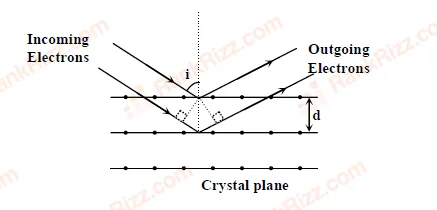
Paragraph: Wave property of electrons implies that they will show diffraction effects. Davisson and Germer demonstrated this by diffracting electrons from crystals. The law governing the diffraction from a crystal is obtained by requiring that electron waves reflected from the planes of atoms in a crystal interfere constructively (see in figure).Figure for JEE Main 2008 Physics question on Single slit diffraction
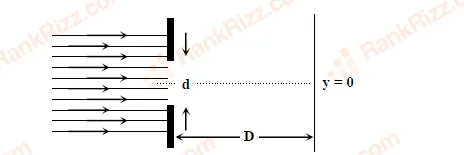
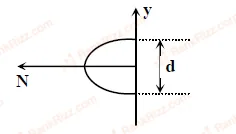
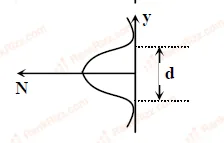
Question: In an experiment, electrons are made to pass through a narrow slit of width 'dd' comparable to their de Broglie wavelength. They are detected on a screen at a distance 'DD' from the slit (see figure).Figure for JEE Main 2008 Physics question on Single slit diffraction
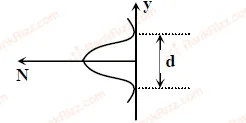
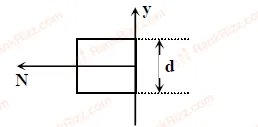
Which of the following graph can be expected to represent the number of electrons 'NN' detected as a function of the detector position 'yy' (y=0y = 0 corresponds to the middle of the slit)?

  1. A
    Figure for JEE Main 2008 Physics question on Single slit diffraction
  2. B
    Figure for JEE Main 2008 Physics question on Single slit diffraction
  3. C
    Figure for JEE Main 2008 Physics question on Single slit diffraction
  4. D
    Figure for JEE Main 2008 Physics question on Single slit diffraction
JEE MAIN 2007Young's double slit experiment: fringe width and intensity

In a Young's double slit experiment the intensity at a point where the path difference is λ6\frac{\lambda}{6} (λ\lambda being the wavelength of the light used) is II. If I0I_0 denotes the maximum intensity, II0\frac{I}{I_0} is equal to

  1. A

    12\frac{1}{\sqrt{2}}

  2. B

    32\frac{\sqrt{3}}{2}

  3. C

    1/21/2

  4. D

    3/43/4

JEE MAIN 2005Young's double slit experiment: fringe width and intensity

A Young's double slit experiment uses a monochromatic source. The shape of the interference fringes formed on a screen is

  1. A

    hyperbola

  2. B

    circle

  3. C

    straight line

  4. D

    parabola

JEE MAIN 2005Resolving power of microscopes and telescopes

Two point white dots are 11 mm apart on a black paper. They are viewed by eye of pupil diameter 33 mm. Approximately, what is the maximum distance at which these dots can be resolved by the eye? [Take wavelength of light =500= 500 nm]

  1. A

    55 m

  2. B

    11 m

  3. C

    66 m

  4. D

    33 m

JEE MAIN 2005Polarisation: Malus's law and Brewster's law

When an unpolarized light of intensity I0I_0 is incident on a polarizing sheet, the intensity of the light which does not get transmitted is

  1. A

    12I0\frac{1}{2} I_0

  2. B

    14I0\frac{1}{4} I_0

  3. C

    zero

  4. D

    I0I_0

JEE MAIN 2005Single slit diffraction

If I0I_0 is the intensity of the principal maximum in the single slit diffraction pattern, then what will be its intensity when the slit width is doubled?

  1. A

    2I02 I_0

  2. B

    4I04 I_0

  3. C

    I0I_0

  4. D

    I0/2I_0/2

JEE MAIN 2004Polarisation: Malus's law and Brewster's law

The angle of incidence at which reflected light totally polarized for reflection from air to glass (refractive index nn), is

  1. A

    sin⁡−1(n)\sin^{-1}(n)

  2. B

    sin⁡−1(1/n)\sin^{-1}(1/n)

  3. C

    tan⁡−1(1/n)\tan^{-1}(1/n)

  4. D

    tan⁡−1(n)\tan^{-1}(n)

JEE MAIN 2004Young's double slit experiment: fringe width and intensity

The maximum number of possible interference maxima for slit-separation equal to twice the wavelength in Young's double-slit experiment is

  1. A

    infinite

  2. B

    five

  3. C

    three

  4. D

    zero