RankRizz

Young's double slit experiment: fringe width and intensity — JEE Main Previous Year Questions

Young's double slit experiment: fringe width and intensity has been asked 68 times in JEE Main, in 19 different years between 2004 and 2026, and in all of the last five exam years (2022–2026), 37 questions in all. That is 34% of Wave Optics, its most-asked topic. Last asked in JEE Main 06 Apr 2026, Shift 2. 51 are multiple choice and 17 numerical-value; 22 easy, 36 medium and 1 hard by our difficulty labels. All of them are below, newest first, free to read.

Questions

68

Years asked

19

Since

2004

Of the chapter

34%

When JEE Main asked it

Questions on Young's double slit experiment: fringe width and intensity in every year it was asked, newest first.

JEE Main questions on Young's double slit experiment: fringe width and intensity by year, 2004–2026
YearRelative frequencyQuestions
20269
202511
20243
202311
20223
20213
20202
20194
20171
20161
20152
20143
20136
20124
20111
20091
20071
20051
20041
Total68

Every Young's double slit experiment: fringe width and intensity question

1–20 OF 68 · NEWEST FIRST

JEE MAIN 2026 · 06 APR S1Young's double slit experiment: fringe width and intensity

In interference experiment the path difference between two interfering waves at a point AA on the screen is λ/3\lambda/3, where λ\lambda is the wavelength of these waves, and at another point BB the path difference is λ/6\lambda/6. The ratio of intensities at points AA and BB is _______.

  1. A

    3

  2. B

    4

  3. C

    1/3

  4. D

    1/4

JEE MAIN 2026 · 06 APR S2Young's double slit experiment: fringe width and intensity

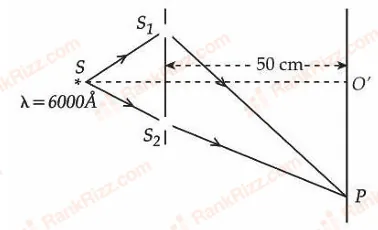
In a Young double slit experiment, the wavelength of incident light is 6000 Å. The separation between slits S1S_1 and S2S_2 is 5 cm and the distance between slits plane and screen is 50 cm, as shown in the figure below. If the resultant intensity at P is equal to the intensity due to individual slits, the path difference between interfering waves is __________ Å.

Figure for JEE Main 2026 Physics question on Young's double slit experiment: fringe width and intensity
  1. A

    4000

  2. B

    3000

  3. C

    2000

  4. D

    1000

JEE MAIN 2026 · 05 APR S1Young's double slit experiment: fringe width and intensity

In Young's double slit experiment, the fringe width of the interference pattern produced on the screen is 2.4 μ\mum. If the experiment is carried out in another medium having refractive index 1.2, the fringe width will be _______ μ\mum.

  1. A

    1.21.2 

  2. B

    22 

  3. C

    2.42.4

  4. D

    2.882.88

JEE MAIN 2026 · 05 APR S2Young's double slit experiment: fringe width and intensity

The maximum intensity in a Young's double slit experiment is I0I_0, distance between the slits (d) is  5λ5\lambda, where λ\lambda is the wavelength of light used. The intensity of the fringe, exactly opposite to one of the slits on the screen, placed at D=10dD = 10d is_________.

  1. A

    I04\frac{I_0}{4}

  2. B

    I02\frac{I_0}{2}

  3. C

    I0I_0

  4. D

    3I04\frac{3I_0}{4}

JEE MAIN 2026 · 04 APR S2Young's double slit experiment: fringe width and intensity

In a double slit experiment, when one of the slits is covered by a transparent mica sheet of refractive index 1.56, the central fringe shifts to the position of 7th^{th} bright fringe, obtained with both slits uncovered. If the light source wavelength is 450 nm, the thickness of mica sheet is α×10−9\alpha \times 10^{-9} m. The value of α\alpha is ______.

JEE MAIN 2026 · 28 JAN S2Young's double slit experiment: fringe width and intensity

A beam of light consisting of wavelengths 650 nm and 550 nm illuminates the Young's double slits with separation of 2 mm such that the interference fringes are formed on a screen, placed at a distance of 1.2 m from the slits. The least distance of a point from the central maximum, where the bright fringes due to both the wavelengths coincide, is______×10−5\times10^{-5}m

JEE MAIN 2026 · 23 JAN S1Young's double slit experiment: fringe width and intensity

In two separate Young's double-slit experimental set-ups and two monochromatic light sources of different wavelengths are used to get fringes of equal width. the ratios of the slits separations and that of the wavelengths of light used are 2: 1 and 1 : 2 respectively. The corresponding ratio of the distances between the slits and the respective screens (D1/D2)(D_{1}/D_{2}) is ______.

JEE MAIN 2026 · 21 JAN S1Young's double slit experiment: fringe width and intensity

In a double slit experiment the distance between the slits is 0.1 cm and the screen is placed at 50 cm from the slits plane. When one slit is covered with a transparent sheet having thickness t and refractive index n(=1.5), the central fringe shifts by 0.2 cm. The value of t is____ cm

  1. A

    5.6×10−45.6\times10^{-4}

  2. B

    6.0×10−36.0\times10^{-3}

  3. C

    8×10−48\times10^{-4}

  4. D

    5.0×10−35.0\times10^{-3}

JEE MAIN 2026 · 21 JAN S2Young's double slit experiment: fringe width and intensity

In a Young's double slit experiment set up, the two slits are kept 0.4. mm apart and screen is placed at 1 m from slits. If a thin transparent sheet of thickness 20μm20\mu m is introduced in front of one of the slits then center bright fringe shifts by 20 mm on the screen. The refractive index of transparent sheet is given by α10\frac{\alpha}{10}, where α\alpha is __________.

JEE MAIN 2025 · 08 APR S2Young's double slit experiment: fringe width and intensity

In a Young's double slit experiment, the source is white light. One of the slits is covered by red filter and another by a green filter. In this case

  1. A

    There shall be an interference pattern for red distinct from that for green.

  2. B

    There shall be no interference fringes.

  3. C

    There shall be alternate interference fringes of red and green.

  4. D

    There shall be an interference pattern, where each fringe's pattern center is green and outer edges is red.

JEE MAIN 2025 · 07 APR S1Young's double slit experiment: fringe width and intensity

Two plane polarized light waves combine at a certain point whose electric field components are E1=E0sin⁡ωtE_1 = E_0 \sin \omega t and E2=E0sin⁡(ωt+π3)E_2 = E_0 \sin(\omega t + \frac{\pi}{3}). Find the amplitude of the resultant wave.

  1. A

    0.9 E

  2. B

    E0E_0

  3. C

    1.7 E0E_0

  4. D

    3.4 E0E_0

JEE MAIN 2025 · 04 APR S1Young's double slit experiment: fringe width and intensity

In a Young's double slit experiment, the slits are separated by 0.2 mm. If the slits separation is increased to 0.4 mm, the percentage change of the fringe width is:

  1. A

    0%

  2. B

    100%

  3. C

    50%

  4. D

    25%

JEE MAIN 2025 · 04 APR S2Young's double slit experiment: fringe width and intensity

In a Young's double slit experiment, two slits are located 1.5 mm apart. The distance of screen from slits is 2 m and the wavelength of the source is 400 nm. If the 20 maxima of the double slit pattern are contained within the centre maximum of the single slit diffraction pattern, then the width of each slit is x×10−3x \times 10^{-3} cm, where x-value is ______.

JEE MAIN 2025 · 03 APR S1Young's double slit experiment: fringe width and intensity

Two coherent monochromatic light beams of intensities 4I4I and 9I9Iare superimposed. The difference between the maximum and minimum intensities in the resulting interference pattern is xIxI. The value of x is __________.

JEE MAIN 2025 · 03 APR S2Young's double slit experiment: fringe width and intensity

Width of one of the two slits in a Young's double slit interference experiment is half of the other slit. The ratio of the maximum to the minimum intensity in the interference pattern is:

  1. A

    (22+1):(22−1)(2\sqrt{2} + 1) : (2\sqrt{2} - 1)

  2. B

    (3+22):(3−22)(3 + 2\sqrt{2}) : (3 - 2\sqrt{2})

  3. C

    9:19 : 1

  4. D

    3:13 : 1

JEE MAIN 2025 · 03 APR S2Young's double slit experiment: fringe width and intensity

Two monochromatic light beams have intensities in the ratio 1:9. An interference pattern is obtained by these beams. The ratio of the intensities of the maximum to minimum is

  1. A

    8 : 1

  2. B

    9 : 1

  3. C

    3 : 1

  4. D

    4 : 1

JEE MAIN 2025 · 02 APR S1Young's double slit experiment: fringe width and intensity

A light wave is propagating with plane wave fronts of the type x+y+zx + y + z = constant. The angle made by the direction of wave propagation with the x-axis is:

  1. A

    cos⁡−1(13)\cos^{-1}\left(\frac{1}{\sqrt{3}}\right)

  2. B

    cos⁡−1(23)\cos^{-1}\left(\frac{2}{3}\right)

  3. C

    cos⁡−1(13)\cos^{-1}\left(\frac{1}{3}\right)

  4. D

    cos⁡−1(23)\cos^{-1}\left(\sqrt{\frac{2}{3}}\right)

JEE MAIN 2025 · 28 JAN S1Young's double slit experiment: fringe width and intensity

A double slit interference experiment performed with a light of wavelength 600 nm forms an interference fringe pattern on a screen with 10 th bright fringe having its centre at a distance of 10 mm from the central maximum. Distance of the centre of the same 10th bright fringe from the central maximum when the source of light is replaced by another source of wavelength 660 nm would be _________ mm .

JEE MAIN 2025 · 28 JAN S2Young's double slit experiment: fringe width and intensity

A thin transparent film with refractive index 1.4 , is held on circular ring of radius 1.8 cm . The fluid in the film evaporates such that transmission through the film at wavelength 560 nm goes to a minimum every 12 seconds. Assuming that the film is flat on its two sides, the rate of evaporation is ____π×10−13m3/s\pi \times 10^{-13}m^{3}/s.

JEE MAIN 2025 · 24 JAN S1Young's double slit experiment: fringe width and intensity

The Young's double slit interference experiment is performed using light  consisting of  480 nm480\,nm and  600 nm600\,nm wavelengths. The least number of the bright fringes of  480 nm480\,nm  light that are  required for the first coincidence with the bright fringes formed by  600 nm600\,nm light is:

  1. A

    5

  2. B

    4

  3. C

    6

  4. D

    8

Young's double slit experiment: fringe width and intensity: common questions

How many Young's double slit experiment questions have come in JEE Main?
Young's double slit experiment has been asked 68 times in JEE Main, in 19 different years between 2004 and 2026. It came up in all of the last five exam years (2022–2026), 37 questions in all.
Is Young's double slit experiment important for JEE Main?
It is the most-asked topic in Wave Optics: 68 of the chapter's 198 JEE Main questions (34%). It came up in all of the last five exam years (2022–2026), 37 questions in all.
When was Young's double slit experiment last asked in JEE Main?
Most recently in JEE Main 06 Apr 2026, Shift 2. Questions on this page are newest first, so the latest ones are at the top.
What kind of Young's double slit experiment questions does JEE Main ask?
51 are multiple choice and 17 numerical-value; 22 easy, 36 medium and 1 hard by our difficulty labels. Each question shows its answer key and worked solution where we have them.