Wave Optics JEE Main PYQs with answer key
PHYSICS · 198 PAST QUESTIONS · 6 TOPICS · 2004–2026
HOW TO USE THIS SHEET
Every JEE Main Wave Optics question we hold, grouped by topic, most-asked topic first and newest first inside each. The answer key is at the end (197 of 198 questions have a checked key); the worked solution is on each question’s page, printed beside it.
Young's double slit experiment: fringe width and intensity 68
In interference experiment the path difference between two interfering waves at a point on the screen is , where is the wavelength of these waves, and at another point the path difference is . The ratio of intensities at points and is _______.
- (A)
3
- (B)
4
- (C)
1/3
- (D)
1/4
rr2.rankrizz.com/jee-main/physics/wave-optics/q/6-apr-2026-s1-q36
- (A)
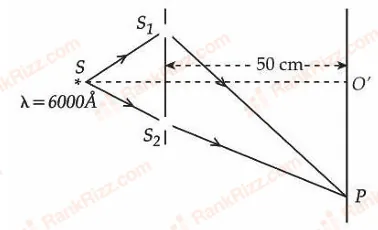
In a Young double slit experiment, the wavelength of incident light is 6000 Å. The separation between slits and is 5 cm and the distance between slits plane and screen is 50 cm, as shown in the figure below. If the resultant intensity at P is equal to the intensity due to individual slits, the path difference between interfering waves is __________ Å.
- (A)
4000
- (B)
3000
- (C)
2000
- (D)
1000
rr2.rankrizz.com/jee-main/physics/wave-optics/q/6-apr-2026-s2-q45
- (A)
In Young's double slit experiment, the fringe width of the interference pattern produced on the screen is 2.4 m. If the experiment is carried out in another medium having refractive index 1.2, the fringe width will be _______ m.
- (A)
- (B)
- (C)
- (D)
rr2.rankrizz.com/jee-main/physics/wave-optics/q/5-apr-2026-s1-q39
- (A)
The maximum intensity in a Young's double slit experiment is , distance between the slits (d) is , where is the wavelength of light used. The intensity of the fringe, exactly opposite to one of the slits on the screen, placed at is_________.
- (A)
- (B)
- (C)
- (D)
rr2.rankrizz.com/jee-main/physics/wave-optics/q/5-apr-2026-s2-q42
- (A)
In a double slit experiment, when one of the slits is covered by a transparent mica sheet of refractive index 1.56, the central fringe shifts to the position of 7 bright fringe, obtained with both slits uncovered. If the light source wavelength is 450 nm, the thickness of mica sheet is m. The value of is ______.
Answer: ____________
rr2.rankrizz.com/jee-main/physics/wave-optics/q/4-apr-2026-s2-q50
A beam of light consisting of wavelengths 650 nm and 550 nm illuminates the Young's double slits with separation of 2 mm such that the interference fringes are formed on a screen, placed at a distance of 1.2 m from the slits. The least distance of a point from the central maximum, where the bright fringes due to both the wavelengths coincide, is______m
Answer: ____________
rr2.rankrizz.com/jee-main/physics/wave-optics/q/28-jan-2026-s2-q49
In two separate Young's double-slit experimental set-ups and two monochromatic light sources of different wavelengths are used to get fringes of equal width. the ratios of the slits separations and that of the wavelengths of light used are 2: 1 and 1 : 2 respectively. The corresponding ratio of the distances between the slits and the respective screens is ______.
Answer: ____________
rr2.rankrizz.com/jee-main/physics/wave-optics/q/23-jan-2026-s1-q48
In a double slit experiment the distance between the slits is 0.1 cm and the screen is placed at 50 cm from the slits plane. When one slit is covered with a transparent sheet having thickness t and refractive index n(=1.5), the central fringe shifts by 0.2 cm. The value of t is____ cm
- (A)
- (B)
- (C)
- (D)
rr2.rankrizz.com/jee-main/physics/wave-optics/q/21-jan-2026-s1-physics-q5
- (A)
In a Young's double slit experiment set up, the two slits are kept 0.4. mm apart and screen is placed at 1 m from slits. If a thin transparent sheet of thickness is introduced in front of one of the slits then center bright fringe shifts by 20 mm on the screen. The refractive index of transparent sheet is given by , where is __________.
Answer: ____________
rr2.rankrizz.com/jee-main/physics/wave-optics/q/21-jan-2026-s2-physics-q23
In a Young's double slit experiment, the source is white light. One of the slits is covered by red filter and another by a green filter. In this case
- (A)
There shall be an interference pattern for red distinct from that for green.
- (B)
There shall be no interference fringes.
- (C)
There shall be alternate interference fringes of red and green.
- (D)
There shall be an interference pattern, where each fringe's pattern center is green and outer edges is red.
rr2.rankrizz.com/jee-main/physics/wave-optics/q/2025-apr-8-s2-q43
- (A)
Two plane polarized light waves combine at a certain point whose electric field components are and . Find the amplitude of the resultant wave.
- (A)
0.9 E
- (B)
- (C)
1.7
- (D)
3.4
rr2.rankrizz.com/jee-main/physics/wave-optics/q/2025-apr-7-s1-q27
- (A)
In a Young's double slit experiment, the slits are separated by 0.2 mm. If the slits separation is increased to 0.4 mm, the percentage change of the fringe width is:
- (A)
0%
- (B)
100%
- (C)
50%
- (D)
25%
rr2.rankrizz.com/jee-main/physics/wave-optics/q/2025-apr-4-s1-q30
- (A)
In a Young's double slit experiment, two slits are located 1.5 mm apart. The distance of screen from slits is 2 m and the wavelength of the source is 400 nm. If the 20 maxima of the double slit pattern are contained within the centre maximum of the single slit diffraction pattern, then the width of each slit is cm, where x-value is ______.
Answer: ____________
rr2.rankrizz.com/jee-main/physics/wave-optics/q/2025-apr-4-s2-q49
Two coherent monochromatic light beams of intensities and are superimposed. The difference between the maximum and minimum intensities in the resulting interference pattern is . The value of x is __________.
Answer: ____________
rr2.rankrizz.com/jee-main/physics/wave-optics/q/2025-apr-03-s1-q48
Width of one of the two slits in a Young's double slit interference experiment is half of the other slit. The ratio of the maximum to the minimum intensity in the interference pattern is:
- (A)
- (B)
- (C)
- (D)
rr2.rankrizz.com/jee-main/physics/wave-optics/q/2025-apr-3-s2-q29
- (A)
Two monochromatic light beams have intensities in the ratio 1:9. An interference pattern is obtained by these beams. The ratio of the intensities of the maximum to minimum is
- (A)
8 : 1
- (B)
9 : 1
- (C)
3 : 1
- (D)
4 : 1
rr2.rankrizz.com/jee-main/physics/wave-optics/q/2025-apr-3-s2-q31
- (A)
A light wave is propagating with plane wave fronts of the type = constant. The angle made by the direction of wave propagation with the x-axis is:
- (A)
- (B)
- (C)
- (D)
rr2.rankrizz.com/jee-main/physics/wave-optics/q/2025-apr-02-s1-q26
- (A)
A double slit interference experiment performed with a light of wavelength 600 nm forms an interference fringe pattern on a screen with 10 th bright fringe having its centre at a distance of 10 mm from the central maximum. Distance of the centre of the same 10th bright fringe from the central maximum when the source of light is replaced by another source of wavelength 660 nm would be _________ mm .
Answer: ____________
rr2.rankrizz.com/jee-main/physics/wave-optics/q/28-jan-2025-s1-q46
A thin transparent film with refractive index 1.4 , is held on circular ring of radius 1.8 cm . The fluid in the film evaporates such that transmission through the film at wavelength 560 nm goes to a minimum every 12 seconds. Assuming that the film is flat on its two sides, the rate of evaporation is ____.
Answer: ____________
rr2.rankrizz.com/jee-main/physics/wave-optics/q/28-jan-2025-s2-q46
The Young's double slit interference experiment is performed using light consisting of and wavelengths. The least number of the bright fringes of light that are required for the first coincidence with the bright fringes formed by light is:
- (A)
5
- (B)
4
- (C)
6
- (D)
8
rr2.rankrizz.com/jee-main/physics/wave-optics/q/24-jan-2025-s1-q41
- (A)
In a Young's double slit experiment, the intensity at a point is of the maximum intensity, the minimum distance of the point from the central maximum is _______ m. (Given : nm, mm, m)
Answer: ____________
rr2.rankrizz.com/jee-main/physics/wave-optics/q/9-apr-2024-s1-q29
In Young's double slit experiment, carried out with light of wavelength , the distance between the slits is and the screen is at from the slits. The central maximum is at . The value of for third maxima is ______ mm.
Answer: ____________
rr2.rankrizz.com/jee-main/physics/wave-optics/q/5-apr-2024-s1-q29
In Young's double slit experiment, light from two identical sources are superimposing on a screen. The path difference between the two lights reaching at a point on the screen is . The ratio of intensity of fringe at this point with respect to the maximum intensity of the fringe is:
- (A)
- (B)
- (C)
- (D)
rr2.rankrizz.com/jee-main/physics/wave-optics/q/29-jan-2024-s2-q17
- (A)
In a Young's double slit experiment, the ratio of amplitude of light coming from slits is . The ratio of the maximum to minimum intensity in the interference pattern is
- (A)
- (B)
- (C)
- (D)
rr2.rankrizz.com/jee-main/physics/wave-optics/q/13-apr-2023-s2-q17
- (A)
The ratio of intensities at two points P and Q on the screen in a Young's double slit experiment where phase difference between two waves of same amplitude are and , respectively are
- (A)
2 : 3
- (B)
1 : 3
- (C)
3 : 1
- (D)
3 : 2
rr2.rankrizz.com/jee-main/physics/wave-optics/q/10-apr-2023-s2-q15
- (A)
The width of fringe is 2 mm on the screen in a double slit experiment for the light of wavelength of 400 nm. The width of the fringe for the light of wavelength 600 nm will be:
- (A)
4 mm
- (B)
2 mm
- (C)
1.33 mm
- (D)
3 mm
rr2.rankrizz.com/jee-main/physics/wave-optics/q/08-apr-2023-s2-q16
- (A)
Given below are two statements: one is labelled as Assertion A and the other is labelled as Reason R
Assertion A: The phase difference of two light waves change if they travel through different media having same thickness, but different indices of refraction.
Reason R: The wavelengths of waves are different in different media.
In the light of the above statements, choose the most appropriate answer from the options given below- (A)
Both A and R are correct but R is NOT the correct explanation of A
- (B)
A is not correct but R is correct
- (C)
A is correct but R is not correct
- (D)
Both A and R are correct and R is the correct explanation of A
rr2.rankrizz.com/jee-main/physics/wave-optics/q/6-apr-2023-s2-q17
- (A)
A beam of light consisting of two wavelengths 7000 and 5500 is used to obtain interference pattern in Young's double slit experiment. The distance between the slits is 2.5 mm and the distance between the plane of slits and the screen is 150 cm. The least distance from the central fringe, where the bright fringes due to both the wavelengths coincide, is m. The value of is ______.
Answer: ____________
rr2.rankrizz.com/jee-main/physics/wave-optics/q/6-apr-2023-s2-q30
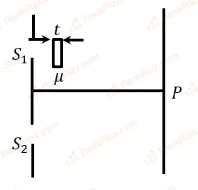
As shown in the figure, in Young's double slit experiment, a thin plate of thickness m and refractive index is inserted infront of slit . The experiment is conducted in air () and uses a monochromatic light of wavelength nm. Due to the insertion of the plate, central maxima is shifted by a distance of . is the fringe-width before the insertion of the plate. The value of is ______.
Answer: ____________
rr2.rankrizz.com/jee-main/physics/wave-optics/q/01-feb-2023-s2-q29
Two light waves of wavelengths 800 and 600 nm are used in Young's double slit experiment to obtain interference fringes on a screen placed 7 m away from plane of slits. If the two slits are separated by 0.35 mm, then shortest distance from the central bright maximum to the point where the bright fringes of the two wavelength coincide will be ______ mm.
Answer: ____________
rr2.rankrizz.com/jee-main/physics/wave-optics/q/31-jan-2023-s2-q29
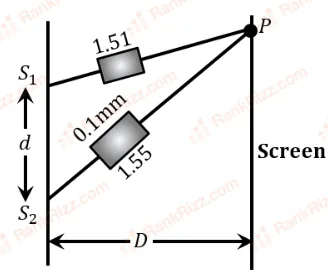
In Young's double slit experiment, two slits and are distance apart and the separation from slits to screen is (as shown in figure). Now if two transparent slabs of equal thickness mm but refractive index and are introduced in the path of beam from and respectively. The central bright fringe spot will shift by ______ number of fringes.
Answer: ____________
rr2.rankrizz.com/jee-main/physics/wave-optics/q/30-jan-2023-s1-q28
In a Young's double slit experiment, the intensities at two points, for the path difference and ( being the wavelength of light used) are and respectively. If denotes the intensity produced by each one of the individual slits, then ______.
Answer: ____________
rr2.rankrizz.com/jee-main/physics/wave-optics/q/30-jan-2023-s2-q29
In a Young's double slit experiment, two slits are illuminated with a light of wavelength nm. The line joining is perpendicular to as shown in the figure. If the first minimum is detected at , the value of slits separation will be:
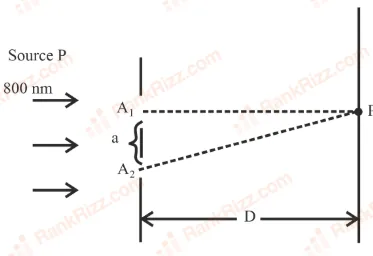
The distance of screen from slits cm. Answer in mm.- (A)
0.4 mm
- (B)
0.5 mm
- (C)
0.2 mm
- (D)
0.1 mm
rr2.rankrizz.com/jee-main/physics/wave-optics/q/29-jan-2023-s1-q27
- (A)
In Young's double slits experiment, the position of 5 bright fringe from the central maximum is 5 cm. The distance between slits and screen is 1 m and wavelength of used monochromatic light is 600 nm. The separation between the slits is:
- (A)
60 m
- (B)
48 m
- (C)
12 m
- (D)
36 m
rr2.rankrizz.com/jee-main/physics/wave-optics/q/25-jan-2023-s1-q16
- (A)
Two beams of light having intensities and interfere to produce a fringe pattern on a screen. The phase difference between the two beams are and at points and respectively. The difference between the resultant intensities at the two points is . The value of will be ______.
Answer: ____________
rr2.rankrizz.com/jee-main/physics/wave-optics/q/27-jul-2022-s1-q29
In Young's double slit experiment, the fringe width is . If the entire arrangement is placed in water of refractive index , then the fringe width becomes (in mm)
- (A)
- (B)
- (C)
- (D)
rr2.rankrizz.com/jee-main/physics/wave-optics/q/26-jul-2022-s1-q16
- (A)
The interference pattern is obtained with two coherent light sources of intensity ratio . And the ratio is . Then, the value of will be equal to :
- (A)
3
- (B)
4
- (C)
2
- (D)
1
rr2.rankrizz.com/jee-main/physics/wave-optics/q/25-jun-2022-s2-q15
- (A)
The light waves from two coherent sources have same intensity . In interference pattern the intensity of light at minima is zero. What will be the intensity of light at maxima?
- (A)
- (B)
- (C)
- (D)
rr2.rankrizz.com/jee-main/physics/wave-optics/q/27-aug-2021-s2-q17
- (A)
In Young's double slit experiment, if the source of light changes from orange to blue then:
- (A)
the central bright fringe will become a dark fringe.
- (B)
the distance between consecutive fringes will decrease.
- (C)
the distance between consecutive fringes will increase.
- (D)
the intensity of the minima will increase.
rr2.rankrizz.com/jee-main/physics/wave-optics/q/27-jul-2021-s1-q18
- (A)
In the Young's double slit experiment, the distance between the slits varies in time as ; where , and are constants. The difference between the largest fringe width and the smallest fringe width obtained over time is given as:
- (A)
- (B)
- (C)
- (D)
rr2.rankrizz.com/jee-main/physics/wave-optics/q/25-jul-2021-s1-q14
- (A)
In a Young's double slit experiment 15 fringes are observed on a small portion of the screen when light of wavelength 500 nm is used. Ten fringes are observed on the same section of the screen when another light source of wavelength is used. Then the value of is (in nm) ___________.
Answer: ____________
rr2.rankrizz.com/jee-main/physics/wave-optics/q/9-jan-2020-s2-q24
In a Young's double slit experiment, the separation between the slits is 0.15 mm. In the experiment, a source of light of wavelength 589 nm is used and the interference pattern is observed on a screen kept 1.5 m away. The separation between the successive bright fringes on the screen is:
- (A)
6.9 mm
- (B)
3.9 mm
- (C)
5.9 mm
- (D)
4.9 mm
rr2.rankrizz.com/jee-main/physics/wave-optics/q/7-jan-2020-s2-q18
- (A)
In a double slit experiment, when a thin film of thickness t having refractive index μ is introduced in front of one of the slits, the maximum at the centre of the fringe pattern shifts by one fringe width. The value of t is ( is the wavelength of the light used):
- (A)
- (B)
- (C)
- (D)
rr2.rankrizz.com/jee-main/physics/wave-optics/q/12-apr-2019-s1-q26
- (A)
The figure shows a Young's double slit experimental setup. It is observed that when a thin transparent sheet of thickness t and refractive index is put in front of one of the slits, the central maximum gets shifted by a distance equal to n fringe width. If the wavelength of light used is then t will be:
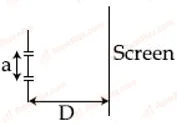
- (A)
- (B)
- (C)
- (D)
rr2.rankrizz.com/jee-main/physics/wave-optics/q/9-apr-2019-s1-q26
- (A)
Consider a Young's double slit experiment as shown in figure. What should be the slit separation in terms of wavelength such that the first minima occurs directly in front of the slit ()?
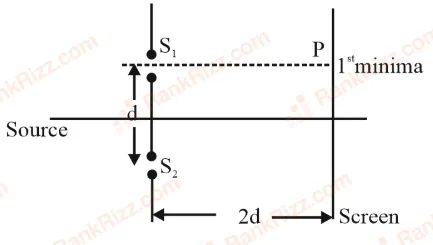
- (A)
- (B)
- (C)
- (D)
rr2.rankrizz.com/jee-main/physics/wave-optics/q/10-jan-2019-s2-q26
- (A)
In a young's double slit experiment, the slits are placed 0.320 mm apart. Light of wavelength nm is incident on the slits. The total number of bright fringes that are observed in the angular range is:
- (A)
321
- (B)
641
- (C)
320
- (D)
640
rr2.rankrizz.com/jee-main/physics/wave-optics/q/9-jan-2019-s2-q25
- (A)
In a Young's double slit experiment, slits are separated by 0.5 mm, and the screen is placed 150 cm away. A beam of light consisting of two wavelengths, 650 nm and 520 nm, is used to obtain interference fringes on the screen. The least distance from the common central maximum to the point where the bright fringes due to both the wavelengths coincide is:
- (A)
15.6 mm
- (B)
1.56 mm
- (C)
7.8 mm
- (D)
9.75 mm
rr2.rankrizz.com/jee-main/physics/wave-optics/q/2-apr-2017-offline-q25
- (A)
In Young's double-slit experiment, the distance between slits and the screen is 1 m and monochromatic light of wavelength 600 nm is being used. A person standing near the slits is looking at the fringe pattern. When the separation between the slits is varied, the interference pattern disappears for a particular distance between the slits. If the angular resolution of the eye is , then the value of is close to
- (A)
1 mm
- (B)
3 mm
- (C)
2 mm
- (D)
4 mm
rr2.rankrizz.com/jee-main/physics/wave-optics/q/9-apr-2016-online-q24
- (A)
In a Young's double slit experiment with light of wavelength , the separation of slits is and distance of screen is such that . If the Fringe width is , the distance from point of maximum intensity to the point where intensity falls to half of the maximum intensity on either side is:
- (A)
- (B)
- (C)
- (D)
rr2.rankrizz.com/jee-main/physics/wave-optics/q/11-apr-2015-online-q26
- (A)
On a hot summer night, the refractive index of air is the smallest near the ground and increases with a height from the ground. When a light beam is directed horizontally, the Huygens' principle leads us to conclude that as it travels, the light beam,
- (A)
bends upward.
- (B)
becomes narrower.
- (C)
goes horizontally without any deflection.
- (D)
bends downward.
rr2.rankrizz.com/jee-main/physics/wave-optics/q/4-apr-2015-offline-q26
- (A)
Interference pattern is observed at 'P' due to superimposition of two rays coming out from a source 'S' as shown in the figure. The value of 'l' for which maxima is obtained at 'P' is: (R is perfect reflecting surface)
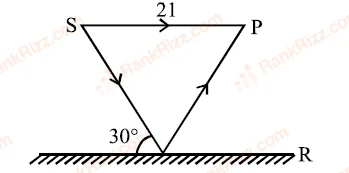
- (A)
- (B)
- (C)
- (D)
rr2.rankrizz.com/jee-main/physics/wave-optics/q/12-apr-2014-online-q25
- (A)
Two monochromatic light beams of intensity 16 and 9 units are interfering. The ratio of intensities of bright and dark parts of the resultant pattern is:
- (A)
- (B)
- (C)
- (D)
rr2.rankrizz.com/jee-main/physics/wave-optics/q/11-apr-2014-online-q26
- (A)
Using monochromatic light of wavelength , an experimentalist sets up the Young's double slit experiment in three ways as shown. If she observes that , the wavelength of light used is:
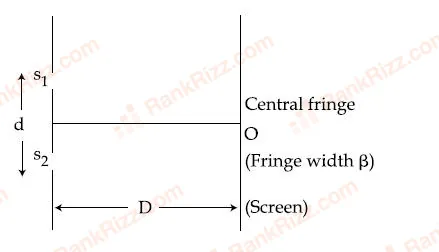
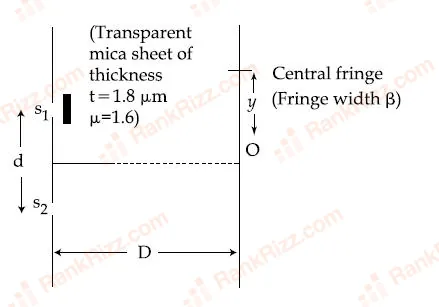
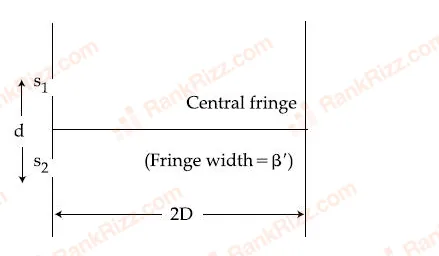
- (A)
520 nm
- (B)
580 nm
- (C)
540 nm
- (D)
560 nm
rr2.rankrizz.com/jee-main/physics/wave-optics/q/9-apr-2014-online-q25
- (A)
A thin glass plate of thickness ( is wavelength of light used) and refractive index is inserted between one of the slits and the screen in Young's double slit experiment. At a point on the screen equidistant from the slits, the ratio of the intensities before and after the introduction of the glass plate is :
- (A)
2 : 1
- (B)
1 : 4
- (C)
4 : 1
- (D)
4 : 3
rr2.rankrizz.com/jee-main/physics/wave-optics/q/25-apr-2013-online-q23
- (A)
The source that illuminates the double-slit in 'double-slit interference experiment' emits two distinct monochromatic waves of wavelength 500 nm and 600 nm, each of them producing its own pattern on the screen. At the central point of the pattern when path difference is zero, maxima of both the patterns coincide and the resulting interference pattern is most distinct at the region of zero path difference. But as one moves out of this central region, the two fringe systems are gradually out of step such that maximum due to one wavelength coincides with the minimum due to the other and the combined fringe system becomes completely indistinct. This may happen when path difference in nm is:
- (A)
2000
- (B)
3000
- (C)
1000
- (D)
1500
rr2.rankrizz.com/jee-main/physics/wave-optics/q/25-apr-2013-online-q24
- (A)
identical waves each of intensity interfere with each other. The ratio of maximum intensities if the interference is (i) coherent and (ii) incoherent is :
- (A)
- (B)
- (C)
- (D)
rr2.rankrizz.com/jee-main/physics/wave-optics/q/23-apr-2013-online-q25
- (A)
This question has Statement-1 and Statement-2. Of the four choices given after the Statements, choose the one that best describes the two Statements.
Statement-1: In Young's double slit experiment, the number of fringes observed in the field of view is small with longer wavelength of light and is large with shorter wavelength of light.
Statement-2: In the double slit experiment the fringe width depends directly on the wavelength of light.- (A)
Statement-1 is true, Statement-2 is true and the Statement-2 is correct explanation of the Statement-1.
- (B)
Statement-1 is false and the Statement-2 is true.
- (C)
Statement-1 is true Statement-2 is true and the Statement-2 is not correct explanation of the Statement-1.
- (D)
Statement-1 is true and the Statement-2 is false.
rr2.rankrizz.com/jee-main/physics/wave-optics/q/22-apr-2013-online-q27
- (A)
A ray of light of intensity I is incident on a parallel glass slab at point A as shown in the diagram. It undergoes partial reflection and refraction. At each reflection, 25% of incident energy is reflected. The rays AB and A'B' undergo interference. The ratio of and is :
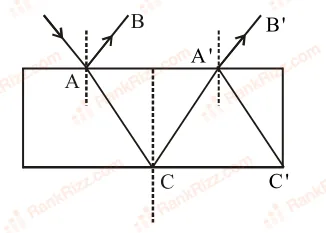
- (A)
49 : 1
- (B)
7 : 1
- (C)
4 : 1
- (D)
8 : 1
rr2.rankrizz.com/jee-main/physics/wave-optics/q/9-apr-2013-online-q25
- (A)
Two coherent point sources and are separated by a small distance as shown in the figure. The fringes obtained on the screen will be
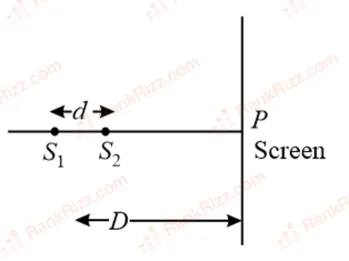
- (A)
semi-circles
- (B)
concentric circles
- (C)
points
- (D)
straight lines
rr2.rankrizz.com/jee-main/physics/wave-optics/q/7-apr-2013-offline-q26
- (A)
In Young's double slit experiment, one of the slit is wider than other, so that the amplitude of the light from one slit is double of that from other slit. If be the maximum intensity, the resultant intensity when they interfere at phase difference is given by
- (A)
- (B)
- (C)
- (D)
rr2.rankrizz.com/jee-main/physics/wave-optics/q/2012-physics-499041
- (A)
In Young's double slit interference experiment, the slit widths are in the ratio . Then the ratio of intensity at the maxima and minima in the interference pattern is
- (A)
- (B)
- (C)
- (D)
rr2.rankrizz.com/jee-main/physics/wave-optics/q/2012-physics-499201
- (A)
In Young's double slit experiment, the two slits act as coherent sources of equal amplitude A and wavelength . In another experiment with the same setup the two slits are sources of equal amplitude A and wavelength but are incoherent. The ratio of the intensity of light at the midpoint of the screen in the first case to that in the second case is
- (A)
1:1
- (B)
2:1
- (C)
4:1
- (D)
1:4
rr2.rankrizz.com/jee-main/physics/wave-optics/q/2012-physics-499301
- (A)
The maximum number of possible interference maxima for slit separation equal to , where is the wavelength of light used, in a Young's double slit experiment is
- (A)
zero
- (B)
- (C)
infinite
- (D)
rr2.rankrizz.com/jee-main/physics/wave-optics/q/2012-physics-499403
- (A)
Direction: The question has a paragraph followed by two statements, Statement-1 and Statement-2. Of the given four alternatives after the statements, choose the one that describes the statements. A thin air film is formed by putting the convex surface of a plane-convex lens over a plane glass plate. With monochromatic light, this film gives an interference pattern due to light reflected from the top (convex) surface and the bottom (glass plate) surface of the film. Statement-1: When light reflects from the air-glass plate interface, the reflected wave suffers a phase change of . Statement-2: The centre of the interference pattern is dark.
- (A)
Statement-1 is true, Statement-2 is true; Statement-2 is the correct explanation of Statement-1.
- (B)
Statement-1 is true, Statement-2 is true; Statement-2 is not the correct explanation of Statement-1.
- (C)
Statement-1 is false. Statement-2 is true.
- (D)
Statement-1 is true, Statement-2 is false.
rr2.rankrizz.com/jee-main/physics/wave-optics/q/2011-physics-499493
- (A)
A mixture of light, consisting of wavelength nm and an unknown wavelength, illuminates Young's double slit and gives rise to two overlapping interference patterns on the screen. The central maximum of both lights coincide. Further, it is observed that the third bright fringe of known light coincides with the bright fringe of the unknown light. From this data, the wavelength of the unknown light is
- (A)
nm
- (B)
nm
- (C)
nm
- (D)
nm
rr2.rankrizz.com/jee-main/physics/wave-optics/q/2009-physics-499582
- (A)
In a Young's double slit experiment the intensity at a point where the path difference is ( being the wavelength of the light used) is . If denotes the maximum intensity, is equal to
- (A)
- (B)
- (C)
- (D)
rr2.rankrizz.com/jee-main/physics/wave-optics/q/2007-physics-499774
- (A)
A Young's double slit experiment uses a monochromatic source. The shape of the interference fringes formed on a screen is
- (A)
hyperbola
- (B)
circle
- (C)
straight line
- (D)
parabola
rr2.rankrizz.com/jee-main/physics/wave-optics/q/2005-physics-500225
- (A)
The maximum number of possible interference maxima for slit-separation equal to twice the wavelength in Young's double-slit experiment is
- (A)
infinite
- (B)
five
- (C)
three
- (D)
zero
rr2.rankrizz.com/jee-main/physics/wave-optics/q/2004-physics-500272
- (A)
Wavefronts and Huygens' principle 50
Given below are two statements:
Statement I: A plane wave after passing through prism remains as plane wave but passing through small pin hole may become spherical wave.
Statement II: The curvature of a spherical wave emerging from a slit will increase for increasing slit wridth
In the light of the above statements, choose the correct answer from the options given below- (A)
Both Statement I and Statement II are true
- (B)
Statement I is false but Statement II is true
- (C)
Statement I is true but Statement II is false
- (D)
Both Statement I and Statement II are false
rr2.rankrizz.com/jee-main/physics/wave-optics/q/28-jan-2026-s1-q45
- (A)
In the Young's double slit experiment the intensity produced by each one of the individual slits is The distance between two slits is 2 mm . The distance of screen from slits is 10 m. The wavelength of light is . The intensity of light on the screen in front of one of the slits is __________.
- (A)
- (B)
- (C)
- (D)
rr2.rankrizz.com/jee-main/physics/wave-optics/q/24-jan-2026-s2-q26
- (A)
The wavelength of light, while it is passing through water is 540 nm. The refractive index of water is . The wavelength of the same light when it is passing through a transparent medium having refractive index of is ____________nm.
- (A)
840
- (B)
380
- (C)
480
- (D)
540
rr2.rankrizz.com/jee-main/physics/wave-optics/q/22-jan-2026-s2-q26
- (A)
Given below are two statements :
Statement I : In a Young's double slit experiment, the angular separation of fringes will increase as the screen is moved away from the plane of the slits
Statement II: In a Young's double slit experiment, the angular separation of fringes will increase when monochromatic source is replaced by another monochromatic source of higher wavelength
In the light of the above statements, choose the correct answer from the options given below :- (A)
Both Statement I and Statement II are true
- (B)
Statement I is false but Statement II is true
- (C)
Both Statement I and Statement II are false
- (D)
Statement I is true but Statement II is false
rr2.rankrizz.com/jee-main/physics/wave-optics/q/21-jan-2026-s2-q28
- (A)
A monochromatic light of frequency Hz travelling through air, is incident on a medium of refractive index '2'. Wavelength of the refracted light will be:
- (A)
300 nm
- (B)
600 nm
- (C)
400 nm
- (D)
500 nm
rr2.rankrizz.com/jee-main/physics/wave-optics/q/2025-apr-3-s2-q34
- (A)
Young's double slit inteference apparatus is immersed in a liquid of refractive index 1.44. It has slit separation of 1.5 mm . The slits are illuminated by a parallel beam of light whose wavelength in air is 690 nm . The fringe-width on a screen placed behind the plane of slits at a distance of 0.72 m , will be :
- (A)
0.23 mm
- (B)
0.33 mm
- (C)
0.63 mm
- (D)
0.46 mm
rr2.rankrizz.com/jee-main/physics/wave-optics/q/24-jan-2025-s2-q29
- (A)
The width of one of the two slits in Young's double slit experiment is d while that of the other slit is d. If the ratio of the maximum to the minimum intensity in the interference pattern on the screen is 9:4 then what is the value of ? (Assume that the field strength varies according to the slit width.)
- (A)
4
- (B)
5
- (C)
3
- (D)
2
rr2.rankrizz.com/jee-main/physics/wave-optics/q/23-jan-2025-s2-q36
- (A)
Given below are two statements : one is labelled as Assertion (A) and the other is labelled as Reason (R).
Assertion-(A) : If Young's double slit experiment is performed in an optically denser medium than air, then the consecutive fringes come closer. Reason-(R) : The speed of light reduces in an optically denser medium than air while its frequency does not change. In the light of the above statements, choose the most appropriate answer from the options given below :- (A)
Both (A) and (R) are true but (R) is not the correct explanation of (A)
- (B)
Both (A) and (R) are true and (R) is the correct explanation of (A)
- (C)
(A) is true but (R) is false
- (D)
(A) is false but (R) is true
rr2.rankrizz.com/jee-main/physics/wave-optics/q/22-jan-2025-s1-q43
- (A)
A transparent film of refractive index, 2.0 is coated on a glass slab of refractive index, 1.45. What is the minimum thickness of transparent film to be coated for the maximum transmission of Green light of wavelength 550 nm . [Assume that the light is incident nearly perpendicular to the glass surface.]
- (A)
137.5 nm
- (B)
275 nm
- (C)
94.8 nm
- (D)
68.7 nm
rr2.rankrizz.com/jee-main/physics/wave-optics/q/22-jan-2025-s2-q31
- (A)
Given below are two statements. One is labelled as Assertion (A) and the other is labelled as Reason (R). Assertion (A) : In Young's double slit experiment, the fringes produced by red light are closer as compared to those produced by blue light. Reason (R): The fringe width is directly proportional to the wavelength of light. In the light of the above statements, choose the correct answer from the options given below :
- (A)
Both (A) and (R) are true but (R) is NOT the correct explanation of (A)
- (B)
(A) is true but (R) is false
- (C)
Both (A) and (R) are true and (R) is the correct explanation of (A)
- (D)
(A) is false but (R) is true
rr2.rankrizz.com/jee-main/physics/wave-optics/q/22-jan-2025-s2-q34
- (A)
Monochromatic light of wavelength is used in Young's double slit experiment. An interference pattern is obtained on a screen. When one of the slits is covered with a very thin glass plate (refractive index ), the central maximum is shifted to a position previously occupied by the bright fringe. The thickness of the glass-plate is ______ .
Answer: ____________
rr2.rankrizz.com/jee-main/physics/wave-optics/q/9-apr-2024-s2-q30
Two slits are 1 mm apart and the screen is located 1 m away from the slits. A light of wavelength 500 nm is used. The width of each slit to obtain 10 maxima of the double slit pattern within the central maximum of the single slit pattern is _____ m.
Answer: ____________
rr2.rankrizz.com/jee-main/physics/wave-optics/q/8-apr-2024-s2-q29
Two coherent monochromatic light beams of intensities I and 4I are superimposed. The difference between maximum and minimum possible intensities in the resulting beam is . The value of is ___________.
Answer: ____________
rr2.rankrizz.com/jee-main/physics/wave-optics/q/6-apr-2024-s2-q29
Light emerges out of a convex lens when a source of light kept at its focus. The shape of wavefront of the light is :
- (A)
both spherical and cylindrical
- (B)
plane
- (C)
spherical
- (D)
cylindrical
rr2.rankrizz.com/jee-main/physics/wave-optics/q/5-apr-2024-s1-q17
- (A)
Two wavelengths and are used in Young's double slit experiment. and . The minimum order of fringe produced by which overlaps with the fringe produced by is n. The value of n is _____.
Answer: ____________
rr2.rankrizz.com/jee-main/physics/wave-optics/q/04-apr-2024-s1-q29
The width of one of the two slits in a Young's double slit experiment is 4 times that of the other slit. The ratio of the maximum of the minimum intensity in the interference pattern is:
- (A)
- (B)
- (C)
- (D)
rr2.rankrizz.com/jee-main/physics/wave-optics/q/04-apr-2024-s2-q16
- (A)
In Young's double slit experiment, monochromatic light of wavelength 5000 Å is used. The slits are 1.0 mm apart and screen is placed at 1.0 m away from slits. The distance from the centre of the screen where intensity becomes half of the maximum intensity for the first time is ______ m.
Answer: ____________
rr2.rankrizz.com/jee-main/physics/wave-optics/q/01-feb-2024-s2-q29
Two waves of intensity ratio cross each other at a point. The resultant intensities at the point, when (a) Waves are incoherent is (b) Waves are coherent is and differ in phase by . If , then = _________.
Answer: ____________
rr2.rankrizz.com/jee-main/physics/wave-optics/q/31-jan-2024-s1-q29
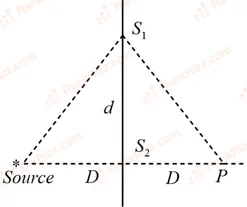
In a double slit experiment shown in figure, when light of wavelength nm is used, dark fringe is observed at . If m, the minimum distance between the slits and is mm. Write the value of to the nearest integer.
Answer: ____________
rr2.rankrizz.com/jee-main/physics/wave-optics/q/29-jan-2024-s1-q29
Two light beams of intensities 4I and 9I interfere on a screen. The phase difference between these beams on the screen at point A is zero and at point B is . The difference of resultant intensities, at the point A and B, will be _____ I.
Answer: ____________
rr2.rankrizz.com/jee-main/physics/wave-optics/q/29-jul-2022-s1-q25
In a Young's double slit experiment, a laser light of 560 nm produces an interference pattern with consecutive bright fringes' separation of 7.2 mm. Now another light is used to produce an interference pattern with consecutive bright fringes' separation of 8.1 mm. The wavelength of second light is _____ nm.
Answer: ____________
rr2.rankrizz.com/jee-main/physics/wave-optics/q/28-jul-2022-s1-q29
Two coherent sources of light interfere. The intensity ratio of two sources is . For this interference pattern if the value of is equal to , then will be
- (A)
1.5
- (B)
2
- (C)
0.5
- (D)
1
rr2.rankrizz.com/jee-main/physics/wave-optics/q/27-jul-2022-s2-q16
- (A)
Using Young's double slit experiment, a monochromatic light of wavelength 5000 A produces fringes of fringe width 0.5 mm. If another monochromatic light of wavelength 6000 A is used and the separation between the slits is doubled, then the new fringe width will be
- (A)
0.5 mm
- (B)
1.0 mm
- (C)
0.6 mm
- (D)
0.3 mm
rr2.rankrizz.com/jee-main/physics/wave-optics/q/29-jun-2022-s1-q17
- (A)
In a double slit experiment with monochromatic light, fringes are obtained on a screen placed at some distance from the plane of slits. If the screen is moved by m towards the slits, the change in fringe width is cm. If the distance between the slits is 1 mm, then the wavelength of the light will be ______ nm.
Answer: ____________
rr2.rankrizz.com/jee-main/physics/wave-optics/q/29-jun-2022-s2-q27
In young's double slit experiment performed using a monochromatic light of wavelength , when a glass plate () of thickness is introduced in the path of the one of the interfering beams, the intensity at the position where the central maximum occurred previously remains unchanged. The value of will be
- (A)
3
- (B)
2
- (C)
1.5
- (D)
0.5
rr2.rankrizz.com/jee-main/physics/wave-optics/q/28-jun-2022-s2-q16
- (A)
In a Young's double slit experiment, an angular width of the fringe is 0.35° on a screen placed at 2 m away for particular wavelength of 450 nm. The angular width of the fringe, when whole system is immersed in a medium of refractive index , is . The value of is ______.
Answer: ____________
rr2.rankrizz.com/jee-main/physics/wave-optics/q/28-jun-2022-s2-q28
In Young's double slit experiment the two slits are mm distance apart. Interference pattern is observed on a screen at a distance cm from the slits. The first dark fringe is observed on the screen directly opposite to one of the slits. The wavelength of light will be ______ nm.
Answer: ____________
rr2.rankrizz.com/jee-main/physics/wave-optics/q/27-jun-2022-s1-q28
The two light beams having intensities and interfere to produce a fringe pattern on a screen. The phase difference between the beams is at point and at point . Then the difference between the resultant intensities at and will be :
- (A)
- (B)
- (C)
- (D)
rr2.rankrizz.com/jee-main/physics/wave-optics/q/25-jun-2022-s1-q16
- (A)
Two light beams of intensities in the ratio of are allowed to interfere. The ratio of the intensity of maxima and minima will be :
- (A)
- (B)
- (C)
- (D)
rr2.rankrizz.com/jee-main/physics/wave-optics/q/24-jun-2022-s2-q10
- (A)
The width of one of the two slits in a Young's double slit experiment is three times the other slit. If the amplitude of the light coming from a slit is proportional to the slit-width, the ratio of minimum to maximum intensity in the interference pattern is where is _________.
Answer: ____________
rr2.rankrizz.com/jee-main/physics/wave-optics/q/1-sep-2021-s2-q25
In a Young's double slit experiment, the slits are separated by 0.3 mm and the screen is 1.5 m away from the plane of slits. Distance between fourth bright fringes on both sides of central bright fringe is 2.4 cm. The frequency of light used is Hz.
Answer: ____________
rr2.rankrizz.com/jee-main/physics/wave-optics/q/31-aug-2021-s2-q28
White light is passed through a double slit and interference is observed on a screen 1.5 m away. The separation between the slits is 0.3 mm. The first violet and red fringes are formed 2.0 mm and 3.5 mm away from the central white fringes. The difference in wavelengths of red and violet light is (in nm).
Answer: ____________
rr2.rankrizz.com/jee-main/physics/wave-optics/q/26-aug-2021-s1-q29
The difference in the number of waves when yellow light propagates through air and vacuum columns of the same thickness is one. The thickness of the air column is _________ mm. [Refractive index of air = 1.0003, the wavelength of yellow light in vacuum = 6000 Å]
Answer: ____________
rr2.rankrizz.com/jee-main/physics/wave-optics/q/27-jul-2021-s2-q28
A fringe width of 6 mm was produced for two slits separated by 1 mm apart. The screen is placed 10 m away. The wavelength of light used is nm. The value of to the nearest integer is ________.
Answer: ____________
rr2.rankrizz.com/jee-main/physics/wave-optics/q/16-mar-2021-s1-q27
Two coherent light sources having intensity in the ratio produce an interference pattern. The ratio will be:
- (A)
- (B)
- (C)
- (D)
rr2.rankrizz.com/jee-main/physics/wave-optics/q/25-feb-2021-s1-q15
- (A)
In a Young's double slit experiment, the width of the one of the slit is three times the other slit. The amplitude of the light coming from a slit is proportional to the slit-width. Find the ratio of the maximum to the minimum intensity in the interference pattern.
- (A)
1 : 4
- (B)
2 : 1
- (C)
3 : 1
- (D)
4 : 1
rr2.rankrizz.com/jee-main/physics/wave-optics/q/24-feb-2021-s1-q17
- (A)
If the source of light used in a Young's double slit experiment is changed from red to violet:
- (A)
consecutive fringe lines will come closer.
- (B)
the fringes will become brighter.
- (C)
the central bright fringe will become a dark fringe.
- (D)
the intensity of minima will increase.
rr2.rankrizz.com/jee-main/physics/wave-optics/q/24-feb-2021-s2-q15
- (A)
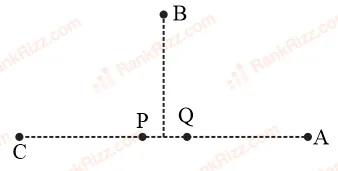
In the figure below, and are two equally intense coherent sources emitting radiation of wavelength . The separation between P and Q is and the phase of P is ahead of that of Q by . A, B and C are three distinct point of observation, each equidistant from the midpoint of PQ. The intensities of radiation at A, B, C will be in the ratio:
- (A)
0 : 1 : 4
- (B)
2 : 1 : 0
- (C)
0 : 1 : 2
- (D)
4 : 1 : 0
rr2.rankrizz.com/jee-main/physics/wave-optics/q/6-sep-2020-s1-q16
- (A)
A Young's double-slit experiment is performed using monochromatic light of wavelength . The intensity of light at a point on the screen, where the path difference is , is units. The intensity of light at a point where the path difference is is given by , where n is an integer. The value of n is___
Answer: ____________
rr2.rankrizz.com/jee-main/physics/wave-optics/q/6-sep-2020-s2-q24
In a Young's double slit experiment, light of 500 nm is used to produce and interference pattern. When the distance between the slits is 0.05 mm, the angular width (in degree) of the fringes formed on the distance screen is close to:
- (A)
0.17°
- (B)
0.57°
- (C)
1.7°
- (D)
0.07°
rr2.rankrizz.com/jee-main/physics/wave-optics/q/3-sep-2020-s1-q16
- (A)
Two light waves having the same wavelength in vacuum are in phase initially. Then the first wave travels a path through a medium of refractive index while the second wave travels a path of length through a medium of refractive index . After this the phase difference between the two waves is:
- (A)
- (B)
- (C)
- (D)
rr2.rankrizz.com/jee-main/physics/wave-optics/q/3-sep-2020-s2-q18
- (A)
Interference fringes are observed on a screen by illuminating two thin slits 1 mm apart with a light source . The distance between the screen and the slits is 100 cm. If a bright fringe is observed on a screen at distance of 1.27 mm from the central bright fringe, then the path difference between the waves, which are reaching this point from the slits is close to:
- (A)
1.27 m
- (B)
2.87 nm
- (C)
2 nm
- (D)
2.05 m
rr2.rankrizz.com/jee-main/physics/wave-optics/q/2-sep-2020-s1-q18
- (A)
In a Young's double slit experiment, 16 fringes are observed in a certain segment of the screen when light of wavelength 700 nm is used. If the wavelength of light is changed to 400 nm, the number of fringes observed in the same segment of the screen would be:
- (A)
24
- (B)
30
- (C)
18
- (D)
28
rr2.rankrizz.com/jee-main/physics/wave-optics/q/2-sep-2020-s2-q17
- (A)
In a double-slit experiment, at a certain point on the screen the path difference between the two interfering waves is th of a wavelength. The ratio of the intensity of light at that point to that at the center of a bright fringe is:
- (A)
0.853
- (B)
0.672
- (C)
0.568
- (D)
0.760
rr2.rankrizz.com/jee-main/physics/wave-optics/q/8-jan-2020-s2-q18
- (A)
In a Young's double-slit experiment, the ratio of the slit's width is 4:1. The ratio of the intensity of maxima to minima, close to the central fringe on the screen, will be
- (A)
25 : 9
- (B)
9 : 1
- (C)
: 16
- (D)
4 : 1
rr2.rankrizz.com/jee-main/physics/wave-optics/q/10-apr-2019-s2-q25
- (A)
In an interference experiment the ratio of amplitudes of coherent waves is . The ratio of maximum and minimum intensities of fringes will be:
- (A)
4
- (B)
9
- (C)
2
- (D)
18
rr2.rankrizz.com/jee-main/physics/wave-optics/q/8-apr-2019-s1-q26
- (A)
In a Young's double slit experiment, the path difference, at a certain point on the screen, between two interfering waves is th of wavelength. The ratio of the intensity at this point to that at the centre of a bright fringe is close to:
- (A)
0.74
- (B)
0.85
- (C)
0.94
- (D)
0.8
rr2.rankrizz.com/jee-main/physics/wave-optics/q/11-jan-2019-s1-q25
- (A)
In a Young's double slit experiment slit separation 0.1 mm, one observes a bright fringe at angle rad by using light of wavelength . When the light of wavelength is used a bright fringe is seen at the same angle in the same set up. Given that and are in visible range (380 nm to 740 nm), their values are:
- (A)
400 nm, 500 nm
- (B)
380 nm, 525 nm
- (C)
625 nm, 500 nm
- (D)
380 nm, 500 nm
rr2.rankrizz.com/jee-main/physics/wave-optics/q/10-jan-2019-s1-q25
- (A)
Two coherent sources produce waves of different intensities which interfere. After interference, the ratio of the maximum intensity to the minimum intensity is 16. The intensity of the waves are in the ratio:
- (A)
25 : 9
- (B)
16 : 9
- (C)
5 : 3
- (D)
4 : 1
rr2.rankrizz.com/jee-main/physics/wave-optics/q/9-jan-2019-s1-q27
- (A)
An initially parallel cylindrical beam travels in a medium of refractive index , where and are positive constants and is the intensity of the light beam. The intensity of the beam is decreasing with increasing radius. The initial shape of the wave front of the beam is
- (A)
convex
- (B)
concave
- (C)
convex near the axis and concave near the periphery
- (D)
planar
rr2.rankrizz.com/jee-main/physics/wave-optics/q/2010-physics-499651
- (A)
Polarisation: Malus's law and Brewster's law 38
An unpolarized light of intensity passes through polarizer and then through a certain optically active solution and finally it goes to analyser. If the angle between analyser and polariser is 0 and intensity of light emerged from analyser is , the angle of rotation of the light by the solution with respect to analyser is _______ degrees.
Answer: ____________
rr2.rankrizz.com/jee-main/physics/wave-optics/q/6-apr-2026-s1-q47
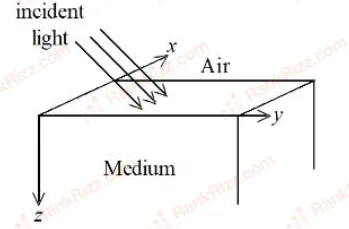
An unpolarized light is incident on the plane interface of air-dielectric medium shown in figure. If the incident angle is equal to Brewster angle, identify the expression representing reflected wave.
- (A)
- (B)
- (C)
- (D)
rr2.rankrizz.com/jee-main/physics/wave-optics/q/4-apr-2026-s1-q45
- (A)
An unpolarized light of certain intensity passes through a combination of two polarizers whose transmission axes are at 30° and 90°, respectively, with respect to the horizontal axis. A third polarizer with its transmission axis at 60° with the horizontal axis is placed between the two existing polarizers. The ratio of the output intensities with and without the third polarizer is ______.
- (A)
- (B)
- (C)
- (D)
rr2.rankrizz.com/jee-main/physics/wave-optics/q/4-apr-2026-s2-q42
- (A)
Au unpolarised light is incident at an inteiface of two dielectric media having refractive indices of 2 (incident medium) and (medium) respectively. To satisfy the condition that reflected and refracted rays are perpendicular to each other, the angle of incidence is ___.
- (A)
- (B)
- (C)
- (D)
rr2.rankrizz.com/jee-main/physics/wave-optics/q/24-jan-2026-s1-q31
- (A)
When an unpolarized light falls at a particular angle on a glass plate (placed in air), it is observed that the reflected beam is linearly polarized. The angle of refracted
beam with respect to the normal is ______ .( (1.52) = , refractive indices of air and glass are 1.00 and 1.52, respectively.)
- (A)
- (B)
- (C)
- (D)
rr2.rankrizz.com/jee-main/physics/wave-optics/q/23-jan-2026-s2-q38
- (A)
The angle of polarization for any medium is , what will be critical angle for this :
- (A)
- (B)
- (C)
- (D)
rr2.rankrizz.com/jee-main/physics/wave-optics/q/2026-physics-516363
- (A)
Two polarisers and are placed in such a way that the intensity of the transmitted light will be zero. A third polariser is inserted in between and , at the particular angle between and . The transmitted intensity of the light passing through all three polarisers is maximum. The angle between the polarisers and is :
- (A)
- (B)
- (C)
- (D)
rr2.rankrizz.com/jee-main/physics/wave-optics/q/2025-apr-4-s2-q40
- (A)
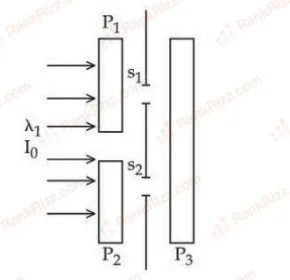
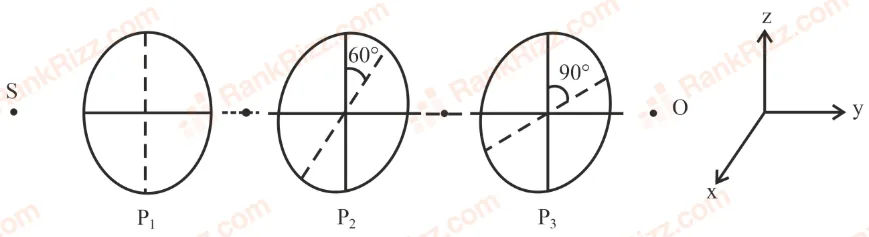
In a Young's double slit experiment, three polarizers are kept as shown in the figure. The transmission axes of and are orthogonal to each other. The polarizer covers both the slits with its transmission axis at to those of and . An unpolarized light of wavelength and intensity is incident on and .The intensity at a point after where the path difference between the light waves from and is
- (A)
- (B)
- (C)
- (D)
rr2.rankrizz.com/jee-main/physics/wave-optics/q/24-jan-2025-s2-q43
- (A)
When unpolarized light is incident at an angle of 60° on a transparent medium from air. The reflected ray is completely polarized. The angle of refraction in the medium is
- (A)
30°
- (B)
60°
- (C)
90°
- (D)
45°
rr2.rankrizz.com/jee-main/physics/wave-optics/q/31-jan-2024-s2-q16
- (A)
A beam of unpolarised light of intensity is passed through a polaroid and then through another polaroid which is oriented so that its principal plane makes an angle of relative to that of . The intensity of emergent light is:
- (A)
- (B)
- (C)
- (D)
rr2.rankrizz.com/jee-main/physics/wave-optics/q/30-jan-2024-s2-q14
- (A)
When a polaroid sheet is rotated between two crossed polaroids then the transmitted light intensity will be maximum for a rotation of :
- (A)
60°
- (B)
30°
- (C)
90°
- (D)
45°
rr2.rankrizz.com/jee-main/physics/wave-optics/q/27-jan-2024-s2-q16
- (A)
Unpolarised light of intensity 32 W m passes through the combination of three polaroids such that the pass axis of the last polaroid is perpendicular to that of the pass axis of first polaroid. If intensity of emerging light is 3 W m, then the angle between pass axis of first two polaroids is _______ .
Answer: ____________
rr2.rankrizz.com/jee-main/physics/wave-optics/q/10-apr-2023-s1-q29
'' polarizing sheets are arranged such that each makes an angle 45° with the proceeding sheet. An unpolarized light of intensity is incident into this arrangement. The output intensity is found to be . The value of will be:
- (A)
3
- (B)
6
- (C)
5
- (D)
4
rr2.rankrizz.com/jee-main/physics/wave-optics/q/01-feb-2023-s1-q16
- (A)
Two polaroids and are placed in such a way that the pass-axis of polaroids are perpendicular to each other. Now, another polaroid is placed between and bisecting angle between them. If intensity of unpolarised light is then intensity of transmitted light after passing through polaroid will be:
- (A)
- (B)
- (C)
- (D)
Zero
rr2.rankrizz.com/jee-main/physics/wave-optics/q/31-jan-2023-s1-q15
- (A)
As shown in figures, three identical polaroids , and are placed one after another. The pass axis of and are inclined at angle of and with respect to axis of . The source has an intensity of W m. The intensity of light at point is ______ W m.
Answer: ____________
rr2.rankrizz.com/jee-main/physics/wave-optics/q/29-jan-2023-s1-q28
Unpolarised light is incident on the boundary between two dielectric media, whose dielectric constants are (medium ) and (medium ), respectively. To satisfy the condition, so that the reflected and refracted rays are perpendicular to each other, the angle of incidence should be , the value of is ______.
(Given for dielectric media, )Answer: ____________
rr2.rankrizz.com/jee-main/physics/wave-optics/q/29-jan-2023-s2-q28
Given below are two statements :
Statement I : If the Brewster's angle for the light propagating from air to glass is , then Brewster's angle for the light propagating from glass to air is .
Statement II : The Brewster's angle for the light propagating from glass to air is , where is the refractive index of glass.
In the light of the above statements, choose the correct answer from the options given below :- (A)
Both Statements I and Statement II are true.
- (B)
Statement I is true but Statement II is false.
- (C)
Both Statement I and Statement II are false.
- (D)
Statement I is false but Statement II is true.
rr2.rankrizz.com/jee-main/physics/wave-optics/q/24-jan-2023-s1-q16
- (A)
Given below are two statements:
Statement I: If the Brewster's angle for the light propagating from air to glass is , then Brewster's angle for the light propagating from glass to air is .
Statement II: The Brewster's angle for the light propagating from glass to air is , where is the refractive index of glass.
In the light of the above statements, choose the correct answer from the options given below:- (A)
Both Statements I and Statement II are true.
- (B)
Statement I is true but Statement II is false.
- (C)
Both Statements I and Statement II are false.
- (D)
Statement I is false but Statement II is true.
rr2.rankrizz.com/jee-main/physics/wave-optics/q/24-jan-2023-s1-q16-494031
- (A)
An unpolarised light beam of intensity is passed through a polaroid P and then through another polaroid Q which is oriented in such a way that its passing axis makes an angle of 30° relative to that of P. The intensity of the emergent light is
- (A)
- (B)
- (C)
- (D)
rr2.rankrizz.com/jee-main/physics/wave-optics/q/29-jul-2022-s2-q18
- (A)
A light whose electric field vectors are completely removed by using a good polaroid, allowed to incident on the surface of the prism at Brewster's angle. Choose the most suitable option for the phenomenon related to the prism.
- (A)
Reflected and refracted rays will be perpendicular to each other.
- (B)
Wave will propagate along the surface of prism.
- (C)
No refraction, and there will be total reflection of light.
- (D)
No reflection. and there will be total transmission of light.
rr2.rankrizz.com/jee-main/physics/wave-optics/q/25-jun-2022-s2-q16
- (A)
A source of light is placed in front of a screen. The intensity of light on the screen is . Two Polaroids and are so placed in between the source of light and screen that the intensity of light on the screen is . Then the , should be rotated by an angle of _________ (degrees) so that the intensity of light on the screen becomes .
Answer: ____________
rr2.rankrizz.com/jee-main/physics/wave-optics/q/26-aug-2021-s2-q29
An unpolarized light beam is incident on the polarizer of a polarization experiment and the intensity of light beam emerging from the analyzer is measured as 100 Lumens. Now, if the analyzer is rotated around the horizontal axis (direction of light) by 30° in clockwise direction, the intensity of emerging light will be ______ Lumens.
Answer: ____________
rr2.rankrizz.com/jee-main/physics/wave-optics/q/24-feb-2021-s1-q28
A beam of plane polarized light of large cross-sectional area and uniform intensity of 3.3 W m falls normally on a polarizer (cross-sectional area m), which rotates about its axis with an angular speed of 31.4 rad s. The energy of light passing through the polarizer per revolution, is close to:
- (A)
J
- (B)
J
- (C)
J
- (D)
J
rr2.rankrizz.com/jee-main/physics/wave-optics/q/4-sep-2020-s1-q17
- (A)
A polarizer - analyser set is adjusted such that the intensity of light coming out of the analyser is just 36% of the original intensity. Assuming that the polarizer - analyser set does not absorb any light, the angle by which the analyser needs to be rotated further, to reduce the output intensity to zero, is ()
- (A)
53
- (B)
37
- (C)
90
- (D)
45
rr2.rankrizz.com/jee-main/physics/wave-optics/q/7-jan-2020-s1-q17
- (A)
A system of three polarizers P, P, P is set up such that the pass axis of P is crossed with respect to that of P. The pass axis of P is inclined at 60° to the pass axis of P. When a beam of unpolarized light of intensity I is incident on P, the intensity of light transmitted by the three polarizers is I. The ratio (I/I) equals (nearly):
- (A)
5.33
- (B)
16.00
- (C)
1.80
- (D)
10.67
rr2.rankrizz.com/jee-main/physics/wave-optics/q/12-apr-2019-s2-q24
- (A)
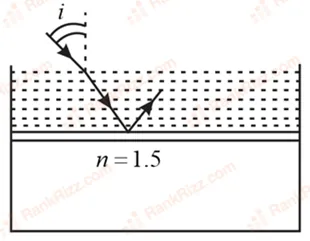
Consider a tank made of glass (refractive index 1.5) with a thick bottom. It is filled with a liquid of refractive index . A student finds that, irrespective of what the incident angle (see figure) is for a beam of light entering the liquid, the light reflected from the liquid glass interface is never completely polarized. For this to happen, the minimum value of is:
- (A)
- (B)
- (C)
- (D)
rr2.rankrizz.com/jee-main/physics/wave-optics/q/9-jan-2019-s1-q28
- (A)
Unpolarized light of intensity I is incident on a system of two polarizers, A followed by B. The intensity of emergent light is . If a third polarizer C is placed between A and B, the intensity of emergent light is reduced to . The angle between the polarizers A and C is , then:
- (A)
- (B)
- (C)
- (D)
rr2.rankrizz.com/jee-main/physics/wave-optics/q/16-apr-2018-online-q25
- (A)
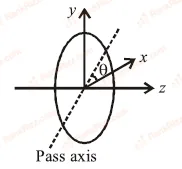
A plane polarized light is incident on a polariser with its pass axis making angle with x-axis, as shown in the figure. At four different values of , = 8, 38, 188 and 218, the observed intensities are same. What is the angle between the direction of polarization and x-axis?
- (A)
203
- (B)
45
- (C)
98
- (D)
128
rr2.rankrizz.com/jee-main/physics/wave-optics/q/15-apr-2018-s2-q25
- (A)
Unpolarized light of intensity I passes through an ideal polariser A. Another identical polariser B is placed behind A. The intensity of light beyond B is found to be . Now another identical polariser C is placed between A and B. The intensity beyond B is now found to be . The angle between polariser A and C is:
- (A)
60
- (B)
0
- (C)
30
- (D)
45
rr2.rankrizz.com/jee-main/physics/wave-optics/q/8-apr-2018-offline-q25
- (A)
The angular width of the central maximum in a single slit diffraction pattern is 60. The width of the slit is 1 m. The slit is illuminated by monochromatic plane waves. If another slit of the same width is made near it, Young's fringes can be observed on a screen placed at a distance 50 cm from the slits. If the observed fringe width is 1 cm, what is slit separation distance? (i.e., the distance between the centres of each slit.)
- (A)
100 m
- (B)
25 m
- (C)
50 m
- (D)
75 m
rr2.rankrizz.com/jee-main/physics/wave-optics/q/8-apr-2018-offline-q26
- (A)
Unpolarized light of intensity is incident on surface of a block of glass at Brewster's angle. In that case, which one of the following statements is true?
- (A)
transmitted light is partially polarized with intensity
- (B)
transmitted light is completely polarized with intensity less than
- (C)
reflected light is partially polarized with intensity
- (D)
reflected light is completely polarized with intensity less than
rr2.rankrizz.com/jee-main/physics/wave-optics/q/11-apr-2015-online-q27
- (A)
A ray of light is incident from a denser to a rarer medium. The critical angle for total internal reflection is and Brewster's angle of incidence is , such that . The relative refractive index of the two media is:
- (A)
0.4
- (B)
0.2
- (C)
0.9
- (D)
0.8
rr2.rankrizz.com/jee-main/physics/wave-optics/q/19-apr-2014-online-q24
- (A)
Two beams, A and B of plane polarized light with mutually perpendicular planes of polarization are seen through a polaroid. From the position when the beam A has maximum intensity (and beam B has zero intensity), a rotation of polaroid through 30° makes the two beams appear equally bright. If the initial intensities of the two beams are and respectively, then equals:
- (A)
3
- (B)
- (C)
1
- (D)
rr2.rankrizz.com/jee-main/physics/wave-optics/q/6-apr-2014-offline-q26
- (A)
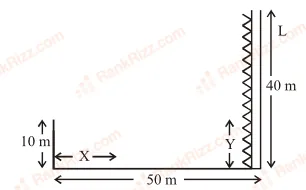
A person lives in a high-rise building on the bank of a river 50 m wide. Across the river is a well lit tower of height 40 m. When the person, who is at a height of 10 m, looks through a polarizer at an appropriate angle at light of the tower reflecting from the river surface, he notes that intensity of light coming from distance X from his building is the least and this corresponds to the light coming from light bulbs at height 'Y' on the tower. The values of X and Y are respectively close to (refractive index of water )
- (A)
25 m, 10 m
- (B)
13 m, 27 m
- (C)
22 m, 13 m
- (D)
17 m, 20 m
rr2.rankrizz.com/jee-main/physics/wave-optics/q/9-apr-2013-online-q26
- (A)
A beam of unpolarised light of intensity is passed through a polaroid A and then through another polaroid B which is oriented so that its principle plane makes an angle of 45° relative to that of A. The intensity of the emergent light is:
- (A)
- (B)
- (C)
- (D)
rr2.rankrizz.com/jee-main/physics/wave-optics/q/7-apr-2013-offline-q25
- (A)
Two polaroids have their polarizing directions parallel so that the intensity of a transmitted light is maximum. The angle through which either polaroid must be turned if the intensity is to drop by one-half is
- (A)
- (B)
- (C)
- (D)
rr2.rankrizz.com/jee-main/physics/wave-optics/q/2012-physics-499133
- (A)
When an unpolarized light of intensity is incident on a polarizing sheet, the intensity of the light which does not get transmitted is
- (A)
- (B)
- (C)
zero
- (D)
rr2.rankrizz.com/jee-main/physics/wave-optics/q/2005-physics-500229
- (A)
The angle of incidence at which reflected light totally polarized for reflection from air to glass (refractive index ), is
- (A)
- (B)
- (C)
- (D)
rr2.rankrizz.com/jee-main/physics/wave-optics/q/2004-physics-500270
- (A)
Single slit diffraction 29
A slit of width is illuminated by light of wavelength . The linear separation between 1st and 3rd minima in the diffraction pattern produced on a screen placed at a distance from the slit system is :
- (A)
- (B)
- (C)
- (D)
rr2.rankrizz.com/jee-main/physics/wave-optics/q/4-apr-2026-s1-q33
- (A)
In single slit diffraction pattern, the wavelength of light used is 628 nm and slit width is 0.2 mm, the angular width of central maximum is degrees. The value of is __________.
Answer: ____________
rr2.rankrizz.com/jee-main/physics/wave-optics/q/2-apr-2026-s1-q46
Which of the following are true for a single slit diffraction?
A. Width of central maxima increases with increase in wavelength keeping slit width constant.
B. Width of central maxima increases with decrease in wavelength keeping slit width constant.
C. Width of central maxima increases with decrease in slit width at constant wavelength.
D. Width of central maxima increases with increase in slit width at constant wavelength.
E. Brightness of central maxima increases for decrease in wavelength at constant slit width.- (A)
A, C, E only
- (B)
A., D only
- (C)
B, C only
- (D)
B, D only
rr2.rankrizz.com/jee-main/physics/wave-optics/q/22-jan-2026-s2-q45
- (A)
If the measured angular separation between the second minimum to the left of the central maximum and the third minimum to the right of the central maximum is 30° in a single slit diffraction pattern recorded using 628 nm light, then the width of the slit is ______ µm.
Answer: ____________
rr2.rankrizz.com/jee-main/physics/wave-optics/q/2025-apr-02-s1-q48
A parallel beam of monochromatic light of wavelength passes through single slit of width. Angular divergence corresponding to second order minima would be ______ .
Answer: ____________
rr2.rankrizz.com/jee-main/physics/wave-optics/q/8-apr-2024-s1-q29
In a single slit experiment, a parallel beam of green light of wavelength nm passes through a slit of width mm. The transmitted light is collected on a screen cm away. The distance of first order minima from the central maximum will be m. The value of is :
Answer: ____________
rr2.rankrizz.com/jee-main/physics/wave-optics/q/05-apr-2024-s2-q29
A monochromatic light of wavelength is incident on the single slit of width mm. If the diffraction pattern is formed at the focus of the convex lens of focal length cm, the linear width of the central maximum is :
- (A)
mm
- (B)
mm
- (C)
mm
- (D)
mm
rr2.rankrizz.com/jee-main/physics/wave-optics/q/01-feb-2024-s1-q16
- (A)
A microwave of wavelength 2.0 cm falls normally on a slit of width 4.0 cm. The angular spread of the central maxima of the diffraction pattern obtained on a screen 1.5 m away from the slit, will be:
- (A)
30°
- (B)
15°
- (C)
60°
- (D)
45°
rr2.rankrizz.com/jee-main/physics/wave-optics/q/01-feb-2024-s2-q17
- (A)
The diffraction pattern of a light of wavelength diffracting from a slit of width is focused on the focal plane of a convex lens of focal length . The width of the secondary maxima will be :
- (A)
- (B)
- (C)
- (D)
rr2.rankrizz.com/jee-main/physics/wave-optics/q/30-jan-2024-s1-q17
- (A)
In a single slit diffraction pattern, a light of wavelength is used. The distance between the first and third minima in the diffraction pattern is found to be mm when the screen is placed cm away from slits. The width of the slit is ______ m.
Answer: ____________
rr2.rankrizz.com/jee-main/physics/wave-optics/q/29-jan-2024-s2-q29
A parallel beam of monochromatic light of wavelength 5000 is incident normally on a single narrow slit of width 0.001 mm. The light is focused by convex lens on screen, placed on its focal plane. The first minima will be formed for the angle of diffraction of _____ (degree).
Answer: ____________
rr2.rankrizz.com/jee-main/physics/wave-optics/q/27-jan-2024-s2-q29
A single slit of width is illuminated by a monochromatic light of wavelength nm. The value of for which first minimum appears at on the screen will be :
- (A)
m
- (B)
m
- (C)
m
- (D)
m
rr2.rankrizz.com/jee-main/physics/wave-optics/q/15-apr-2023-s1-q17
- (A)
For a specific wavelength nm of light coming from a galaxy moving with velocity , the observed wavelength is nm. The value of is
- (A)
m s
- (B)
m s
- (C)
m s
- (D)
m s
rr2.rankrizz.com/jee-main/physics/wave-optics/q/26-jun-2022-s2-q8
- (A)
Sodium light of wavelengths nm and nm is used to study diffraction at a single slit of aperture mm. The distance between the slit and the screen is m. The separation between the positions of the first maxima of diffraction pattern obtained in the two cases is ______ m.
Answer: ____________
rr2.rankrizz.com/jee-main/physics/wave-optics/q/24-jun-2022-s1-q28
With what speed should a galaxy move outward with respect to earth so that the sodium-D line at wavelength 5890 is observed at 5896 ?
- (A)
306 km sec
- (B)
322 km sec
- (C)
296 km sec
- (D)
336 km sec
rr2.rankrizz.com/jee-main/physics/wave-optics/q/20-jul-2021-s2-q14
- (A)
A galaxy is moving away from the earth at a speed of 286 km s. The shift in the wavelength of a red line at 630 nm is m. The value of , to the nearest integer, is ___.
[Take the value of the speed of the light , as m s]Answer: ____________
rr2.rankrizz.com/jee-main/physics/wave-optics/q/18-mar-2021-s2-q25
Consider the diffraction pattern obtained from the sunlight incident on a pinhole of diameter 0.1 m. If the diameter of the pinhole is slightly increased, it will affect the diffraction pattern such that
- (A)
its size increases, and intensity increases
- (B)
its size decreases, and intensity decreases
- (C)
its size decreases, but intensity increases
- (D)
its size increases, but intensity decreases
rr2.rankrizz.com/jee-main/physics/wave-optics/q/25-feb-2021-s2-q14
- (A)
Orange light of wavelength m illuminates a single slit of width m. The maximum possible number of diffraction minima produced on both sides of the central maximum is __________
Answer: ____________
rr2.rankrizz.com/jee-main/physics/wave-optics/q/4-sep-2020-s2-q25
Visible light of wavelength cm falls normally on a single slit and produces a diffraction pattern. It is found that the second diffraction minimum is at 60 from the central maximum. If the first minimum is produced at , then is close to
- (A)
20
- (B)
30
- (C)
25
- (D)
45
rr2.rankrizz.com/jee-main/physics/wave-optics/q/7-jan-2020-s1-q18
- (A)
In a double-slit experiment, green light (5303 Å) falls on a double slit having a separation of and a width of . The number of bright fringes between the first and the second diffraction minima is
- (A)
10
- (B)
5
- (C)
4
- (D)
9
rr2.rankrizz.com/jee-main/physics/wave-optics/q/11-jan-2019-s2-q25
- (A)
Light of wavelength 550 nm falls normally on a slit of width cm. The angular position of the second minima from the central maximum will be (in radians):
- (A)
- (B)
- (C)
- (D)
rr2.rankrizz.com/jee-main/physics/wave-optics/q/15-apr-2018-s1-q24
- (A)
A single slit of width 0.1 mm is illuminated by a parallel beam of light of wavelength 6000 Å and diffraction bands are observed on a screen 0.5 m from the slit. The distance of the third dark band from the central bright band is:
- (A)
9 mm
- (B)
3 mm
- (C)
4.5 mm
- (D)
1.5 mm
rr2.rankrizz.com/jee-main/physics/wave-optics/q/9-apr-2017-online-q25
- (A)
A single slit of width is illuminated by a coherent monochromatic light of wavelength . If the second and fourth minima in the diffraction pattern at a distance 1 cm from the slit are at 3 cm and 6 cm respectively from the central maximum, what is the width of the central maximum? (i.e. distance between first minimum on either side of the central maximum)
- (A)
4.5 cm
- (B)
1.5 cm
- (C)
6.0 cm
- (D)
3.0 cm
rr2.rankrizz.com/jee-main/physics/wave-optics/q/8-apr-2017-online-q24
- (A)
The box of a pin hole camera, of length L, has a hole of radius a. It is assumed that when the hole is illuminated by a parallel beam of light of wavelength the spread of the spot (obtained on the opposite wall of the camera) is the sum of its geometrical spread and the spread due to diffraction. The spot would then have its minimum size (say ) when:
- (A)
and
- (B)
and
- (C)
and
- (D)
and
rr2.rankrizz.com/jee-main/physics/wave-optics/q/3-apr-2016-offline-q22
- (A)
In Young's double-slit experiment, the distance between the two identical slits is 6.1 times larger than the slit width. Then the number of intensity maxima observed within the central maximum of the single-slit diffraction pattern is:
- (A)
3
- (B)
6
- (C)
24
- (D)
12
rr2.rankrizz.com/jee-main/physics/wave-optics/q/19-apr-2014-online-q25
- (A)
In an experiment of single slit diffraction pattern, first minimum for red light coincides with first maximum of some other wavelength. If wavelength of red light is 6600 , then wavelength of first maximum will be:
- (A)
3300
- (B)
4400
- (C)
5500
- (D)
6600
rr2.rankrizz.com/jee-main/physics/wave-optics/q/12-apr-2014-online-q26
- (A)
The first diffraction minimum due to the single slit diffraction is seen at for a light of wavelength falling perpendicularly on the slit. The width of the slit is
- (A)
cm
- (B)
cm
- (C)
cm
- (D)
cm
rr2.rankrizz.com/jee-main/physics/wave-optics/q/2012-physics-499402
- (A)
Paragraph: Wave property of electrons implies that they will show diffraction effects. Davisson and Germer demonstrated this by diffracting electrons from crystals. The law governing the diffraction from a crystal is obtained by requiring that electron waves reflected from the planes of atoms in a crystal interfere constructively (see in figure).
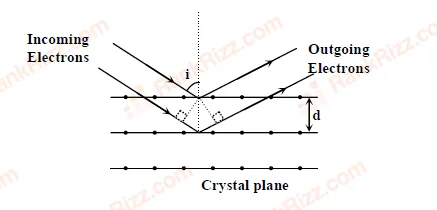
Question: In an experiment, electrons are made to pass through a narrow slit of width '' comparable to their de Broglie wavelength. They are detected on a screen at a distance '' from the slit (see figure).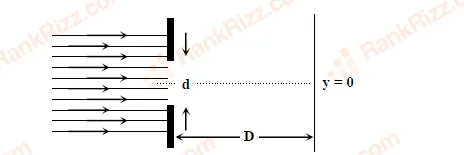
Which of the following graph can be expected to represent the number of electrons '' detected as a function of the detector position '' ( corresponds to the middle of the slit)?- (A)
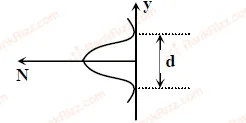
- (B)
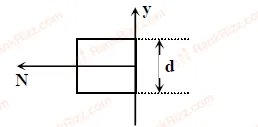
- (C)
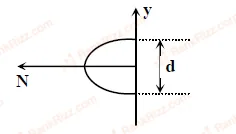
- (D)
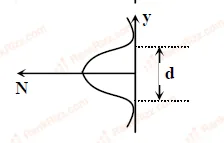
rr2.rankrizz.com/jee-main/physics/wave-optics/q/2008-physics-499891
- (A)
If is the intensity of the principal maximum in the single slit diffraction pattern, then what will be its intensity when the slit width is doubled?
- (A)
- (B)
- (C)
- (D)
rr2.rankrizz.com/jee-main/physics/wave-optics/q/2005-physics-500231
- (A)
Resolving power of microscopes and telescopes 12
Some distant star is to be observed by some telescope of diameter of objective lens , at an angular resolution of radian. If the wavelength of light from the star reaching the telescope is 500 nm, the minimum diameter of the objective lens of the telescope is __________ cm. (nearest integer)
Answer: ____________
rr2.rankrizz.com/jee-main/physics/wave-optics/q/8-apr-2026-s2-q47
A telescope with objective diameter is used to observe a distant star emitting light of wavelength 500 nm, at a resolution of radian. The value of is _____ cm.
- (A)
- (B)
- (C)
- (D)
rr2.rankrizz.com/jee-main/physics/wave-optics/q/4-apr-2026-s1-q44
- (A)
A microscope was initially placed in air (refractive index 1). It is then immersed in oil (refractive index 2). For a light whose wavelength in air is , calculate the change of microscope's resolving power due to oil
- (A)
Resolving power will be in the oil than it was in the air
- (B)
Resolving power will be twice in the oil than it was in the air
- (C)
Resolving power will be four times in the oil than it was in the air
- (D)
Resolving power will be in the oil than it was in the air
rr2.rankrizz.com/jee-main/physics/wave-optics/q/27-jul-2022-s1-q16
- (A)
The aperture of the objective is cm. The resolving power of this telescope, if a light of wavelength Å is used to see the object will be
- (A)
- (B)
- (C)
- (D)
rr2.rankrizz.com/jee-main/physics/wave-optics/q/28-jun-2022-s1-q14
- (A)
The aperture diameter of a telescope is m. The separation between the moon and the earth is km. With light of wavelength Å, the minimum separation between objects on the surface of moon, so that they are just resolved, is close to:
- (A)
60 m
- (B)
20 m
- (C)
200 m
- (D)
600 m
rr2.rankrizz.com/jee-main/physics/wave-optics/q/9-jan-2020-s1-q18
- (A)
The value of numerical aperture of the objective lens of a microscope is 1.25. If light of wavelength 5000 Å is used, the minimum separation between two points, to be seen as distinct, will be:
- (A)
0.48 μm
- (B)
0.24 μm
- (C)
0.38 μm
- (D)
0.12 μm
rr2.rankrizz.com/jee-main/physics/wave-optics/q/12-apr-2019-s1-q25
- (A)
Diameter of the objective lens of a telescope is 250 cm. For light of wavelength 600 nm coming from a distant object, the limit of resolution of the telescope is close to:
- (A)
rad
- (B)
rad
- (C)
rad
- (D)
rad
rr2.rankrizz.com/jee-main/physics/wave-optics/q/9-apr-2019-s2-q26
- (A)
Calculate the limit of resolution of a telescope objective having a diameter of 200 cm, if it has to detect light of wavelength 500 nm coming from a star.
- (A)
radian
- (B)
radian
- (C)
radian
- (D)
radian
rr2.rankrizz.com/jee-main/physics/wave-optics/q/8-apr-2019-s2-q25
- (A)
Two stars are 10 light years away from the earth. They are seen through a telescope of objective diameter 30 cm. The wavelength of light is 600 nm. To see the stars just resolved by the telescope, the minimum distance between them should be (1 light year = m) of the order of:
- (A)
km
- (B)
km
- (C)
km
- (D)
km
rr2.rankrizz.com/jee-main/physics/wave-optics/q/10-apr-2016-online-q24
- (A)
Assuming that the human pupil has a radius of 0.25 cm and a comfortable viewing distance of 25 cm. The minimum separation between two point objects that the human eye can resolve for the light of wavelength 500 nm is
- (A)
300 m
- (B)
1 m
- (C)
30 m
- (D)
100 m
rr2.rankrizz.com/jee-main/physics/wave-optics/q/4-apr-2015-offline-q27
- (A)
A telescope of aperture m diameter is focused on a window at 80 m distance fitted with a wire mesh of spacing m. Given: m, which of the following is true for observing the mesh through the telescope?
- (A)
Yes, it is possible with the same aperture size.
- (B)
Possible also with an aperture half the present diameter.
- (C)
No, it is not possible.
- (D)
Given data is not sufficient.
rr2.rankrizz.com/jee-main/physics/wave-optics/q/2012-physics-499199
- (A)
Two point white dots are mm apart on a black paper. They are viewed by eye of pupil diameter mm. Approximately, what is the maximum distance at which these dots can be resolved by the eye? [Take wavelength of light nm]
- (A)
m
- (B)
m
- (C)
m
- (D)
m
rr2.rankrizz.com/jee-main/physics/wave-optics/q/2005-physics-500227
- (A)
YDSE with slabs, white light and modified setups 1
In a Young's double slit experiment with light of wavelength , fringe pattern on the screen has fringe width . When two thin transparent glass (refractive index ) plates of thickness and () are placed in the path of the two beams respectively, the fringe pattern will shift by a distance
- (A)
- (B)
- (C)
- (D)
rr2.rankrizz.com/jee-main/physics/wave-optics/q/2012-physics-499132
- (A)
Answer key
- 01 C
- 02 C
- 03 B
- 04 B
- 05 5625
- 06 429
- 07 4
- 08 B
- 09 14
- 10 B
- 11 C
- 12 C
- 13 15
- 14 24
- 15 B
- 16 D
- 17 A
- 18 11
- 19 54
- 20 A
- 21 200
- 22 10
- 23 A
- 24 D
- 25 D
- 26 D
- 27 D
- 28 462
- 29 4
- 30 48
- 31 10
- 32 3
- 33 C
- 34 A
- 35 2
- 36 B
- 37 B
- 38 C
- 39 B
- 40 B
- 41 750
- 42 C
- 43 D
- 44 B
- 45 C
- 46 B
- 47 C
- 48 C
- 49 A
- 50 A
- 51 C
- 52 D
- 53 C
- 54 C
- 55 D
- 56 D
- 57 —
- 58 A
- 59 B
- 60 D
- 61 C
- 62 B
- 63 B
- 64 A
- 65 C
- 66 D
- 67 C
- 68 B
- 69 C
- 70 C
- 71 C
- 72 B
- 73 A
- 74 A
- 75 B
- 76 B
- 77 A
- 78 D
- 79 4
- 80 2
- 81 8
- 82 B
- 83 9
- 84 C
- 85 125
- 86 13
- 87 2
- 88 24
- 89 630
- 90 B
- 91 D
- 92 600
- 93 B
- 94 4
- 95 450
- 96 B
- 97 D
- 98 1
- 99 5
- 100 300
- 101 2
- 102 600
- 103 C
- 104 D
- 105 A
- 106 B
- 107 9
- 108 B
- 109 C
- 110 A
- 111 D
- 112 A
- 113 B
- 114 A
- 115 B
- 116 C
- 117 A
- 118 D
- 119 30
- 120 A
- 121 C
- 122 C
- 123 A
- 124 C
- 125 A
- 126 B
- 127 A
- 128 A
- 129 D
- 130 30
- 131 B
- 132 C
- 133 24
- 134 7
- 135 B
- 136 B
- 137 C
- 138 D
- 139 30
- 140 75
- 141 B
- 142 B
- 143 D
- 144 A
- 145 A
- 146 A
- 147 D
- 148 B
- 149 D
- 150 D
- 151 D
- 152 B
- 153 A
- 154 A
- 155 A
- 156 D
- 157 C
- 158 36
- 159 A
- 160 6
- 161 6
- 162 275
- 163 B
- 164 C
- 165 A
- 166 2
- 167 30
- 168 A
- 169 B
- 170 3
- 171 A
- 172 6
- 173 C
- 174 200
- 175 C
- 176 B
- 177 D
- 178 A
- 179 D
- 180 A
- 181 D
- 182 B
- 183 C
- 184 D
- 185 C
- 186 203
- 187 B
- 188 B
- 189 C
- 190 A
- 191 B
- 192 B
- 193 A
- 194 A
- 195 C
- 196 A
- 197 A
- 198 C
“—” marks a question whose key we have not checked yet; its page shows the latest on it.
Past questions are reproduced with their sitting. Not affiliated with NTA or the IITs. Every question, online and free: rr2.rankrizz.com/jee-main/physics/wave-optics