RankRizz

Wave Optics — JEE Main Previous Year Questions

Every Wave Optics question JEE Main has set from 2004–2026, grouped by the idea it tests rather than the order of the syllabus. 198 questions across 6 distinct ideas. Free to read, answer key on every one.

DATA UPDATED

Questions

198

Distinct ideas

6

Share of marks

4.8%

Difficulty

MEDIUM

The ideas inside Wave Optics

A chapter is not one subject — it is a handful of procedures the examiner reuses. These are the ones Wave Optics questions actually test.

Every Wave Optics question

21–40 OF 198 · NEWEST FIRST

JEE MAIN 2026 · 21 JAN S1Young's double slit experiment: fringe width and intensity

In a double slit experiment the distance between the slits is 0.1 cm and the screen is placed at 50 cm from the slits plane. When one slit is covered with a transparent sheet having thickness t and refractive index n(=1.5), the central fringe shifts by 0.2 cm. The value of t is____ cm

  1. A

    5.6×10−45.6\times10^{-4}

  2. B

    6.0×10−36.0\times10^{-3}

  3. C

    8×10−48\times10^{-4}

  4. D

    5.0×10−35.0\times10^{-3}

JEE MAIN 2026 · 21 JAN S2Wavefronts and Huygens' principle

Given below are two statements :
Statement I : In a Young's double slit experiment, the angular separation of fringes will increase as the screen is moved away from the plane of the slits
Statement II: In a Young's double slit experiment, the angular separation of fringes will increase when monochromatic source is replaced by another monochromatic source of higher wavelength
In the light of the above statements, choose the correct answer from the options given below :

  1. A

    Both Statement I and Statement II are true

  2. B

    Statement I is false but Statement II is true

  3. C

    Both Statement I and Statement II are false

  4. D

    Statement I is true but Statement II is false

JEE MAIN 2026 · 21 JAN S2Young's double slit experiment: fringe width and intensity

In a Young's double slit experiment set up, the two slits are kept 0.4. mm apart and screen is placed at 1 m from slits. If a thin transparent sheet of thickness 20μm20\mu m is introduced in front of one of the slits then center bright fringe shifts by 20 mm on the screen. The refractive index of transparent sheet is given by α10\frac{\alpha}{10}, where α\alpha is __________.

JEE MAIN 2026Polarisation: Malus's law and Brewster's law

The angle of polarization for any medium is 60∘ 60^{\circ\ }, what will be critical angle for this :

  1. A

    sin⁡−1(3)\sin^{-1}\left(\sqrt{3}\right)

  2. B

    tan⁡−1(3)\tan^{-1}\left(\sqrt{3}\right)

  3. C

    sin⁡−1(13 )\sin^{-1}\left(\frac{1}{\sqrt{3\ }}\right)

  4. D

    tan⁡−1(13 )\tan^{-1}\left(\frac{1}{\sqrt{3\ }}\right)

JEE MAIN 2025 · 08 APR S2Young's double slit experiment: fringe width and intensity

In a Young's double slit experiment, the source is white light. One of the slits is covered by red filter and another by a green filter. In this case

  1. A

    There shall be an interference pattern for red distinct from that for green.

  2. B

    There shall be no interference fringes.

  3. C

    There shall be alternate interference fringes of red and green.

  4. D

    There shall be an interference pattern, where each fringe's pattern center is green and outer edges is red.

JEE MAIN 2025 · 07 APR S1Young's double slit experiment: fringe width and intensity

Two plane polarized light waves combine at a certain point whose electric field components are E1=E0sin⁡ωtE_1 = E_0 \sin \omega t and E2=E0sin⁡(ωt+π3)E_2 = E_0 \sin(\omega t + \frac{\pi}{3}). Find the amplitude of the resultant wave.

  1. A

    0.9 E

  2. B

    E0E_0

  3. C

    1.7 E0E_0

  4. D

    3.4 E0E_0

JEE MAIN 2025 · 04 APR S1Young's double slit experiment: fringe width and intensity

In a Young's double slit experiment, the slits are separated by 0.2 mm. If the slits separation is increased to 0.4 mm, the percentage change of the fringe width is:

  1. A

    0%

  2. B

    100%

  3. C

    50%

  4. D

    25%

JEE MAIN 2025 · 04 APR S2Polarisation: Malus's law and Brewster's law

Two polarisers P1P_1 and P2P_2 are placed in such a way that the intensity of the transmitted light will be zero. A third polariser P3P_3 is inserted in between P1P_1 and P2P_2, at the particular angle between P2P_2 and P3P_3. The transmitted intensity of the light passing through all three polarisers is maximum. The angle between the polarisers P2P_2 and P3P_3 is :

  1. A

    π4\frac{\pi}{4}

  2. B

    π6\frac{\pi}{6}

  3. C

    π8\frac{\pi}{8}

  4. D

    π3\frac{\pi}{3}

JEE MAIN 2025 · 04 APR S2Young's double slit experiment: fringe width and intensity

In a Young's double slit experiment, two slits are located 1.5 mm apart. The distance of screen from slits is 2 m and the wavelength of the source is 400 nm. If the 20 maxima of the double slit pattern are contained within the centre maximum of the single slit diffraction pattern, then the width of each slit is x×10−3x \times 10^{-3} cm, where x-value is ______.

JEE MAIN 2025 · 03 APR S1Young's double slit experiment: fringe width and intensity

Two coherent monochromatic light beams of intensities 4I4I and 9I9Iare superimposed. The difference between the maximum and minimum intensities in the resulting interference pattern is xIxI. The value of x is __________.

JEE MAIN 2025 · 03 APR S2Young's double slit experiment: fringe width and intensity

Width of one of the two slits in a Young's double slit interference experiment is half of the other slit. The ratio of the maximum to the minimum intensity in the interference pattern is:

  1. A

    (22+1):(22−1)(2\sqrt{2} + 1) : (2\sqrt{2} - 1)

  2. B

    (3+22):(3−22)(3 + 2\sqrt{2}) : (3 - 2\sqrt{2})

  3. C

    9:19 : 1

  4. D

    3:13 : 1

JEE MAIN 2025 · 03 APR S2Young's double slit experiment: fringe width and intensity

Two monochromatic light beams have intensities in the ratio 1:9. An interference pattern is obtained by these beams. The ratio of the intensities of the maximum to minimum is

  1. A

    8 : 1

  2. B

    9 : 1

  3. C

    3 : 1

  4. D

    4 : 1

JEE MAIN 2025 · 03 APR S2Wavefronts and Huygens' principle

A monochromatic light of frequency 5×10145 \times 10^{14} Hz travelling through air, is incident on a medium of refractive index '2'. Wavelength of the refracted light will be:

  1. A

    300 nm

  2. B

    600 nm

  3. C

    400 nm

  4. D

    500 nm

JEE MAIN 2025 · 02 APR S1Young's double slit experiment: fringe width and intensity

A light wave is propagating with plane wave fronts of the type x+y+zx + y + z = constant. The angle made by the direction of wave propagation with the x-axis is:

  1. A

    cos⁡−1(13)\cos^{-1}\left(\frac{1}{\sqrt{3}}\right)

  2. B

    cos⁡−1(23)\cos^{-1}\left(\frac{2}{3}\right)

  3. C

    cos⁡−1(13)\cos^{-1}\left(\frac{1}{3}\right)

  4. D

    cos⁡−1(23)\cos^{-1}\left(\sqrt{\frac{2}{3}}\right)

JEE MAIN 2025 · 02 APR S1Single slit diffraction

If the measured angular separation between the second minimum to the left of the central maximum and the third minimum to the right of the central maximum is 30° in a single slit diffraction pattern recorded using 628 nm light, then the width of the slit is ______ µm.

JEE MAIN 2025 · 28 JAN S1Young's double slit experiment: fringe width and intensity

A double slit interference experiment performed with a light of wavelength 600 nm forms an interference fringe pattern on a screen with 10 th bright fringe having its centre at a distance of 10 mm from the central maximum. Distance of the centre of the same 10th bright fringe from the central maximum when the source of light is replaced by another source of wavelength 660 nm would be _________ mm .

JEE MAIN 2025 · 28 JAN S2Young's double slit experiment: fringe width and intensity

A thin transparent film with refractive index 1.4 , is held on circular ring of radius 1.8 cm . The fluid in the film evaporates such that transmission through the film at wavelength 560 nm goes to a minimum every 12 seconds. Assuming that the film is flat on its two sides, the rate of evaporation is ____π×10−13m3/s\pi \times 10^{-13}m^{3}/s.

JEE MAIN 2025 · 24 JAN S1Young's double slit experiment: fringe width and intensity

The Young's double slit interference experiment is performed using light  consisting of  480 nm480\,nm and  600 nm600\,nm wavelengths. The least number of the bright fringes of  480 nm480\,nm  light that are  required for the first coincidence with the bright fringes formed by  600 nm600\,nm light is:

  1. A

    5

  2. B

    4

  3. C

    6

  4. D

    8

JEE MAIN 2025 · 24 JAN S2Wavefronts and Huygens' principle

Young's double slit inteference apparatus is immersed in a liquid of refractive index 1.44. It has slit separation of 1.5 mm . The slits are illuminated by a parallel beam of light whose wavelength in air is 690 nm . The fringe-width on a screen placed behind the plane of slits at a distance of 0.72 m , will be :

  1. A

    0.23 mm

  2. B

    0.33 mm

  3. C

    0.63 mm

  4. D

    0.46 mm

JEE MAIN 2025 · 24 JAN S2Polarisation: Malus's law and Brewster's law

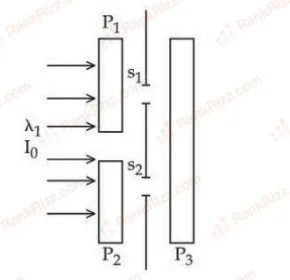
In a Young's double slit experiment, three polarizers are kept as shown in the figure. The transmission axes of  P1P_1  and  P2P_2 are orthogonal to each other. The polarizer  P3P_3  covers both the slits with its transmission axis at  45∘45^\circ  to those of  P1P_1  and  P2P_2. An unpolarized light of wavelength  λ\lambda and intensity  I0I_0  is incident on  P1P_1  and  P2P_2.The intensity at a point after  P3P_3  where the path difference between the light waves from s1s_1  and  s2s_2  is  λ3 is:\frac{\lambda}{3}\text{ is:}

page8_img1
  1. A

    Io2\frac{I_o}{2}

  2. B

    Io4\frac{I_o}{4}

  3. C

    Io3\frac{I_o}{3}

  4. D

    IoI_o